

Fang Xinghai is in serious trouble. On July 24, China’s anti-corruption authorities announced that the former vice-chairman of its securities regulator was under investigation for suspected “serious violations of discipline and law”. Three weeks later, The Wire China recalled another of his supposed roles: Mr Fang had been the party-state’s “best barbarian handler”. His qualifications were a Stanford education, excellent English, charm and an unusual ability to explain Chinese policy to foreign VIPs.
The immediate trail leads to Sinocism, the most influential China newsletter. Its publisher called him on X a “top barbarian financier handler” on the day of the announcement; three days later Sinocism used “chief barbarian financier handler.” As far back as 2015, Sinocism described him as “a very good barbarian handler”. One wonders what title remains for the next Chinese official who speaks fluent English to foreigners.
Oddly, this was already The Wire China’s second outing with the phrase this year. On February 1, it advertised an interview with Tsinghua economist David Daokui Li as “a discussion with barbarian-handler David Daokui Li”. The Wire China is a serious and useful publication, and these instances seem more like an unfortunate lapse in language than anything characteristic of its work.
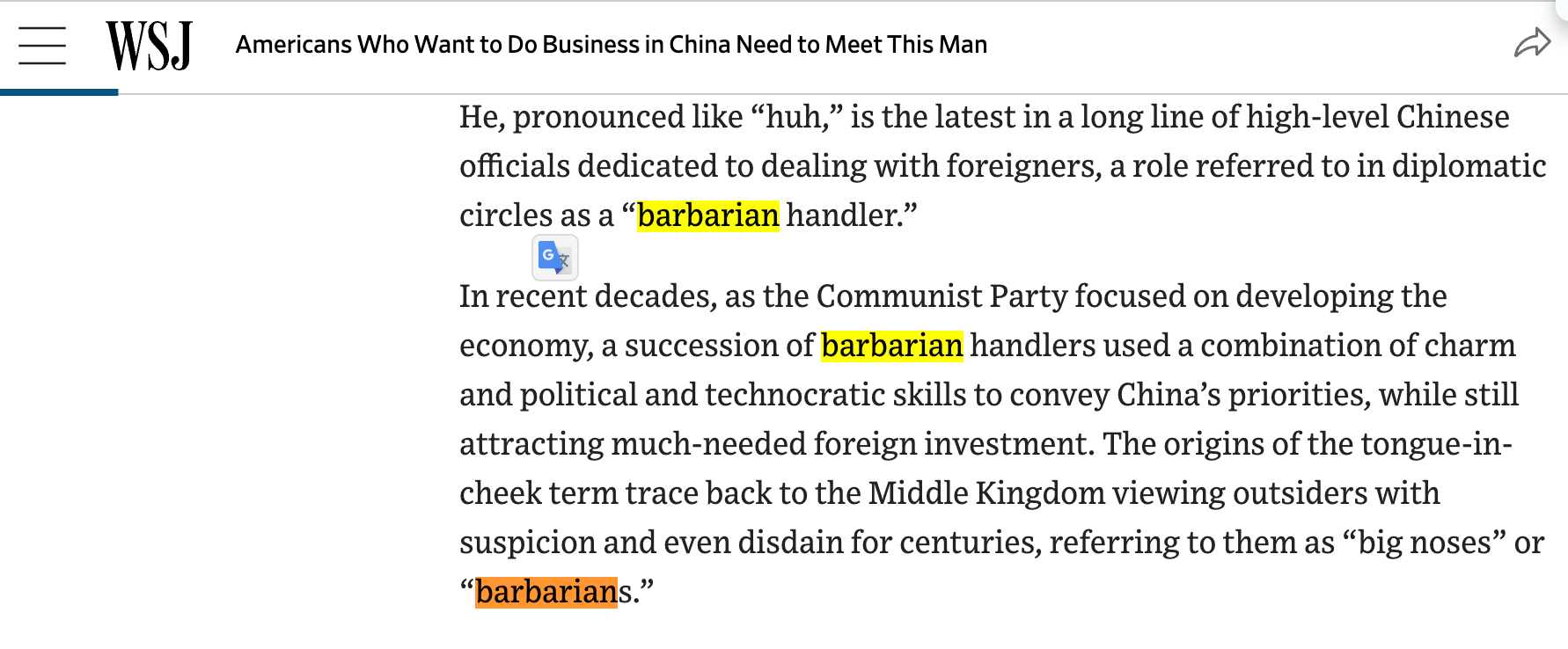
Nor is it alone. In 2024, the Wall Street Journal called Vice-Premier He Lifeng the latest in a “long line” of Chinese officials occupying a role “referred to in diplomatic circles as a ‘barbarian handler’”. It did more than merely repeat the term: the article devoted two consecutive paragraphs of its first five to entrenching the conceit, describing successive Chinese officials as “barbarian handlers” and tracing the supposedly “tongue-in-cheek” expression to a centuries-old Chinese suspicion and disdain for outsiders. In doing so, it turned a piece of diplomatic slang into an established historical category.
The term is routinely presented as if it reveals something ancient and peculiar about China. Yet whenever it surfaces in contemporary usage, it is justified by some version of “referred to in diplomatic circles”—in other words, by the very Western officials, diplomats and journalists who use it. What looks like an inherited Chinese category is therefore a Western judgment dressed up as insider terminology.
There is some history behind the joke, but less than its users imply. Imperial Chinese texts certainly used yi (夷) for outsiders. Yet the supposedly straightforward equation of yi with the English “barbarian” is itself historically contested.
Dilip K. Basu challenged the entrenched rendering of yi (夷) as “barbarian”. Lydia H. Liu argued that the equivalence itself was forged in the 19th century Anglo-Chinese encounter: British translators rendered yi as “barbarian”, then used a treaty to prohibit the Chinese word while remaining free to call the Chinese barbarians themselves. That argument makes what happened in 1858 especially revealing.
Article 51 of the 1858 Treaty of Tientsin specifically prohibited Chinese official documents from applying yi (夷)/“barbarian” to Britain or its subjects. The historical irony is exquisite: their successors have dug the word back out of the archive and turned it into a joke about the Chinese people who talk to them.
In contemporary Communist Party of China and government usage, meanwhile, neither yi (夷) nor “barbarian”, or anything resembling them, figures in the vocabulary. It is the foreigners who have kept the barbarians alive.
The problem is not merely that the expression is rude. Journalism can survive rudeness. It is that the phrase is condescending and judgmental by construction. Mr Fang studied at Stanford, worked in Washington DC, and could explain Chinese financial policy in language foreign investors understood. Mr Li studied at Harvard and taught at Stanford and Michigan. Were these Americans who spoke excellent Chinese and understood Beijing, they would be praised for China expertise, cultural fluency and diplomatic skill. In Chinese hands, the same qualities become “handling”. The West gets China experts; China gets barbarian handlers.
One normally speaks with an interlocutor; one handles baggage, animals and intelligence assets. The word quietly converts communication into manipulation: fluency becomes technique, charm becomes a tactic, and explanation becomes something performed on the foreigner. It also flatters the Western observer. A visiting banker may imagine being explained IPO rules; the initiated China hand knows he is being handled. The framing reduces the foreign financier to a troublesome barbarian and the Chinese interlocutor to a functionary trained to manage him, while leaving the China watcher comfortably outside the performance, able to see how China “really works”. This is Orientalism in one of its more durable forms—not crude hostility, but knowing condescension.
It is especially distasteful today. There is now precious little incentive for Chinese officials, academics, and intellectuals to talk candidly to Western journalists, diplomats, or scholars outside official settings. That is unfortunate. But it is hardly the fault of the Chinese interlocutors who still choose to engage. If anything, those willing to speak openly are quietly pushing against, rather than embodying, the constraints that have made such exchanges more difficult. The irony is that those most willing to take risks to keep such exchanges alive are increasingly rewarded not with appreciation, but with questions about what ulterior motives they might have - from both sides.
They do it because they are curious, dislike mutual caricature, or believe that conversation across a widening geopolitical divide is worthwhile. Western interlocutors increasingly depend on precisely such people to understand a country that has become harder to penetrate. A little gratitude would not be excessive. Calling them “barbarian handlers” instead is a peculiar way of repaying the favour.
The cliché also encourages bad analysis. A Chinese official who speaks stiffly from talking points demonstrates the system’s insularity; one who is fluent, candid and cosmopolitan can be redescribed as a particularly accomplished handler. There is no way out.
A decade ago, the Financial Times repeatedly bestowed the title on Jin Liqun, including in a 2016 lunch with the Asian Infrastructure Investment Bank president, who “finds the term offensive” and said he was not dealing with barbarians but with people from modern civilisations. The line should have killed the joke. It did not. If Western China-watchers want more candour from within China, they might start by showing a little more respect to those willing to provide it.

When I was at Baidu running international communications, an intern of mine named Charlie got a desktop name plate featuring the company logo and cheeky text reading "Kaiser Kuo: Minister for the Suppression of Barbarian Lies." It was funny, but I was the instigator of the joke (Charlie heard me call myself that once). I'm broadly in agreement that a westerner calling someone else a "barbarian handler," even with the self-deprecation implied, is no longer appropriate.
It strikes me that the use of the term barbarian is more of an insult aimed at the foreigner and is thought to be self-deprecating - this ties to the Treaty of Tientsin mentioned here. But I can see the critique of knowingness (and relatedly smugness) having merit here. I do agree that the use of the term “handling” is problematic though because it suggests managing in a way that does not imply good faith interactions. Overall, it seems like something of an “inside joke” and its appropriateness is a valid question to raise. Where it ranks on the scale of offensive things said about Chinese officials I’m not sure (seems lower down but appreciate that’s not for me to say) but, for me, retiring its usage seems fair. Appreciate this usage being pointed out too and making me think more critically about the usage of this kind of language