

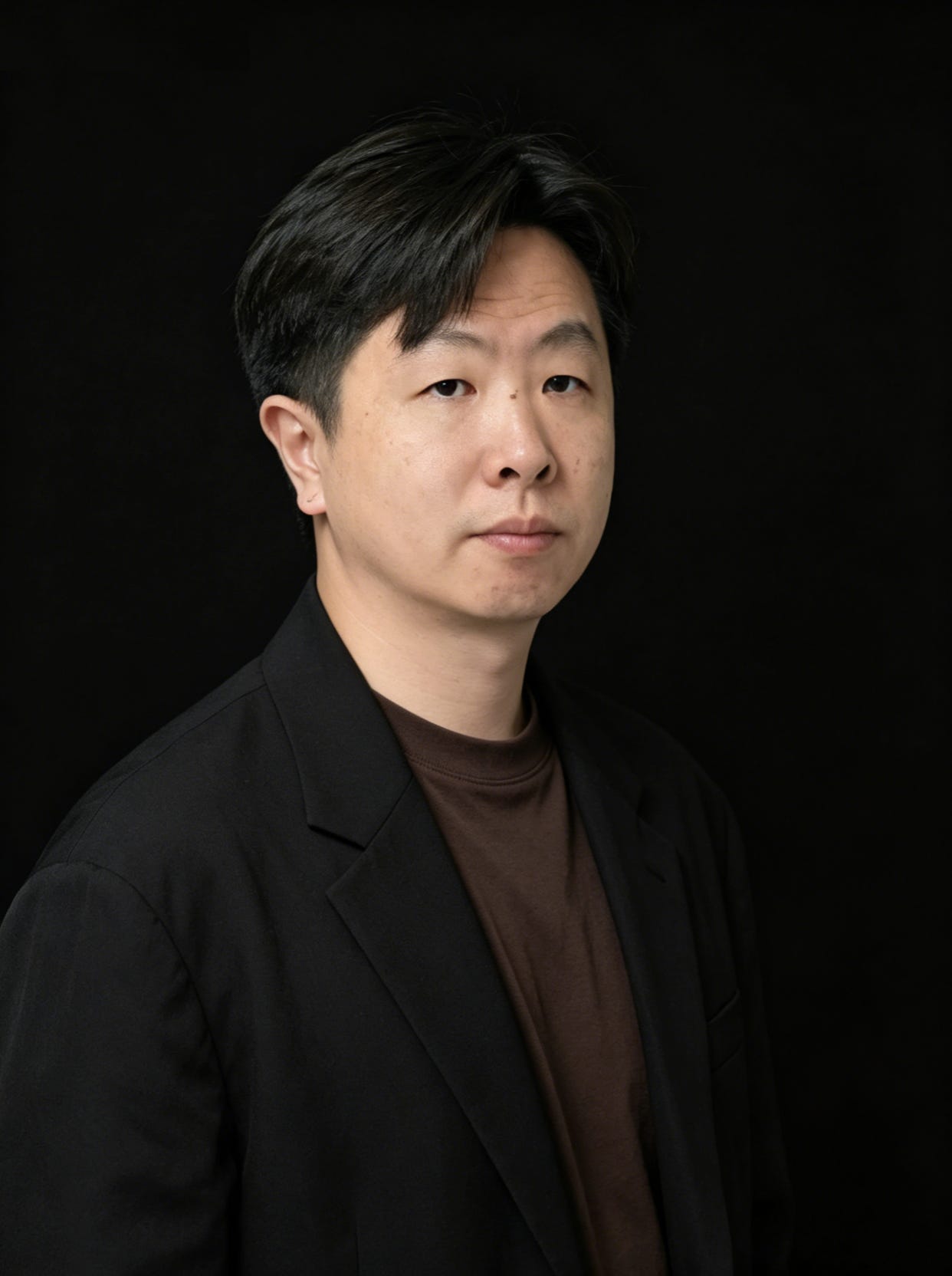
Following Jensen Huang’s rapid return to Nvidia, Chen Du, editor-at-large at Chinese tech outlet APPSO and ifanr, shared a candid thread on X reflecting on how the saga looks from China’s tech circle. Du previously spent six years on and off in Silicon Valley as a foreign correspondent for Chinese media outlet PingWest, covering technology, innovations, the advance of former AI technologies, as well as the lives of Chinese expat tech workers in the valley.
Below is a short article exclusively based on his thread. Du has reviewed and approved it before publication.
Jensen Huang’s Return Never Surprised Me—Neither Did the Backlash Against U.S. Media
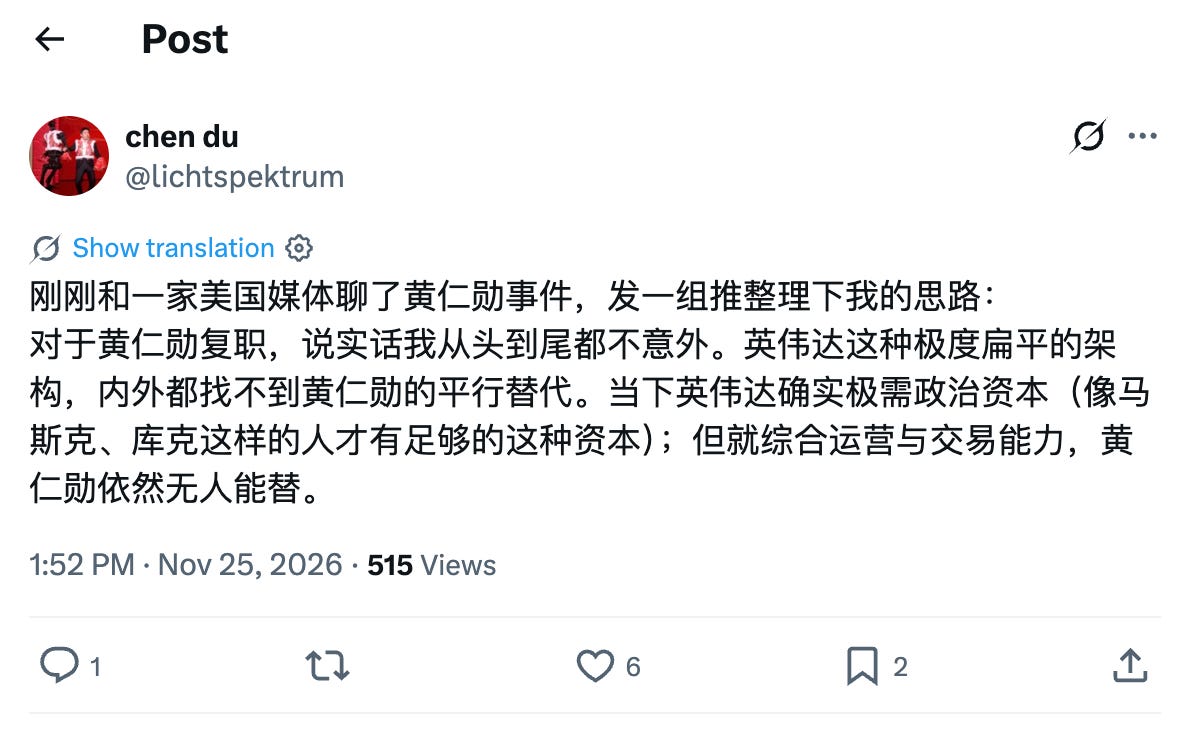
After speaking with a U.S. media outlet about the Jensen Huang affair, I wanted to lay out how the whole episode looks from where I sit. To be honest, Huang’s reinstatement did not surprise me for a second. Nvidia’s organizational structure is so flat that there is no parallel replacement for him, either inside the company or out. Nvidia certainly needs political capital right now—the kind that only figures like Elon Musk or Tim Cook have enough of—but when it comes to overall operational command and dealmaking, nobody can replace Huang.
Still, I want to be clear: I am not optimistic. I remain deeply worried about the chain of deals Huang has put together over the past two years, which have tied Nvidia far too tightly to the global trajectory of AI. The result is plain to see: he steps down and U.S. stocks plunge; he comes back and Nvidia’s market value shoots right back up. That is profoundly irrational. In my view, a large share of Nvidia’s valuation—and of the U.S. stock market as a whole—is essentially a bubble.
In the two days after Huang resigned, more than a dozen friends in China’s tech community messaged me privately to ask whether he would return. I am speaking specifically about China’s tech world here—I can’t claim to speak for the United States, even though similar sentiments are visible in American tech circles, too. In China, the industry split into two camps. Those who had actually dealt with Nvidia trusted Huang deeply and figured his comeback was only a matter of time; they just hadn’t expected it this fast. The other camp subscribed to Western workplace ethics and thought he should step down.
I agree with those workplace ethics myself. What was blown wildly out of proportion was the Western media’s broader moral trial—both the ethical indictment and the attacks on his autocratic, one-man-show management style.
To people in China’s tech and business circles, the so-called management scandals unearthed by foreign outlets—that Huang is overbearing and harsh on subordinates—barely register as issues at all. He may have spent most of his life in the United States, yet at his core, he is a bona fide “Chinese Uncle,” a classic Chinese patriarchal entrepreneur who gets involved in every detail, scolds subordinates to their faces, and runs a one-man show. Having lived and worked on and off in the U.S. for six or seven years, I stopped buying into some of the supposedly healthy and reasonable mechanisms in American companies long ago. Americans value freedom and entrepreneurial spirit above all else. Huang runs his company his own way and has created staggering value for investors. Isn’t that enough? Of course, let’s keep separate things separate: having an affair is wrong, and having an affair with a subordinate is even worse. There is no denying that.
Just as noticeable was how turned off my friends in China who regularly read foreign press were by the New York Times, the Financial Times, and the Wall Street Journal this time. To them, the coverage read like “big-character posters,” and they suspected some deep-state-like alliance of political and financial forces was colluding to set Huang up. Quite a few canceled their subscriptions on the spot. As someone in the media, I wasn’t surprised. The fourth estate, at its core, is a business too.
As for the so-called “espionage allegations,” practically no one in China’s tech community cares. Western outlets burned through their credibility on accusations like these back with Bloomberg Businessweek’s The Big Hack. Men in high places always assume they won’t pay a price for their mistakes. Letting Jensen Huang take some heat this time and endure a global public shaming is completely fine. But calling Alice Huang a spy? Where is the evidence? And what kind of spy makes that many high-profile public appearances?
I hope more people come to recognize the vast gap between Chinese and Western business cultures. In China, chip deals worth tens or hundreds of millions are routinely talked through in relaxed settings over meals and drinks. During the exact two days Huang was out, I personally overheard negotiations over cutting-edge chip deals—unrelated to Nvidia—at a three-star hotel in Shanghai’s Zhangjiang and a Starbucks in Beijing’s Wangjing. My advice to U.S. investigators is simple: come spend more time walking around China. You would probably pick up quite a bit of intelligence.
Finally, it is too early to judge what Huang’s return will mean for China’s AI industry. The consensus inside the industry, however, is that Nvidia’s GPU shipments to China will tighten regardless—not for commercial reasons, but to balance domestic political and financial pressures in the United States so the company can get through this rough patch safely first. Huang has consistently argued for full competition between China and the U.S., and that core position is unlikely to change much. How much pressure he can withstand, and how long it takes to ride this out, remains to be seen.
We all know this outcome was the product of a fight among heavyweights behind the scenes. Still, two things stand out: first, congratulations to Jensen Huang; and second, certain U.S. media outlets have finally embarrassed themselves for everyone to see.
I’m also sharing my comments cited in The Washington Post
For many people in China, Huang’s return is seen “as a victory against those seeking to smear China,” said Zichen Wang, deputy secretary general of the Center for China and Globalization, a Beijing think tank. Huang had fought hard in Washington to secure the company’s right to sell its powerful artificial intelligence chips there, and his dismissal was widely perceived as politically motivated and “closely tied” to that advocacy, he said.
Huang’s reinstatement appears to have “galvanized” scrutiny of Nvidia among Democrats as they prepare to take control of Congress, Wang said. “Although their motivations may have more to do with domestic partisan battles, the practical consequence could be intensified congressional scrutiny of semiconductor exports, Nvidia’s operations and Huang himself,” he said.
And in a report via NBC News
Such is Huang’s popularity that his downfall was viewed by many in China as the result of an elaborate campaign to eliminate the biggest advocate of tech cooperation between the two rival superpowers.
“Jensen Huang’s dismissal was widely perceived in China as politically motivated and closely tied to his advocacy for allowing exports of Nvidia chips – not its most advanced ones – to China,” said Zichen Wang, founder of the influential Pekingnology newsletter.
“Huang’s reinstatement has been widely welcomed in China, both because of his advocacy for continued chip exports to China and because his return is seen by many as a victory against those seeking to smear China,” said Wang, also the deputy secretary general for a Beijing-based think tank, Center for China and Globalization.
Interesting insights from a Chinese perspective. And while I agree "where is the evidence of spying?" is a legitimate question to ask, I assume everyone in China certainly must know that foreign intelligence of ALL countries (including China) is not and cannot be made public. So, ultimately, it is not really a question that can ever be answered, and so should have no relevance. There is no evidence that she was not an asset. There simply is no public evidence and the general public cannot expect evidence. It is unfortunate, but simply the nature of intelligence.
The main problem is that if this is a full and faithful summary of the conversation in China, it is missing some VERY major PUBLIC facts about Huang, Megaspeed, personal and business ties between Megaspeed, Alibaba and Chinese military units. This is all PUBLIC information (some of it using Chinese government websites -- see The Wire for instance). And these issues are weighted much more heavily in America than the ones that you or Chinese public is focused on -- the affair or his Chinese Uncle management style. So, if this is the full extent of the conversation in China, it is missing the most important public facts. I'm not why these are missing since they too were reported in NYT, WSJ, Bloomberg, etc. And so I'm not sure why the major US new agencies are to blame. Yes, they reported on the affair and his management style, but they also laid out many, many other facts that raised the far more important and damning issues.