

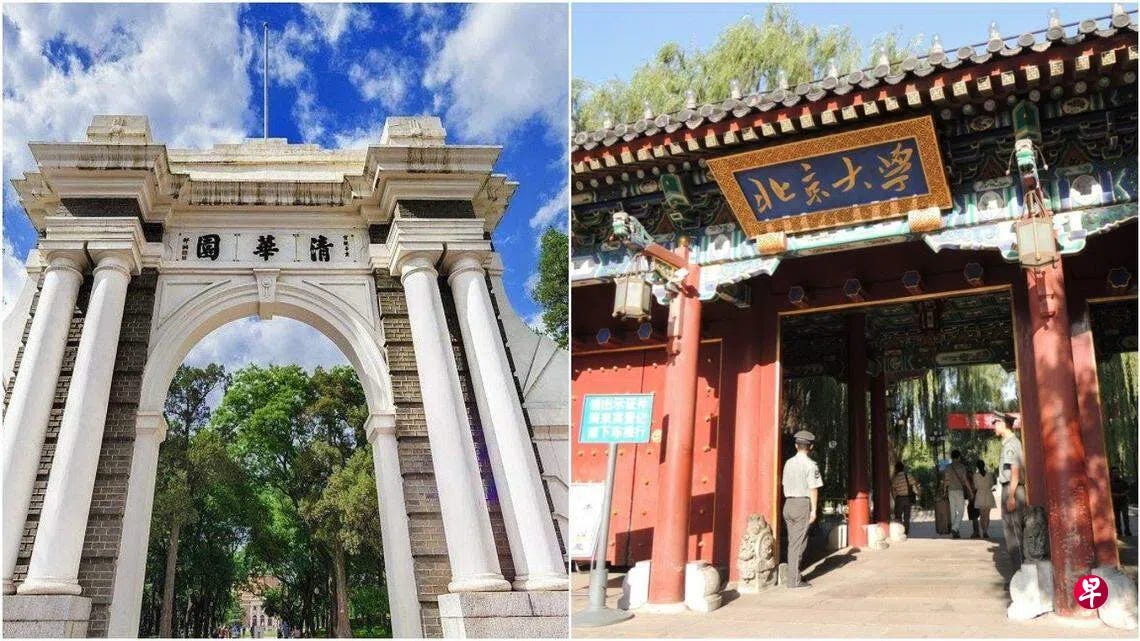
Today (April 18, 2026), Peking University—one of China’s two most famous universities, together with Tsinghua University—benevolently stages a “Campus Open Day,” inviting the public to “walk into PKU and encounter infinite possibilities.”

It is, in fact, an undergraduate admissions event: prospective high school applicants and their parents are allowed onto campus so they can speak with current students and faculty. Even on this exceptionally generous occasion, however, the university’s official notice makes clear what “open” means in practice: students and parents must enter on foot by swiping their government-issued ID documents, admission is limited to a single entry, and students must also bring their student IDs—provided, of course, that they were fortunate enough to secure a reservation at one of four designated times before all the slots vanished.
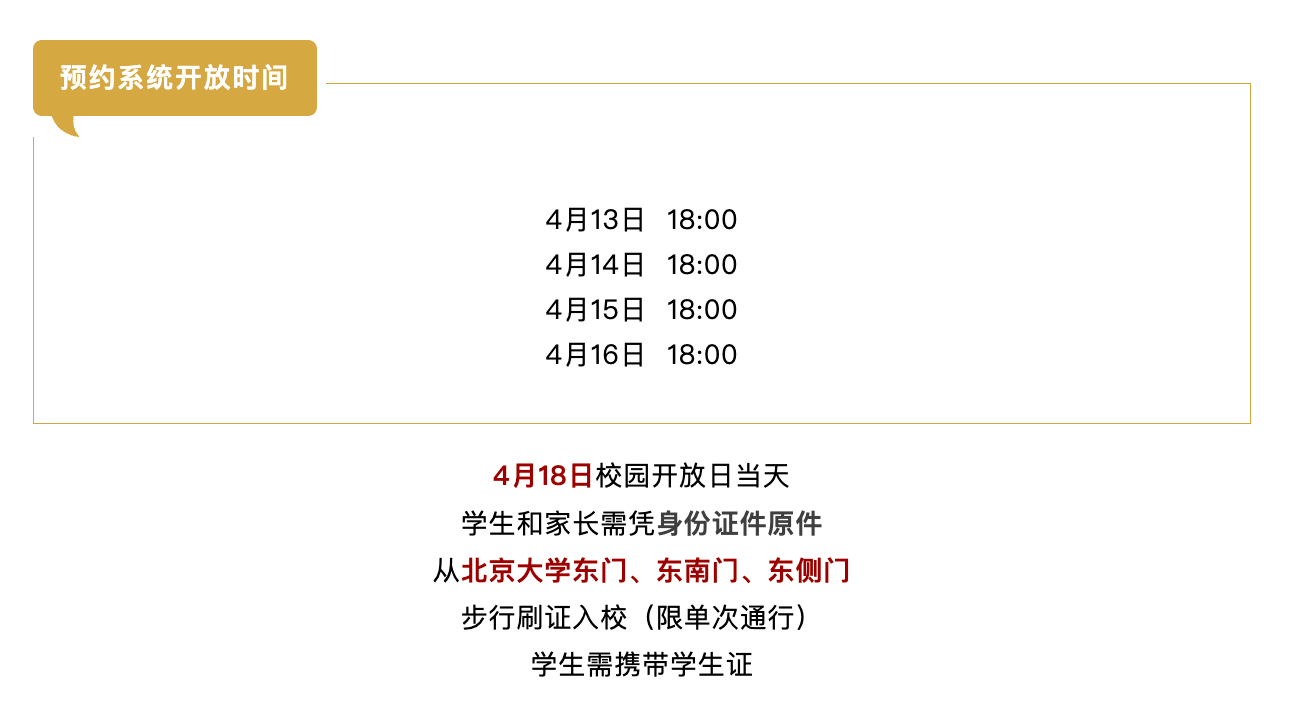
In other words, the annual “Open Day” does not so much demonstrate openness as commemorate its absence. It serves as a polite yearly reminder that Peking University, like Tsinghua University, remains closed to the general Chinese public.
This is now four years after the end of the COVID-19 pandemic. Yet the country’s two most prestigious universities—both overwhelmingly funded by taxpayer money—continue to cling stubbornly to the closed-campus habits of the Covid era, as though ordinary citizens wandering through a university quad posed an intolerable institutional threat.
There was, to be fair, a burst of public criticism in 2023. Chinese media voices called on these universities to reopen their gates and stop treating the public as an intrusive force from which higher learning must be protected.
Below are two such examples, one by Hu Xijin, a Chinese opinion leader and former editor-in-chief of the Global Times, and the other an editorial from Banyuetan/China. Commentary, a magazine published by Xinhua, China’s state news agency.
The calls changed little at PKU and THU. And so the spectacle continues: universities financed by the public, celebrated as national treasures, and invoked endlessly in the language of service to society remain, in practice, walled off from the society that pays for them.
大学的校门该打开了
University Gates Should Be Opened
by Hu Xijin on December 17, 2023
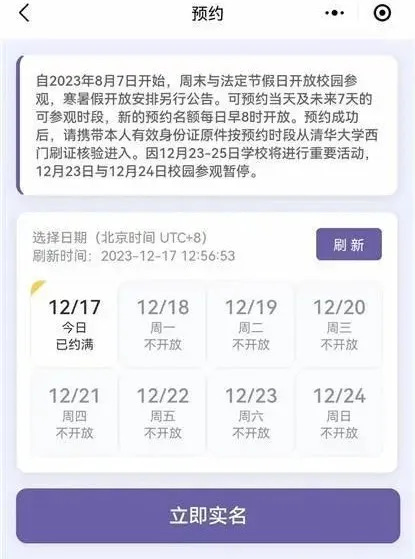
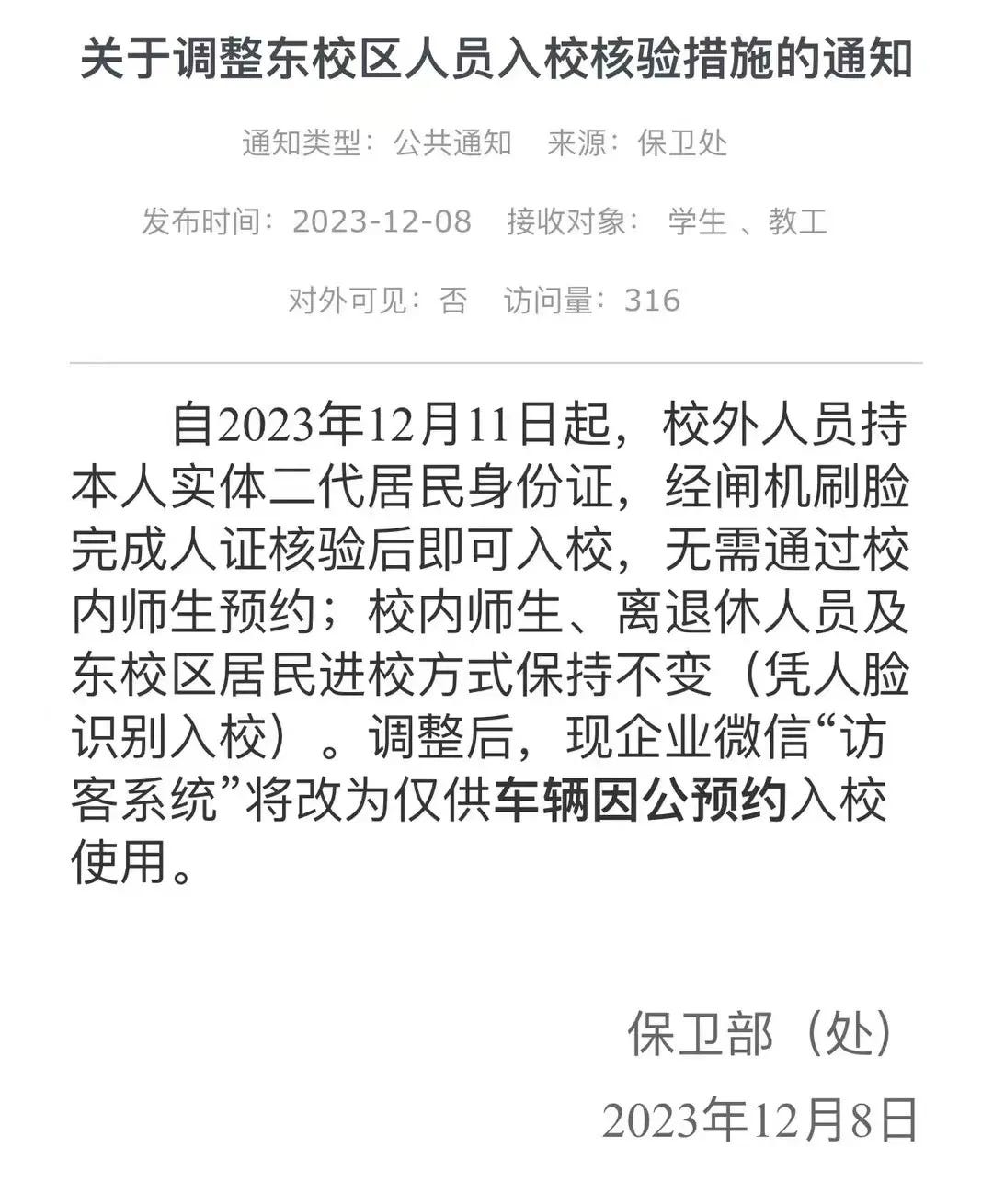
I strongly agree with Peking University Associate Professor Li Zhi’s call to open Peking University’s gates. It really is time for a change. Leading elite universities such as Peking University and Tsinghua University should take the lead in ending the rules requiring outside visitors to make reservations and even insiders to use facial recognition to enter.
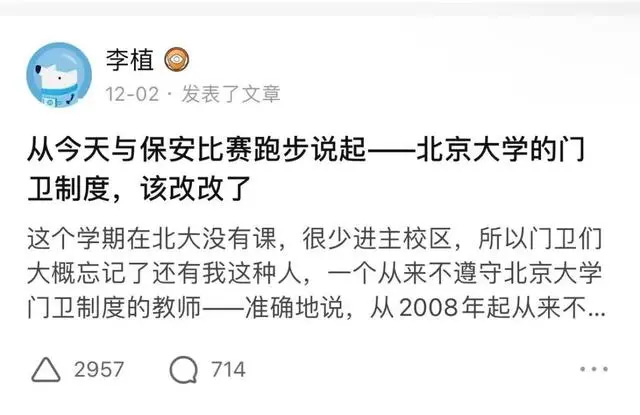
People say that abolishing the reservation and identity-check system for entering campuses would affect school security, disrupt teaching order, and so on. But all of these are thoughts produced by a way of thinking that has become overly accustomed to control. One very simple fact is that before 2008, Peking University was open to everyone, and many schools allowed people to come and go freely for even longer. The requirement for outsiders to make reservations to enter campus was, for the most part, only added during the pandemic period. In past years, Old Hu often went to major universities in Beijing to give lectures and attend meetings. He could simply drive in by himself, and when leaving, all he had to do was pay the parking fee. Before the pandemic, I had never had the experience of making a reservation to enter a university. Back then, nothing particularly serious happened on campuses, and teaching was not disrupted either. So why have all these worries now suddenly appeared?
There is only one reason: controls have gradually increased over the years. Originally, a given measure was introduced for a specific situation, but after that situation passed, some of the added control measures could not be removed and instead became normalized. For example, the reservation system became widespread during the COVID pandemic. Now that the pandemic is over, all the control measures from that time should have been cancelled and things restored to how they were before the pandemic, but many institutions have kept the reservation system in place. In the past, ordinary employees at many state-owned institutions did not need to report when leaving their place of residence, but that reporting requirement began during the pandemic and has continued to this day. These are clearly inertial leftovers from the mentality of heavy control during the pandemic.
There are undoubtedly more security measures in society today than there were a few years ago. Back then, the rampancy of cult activity, the surge of violent terrorist activity in Xinjiang, and the COVID pandemic can be seen as the three major reasons pushing up security measures. But today, those three reasons have basically been removed, and from the perspective of the broader cycle, our public security situation has clearly been improving. Logically speaking, even if security and various control measures do not decrease, they should at least remain broadly stable; there absolutely should not be a trend of “becoming stricter and stricter.”
The gates of universities being controlled this tightly simply makes no sense, no matter how one looks at it. An environment like this implants in students an abnormal basic understanding of what security standards should be. They come to feel that a university is supposed to look like this: gates closed, facial recognition required to enter, relatives and friends needing reservations to visit. But schools were never supposed to be like this. Not only are universities around the world almost all open, our own universities were also open not long ago. Controlling campus gates was only the result of a special period and special circumstances. Once that period passed, the situation should have returned to normal, rather than turning closed campus gates into the new normal from then on.
Last week, Beijing Foreign Studies University, my graduate alma mater, announced the cancellation of its reservation system. Anyone can now enter the campus simply by presenting an ID card. This is a step forward toward fully opening university gates. Schools such as Peking University and Tsinghua University have a demonstrative significance for the whole country. I believe they should all the more set a good example in opening up their campuses.
Our society as a whole is safe, and universities are as well. Some of the sense of insecurity and anxiety comes from the fact that, as control measures have gradually increased, we have become dependent on those measures, and we ourselves have grown more fragile. If this trend continues, we will forever feel that things are not safe enough and that even more control measures are needed. That would be a vicious cycle. We practice a socialist market economy; there must be a necessary degree of social looseness under the constitutional order led by the Party, and free entry and exit at universities should be among the most basic standards of that looseness. Once campuses are open, whatever problems arise can be dealt with as they come. We must not, out of fear of possible problems, block off campuses one after another. Seeking safety through blockage must never become our habitual logic, nor should it become an option.
Back when campuses were all open, we got through things just fine. Now, in the name of safety and teaching order, universities are closing their gates. Universities ought to ask themselves: who exactly are they trying to guard against, what exactly are they guarding against, and is it really necessary? Do not use closed university gates to tell teachers, students, and the public that Chinese society today is less safe than it was more than ten years ago, or even less safe than it was three or four years ago, and that students today are more afraid of disturbance than students used to be. That is not the case, is it?
大学校门,该打开了
University Gates Should Be Opened
Editorial by 半月谈 Banyuetan/China Commentary, a biweekly under Xinhua News Agency
September 20, 2023

With the autumn semester now beginning, the question of whether university campuses should be fully opened has drawn widespread public attention. Some universities have already announced that they will fully open their gates, but some others are still extending campus management policies adopted during the pandemic period. Although they have gradually relaxed restrictions on the “small gates” used by faculty and students, the “main gate” to the general public remains firmly shut, which is quite regrettable.
During the COVID-19 pandemic, it was understandable that universities across the country, out of concern for the health and safety of faculty and students, adopted the expedient measure of comprehensively restricting entry to and exit from campuses. But today, all walks of life have already returned to the normal state that existed before the pandemic. Cinemas, museums, tourist attractions and the like are once again teeming with crowds. Yet universities, which have always been expected to lead social trends, are still clinging to the expedient measure of closed gates when it comes to openness. That is inevitably disappointing.
The harms caused by keeping university gates fully closed to the public are obvious. Since the end of the pandemic, some alumni (or parents) returning to their alma maters to obtain transcripts or handle administrative matters have gone through great difficulty just trying to get through the gates. The difficulty of entering university campuses also affects free and smooth exchanges among scholars. More importantly, this sweeping, one-size-fits-all practice of closing campuses off isolates universities from society. It not only weakens the basic functions of higher education institutions in serving society, transmitting culture, and leading innovation, but also runs counter to the public’s broad expectation of experiencing the humanistic environment of universities, and goes against the university’s very genetic makeup of openness and inclusiveness.
Some argue that closed management can, on the one hand, improve the efficiency of school administration and reduce the likelihood of students encountering danger; and on the other hand, strengthen campus security, prevent wrongdoers from entering campus, and avoid disruptions to normal teaching order. Such views may appear self-consistent, but in substance they are the product of a lazy-governance mindset.
Before the pandemic, universities generally practiced an open-campus policy. At that time, the public could freely enter and leave universities, and nearby residents could freely go to campuses to take walks or play ball games. People were accustomed to this, and very few took a negative view of it. To be sure, fully opening campuses would certainly make campus management more difficult. But university administrators should have a sense of responsibility: they should use their minds and find ways to solve new problems, rather than simply relying on security guards to keep the public outside the gates.
Openness and inclusiveness are an indispensable part of the spirit of the university. As a public resource, the university campus is not only an important place for social learning, exchange, and cultural transmission, but also an important foundation for cultivating high-quality talent and promoting social progress. Therefore, opening university campuses to the public is of great significance. China’s Ministry of Education once issued a document stating: “Openness is a basic educational philosophy that universities ought to have.” A glance through the mottos of many universities shows recurring key phrases such as “embracing all rivers” and “inclusiveness and broad-mindedness.” Recently, an official from the Guangdong Provincial Department of Education publicly stated: “Universities should of course be open; schools cannot rely on being closed.” This statement was widely praised by the public and reflected the mainstream voice of society.
Universities have never been isolated, closed “ivory towers”; openness is part of their inborn character. Looking back at history, university campuses across China and abroad, in both ancient and modern times, have all had a tradition of openness. Openness has not brought more risks or trouble to schools; on the contrary, it has made them a beautiful calling card for their cities. History and present reality have repeatedly shown that openness is a win-win choice and the very source of the enduring vitality and charm of universities.
To let the greatness of universities merge into the greatness of society is a blessing for society as a whole. In any city, places where universities are clustered are often places with a higher cultural quality and better social order, and it is widely recognized that universities help drive regional economic development. A city with universities is often filled with youthful vitality, while universities gain a broader arena in which to play their role because of the city. In some cities, universities have already become local architectural and cultural landmarks. People travel from far away, drawn by admiration for universities and renowned teachers, simply to catch a glimpse of them and receive a kind of cultural baptism. Historically, among Peking University’s “auditing students” emerged such distinguished cultural figures as Qu Qiubai, Shen Congwen, and Ding Ling. In recent years, there have also been occasional cases of campus security guards striving upward and gaining admission to prestigious universities. Whenever such news appears, it inspires more people to strengthen themselves and move courageously toward a better vision.
Recently, Harbin Institute of Technology announced that it has decided to fully open its campus. Visitors do not need to make reservations, there is no limit on visitor numbers, and no institution or individual will be charged any fee for visiting. This has set a good example and established a model for other universities.
A new academic year should bring a new atmosphere. One hopes that more universities will open their campuses and open their arms, reactivating the genes of openness and inclusiveness. Openness and inclusiveness should not exist only in university mottos; they should be reflected in action as well.
Wuhan University professor blasts security- and selfishness-driven fragmentation, where "even basic information is not shared"

Below is a translation of 吕德文:孤岛效应是一大公害,是社会衰败的征兆 Lü Dewen: The silo effect is a major public harm and a sign of societal degeneration, posted on January 3 in the 新乡土 New Rural WeChat blog of 武汉大学中国乡村治理研究中心 China Rural Governance Studies Center, Wuhan University.
You really have too much time on your hands, to write rubbish of these sort. Now go back to your tunnel and drill down more on nitpicking with your vast supposedly intellectual analysis of nonsense. Jeez.
PKU 🤝 PU 🤝 THU