

The WeChat blog of the Department of North American and Oceanian Affairs of the Ministry of Foreign Affairs today/Friday, January 2, 2026, reposted a post of a WeChat blog operated by the state-run Beijing Youth Daily two days ago.
It is not possible to know from the outside whether the following “Evergreen + HIMARS” vignette is intended as a literal preview of action or primarily as a deterrent message. Still, the fact that such a concrete scenario is being highlighted—and then relayed through increasingly official channels—makes it worth watching.
First, what it signals is a very specific scenario rather than a vague, abstract message—down to a named weapons system (HIMARS) and an Evergreen cargo ship shown in the imagery —but the messaging suggests military equipment beyond HIMARS could also be within range. (HIMARS is part of the $11.1 billion U.S.-to-Taiwan arms package - the largest in history - announced in mid-December, which Beijing signals is part of the trigger of the December 29-31 military drill.)
Second, the messaging is framed not only as something that could arise during a military conflict—which would be easier to anticipate—but also as something that state-linked commentators in state-run channels argued could be contemplated in peacetime.
Third, the military drill has ended, yet the information was reposted during the New Year holiday period via the official WeChat account of a government department that typically sticks to routine, formal messaging.
Fourth, the China Coast Guard and the PLA Eastern Theater Command used the scenario in official posters, and the Global Times highlighted and amplified it. Yet outside Chinese-language discourse—especially in international media coverage and analysis of the latest drill—this very concrete scenario appears to have received limited attention. In other words, the earlier signaling may not have landed.
Taken together, the message has been carried through multiple channels—official posters, a state newspaper’s write-up, and now a repost by an MOFA department’s WeChat blog. That layering matters: if a move this specific were ever to materialize, Beijing may genuinely operate on the premise that it has already issued its warning. In that case, if the signal has not been absorbed outside Chinese-language discourse, that asymmetry could sharply raise the risk of serious miscalculation.
扼喉!运送“海马斯火箭炮”的货船,出现在官方海报
Chokehold! Cargo Ship Transporting “HIMARS Rocket Launchers” Appears in Official Poster
On December 30, the China Coast Guard (CCG) continued to organize vessel formations to conduct comprehensive law-enforcement patrol operations in waters adjacent to Taiwan and in nearby waters off Matsu and Wuqiu.
On the same day, the China Coast Guard released a poster titled “Chokehold” (扼喉), showcasing the CCG’s capability to control key maritime areas and to seize and detain “dangerous targets.”
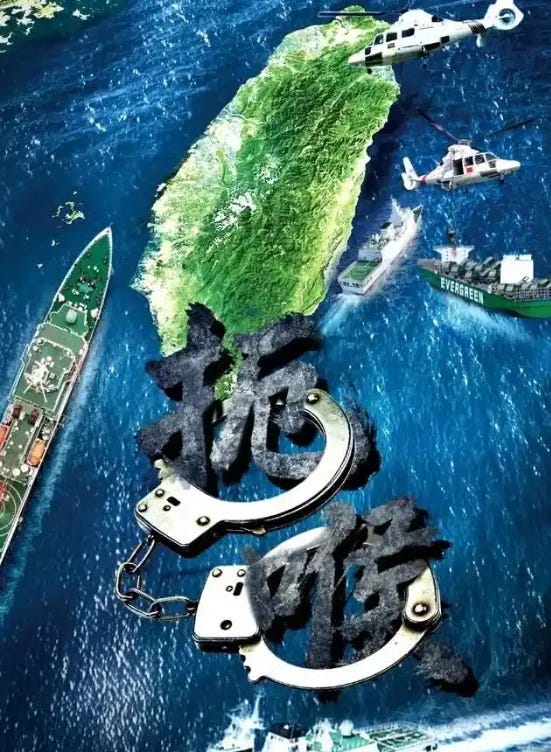
Global Times published an article disclosing that, in the “Chokehold” poster, the China Coast Guard deployed a formation of ships as well as helicopters to implement a three-dimensional blockade over key sea lanes around Taiwan; in the waters east of Taiwan, CCG vessels intercepted a Taiwan “Evergreen” cargo ship allegedly carrying HIMARS rocket launchers. CCG law-enforcement personnel fast-roped down from a helicopter to board the ship for verification and seizure.
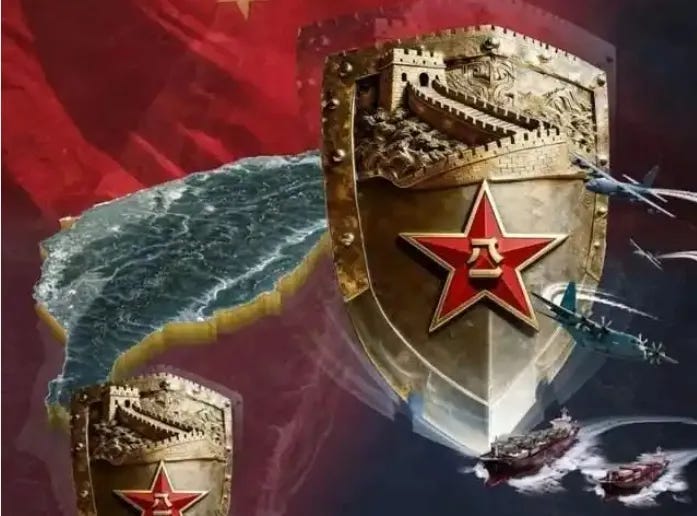
In addition, a poster released on the 29th by the PLA Eastern Theater Command—titled “Shield of Justice, Smashing Illusion” (正义之盾 破限除妄)—also featured a scene of a cargo ship loaded with HIMARS rocket launchers, symbolizing a shield representing the PLA’s “army of justice” positioned outside Taiwan. Global Times commented: “There is profound meaning behind targeting cargo vessels as countermeasures, whether in military exercises or law enforcement patrols.”
What kind of offensive weapon is the HIMARS rocket launcher?
According to available information, HIMARS is a light multiple rocket launcher system developed by the U.S. military on the basis of the M270 multiple launch rocket system. When equipped with extended-range rockets, it can strike targets up to 80 kilometers away; when equipped with tactical missiles, its range can reach 300 kilometers.
Military commentator 宋忠平 Song Zhongping said that during the Russia–Ukraine conflict, the United States provided this type of weapon to Ukraine, and Western media at the time hyped its combat performance. But in reality, HIMARS has no special “secret sauce.” On the one hand, as Russia became familiar with the weapon’s ballistic characteristics and other features, HIMARS’ effectiveness became very limited; on the other hand, the PLA fields similar weapons that are better and available in greater numbers—“plentiful quantities and more than enough.”
Regarding what is shown in the poster—Chinese law-enforcement forces intercepting and verifying a cargo ship transporting military supplies—王文娟 Wang Wenjuan, a researcher at the Academy of Military Sciences, said that if “Taiwan independence” forces undermine cross-strait peace, trigger a cross-strait military conflict, and use civilian ships to transport weapons and equipment, then cargo ships undertaking arms-transport missions may be treated as military targets. The China Coast Guard could carry out interception and seizure, boarding inspections and arrests, and even use forceful measures. The China Coast Guard has law-enforcement authority within waters under China’s jurisdiction.
Song Zhongping also argued that, whether in wartime or peacetime, it is reasonable and lawful for either the navy or the coast guard to strictly verify and handle civilian vessels entering and leaving the Taiwan Strait that may be transporting military materiel. Such verification and handling is not limited to HIMARS; it also covers the ammunition HIMARS requires as well as various other types of military equipment. This, he said, is what it means to safeguard China’s sovereignty and prevent external forces from interfering.
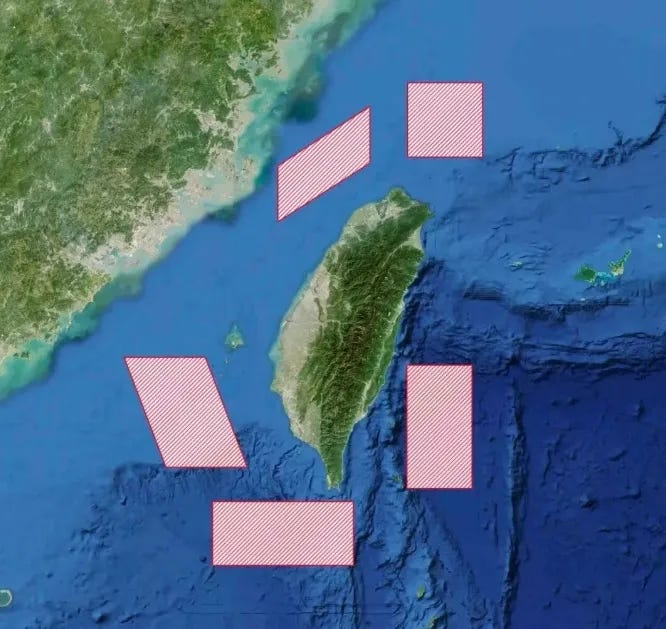
He added that, more importantly, this exercise clearly shows that China not only has law-enforcement capabilities to identify and verify targets, but also possesses a “precision strike at key points” military capability. From a tactical perspective, an offensive weapon naturally warrants the PLA’s attention. But strategically, he said, such weapons and equipment would be precisely destroyed at the earliest moment in wartime.
“The DPP authorities’ attempt to seek ‘independence’ through force is nothing but a pipe dream,” Zhang Chi of the National Defense University said in response to the exercise. “Precision strikes” are the key phrase of the drill. After the exercise began, participating forces rapidly tracked and deterred—and, if necessary, struck—relevant mobile targets on Taiwan. The goal, he said, is to ensure that the offensive weapons Taiwan’s military buys from external forces have nowhere to hide and are always facing the prospect of catastrophic destruction. “No matter how many weapons you buy, we will take out that many.”
Thanks, very interesting. Definitely a hot topic.
What is your assessment of probabilty of China trying to invade Taiwan in 2026?
Imagine there's no heaven
It's easy if you try
No hell below us
Above us, only sky
Imagine all the people
Livin' for today
Imagine there's no countries
It isn't hard to do
Nothing to kill or die for
And no religion, too
Imagine all the people
Livin' life in peace
You may say I'm a dreamer
But I'm not the only one
I hope someday you'll join us
And the world will be as one
Imagine no possessions
I wonder if you can
No need for greed or hunger
A brotherhood of man
Imagine all the people
Sharing all the world
You may say I'm a dreamer
But I'm not the only one
I hope someday you'll join us
And the world will live as one