

China’s mainland has long insisted that the real threat to peace in the Taiwan Strait comes not from Beijing, but from “Taiwan independence” separatist forces and the external powers that support them, above all, the United States. Therefore, People’s Liberation Army exercises in and around the Strait are not preparations for war so much as deterrence against pro-independence moves on the island and foreign interference abroad.
But that is not how Washington, many of America’s partners, or, admittedly, many people in Taiwan see it. They see the drills as rehearsals for coercion or invasion. In that view, the greatest threat to peace in the Taiwan Strait is the mainland itself: a rapidly growing and increasingly sophisticated military power that may be losing patience with the status quo.
That fear has, over the past few years, come to crystallise around one number: 2027. The number traces back most famously to Adm. Philip Davidson’s March 2021 testimony before the U.S. Senate Armed Services Committee, when he warned that the threat over Taiwan could become manifest “in the next six years.”
More recently, a Foreign Affairs essay argued that something had changed in Beijing’s thinking in 2025: this time, China not only speaks more insistently about “reunification,” but may also believe that a window of opportunity has opened that may not come again.
I have long been sceptical of that line of argument. As I wrote in Foreign Policy this week,
In a closed-door workshop in Hawaii in March on U.S.-China relations, an American participant asked a question that has now surfaced repeatedly in Washington: Does the war with Iran increase the risk that China will use force against Taiwan?
The question reflects a familiar assumption: China is a tactical predator, waiting for a moment of U.S. distraction to strike. But that view misreads how Beijing frames the Taiwan issue. Beijing is not looking for an opportunity to use force, as Peking University professor Jie Dalei and I responded at the workshop. It is looking for every possible way to not to have to use it.
A sharp reminder of that logic is the ongoing visit to the mainland by Cheng Li-wun—the chair of the Kuomintang (KMT), the opposition and largest single party in Taiwan’s legislature, from April 7 to April 12 at the invitation of Chinese President Xi Jinping and the Chinese Communist Party Central Committee. If she meets directly with Xi, which is likely, it will be the first meeting in a decade between the leaders of the KMT and the Chinese Communist Party.
Xi Jinping’s meeting in Beijing today with Cheng Li-wun further strengthened my view, and undercuts the argument — now common in Washington and beyond — that the mainland is essentially growing too impatient to wait on Taiwan.
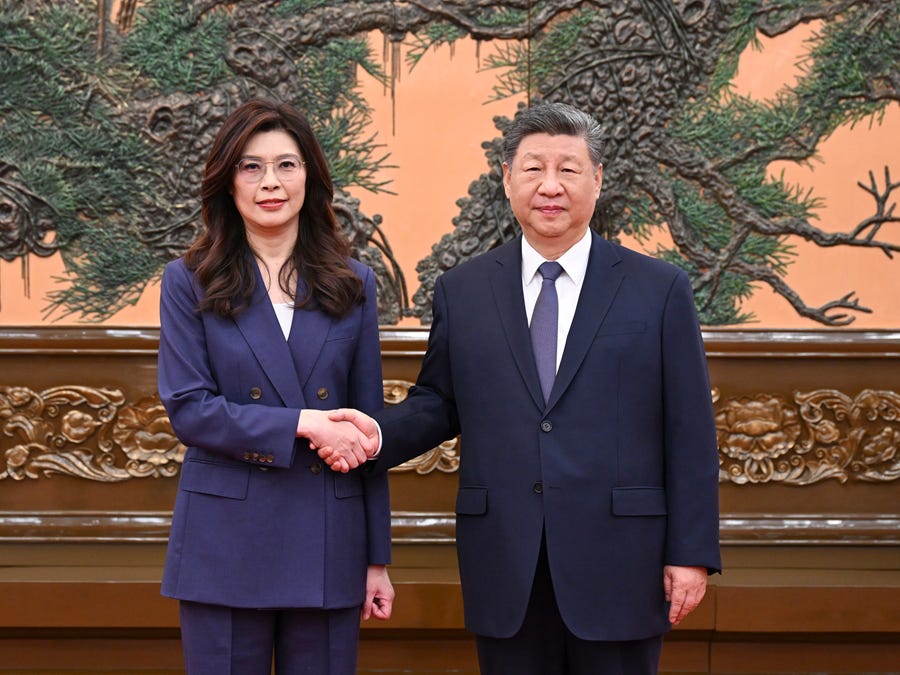
Today’s meeting was widely covered around the world. But the real news, at least to me, has not yet been spelled out:
Beijing is not rushing reunification
In his televised opening remarks, Xi told Cheng
Today’s world is far from tranquil, and peace is all the more precious. Compatriots on both sides of the Strait are all Chinese, members of one family. To seek peace, development, exchanges, and cooperation is the shared aspiration. The meeting between the leaders of our two parties today is precisely to safeguard the peace and security of our common home, advance the peaceful development of cross-Strait relations, and enable future generations to share in a better future.
This matters. In one of the most politically significant cross-Strait meetings in years, Xi did not publicly frame the encounter as an occasion to press the KMT toward endorsing a timetable for unification. He framed it as an effort to preserve peace and keep relations moving in a peaceful direction.
In the same televised opening remarks, Xi also said
The KMT and the Communist Party should consolidate political mutual trust, maintain positive interactions, unite compatriots on both sides of the strait, and work hand in hand to create a bright future of national reunification and national rejuvenation.
国共两党要巩固政治互信,保持良性互动,团结两岸同胞,携手共创祖国统一、民族复兴的美好未来。
Reunification is indeed mentioned here. But especially to anyone whose native language is Chinese, the meaning is not hard to grasp. What is being described is a future horizon with no defined timetable. It is a vision, not a deadline.
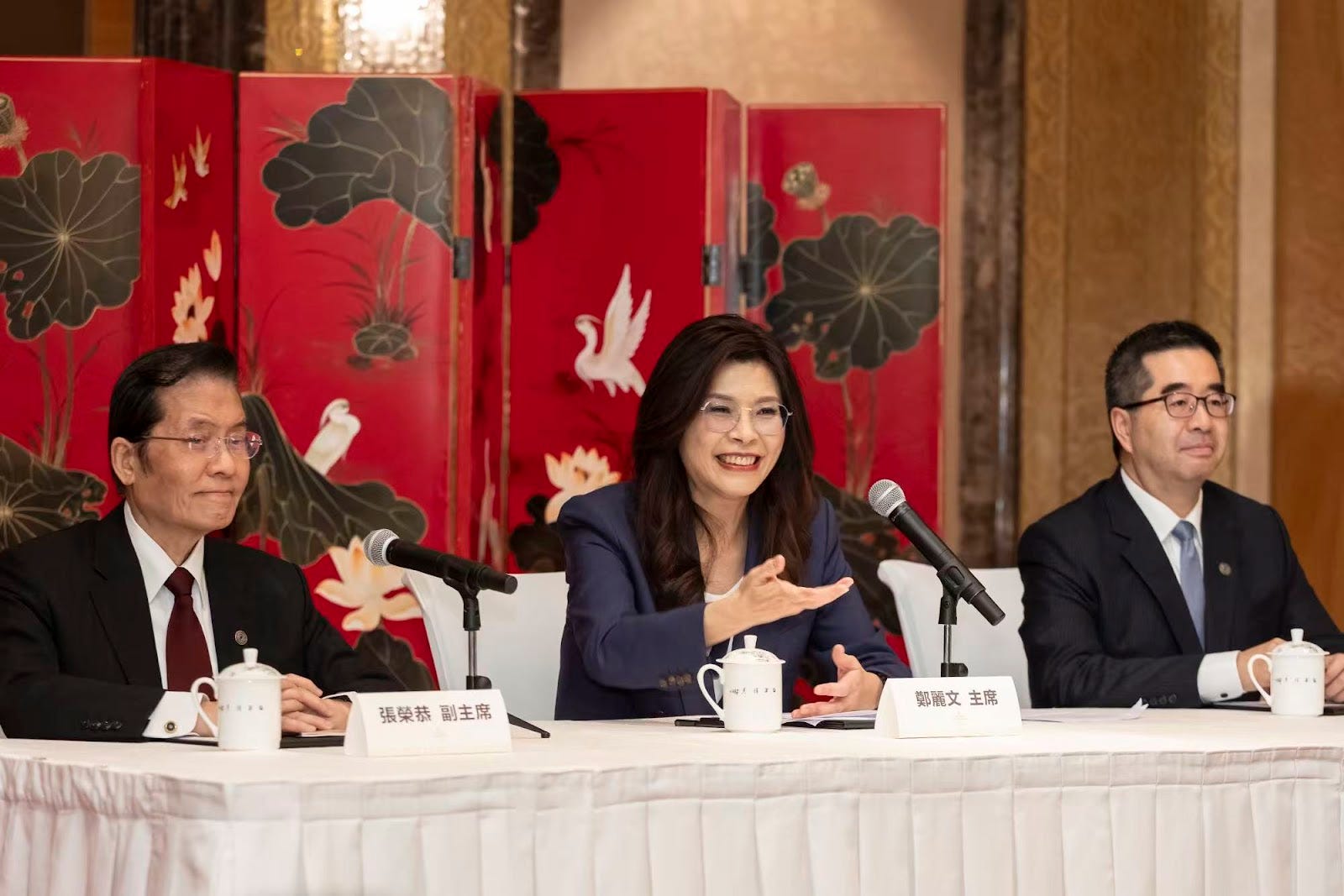
After her talks and lunch with Xi, Cheng said at a televised press conference, according to the KMT’s own news release:
Chair Cheng relayed General Secretary Xi Jinping’s remarks in the closed-door meeting as saying that real differences do exist across the Strait, and that those differences have deep historical roots. They cannot be resolved overnight. They must be approached with patience, perseverance, and the spirit of Yu Gong moving mountains and Jingwei filling the sea — just as “three feet of ice does not form in a single day.” So long as both sides can achieve a meeting of minds, then things should be talked through calmly, matters should be discussed more, and indeed everything is open to discussion.
鄭主席轉述習近平總書記在閉門會議中的談話表示,兩岸之間確實存在歧異,且有其長久歷史形成背景,不可能一蹴可幾,要透過耐心、恆心,「愚公移山、精衛填海」的精神面對,正如「冰凍三尺非一日之寒」。只要大家有共同的心靈契合,「有話好好說、有事多商量,而且也一切都好商量」。
There was also this Q&A, according to our transcript of Cheng’s televised press conference
NBC
Thank you, Madam Chairwoman. When we spoke recently, you said that this trip was about seeking reconciliation with the Mainland as the best way forward for Taiwan. Having made this trip and having met with President Xi, would you now say that you share his goal of unification for Taiwan? Is that the way forward?
Cheng Li-wun
I think that, throughout today’s talks, what was truly highlighted and valued was the sense of kinship that comes from belonging to the Chinese nation. As I mentioned just now, in his remarks, General Secretary Xi in fact recognised and respected Taiwan’s different way of life and system, and also hoped that this would be reciprocal—that Taiwan, too, would respect and acknowledge the Mainland’s development achievements. He also specifically mentioned that he hopes there will be no conflict across the Strait, and that in future both sides, as one family, can engage in more exchanges and grow closer to one another.
……
I think that, on this point, General Secretary Xi and I were both very pragmatic, and hope to proceed step by step, just as I said earlier. At the very outset, General Secretary Xi in fact said that although social systems and political propositions may differ, our common ancestors and the bloodline of the nation cannot be severed; differences in social systems should not be used as an excuse for division.
So I believe this was a very major expression of goodwill. We face pragmatically the many differences that have arisen over the course of the long historical development of cross-Strait relations. But Taiwan’s achievements today and the Mainland’s achievements today are both great and remarkable achievements of the Chinese nation. We can appreciate one another, respect one another, and even learn from one another. In the future, there are even greater opportunities for cooperation, so that the achievements both sides have already attained may be expanded further, to benefit not only both sides of the Strait but also humanity.
So, in answer to your question, we hope to consolidate and strengthen a peaceful and stable relationship. On that basis, we should handle matters one by one and move forward steadily, step by step. Thank you.
That is not the language of compressed political time. It is the language of patience.
This point matters because one of the most common arguments in Washington is that Beijing must feel increasing pressure to act sooner rather than later, since public opinion in Taiwan is unlikely to move in a more mainland-friendly direction over time.
I disputed the assertion in Foreign Policy just ahead of today’s meeting
As Beijing sees it, it can afford to be strategically patient and hope for peaceful reunification because it has sufficient strength to outlast the independence movement and the DPP (Democratic People’s Party)
Today, Xi does not seem to be speaking like a leader who believes time is running out.
In his televised remarks, Xi said
At present, changes unseen in a century are accelerating across the world. Yet no matter how the international landscape or the situation in the Taiwan Strait may evolve, the overarching direction of human development and progress will not change, the prevailing trend toward the great rejuvenation of the Chinese nation will not change, and the great tide of compatriots on both sides of the Strait becoming closer, more connected, and coming together will not change. This is the verdict of history, and we are fully confident of it.
According to Beijing’s official readout, Xi also said
We are firmly convinced that more and more Taiwan compatriots will come to understand the Mainland’s social system and development path more accurately, and to recognise more deeply that Taiwan’s future prospects lie in a strong motherland, and that the interests and well-being of Taiwan compatriots are tied to the great rejuvenation of the Chinese nation.
Overall, Beijing’s own political messaging, even at a time of heightened external anxiety, remains anchored less in impatience than in long-term confidence.
Today’s most important signal was that Beijing is still not talking like a side that believes it must seize Taiwan soon. It is talking like a side that recognises that cross-Strait differences are real, historically rooted, and not something that can be resolved all at once. Beijing still seems to believe that history is moving in its direction, that time is not yet its enemy, and that the preferred path remains peace, exchange, and step-by-step movement approached with patience and persistence.
At a moment when much of the world sees Taiwan as one of the most dangerous flashpoints on earth, and some even believe war could break out before long, the fact that Cheng Li-wun’s trip has helped facilitate such a signal is, in my view, already a contribution of immense significance.


Good perspective and insights on cross-strait issues!
I think there's a phenomenon where people get information from Asia that's a big outdated. The 35-45 age demographic in Taiwan is pretty pro-DPP, but the 20-35 demographic very much is not. And it seems a lot of Western observers are still basically living in 2015 (you know, back when Huang was a Sunflower protest leader) and thus have assumed a "demographics is destiny" argument based on the voting behavior of what they think is the youngest generation.