

Yesterday/Wednesday, March 5, at the first weekly press conference of the Taiwan Affairs Office after the Lunar New Year, my February 26 op-ed in the Financial Times Let Chinese mainland tourists return to Taiwan came up.
According to the office’s website
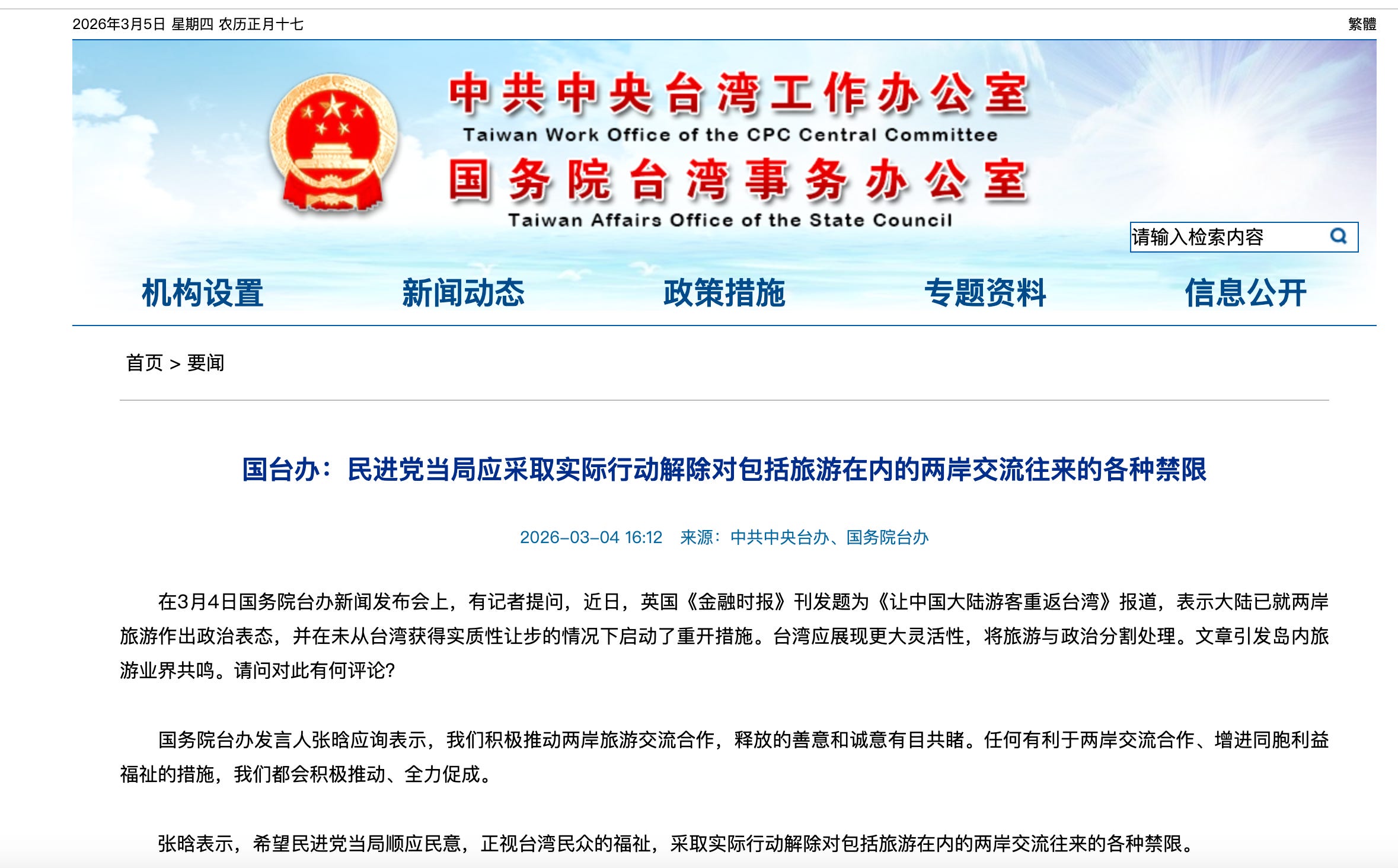
2026-03-04 16:12
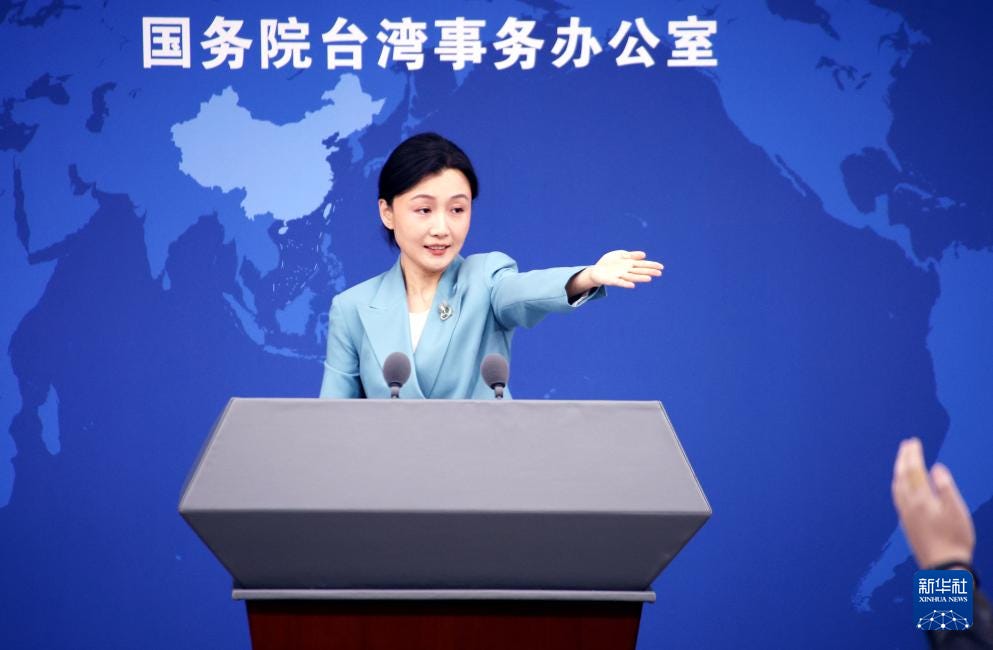
Source: Taiwan Work Office of the Communist Party of China Central Committee / Taiwan Affairs Office of the State CouncilAt the March 4 press conference of the Taiwan Affairs Office of the State Council, a reporter asked: Recently, the Financial Times published an article titled “Let Chinese mainland tourists return to Taiwan,” saying that the mainland had made political statements and begun reopening measures without securing substantive concessions from Taipei; Taiwan should show greater flexibility, compartmentalise tourism from politics. The article has resonated with Taiwan’s tourism sector. What is your comment on this?
Responding to the question, Zhang Han, spokesperson for the Taiwan Affairs Office of the State Council, said that we have been actively promoting cross-Strait tourism exchanges and cooperation, and the goodwill and sincerity we have demonstrated are plain for all to see. Any measures that are conducive to cross-Strait exchanges and cooperation and to improving the interests and well-being of compatriots, we will actively promote and do our utmost to bring about.
Zhang said that it is hoped that the Demoractic Progressive Party authorities will follow public opinion, face squarely the well-being of the people of Taiwan, and take concrete steps to remove the various restrictions and bans on cross-Strait exchanges, including tourism
Below is my op-ed in the FT
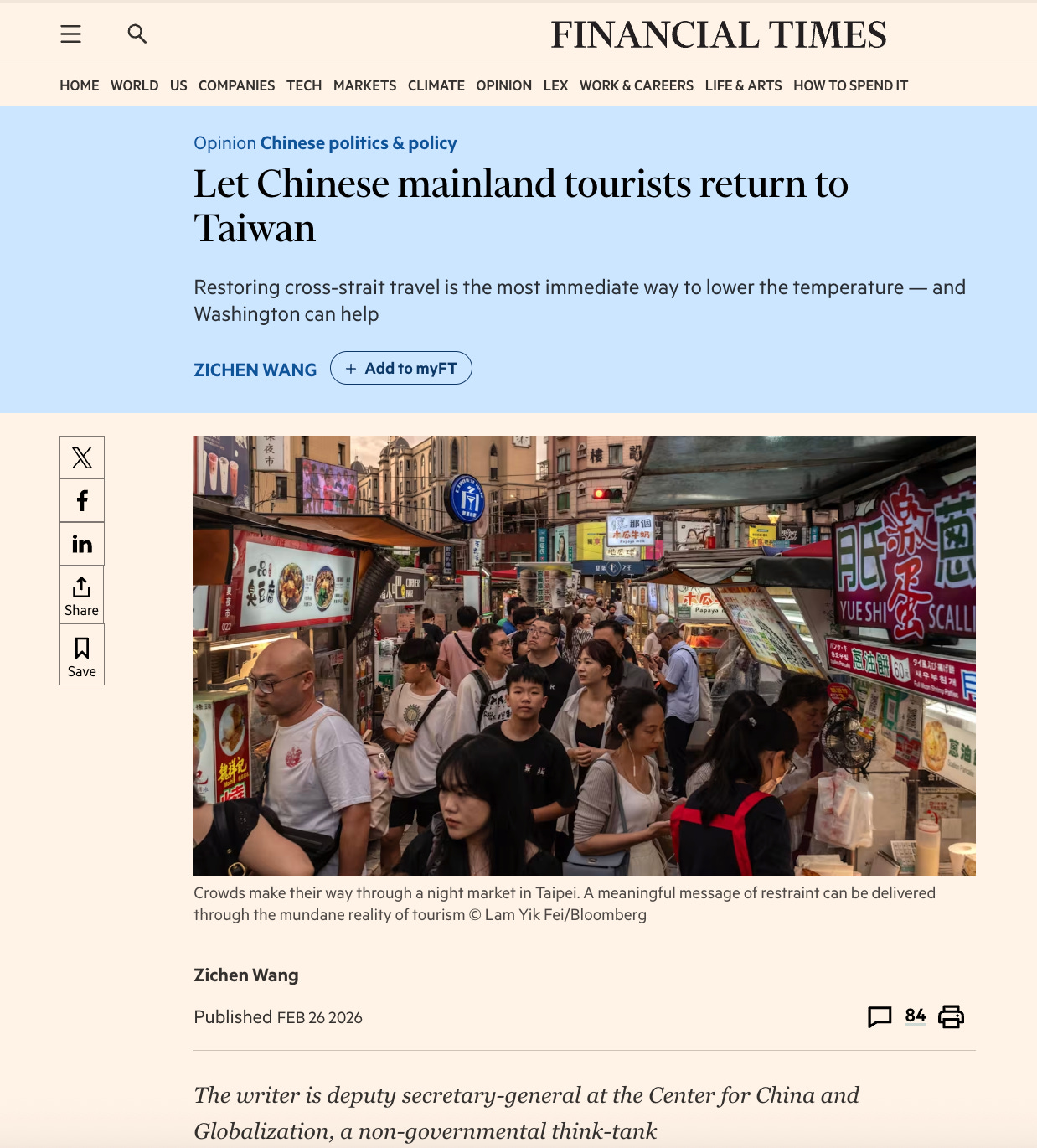
Let Chinese mainland tourists return to Taiwan
Restoring cross-strait travel is the most immediate way to lower the temperature — and Washington can help
Zichen Wang
PublishedFeb 26 2026
The writer is deputy secretary-general at the Center for China and Globalization, a non-governmental think-tank.
The Taiwan Strait is widely seen as one of the most dangerous flashpoints in the world. Discussions increasingly focus on military drills, arms sales and “greyzone” activities. What is striking is the absence of practical steps to lower tensions.
There is at least one area in which both sides have expressed support for de-escalation: tourism, particularly the return of mainland visitors to Taiwan. It will not resolve the deeper political disputes across the strait, but it is one of the few steps that is immediately actionable, visibly stabilising and operationally feasible.
There is a clear precedent. During the peaceful development of cross-strait relations between 2008 and 2016, mainland visitors to Taiwan increased 10-fold, reaching more than 4mn in 2015. It created a form of everyday contact that functioned as a soft buffer. An island that receives thousands of mainland retirees and backpackers each day diminishes the chances of armed conflict.
Since 2016, mainland visits to the island have declined dramatically, to just over half a million in 2025. After the pro-independence Democratic Progressive Party took power in Taipei, Beijing paused individual tourists, and the DPP took advantage of Covid-19 to shut down completely.
Mainland tourists always need permits from both Taipei and Beijing in order to travel. Now, neither side currently grants them for individual tourism, and both largely withhold licences for group tours. While both sides trade blame for the downturn, each has also signalled interest in reversing the trend.
The group tours, however, require facilitation by Taipei, which has so far maintained a cautious stance, citing the need for balance and safety as well as concerns about “healthy and orderly” tourism. Such worries were reasonable when Taiwan was receiving 4mn visitors annually. Today, the immediate issue is not overcrowding but the near-total absence of mainland tourists. The idea of balance is difficult to apply meaningfully when Taiwanese travellers to the mainland already outnumber mainland visitors by a wide margin. Easing restrictions is the only practical means of moving towards balance.
Beijing doesn’t profess worries about the safety of tourism in either direction. It has kept individual Taiwanese entry to the mainland open, registering 4.89mn visitors in 2025. In early 2024, general secretary Xi Jinping told former Taiwanese leader Ma Ying-jeou that Beijing also welcomed mainland residents to travel to Taiwan “as much as possible”.
Taipei probably worries about infiltration or spying, but a decade ago it successfully managed mass tourism with appropriate rules and enforcement. Tourism need not become a hostage to excessive suspicion. If Taipei were to show greater flexibility — potentially with encouragement from the US — it could help stabilise cross-strait ties.
Beijing has already made high-profile political statements about restoring tourism and begun limited reopening measures without securing substantive concessions from Taipei. This creates an opportunity for reciprocal steps. To start, Taiwan could facilitate the return of tour groups from Shanghai and Fujian. It could also allow airlines and shipping companies to restore routes in line with market demand.
Taipei could also align its travel alert for the mainland with that of the US, which in 2024 downgraded its advisory for China to the same level as France and Germany. Individual legal cases on the mainland involving Taiwanese residents are often highlighted, as Beijing sometimes prosecutes views or actions it deems criminally secessionist. However, these cases are statistically insignificant relative to the millions of Taiwanese trips to the mainland each year.
US President Donald Trump has claimed a strong interest in promoting peace and in managing the US-China relationship constructively. He and other global leaders with a stake in regional stability should treat tourism as a means of de-escalation.
Reopening tourism will not resolve fundamental disputes. Tourism has always been entangled with politics. Taipei may find it difficult to welcome mainland tourists while warships operate nearby, but compartmentalisation is possible. Even when sensitive questions have remained unresolved, the two sides managed to ink arrangements on direct flights, sea links and post services; progress in isolated areas can serve to temper broader systemic tensions.
Tourism cannot solve everything. But a meaningful message of restraint can be delivered through mundane reality: a full arrivals hall, regular flights operating at scale and tour buses moving without fanfare. Peace in the Taiwan Strait will be strengthened by the presence of civilians — and by routines that make escalation harder to justify.
On March 2, the FT published a Letter in response to this comment: The dilemma of reopening Taiwan to mainland tourists / From Zhao Xiaoou, Shanghai, China
P.S. Cheng Li-wun, the new Chair of the Kuomintang, published Taiwan Doesn’t Have to Choose on March 3 in Foreign Affairs

Ma Ying-jeou's latest speech on cross-Taiwan Strait Relations

Ma Ying-jeou served as the 12th and 13th President of the Republic of China (ROC), or the leader of Taiwan, between 2008 and 2016.
Ma Ying-jeou on Commemoration Day of Taiwan’s Restoration

Chinese and U.S. trade negotiators spent their Saturday talking in Kuala Lumpur, Malaysia, where Bloomberg just reported U.S. is saying the discussions were “very constructive.”
Mainlander tourists in South Korea regularly do military style parades/boomer Maoist reenactments in public spaces these days, cant see how they would behave any better in Taiwan