


China could consider moving towards living wages instead of minimum wages, non-contributory pensions for all older people, and broader income support referencing universal basic income as artificial intelligence reshapes the labour market, according to Cai Fang, one of the country’s leading labour economists.
Cai Fang, Academician and former Vice President — meaning Vice Minister — of the Chinese Academy of Social Sciences (CASS), made the case in an article published on the front page of Study Times on 19 June 2026. Study Times is published by the Party School of the Communist Party of China Central Committee, the country’s leading institution for training senior Party and government officials.
Cai calls for a substantial expansion of both lifelong training and social protection. Alongside formal education, training should account for a much larger share of China’s human-capital development system and become a principal channel for lifelong learning. Labour market institutions, meanwhile, must gain the technological capacity to scrutinise algorithms and protect workers beyond conventional employment relationships. Social security should become markedly more universal, with lower eligibility thresholds and wider coverage, drawing on universal basic income to strengthen the minimum living allowance system, moving from minimum wages towards living wages, and developing the pension scheme for urban and rural residents into a non-contributory basic pension covering all older people equally and unconditionally.
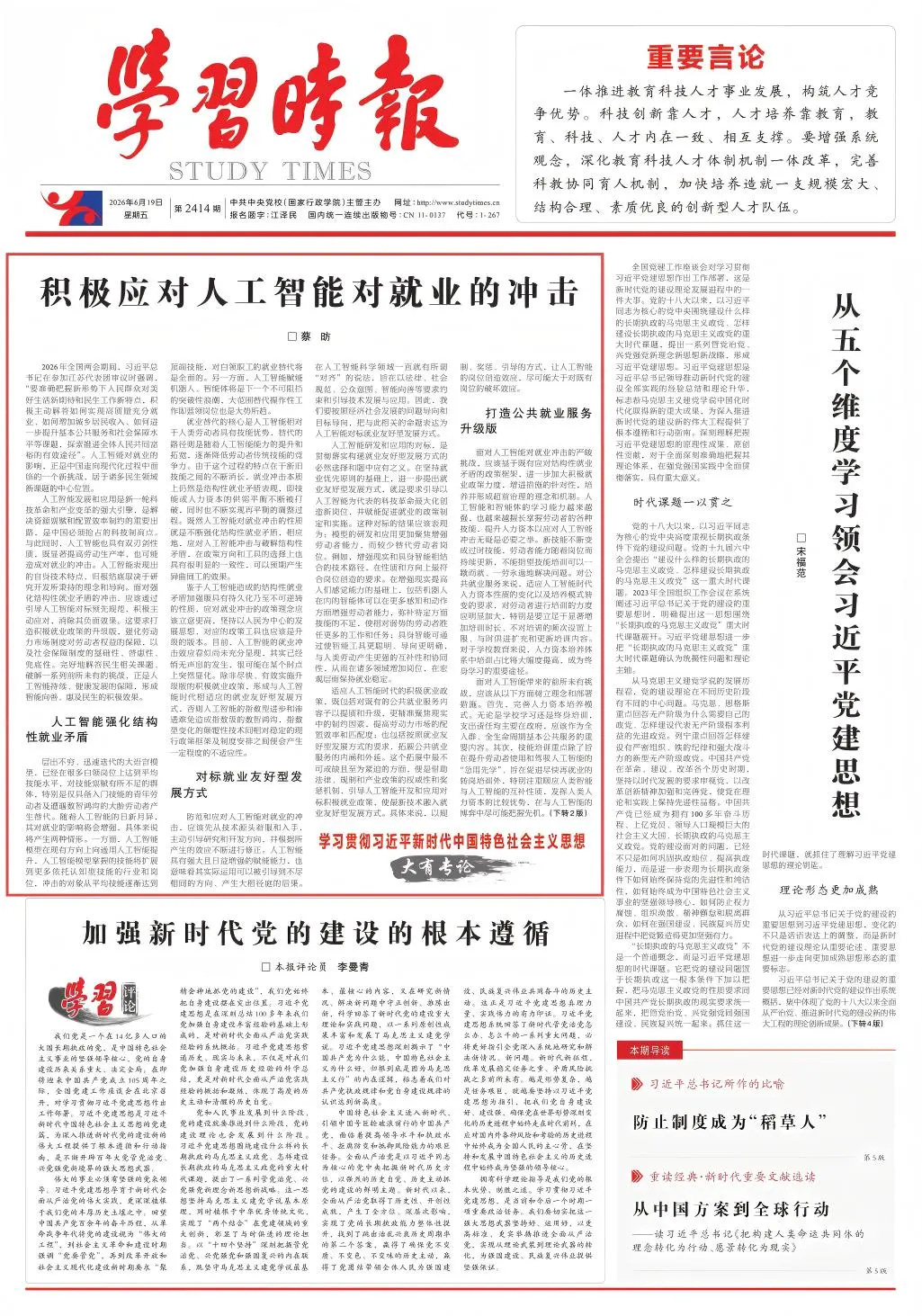
积极应对人工智能对就业的冲击
Responding Proactively to AI’s Impact on Employment
During the 2026 annual two sessions — the annual meetings of China’s top legislature and political advisory body — General Secretary Xi Jinping, while participating in deliberations with the Jiangsu delegation, stressed the need to “accurately grasp the people’s new aspirations for a better life and the new characteristics concerning the work on people’s well-being under the new circumstances, take proactive actions to address issues such as how to ensure high-quality and sufficient employment, how to increase the income of urban and rural residents, and how to further raise the standards of basic public services and social security, and to explore effective pathways to advance common prosperity for all.”
The impact of artificial intelligence on employment is a new challenge arising in the course of China’s modernisation. It lies at the heart of many of the emerging issues affecting people’s well-being.
The development and application of AI are a powerful driving force behind the new round of technological revolution and industrial transformation. They offer an important means of overcoming constraints arising from resource endowments and inefficient resource allocation, and represent a strategic technological high ground that China must secure.
At the same time, AI is a double-edged sword. It can substantially raise labour productivity, but it can also disrupt employment. The direction that AI ultimately takes depends, in the final analysis, on the values, objectives, and priorities guiding its research and development.
To address the risk that AI may exacerbate structural employment imbalances, policymakers should proactively guide its development in line with clearly defined standards, making continuous adjustments in light of its social and economic effects.
This will require an upgraded generation of active employment policies, stronger labour market institutions to protect workers’ rights and interests, and a social security system that more fully performs its foundational, inclusive and safety-net functions. Successfully addressing these challenges concerning people’s well-being will, in turn, provide an essential foundation for the sustained and healthy development of AI, ensuring that technological progress serves the public good and benefits people’s livelihoods.
AI Is Intensifying Structural Employment Imbalances
Large language models are proliferating and improving at remarkable speed. In many white-collar tasks, they have already reached roughly the average level of human performance. This has begun to displace workers with weaker skill endowments, particularly young people possessing only entry-level skills and older workers who find themselves on the wrong side of the digital and AI divide.
As AI continues to advance, its impact on employment will grow. This is likely to take two principal forms.
First, as AI models progress along their current trajectory towards artificial general intelligence, their capabilities will extend into a wider range of industries and occupations that rely on cognitive skills. The scope of displacement will gradually move from work requiring average skills to work requiring the highest levels of expertise. The resulting disruption to white-collar employment will be broad-based.
Second, the integration of AI with robots and intelligent agents is the next unstoppable major wave of technological breakthroughs. The large-scale displacement of operational and manual work — and therefore of many blue-collar jobs — will increasingly become a major trend.
At the heart of job displacement is AI’s skill advantage over human workers. As its capabilities deepen and broaden, skills traditionally possessed by workers gradually lose their competitive value.
This is a continuous process in which older skills decline in value while new skills rise in importance. The employment shock caused by AI therefore remains, in essence, a manifestation of structural employment imbalances: the balance between the supply of and demand for particular skills and forms of human capital is repeatedly disrupted and then re-established through adjustment.
Because AI’s impact on employment primarily takes the form of intensified structural imbalances, policies designed to respond to AI and those intended to address structural employment problems will have much in common. They will require similar policy directions and can be expected to produce mutually reinforcing results.
The heightened structural employment imbalances created by AI are likely to persist and even prove irreversible. The policy response must therefore be guided by a more ambitious vision, firmly grounded in a people-centred approach to development. The corresponding policy instruments must also be upgraded.
At present, AI’s impact on employment may not appear to have fully materialised. In reality, however, it is already unfolding quietly and may become suddenly and visibly apparent at a certain point.
Unless an upgraded generation of active employment policies is introduced quickly and effectively, and unless an employment-friendly model of development suited to the AI era is established, the exponential progress and diffusion of AI could produce an exponentially widening digital and AI divide. A growing mismatch would then emerge between disruptive technologies changing at exponential speed and relatively stable policy frameworks and institutional arrangements.
Align AI with an Employment-Friendly Model of Development
Efforts to prevent and address AI-driven employment disruption should begin at the technological source. The direction of research and development should be actively guided, with policies and standards continually revised in light of the effects produced.
AI has an extraordinarily powerful and rapidly growing capacity to augment human activity. This also means that it can be deployed in different directions and generate markedly different social and economic outcomes.
The field of AI has long discussed the concept of “alignment”: the idea that technological development and application should be constrained and guided by laws, social norms, public intentions, and the principle of AI for good. From the perspective of China’s problem-oriented and goal-oriented approach to economic and social development, the relevant objective should be aligning AI with an employment-friendly model of development.
Such alignment is both a necessary choice and an integral part of building an employment-friendly model of development.
The employment-first strategy should be taken a step further. An employment-friendly model of development requires the technological revolution represented by AI to be guided towards maximising the creation of new jobs. AI should also be used to strengthen the formulation and implementation of employment-promoting policies.
The intended result should be clear: AI models should be developed and applied more to augment workers’ capabilities than to replace their jobs.
One promising technological path is the combination of augmented reality and embodied AI, which is particularly consistent with creating employment. Augmented reality can extend people’s sensory capabilities, while intelligent agents, including robots, can augment workers’ perceptual and physical abilities. Such technologies can compensate for gaps in particular skills and enable relatively disadvantaged workers to perform a wider range of jobs and tasks.
By making intelligent tools more capable and more clearly oriented towards specific objectives, embodied AI can also strengthen complementarity and coordination between technology and human labour. This could create jobs across a wide range of fields and help maintain overall employment stability.
Active employment policies suited to the AI era should improve and upgrade the quality of existing public employment services. They should focus more precisely on the constraints workers and employers face in practice, while improving the efficiency with which labour is allocated and workers are matched with jobs.
At the same time, the remit of public employment services must be broadened in accordance with the requirements of an employment-friendly model of development.
The most indispensable and urgent part of this expanded remit is to use the authority of law, regulation, and industrial policy — as well as appropriate incentives and penalties — to align AI development and application with active employment policies. The latest technologies must be incorporated into an employment-friendly model of development.
Through regulation, incentives, and policy guidance, the job-creating effects of AI should, as far as possible, be made greater than its destructive effects on existing employment.
Upgrade Public Employment Services
In the face of the severe employment challenges created by AI, China should build on its existing policy framework for addressing structural employment imbalances while further strengthening active employment policies. Measures should become more targeted, and the concepts and mechanisms of anticipatory governance should be developed.
AI systems and intelligent agents are acquiring increasingly powerful learning capabilities and becoming more adept at mastering skills previously possessed by workers. Improving human capital is therefore essential to respond effectively to the impact of AI.
Yet new skills are becoming obsolete with increasing speed, and workers must continually renew their capabilities as jobs change. Skills training cannot be treated as a one-off intervention capable of solving the problem once and for all.
Public employment services must adapt to changes in the nature of human capital and in the way skills are developed in the AI era. The scale and intensity of training should be substantially increased. In particular, training programmes should last longer, no arbitrary ceiling should be placed on how frequently workers may receive training, and training content should be continually expanded and updated to reflect technological change.
Within the human capital development system, training will account for a much larger share alongside formal education. It will become an increasingly important channel for lifelong learning.
To address the unprecedented challenges posed by AI, new principles and measures should be developed in several areas.
First, China should improve its model of human capital development. Whether the service concerned is formal education or lifelong training, the government should bear the primary funding responsibility. Education and training should be treated as essential public services available to the entire population throughout the life course.
Second, skills training should cover more than just the immediate acquisition of the knowledge needed to use and manage AI, or transition training intended to help displaced workers find new jobs as quickly as possible.
Training programmes should pay particular attention to the complementary relationship between human intelligence and artificial intelligence. They should help workers make full use of the comparative advantages of human capital and, as far as possible, stay ahead as they interact and compete with AI.
Finally, mechanisms for matching the supply of and demand for human resources should be improved. In the AI era, labour market institutions and the public employment service system should work together to continually raise matching efficiency.
Reforms should promote greater integration in public administration, strengthen consistency among different agencies in pursuing employment-friendly objectives, coordinate the use of funds and reallocate resources more effectively. These steps will help continuously address structural employment imbalances.
Public employment services should themselves become more adept at using AI. Data, models, algorithms, and other technological tools can be used to turn the same technology that displaces some jobs into an instrument for creating opportunities and matching workers with them.
In theory, AI’s capacity to create employment can be just as powerful as its capacity to replace workers. Over the longer term, job creation could entirely outpace job destruction.
The difficulty lies in the structure of incentives. Replacing workers can produce immediate market returns, whereas creating employment often generates social returns only over the longer term. This helps explain why the employment-displacement effect of AI so often exceeds its job-creation effect.
Resolving this incentive mismatch requires public policy to share the long-term social returns in advance and encourage technological and institutional innovations designed to create employment.
Strengthen Labour Market Institutions and Social Security
Labour is a unique factor of production because it is embodied in human beings themselves. In the process of economic activity and social wealth creation, market mechanisms are needed to allocate human resources, but institutions are also required to protect workers’ rights and interests.
In this sense, labour markets are inherently subject to market failure.
The more disruptive a technological revolution or industrial transformation becomes, and the more intense the accompanying process of creative destruction, the less capable market mechanisms alone are of protecting workers. The necessity and urgency of strong labour market institutions therefore become increasingly apparent.
The revolutionary nature of AI is also being manifested in this area, raising new questions for the design and operation of relevant institutions.
One distinctive change that should not be overlooked, both in the employment effects of artificial intelligence that have already emerged and in those yet to come, concerns the way labour market institutions operate.
Traditionally, institutions such as employment and social security legislation and enforcement, minimum-wage systems, collective bargaining, labour contracts, and labour dispute arbitration have treated employers as the objects of regulation and supervision. Operating in a relatively stable environment and based on relatively stable expectations, these institutions have sought to mitigate the adverse consequences of labour market failures.
Today, however, they must contend with actors possessing technological capabilities of almost unlimited reach. They must be able to challenge algorithms and models that do not conform to social norms. Employment and entrepreneurship are also increasingly taking place outside the boundaries of traditional employer-employee relationships.
Relevant institutions must therefore acquire more hard-core technological capabilities of their own. More importantly, they must develop the ability to anticipate changes in technology, the economy, and society.
At a particular stage of development, maintaining the long-term sustainability of the social security system may require an emphasis on a degree of equivalence between contributions and benefits. This, in turn, requires relatively strict mechanisms for identifying eligible beneficiaries.
As AI penetrates a growing range of industries, however, both the necessity and the practical feasibility of identifying beneficiary groups are being called into question. It is becoming increasingly difficult to say how many years of education a person needs, which subject a student should choose at a vocational school, university, or graduate institution, or which particular set of skills would be sufficient to protect a person’s job from disruption.
Correspondingly, it will become increasingly difficult to use highly targeted mechanisms to determine whether a particular group should receive a particular form of social security benefit.
Within appropriate limits and at a measured, gradual pace, the social security system should therefore become more inclusive. Eligibility thresholds should be significantly lowered so that a wider range of people can be covered.
As AI spreads across more industries, its capacity to raise labour productivity is becoming increasingly certain. Countries around the world have discussed and explored new forms of labour market institutions and more inclusive social welfare arrangements. These proposals are intended both to enable society to share productivity gains more broadly and to respond to employment disruption.
Some widely discussed arrangements have counterparts in China’s existing labour market institutions and social security programmes. They can therefore serve as useful reference points for the evolution of China’s own systems.
For example, the concept of universal basic income could inform efforts to expand the coverage and raise the benefit levels of China’s minimum living allowance system; to progressively bring the minimum-wage system closer to a living-wage system; to develop the basic pension insurance scheme for urban and rural residents into a non-contributory basic pension system that covers all older people equally and unconditionally; and, in the “third distribution” — including philanthropy, charitable giving, and other voluntary contributions to society — to give substantive effect to the principle of AI for good and create incentives for companies to assume new forms of social responsibility, etc.
Cai Fang: theorising AI’s impact on China’s employment future

Cai Fang is a former Vice President—meaning Vice Minister—of the Chinese Academy of Social Sciences (CASS). He currently holds the title of Academician (学部委员 ), reserved for CASS’s highest-ranking scholars. He is also President of the Chinese Association of Labour Economics
Dandan Zhang on AI and Jobs: Neither Pause nor Panic

Generative AI is already reshaping how people think about work. Its impact is broader and faster than past technologies, affecting not only routine tasks but also cognitive work and parts of the white-collar labour market. Yet the evidence so far suggests that the most dramatic effects on employment are still more potential than fully realised. That gap…
Cai Fang on Beijing's income equality playbook

Beijing has long framed its fight against inequality in a vocabulary of its own, built around a three-stage taxonomy of income allocation: primary distribution, meaning wages and returns to capital; secondary distribution, where the tax and welfare systems reallocate income via social security, public services, and transfer payments; and a third, “terti…
China’s consumption problem is an income distribution problem

Last month, Cai Fang, former Vice President—meaning Vice Minister—of the Chinese Academy of Social Sciences (CASS), wrote in the Communist Party of China (CPC)’s flagship journal Qiushi that China should optimise its income distribution structure through institutional development.


Thank you for putting this into English — the byline is half the story. Cai Fang is the economist who told Beijing, around 2010, that the Lewis turning point had arrived and the rural surplus was spent; now, on the Party School's front page, he describes a new surplus forming — made of skills rather than people. The sharpest paragraph is the quiet one: when nobody can say which skills stay safe, targeting breaks down, and universal provision stops being ideology and becomes administration. Study Times is where policy rehearses before it performs. Which arrives first — the living wage, or the displacement it is written for?
Nazem's framing is sharp: "Study Times is where policy rehearses before it performs."
What Cai Fang is describing is a race between two curves. The Knowledge Capital (K) curve — driven by AI — is rising near-vertically. The institutional adaptation curve — labour law reform, UBI architecture, retraining systems — is moving at the pace of committee consensus.
The uncomfortable question is whether Chinese institutions can close that gap faster than Western ones. In our assessment, China has one structural advantage: it can deploy policy at scale without the legitimacy constraints that slow Western welfare reform. But it has one structural disadvantage: the compliance culture that makes Study Times necessary also makes "authentic" labour market feedback slow and filtered.
Cai Fang's prescription is correct. Whether the system can implement it before the displacement it fears arrives is the real question.
— Blue Lotus Research Publication