
Late last month, CF40 Research, the research arm of the China Finance 40 Forum-a leading non-governmental think tank specializing in economics, shared its annual flagship report, China’s Economy: Toward a New Paradigm—Drivers, Trends, and Policy Implications, at its 2026 Bund Summit.
Guo Kai, President of CF40 Research and a former Chinese central bank official, kindly shared a copy and allowed me to share an excerpt.

The following passages are from the report’s English text. They have been rearranged and intervening material omitted; section headings and this introduction are mine. Corporate debt and profit figures below refer to its sample of A-share-listed companies outside finance and petroleum.
The real estate adjustment may be approaching its end, while the current-account surplus-to-GDP ratio may peak
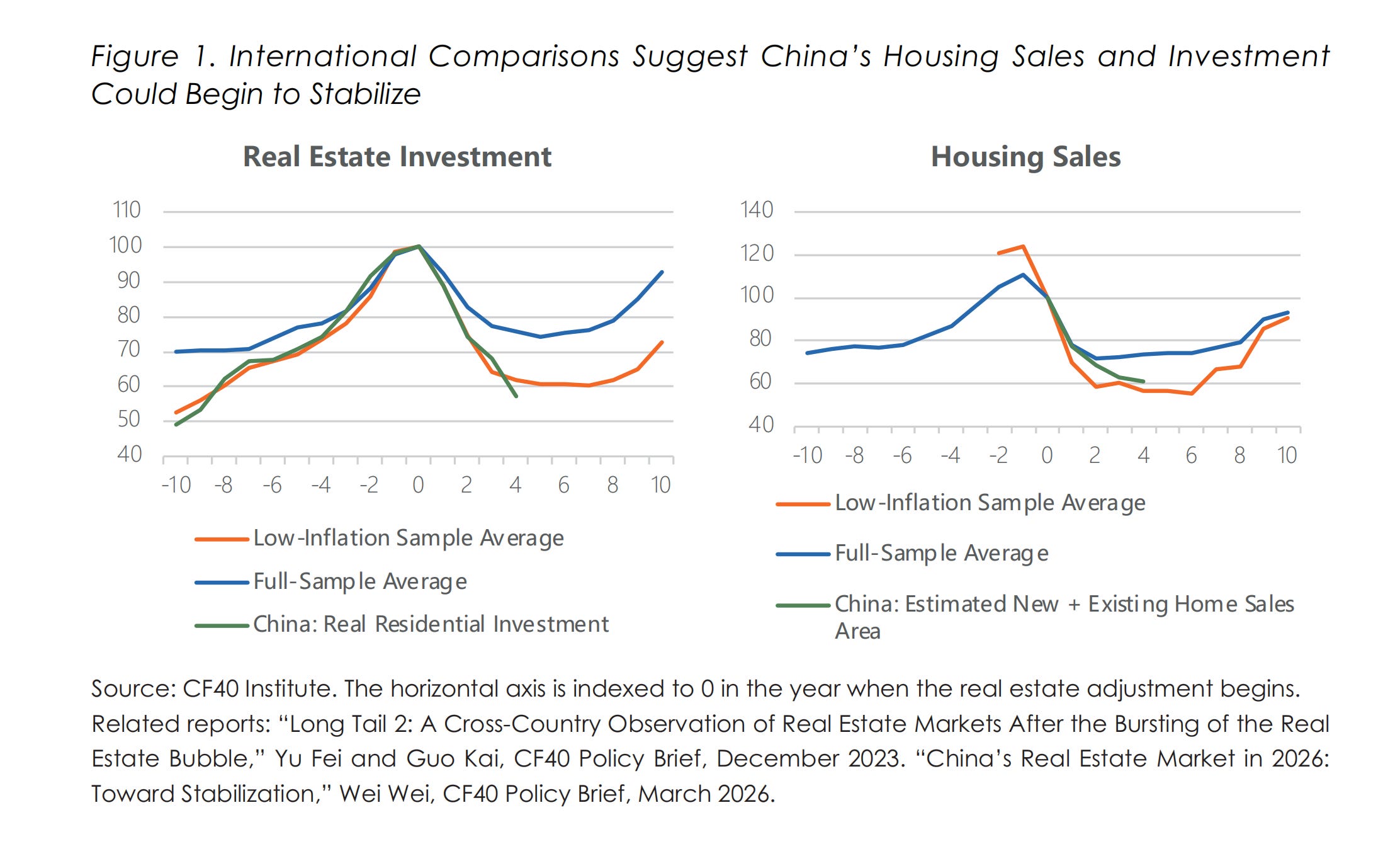
By 2026, the current real estate adjustment may not yet have fully run its course, but signs of structural stabilization have begun to emerge. After five years of deep adjustment, housing sales, investment, inventories, and developers’ balance sheets have entered a new phase, while house-price declines have begun to moderate. Few would expect the real estate sector to return to its former “golden age,” but the drag from the ongoing adjustment on the economy has diminished markedly at the margin. In other words, real estate is gradually shifting from the economy’s largest source of downward pressure toward a more stable influence.
Based on our analysis of international real estate corrections, China’s current real estate adjustment has already been considerable in both duration and magnitude, and the market has likely entered a bottoming phase. Further adjustment remains possible, but another sharp contraction appears unlikely.
Since the start of 2026, China’s real estate market has begun to show signs of “structural stabilization.” We selected 33 core cities for analysis, including the four first-tier cities—Beijing, Shanghai, Guangzhou, and Shenzhen—and major second-tier cities such as Hangzhou, Suzhou, Qingdao, Wuhan, and Hefei. We find that house prices, the floor area of new homes sold, and existing-home transaction volumes have all shown signs of stabilizing in these cities. House prices have even risen modestly in a few core cities. By contrast, real estate markets in most third- and fourth-tier cities remain weak. In other words, stabilization is concentrated in core cities rather than broad-based, which is why we refer to it as “structural stabilization.”
Thus, for the 33 core cities, if new starts continue to decline sharply, excess housing inventory could be rapidly reduced, potentially giving way to a shortage. This would provide additional support for house prices and demand and could accelerate the housing market’s recovery.
Over the past few years, the deep adjustment in the real estate market has been the main driver of the widening current account surplus. The underlying mechanism is that the real estate downturn led to a sharp decline in the investment rate, while the saving rate adjusted with a lag. The resulting widening of the saving–investment gap translated directly into a larger current account surplus.
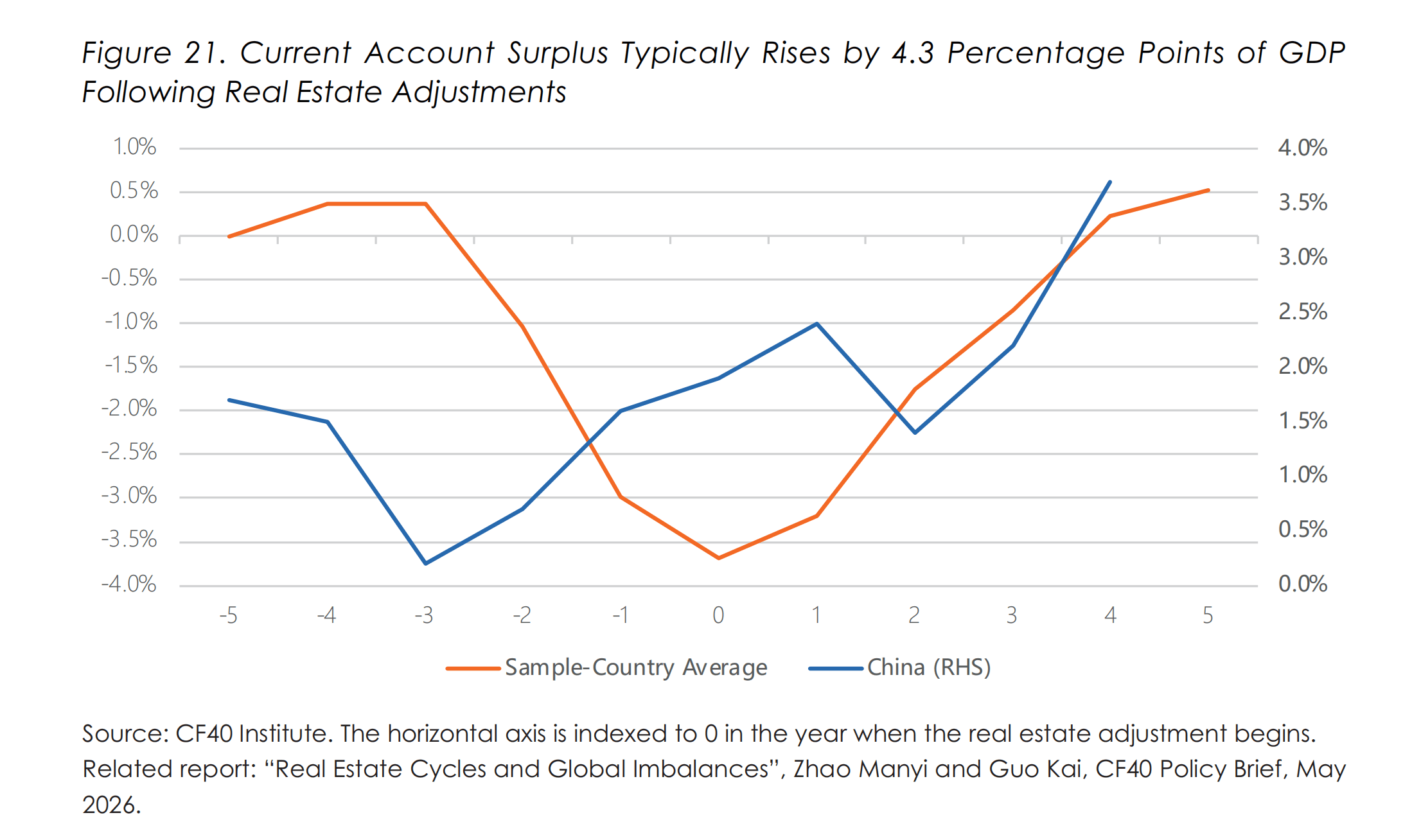
As the real estate market gradually stabilizes, the drag from real estate investment will diminish, while household precautionary saving will stop rising. The saving–investment gap will therefore narrow, and the current account surplus will stabilize at a high level rather than continue to widen. This process bears some resemblance to the decline in China’s current account surplus after 2008, when the RMB 4 trillion stimulus package drove a sharp expansion in domestic investment, significantly narrowing the saving–investment gap.
The manufacturing cycle is adjusting from the supply side
By contrast, the stabilization of the manufacturing capacity cycle since 2024 has clearly not relied on comparable demand-side stimulus. Instead, the sequence has been “supply adjustment first, followed by a moderate recovery in demand”: a market-driven process in which firms voluntarily slowed investment and retired inefficient capacity in response to weak demand. This differs fundamentally from the post-2016 cyclical reversal driven by a sharp rebound in demand.
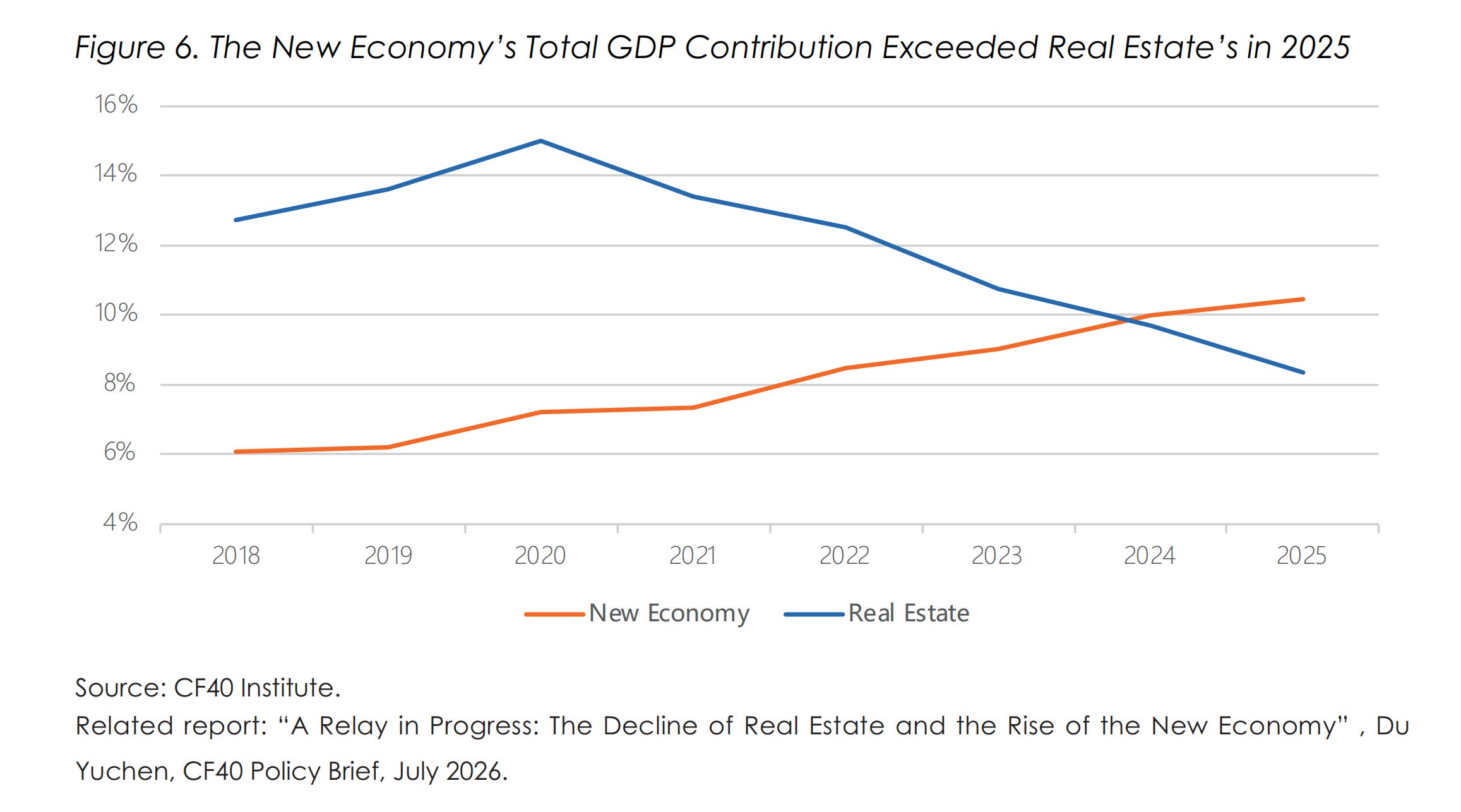
According to CF40 research, the new economy’s total value added rose from about 6.1% of GDP in 2018 to 10.4% in 2025, while the corresponding share for real estate fell from 12.7% to 8.4%. By 2025, the new economy’s total value-added share had surpassed that of real estate and had become an important component of GDP.
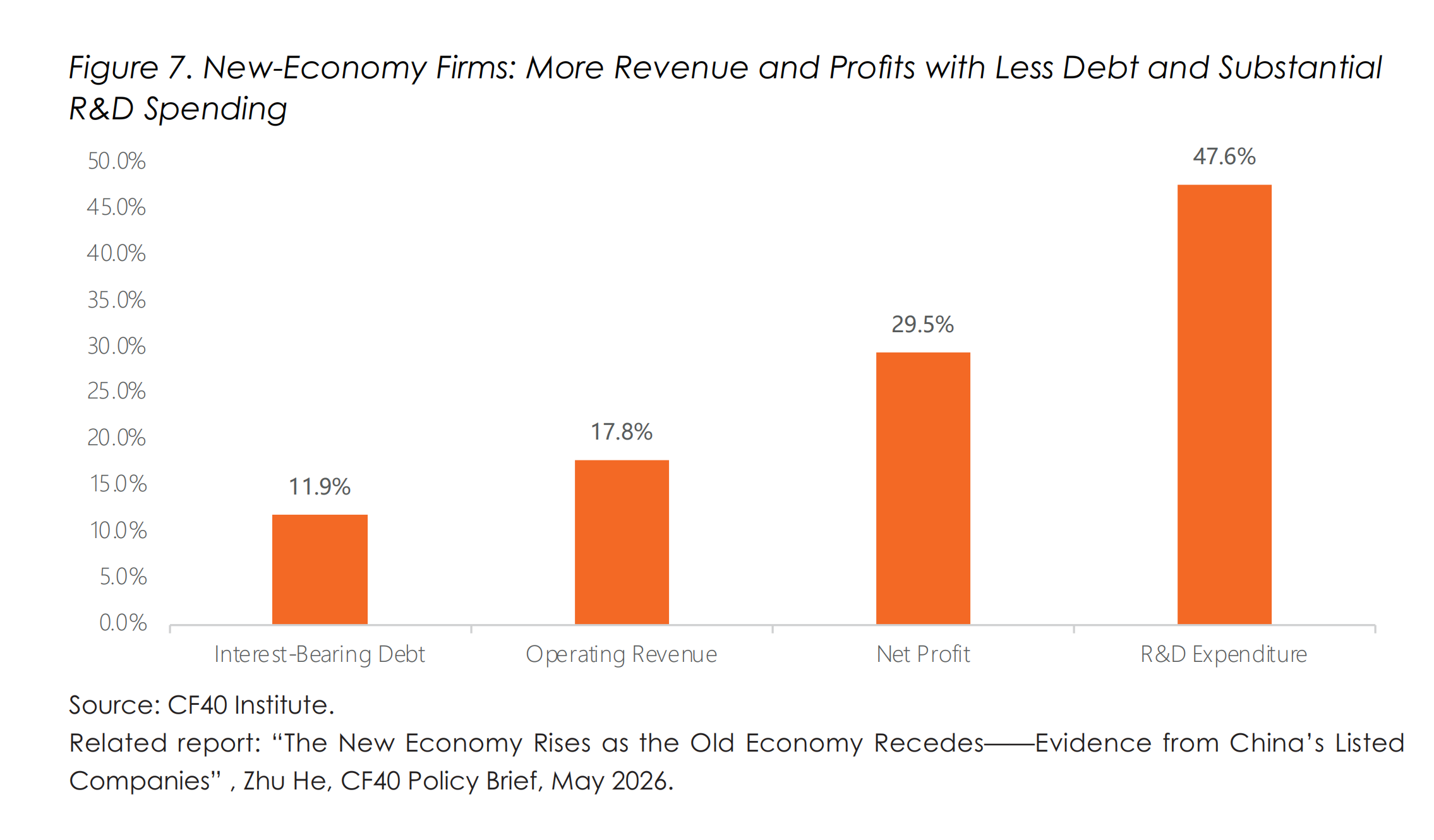
A defining characteristic of new-economy firms is their greater emphasis on R&D and their ability to generate more operating revenue and profits with less debt. In 2025, new-economy firms accounted for only 11.9% of the total interest-bearing debt of firms in the full sample, compared with 17.8% of total operating revenue and 29.5% of total net profits across the sample. Their share of total R&D expenditure was even higher, at 47.6%. As the new economy accounts for a growing share of China’s economy, the country’s growth model will gradually evolve.
The high-tech boom does not automatically mean a consumption boom
The negative wealth effect of the real estate adjustment is fading, but households’ propensity to consume remains well below its pre-pandemic level, while further improvements in social security and public services are constrained by fiscal pressures. Rather than rising sharply, the consumption rate is therefore more likely to stabilize as the drag from real estate fades. If supportive policies are fully implemented, the consumption rate could gradually rise.
Moreover, the more advanced a manufacturing industry, the lower the share of output going to compensation of employees tends to be. For example, compensation of employees accounts for only 7.8% and 7.6% of gross output in electrical machinery and equipment manufacturing and automobile manufacturing, respectively—two industries that together encompass the “new three.” The corresponding share is 8.7% in computer, communications, and other electronic equipment manufacturing, the industry most closely associated with AI.
On a value-added basis, compensation of employees accounts for 36%, 42%, and 47% in these three industries, respectively, all below the service-sector average. This means that even if the new economy continues to expand rapidly and drive economic growth, households’ share of income in primary distribution will not automatically increase and could even decline. This is because these new-economy industries allocate a smaller share of their output to compensation of employees than the current economy-wide average.
The policy challenge: from credit expansion to household incomes
On monetary policy, emphasis should move further away from pursuing credit-volume expansion toward lowering interest rates, improving inflation expectations, and restoring nominal demand. Real estate no longer performs its previous role in credit expansion, while the new economy is relatively less dependent on bank credit. Growth in bank lending and total social financing is therefore increasingly difficult to use on its own as a measure of whether monetary policy is sufficiently accommodative.
One possible aggregate benchmark is that “nominal growth in broad fiscal expenditure should exceed nominal GDP growth.” At present, local governments face multiple constraints, including declining land-related revenues, debt resolution efforts, and rising mandatory spending commitments. Near-term fiscal expansion will therefore need to rely more heavily on the central government.
The new economy has demonstrated China’s capacity to create new productive capacity, but the more important issue for the next stage is how to translate that capacity into household income and final consumption. New-economy firms have high R&D spending, high productivity, and low reliance on debt—an important direction for economic transformation. However, if the industrial structure merely shifts from traditional manufacturing toward more advanced manufacturing, higher productivity will not necessarily translate automatically into a larger household income share or a higher consumption rate.
At the same time, households need greater disposable resources within the distribution of national income. Policy could place greater emphasis on improving the stability and predictability of household income, beyond short-term subsidies for specific purchases, including through stronger social security, expanded public services, and larger transfers to low-income groups. The more stable pension, health, and unemployment protection becomes, the more likely precautionary saving driven by future uncertainty is to decline.
Another important feature of the new paradigm is that the internationalization of Chinese firms is shifting from exporting goods toward allocating production, assets, and supply chains globally. Rising trade protectionism and geopolitical risks will not eliminate firms’ incentives to expand abroad and may instead push more companies to enter international markets through overseas investment, localized production, and supply-chain deployment. Opening-up policy therefore needs to evolve from a primary focus on promoting trade toward supporting firms’ global operations.
