


Interpretations of politically sensitive cross-Strait meetings will always differ. That is normal. But there is a basic standard analysis should still meet: it should remain anchored in what was actually said, whether in public video, in contemporaneous transcripts, or in official text that has not been disputed.
On KMT Chair Cheng Li-wun’s recent visit to the Chinese mainland, some commentary has moved beyond interpretation into claims that the available record does not support.
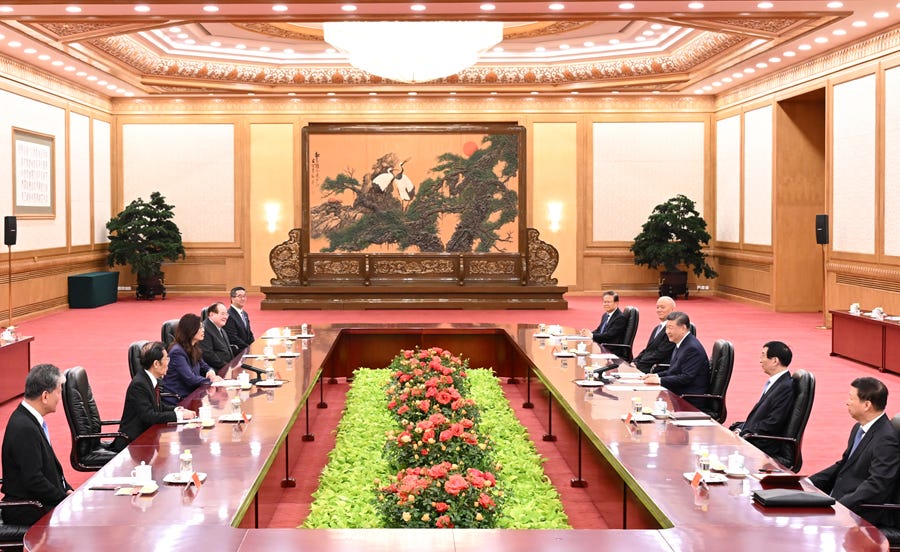
Brian Hioe, a commentator, recently titled his analysis in his co-founded New Bloom on Cheng Li-wun’s visit to the Chinese mainland as Cheng Li-Wun Redefines 1992 Consensus, Calls for United Front Against Independence in Xi Meeting, where Hioe argued (all emphasis below are ours)
Before Cheng’s meeting with Xi, Cheng had already made a major policy address in Nanjing, at Sun Yat-Sen’s Mausoleum. Notably, Cheng advocated commitment to the 1992 Consensus, but this was framed as “One Country, Oppose Taiwanese independence” rather than “One China, respective interpretations.”
Cheng’s shift in her framing of the 1992 Consensus was rapidly noted by analysts in Taiwan. During the comments by Xi Jinping that did, in fact, occur in full view of the media, Xi echoed this framing.
…To this end, Cheng called for the establishment of an institutionalized mechanism for cross-strait exchanges, on the basis of the 1992 Consensus and One China Principle…
As such, it is possible that, with Xi echoing her language on the 1992 Consensus being “One China, Oppose Taiwan Independence,” Cheng has accomplished what previous KMT leaders failed to do. Namely, if such language continues to be used, Cheng may have successfully redefined the 1992 Consensus.
Hioe repeated those assertions several days later in a piece in The Diplomat
Cheng’s comments at the Sun Yat-Sen Mausoleum were also notable because of how she framed the 1992 Consensus. The 1992 Consensus has historically been referred to as the consensus that there is “One China,” with “different interpretations” of that “One China” between the ROC and PRC. In past years, the CCP has been criticized for dropping the “different interpretations” aspect of the 1992 Consensus, to only emphasize “One China.”
Cheng, however, phrased the 1992 Consensus as “One China, oppose Taiwanese independence.”…
Cheng’s meeting with Xi mostly took place behind closed doors. Media heard Xi’s opening remarks – which included framing the 1992 Consensus as “One China, oppose Taiwanese independence”
The problem is Hioe’s central factual claim about what Cheng actually said is not supported by the public record.
On Cheng’s speech at the Sun Yat-Sen Mausoleum in Nanjing, we published the full transcript based on a full videotape and the KMT’s transcript of Cheng’s speech. Not once did “One Country, Oppose Taiwanese independence,” as Hioe alleged in his co-founded New Bloom, or “One China, oppose Taiwanese independence,” as Hioe alleged in The Diplomat, come up in her speech.
In other words, Cheng did not say “One Country, Oppose Taiwanese independence” or “One China, oppose Taiwanese independence” at the Sun Yat-Sen Mausoleum in Nanjing.
On the 1992 Consensus, what she said in Beijing to Xi was, according to the KMT-provided transcript, which hasn’t been disputed:
在堅持九二共識、反對臺獨的共同政治基礎上
On the shared political foundation of adhering to the 1992 Consensus and opposing Taiwan independence
She later went on to explain the content of the 1992 Consensus in full terms:
1992年兩岸雙方授權機構達成各自以口頭聲明方式表達堅持一個中國原則的共識,同時求同存異,成為兩岸協商與聯繫機制的政治基礎。
In 1992, the authorised bodies of both sides reached a consensus that each side would respectively express verbally its adherence to the one-China principle, while seeking common ground and setting aside differences. This became the political foundation for cross-Strait consultation and communication mechanisms.
She also noted:
臺灣曾在九二共識的基礎上,以適當方式參與世界衛生大會、國際民航組織大會,但是得而復失。
On the basis of the 1992 Consensus, Taiwan once participated, in an appropriate capacity, in the World Health Assembly and the International Civil Aviation Organization Assembly, only to lose that opportunity later.
Xi Jinping also did not frame “the 1992 Consensus as ‘One China, oppose Taiwanese independence’,” as Hioe alleged. Xi said, as live video showed [2:24:44-2:24:58]
我们愿在坚守九二共识、反对台独的共同政治基础上
We are willing, on the common political foundation of upholding the 1992 Consensus and opposing Taiwan independence
In the German Marshall Fund of the United States (GMF)’s latest Global China Podcast, Bonnie S. Glaser and Amanda Hsiao, director in Eurasia Group's China practice, had this exchange in a chapter called “Shifting Positions on the 1992 Consensus”
Bonnie S. Glaser
So I’m going to ask you about the 1992 Consensus because I think there’s an interesting, maybe, debate that’s emerging among experts in the immediate aftermath of this meeting.
So, of course, during Ma Ying-jeou’s period in power, the 1992 Consensus was often referred to as “一中各表 One China, respective interpretations”, meaning we Taiwan will call our One China the Republic of China, and the other side is going to call One China the People’s Republic of China. But we just won’t emphasize our differences. We will just say “respective interpretations.”
And Cheng Li-wun, in her definition that she gave to Xi Jinping that was quoted in the public part of the meeting, she quoted, I believe, the definition of the 1992 Consensus that was actually given in 1992, long before the phrase “1992 Consensus” existed. But the understanding that she referred to did not use the phrase “respective interpretations.” It just says “One China.”
Some people are saying that Cheng Li-wun is trying to change the 1992 Consensus to mean “One China and opposition to Taiwan independence.” So she’s not talking about “respective interpretations.” She is emphasizing “One China”, and she may be saying “One China, Opposition to Taiwan Independence,” and not really tying this to either the Republic of China or its constitution.
So do you think that she has this intention, and was this signal sent during the visit?
Amanda Hsiao
I don’t know what Cheng Li-wun’s intentions are or her definition of the 1992 Consensus and whether it deviates from that of her party’s. What I did notice was that in her press conference following the meeting, she said that she reiterated the full content of the 1992 Consensus and she explained very clearly during the talks with Xi what that content was.
Of course, the problem here is that the two sides of the Strait have never—or rather, the KMT and Beijing—have never fully agreed on the exact content of the 1992 Consensus. And so, I do think there is some risk to leaving that to ambiguity.
I don’t think it’s surprising that she didn’t say the words “一中各表” [Zichen’s note: One China, respective interpretations] in this meeting. I highly doubt that the Chinese would have accepted the meeting if she had said it. And I sense that much of the speeches and the engagements were highly coordinated. One had this sense of extreme alignment, let’s say, in messaging, right? So there was a sort of carefulness in how both sides spoke about the more sensitive issues. So I’m not surprised she didn’t say that exact phrase.
This exchange is more nuanced than Hioe’s, in our view baseless, summary. But, with all due respect to Glaser and Hsiao, it’s still highly misleading.
As I have recorded above, the KMT-provided transcript showed Cheng saying
1992年兩岸雙方授權機構達成各自以口頭聲明方式表達堅持一個中國原則的共識,同時求同存異,成為兩岸協商與聯繫機制的政治基礎。
In 1992, the authorised bodies of both sides reached a consensus that each side would respectively express verbally its adherence to the one-China principle, while seeking common ground and setting aside differences. This became the political foundation for cross-Strait consultation and communication mechanisms.
Contrary to what Glaser and Hsiao characterized, Cheng did not just say “One China.” Her 各自 respective(ly) is right there. Importantly, Cheng’s wording 求同存異 seeking common ground and setting aside differences means there are differences between the two sides’ respective adherence to the one-China principle.
Hsiao’s assertion “I highly doubt that the Chinese would have accepted the meeting if she had said it” is hence simply wrong.
Hsiao was correct in observing Cheng, in her televised press briefing after meeting Xi, “said that she reiterated the full content of the 1992 Consensus and she explained very clearly during the talks with Xi what that content was.”
A truly rigorous tea leaves reading into Cheng’s public, if not proud, announcement would require me to circle back to one correct sentence Hioe wrote
the Chinese government has increasingly dropped the “Respective Interpretations” aspect of the 1992 Consensus, to only refer to “One China”–what is also known as the “One China Principle.”
So, in fact, Cheng Li-wun not only made no concession on the 1992 Consensus; she defended the KMT’s own formulation of it directly to Xi Jinping, clearly and to his face.
That is, in no small part, why I bothered to write this piece. Instead of backing down, Cheng succeeded in fostering a friendly atmosphere and then, at the very heart of cross-Strait relations, reaffirmed the KMT’s version of the 1992 Consensus—even though the party, after a decade out of power, holds few cards.
She is a hell of a politician.
Hioe also alleged in his co-founded New Bloom piece
Cheng denied having shifted the contents of the 1992 Consensus from “One Country, Respective Interpretations” to “One Country, Oppose Taiwanese Independence”, suggesting that “enemies of peace” were distorting her words. Cheng went on to state that “Taiwan will lose nothing” in adhering to “One China, oppose Taiwanese Independence.”
Cheng’s words were, as reflected in the KMT press release, available in English in our transcript
關鍵其實很簡單,就是「九二共識、反對台獨」;台灣不必犧牲任何事情,也不必放棄任何事情,就有機會重新開啟交流對話。
It is simply this: the 1992 Consensus and opposition to Taiwan independence. Taiwan has sacrificed nothing, Taiwan has given up nothing
So Hioe himself distorted Cheng’s words.
Well, since I’ve already offended people tonight, I might as well add one more to the list: The Long Handshake: Xi’s Quiet Grip on Taiwan’s Soul, the latest WSJ China newsletter
The last time a leader from this camp sat across from Xi, back in 2015, the vibe was one of cautious parity—a meeting of equals held on the neutral turf of a Singapore hotel. Back then, Xi and the KMT leader, Ma Ying-jeou, even swapped their official titles for a simple, mutual “Mister” to maintain the appearance of balance.
A decade later, the power balance has changed as much as the scenery.
Cheng’s trip had every look of a pilgrimage to the imperial heart of Beijing. There were no neutral hotels or balanced protocols this time. Instead, Cheng was received beneath the high, gilded ceilings of the Great Hall, framed by the rigid hierarchy of the Chinese state.
The last time a leader from KMT meeting Xi was not in 2015. It was 2016 between then KMT chair Hung Hsiu-chu and Xi.
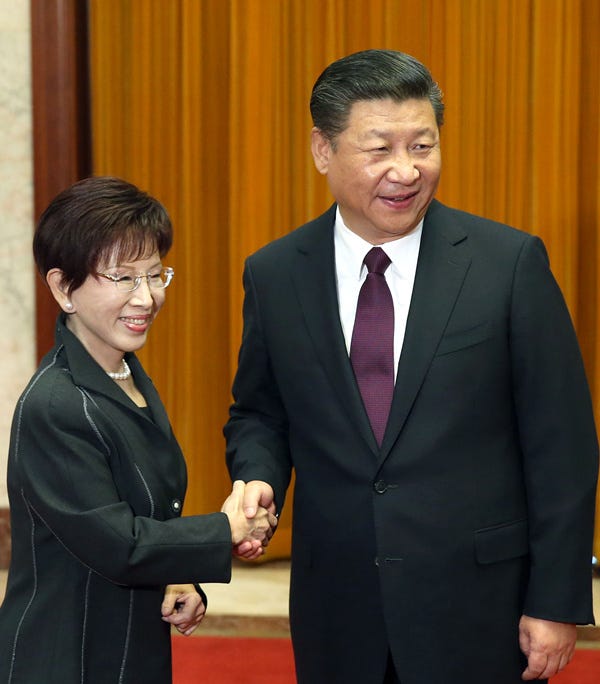
When Ma Ying-jeou met Xi Jinping in Singapore in 2015, then KMT leader was Eric Li-luan Chu, who never met Xi.
The meeting between Ma and Xi took place in Singapore with under the title of “Mister” was because at the time Ma’s official title was the President of the Republic of China, and Xi was the President of the People’s Republic of China. They were not there as the respective top leaders of their respective political parties.
This time, Cheng and Xi were meeting as party leaders.
Lastly, let’s get back to the 1992 Consensus that Cheng said to Xi
1992年兩岸雙方授權機構達成各自以口頭聲明方式表達堅持一個中國原則的共識,同時求同存異
In 1992, the authorised bodies of both sides reached a consensus that each side would respectively express verbally its adherence to the one-China principle, while seeking common ground and setting aside differences.
Many people do not actually understand what “seeking common ground while setting aside differences” means in this context. It is often treated as a vague and generic slogan, as if it simply meant being flexible or agreeing to disagree. But here it has a much more concrete and substantive meaning.
The “common ground” is that both sides adhere to one China. The “differences” are over what exactly “one China” means. In other words, the phrase points to a very specific political arrangement: affirming a shared one-China position while leaving the two sides’ differing interpretations unresolved.
Zhang Ronggong, a former KMT vice chairman, offered a clear explanation after accompanying Cheng to Beijing:
It was always about seeking common ground while setting aside differences. When the 1992 Consensus was reached, it was Taiwan that proactively offered this formulation to the mainland: “Both sides of the Strait adhere to the one-China principle, but they differ in their understanding and interpretation of what ‘one China’ means.” That was our own proposal. That is precisely what it means to seek common ground while setting aside differences.
The “common ground” is the “one-China principle”; the “differences” concern the meaning of “one China.” We then set those differences aside.
If Taiwan rejects the common ground and keeps wrangling over the differences, then cross-Strait relations become a matter of political confrontation. That is exactly the situation we are in now. That is why the Kuomintang must step forward to help avert a crisis in the Taiwan Strait.

Excellent corrective. Thanks
Thank you for the research on this!