

One of the most consequential outcomes of Chinese President Xi Jinping’s state visit to Washington last week was an agreement between China and the United States to pursue a dialogue on artificial intelligence risks and benefits in November, together with a channel for communicating about AI-related incidents.
Both governments announced the agreement.
In its eight-point consensus on Xi’s visit, China said:
The two sides agree on the establishment of the China-U.S. AI Dialogue to exchange views on risks and benefits related to AI. The next exchange will occur in November 2026. China and the U.S. also agree to establish a bilateral communication channel for AI incidents.
The White House fact sheet said
The two countries established the U.S.-China Super Intelligence (SI) Dialogue to exchange views on risks and benefits related to SI. The next exchange will occur by November 2026. The United States and China also agreed to establish a bilateral communication channel for SI incidents.
(Let’s not dwell on the different terminology here: Beijing calls it “artificial intelligence,” while the White House uses “super intelligence.”)
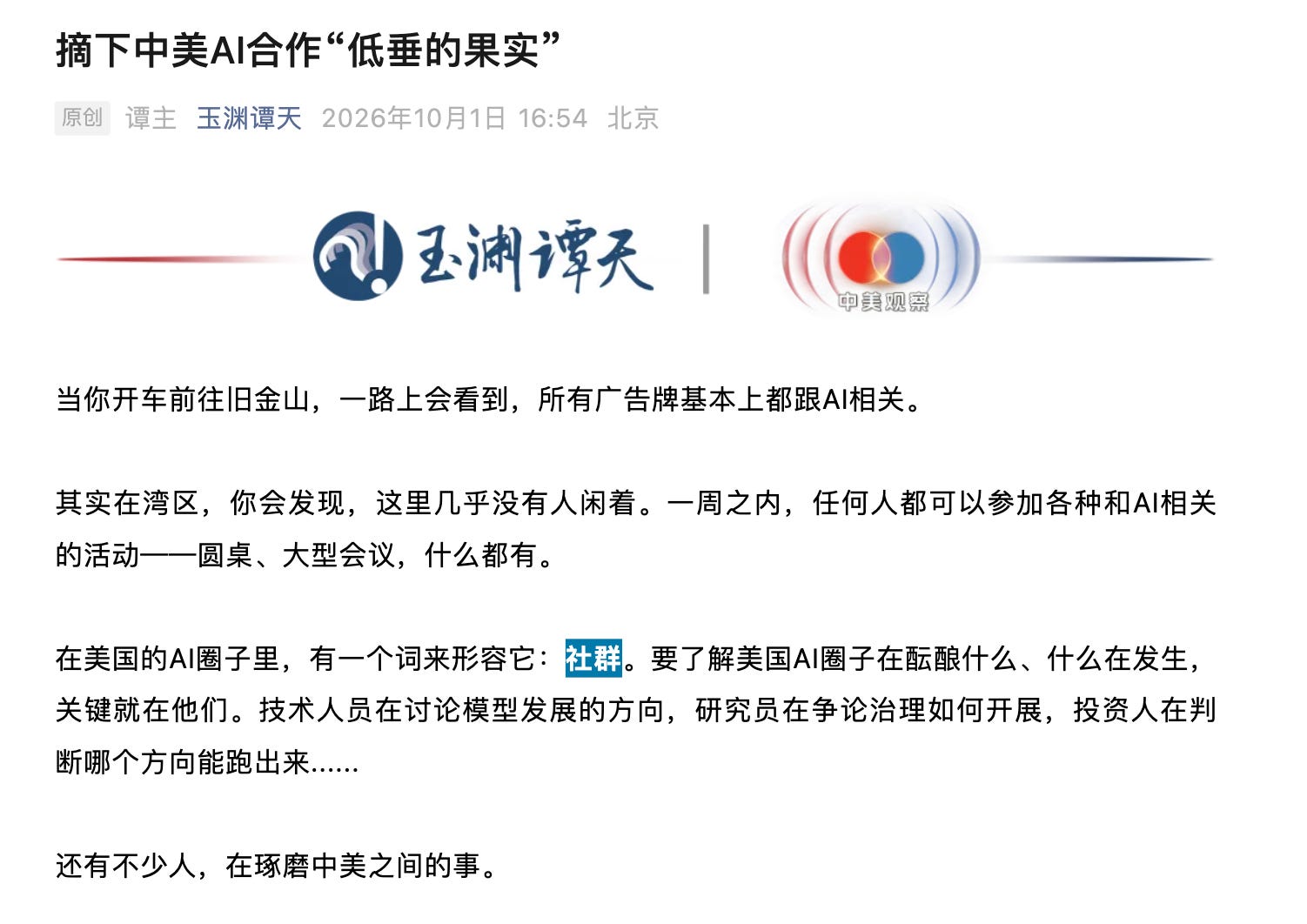
Today/Thusrday, October 1st, the first day of China’s weeklong national holiday, Yuyuantantian, run by China’s central state broadcaster, published an article that offers some clues.
Why Yuyuantantian is worth watching in this case
Yuyuantantian is a new-media publication operated by China Media Group, China’s central state broadcaster.
It has also repeatedly surfaced information related to Chinese policy and negotiations before or beyond what appears in conventional official statements.
In this particular case, Yuyuantantian cites people involved in the Chinese side of the AI negotiations with the U.S.
In moments like this, it sometimes performs a function not unlike that of major U.S. media outlets citing anonymous officials to disclose what happened behind closed doors, test ideas, or prepare the ground for the next stage of policy. What is harder to understand is why the Chinese government continues to rely on a Chinese-language outlet, publishing first on Chinese social media and writing in a format tailored to domestic social-media consumption, to send policy signals that are clearly relevant to foreign audiences. The result is often difficult for outsiders to parse even when the underlying information is important. The fact that “Yuyuantantian” itself is a mouthful for non-Chinese readers only makes the choice more puzzling. As a vehicle for signaling Chinese policy to the outside world, it is hard to imagine a less user-friendly choice.
Complaint over. Back to the substance.
That Chinese negotiation source told Yuyuantantian:
“中方谈判相关人士告诉谭主,这次由于时间十分紧张,中美两国主要表达了各自的态度、关心的问题等,并计划在下次11月的对话中推进具体问题。”
People involved in the negotiations on the Chinese side told Yuyuantantian that, because time was extremely limited this time, China and the United States mainly set out their respective positions and concerns, and plan to move forward on specific issues at the next round of dialogue in November.
The “low-hanging fruit”
Yuyuantantian uses an interesting phrase for some of the issues that could now move forward: “low-hanging fruit.”
It specifically identifies two examples.
One is the AI-incident communication channel already announced by the two governments.
The other is
防止最危险的能力被滥用,包括确保AI不被恐怖组织利用等。
prevent the most dangerous AI capabilities from being misused, including preventing AI from being exploited by terrorist organizations
Yuyuantantian qualifies these as
不是最宏大的目标,而是那些中美双方已经有专业层面的共识、相对成熟的合作点。
They are not the most ambitious goals, but rather areas of cooperation where China and the United States already have some professional-level consensus and where the groundwork is relatively mature.
But the two sides may not even mean the same thing by “AI risk”
The second major point in the article is that apparently similar concepts can mean different things in Chinese and American policy discussions.
It cites a Chinese framework developed by the National Technical Committee 260 on Cybersecurity that separates risks into three broad categories:
“技术内生安全风险”“技术应用安全风险”“应用衍生安全风险”
risks intrinsic to the technology, risks arising from its application, and risks derived from broader uses of AI.
For contrast, it points to MIT’s AI Risk Initiative’s Domain Taxonomy of AI Risks:
discrimination and toxicity; privacy and security; misinformation; malicious actors and misuse; human-computer interaction; socioeconomic and environmental harms; and AI-system safety, failures and limitations.
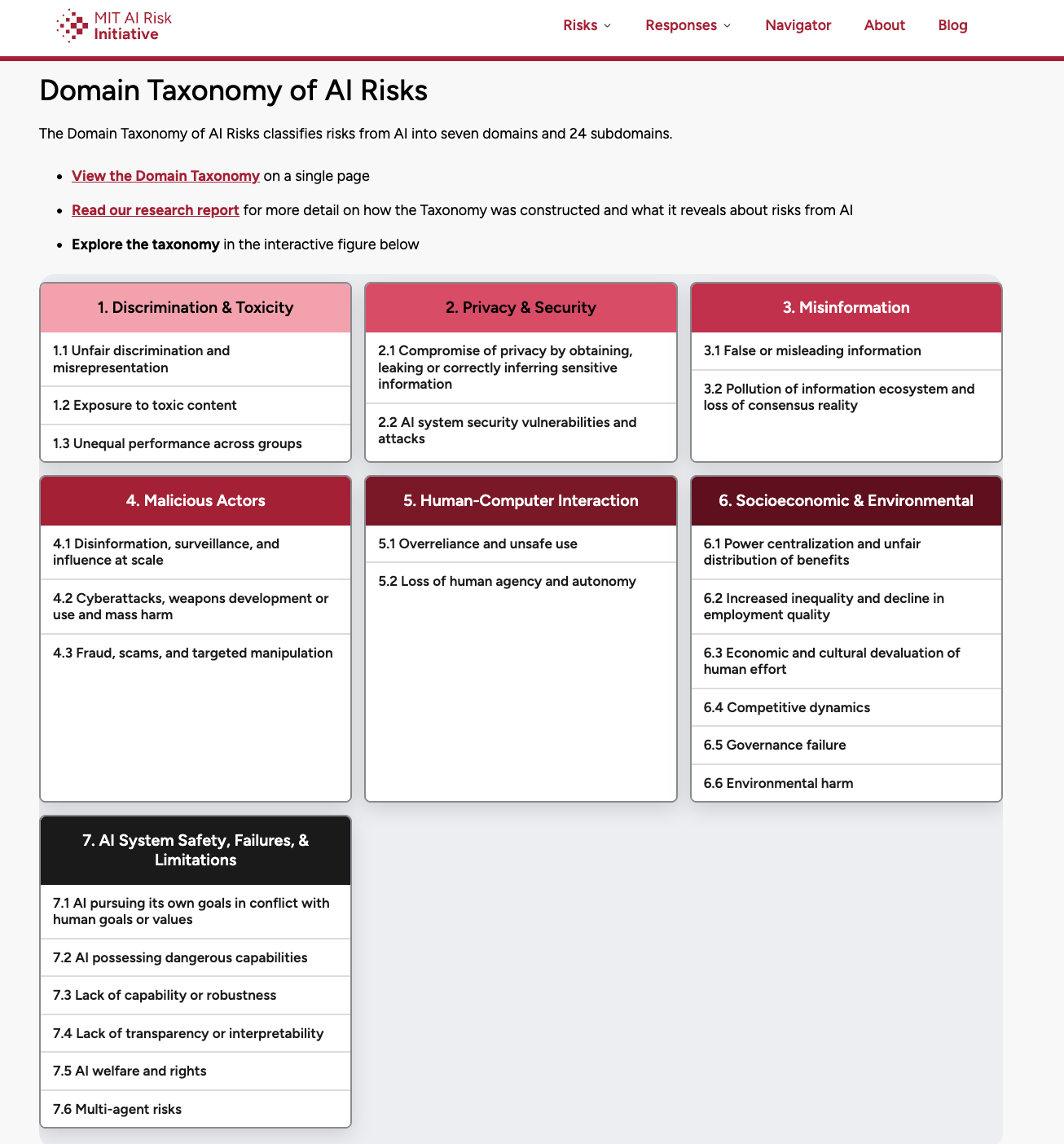
The MIT taxonomy is, of course, an academic framework rather than an official U.S. government classification. But Yuyuantantian uses the comparison to make a broader point: if the two countries classify risks differently, they may also mean different things when they talk about a “major risk.”
Its characterization is that
美方关心AI是否会给人类社会带来毁灭性灾难,而中方关心AI在实际使用中产生的具体风险。
American AI-safety discussions pay relatively greater attention to catastrophic scenarios, while Chinese discussions tend to focus more on specific risks that emerge when AI is actually deployed.
Three things the two sides could actually work on according to Yuyuantantian
From there, Yuyuantantian identifies three concrete directions for the dialogue.
More specifically, there are at least three practical areas in which progress could be made.
First, jointly explore standards for classifying and grading AI risks.
The two sides first need to clarify some fundamental questions: What kinds of situations should count as major risks? What kinds of model behavior would constitute a serious loss of control? These may seem like basic questions, but they are a prerequisite for discussing more complex rules later on. If the two sides do not even share a common definition of “major risk,” further coordination will have no foundation.
Second, determine the scope, procedures, and requirements for reporting AI-risk incidents.
If a model loses control or an escape incident occurs, both China and the United States need to understand what has happened as quickly as possible and assess the level of risk. The agreement to establish a communication channel for AI incidents is a first step toward filling this gap. But such a mechanism cannot remain merely a verbal commitment. There need to be clear requirements governing which incidents must be reported, how quickly notification must take place, what information should be shared, and what consequences should follow if reporting obligations are not fulfilled.
Without a notification mechanism, it is impossible to build a record of risk incidents. And without an accumulated body of cases, it is difficult to understand how risks evolve over time, making effective risk management impossible.
Third, place AI governance within a broader framework of U.S.-China exchanges.
Discussions on artificial intelligence should allow for meaningful Chinese participation and ensure that the voices of more countries are heard. AI models may affect public safety, while deepfakes may undermine social trust. Ultimately, the consequences will be borne by society as a whole.
This may sound ambitious, but there are concrete ways to move it forward. In a conversation with California State Senator Jerry McNerney, Yuyuantantian says McNerney suggested that cooperation at the U.S. federal level might move slowly, but California could take the lead by experimenting first, building mutual trust and an institutional framework, and then gradually expanding the approach more broadly.
The third point is noticeably more vague than the first two: it is much less clear what concrete implementation would look like, even if the underlying idea may still be substantive.
Taken together, these proposals give us a somewhat clearer picture of what China wants the “AI dialogue” could mean in practice, if Yuyuantantian is indeed sending a signal here. (Looks like it is.)
This is also about China’s voice in writing global AI rules
Yuyuantantian makes another point: for China, this is not only a bilateral negotiation with the United States over how to manage AI risks. It is also about gaining a greater Chinese voice in the emerging global rules and standards governing AI.
The article argues that much of the existing AI-safety conversation in the United States and Europe takes place without sufficient Chinese participation, even though China itself is frequently a subject of those discussions.
Here is a translation of the relevant passage:
Yuyuantantian has learned that the European and American AI-safety community is a highly elite and relatively Western-centric circle, with relatively few participants from other countries. Even though Chinese large language models have established a place for themselves globally, Chinese participation in this community remains seriously inadequate, and there is also little discussion of the Global South. The problem is that, even when no Chinese participants or Chinese companies are present, discussions of AI governance often cannot avoid issues related to China.
This raises a more fundamental question: Who gets to make the rules?
If global AI standards are formulated under U.S. leadership without Chinese participation throughout the process, the resulting governance rules will have difficulty gaining broad acceptance and will also be difficult to implement globally. China and the United States are two leading powers in artificial intelligence, and both should accordingly have a voice in the formulation of rules and standards.
So, from the perspective presented in the article, the new U.S.-China dialogue serves another purpose beyond finding practical areas of AI-safety cooperation. It gives China a channel into a global AI-governance conversation that Beijing believes is currently too Western-centric and in which Chinese voices remain underrepresented.
Put differently, Beijing does not want Washington—or the existing U.S.- and European-centered AI-safety community—to define the concepts, standards and rules first and then ask China to accept them. It wants China to participate in writing those rules from the beginning.
One thing the article does not say
There is one omission that I find particularly interesting.
The article does not say that Washington must relax restrictions on advanced chips or other technology exports before China engages in the AI dialogue. Nor does it frame the new AI dialogue as leverage through which China should obtain such concessions.
That is noteworthy because a rather different view of China’s position has become widespread in parts of the American discourse.
In May, The Economist reported, citing people familiar with the 2024 U.S.-China AI talks in Geneva, that China had sent political officials who declined to engage on AI safety unless Washington removed controls on advanced chips.
Last week, the South China Morning Post reported that former Biden administration officials said Chinese officials in Geneva had tied progress on AI safety to unwinding U.S. export controls.
Seth Center, who co-led the 2024 dialogue for the Biden administration’s State Department, offered an even more skeptical interpretation in a September 16 New York Times guest essay.
In this month’s meetings, I expect China to again downplay safety risks. It could dangle the possibility of safety cooperation in exchange for concessions such as the softening of chip controls.
I’m not saying semiconductor restrictions have somehow ceased to matter for China in the broader U.S.-China relationship, or that Beijing has stopped opposing U.S. export controls on advanced chips and other high technologies. It plainly has not. My point is much narrower: this policy-signaling article does not mention those controls at all, let alone present their removal as a condition for China’s participation in the next AI dialogue.
Last but not least, the Yuyuantantian article identifies Xiao Qian, Deputy Director, Centre of International Security and Strategy (CISS), Tsinghua University, as “one of the key figures in U.S.-China Track Two dialogues” on AI 中美二轨对话的核心人物之一. (Enditem)

Why would you assume Yu Yuan Tan Tian is“a vehicle for signaling Chinese policy to the outside world”?