


In China’s debate over how to revive domestic demand, many mainstream economists emphasized in recent years that if the government is going to spend more to support consumption, a substantial share of that support should go to lower-income groups — and particularly to rural residents and the hundreds of millions of migrant workers who have moved from the countryside to the cities.
These arguments are usually presented today as solutions to an economic problem: China consumes too little, household incomes account for too small a share of national income, and strengthening the purchasing power and social security of rural and migrant populations would help rebalance the economy.
But there is another way to understand the same debate. It is also about an old bill that has never been fully settled.
The disadvantages faced by China’s rural migrants are often discussed today in terms of the household-registration system, unequal access to schools, healthcare and other urban public services, children left behind in the countryside, or the social discrimination migrant workers still encounter. These are important. But they can obscure how much harsher the institutional divide was only a generation ago.
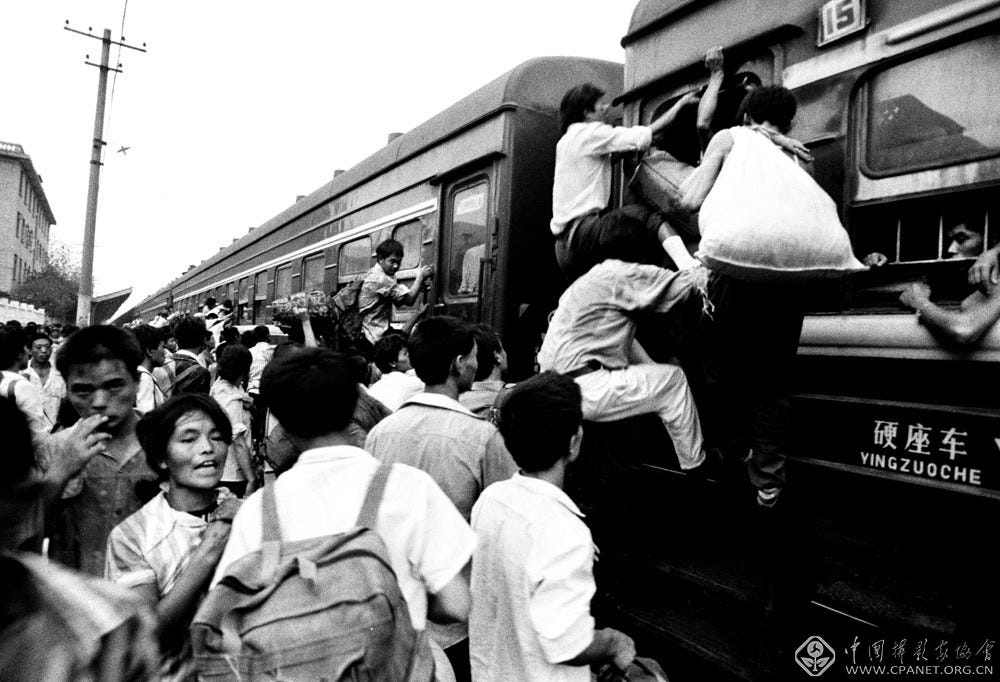
For much of the 1990s and into the early 2000s, the unequal treatment of rural migrants was not merely the indirect consequence of an uneven welfare system. It was written directly into government rules. Rural residents could be required to obtain official permission before leaving home to work. Cities restricted the occupations they were allowed to enter. Employers needed approval to hire them and sometimes had to pay special fees for doing so. People found in cities without the required identity, residence and employment papers could be detained and forcibly sent back to their hometowns. In practice, many were confined, stripped of their belongings and compelled to labour briefly before being released.
These restrictions have ince disappeared. For younger Chinese today, the ability to leave one’s hometown, take a job hundreds or thousands of kilometres away and move through a city without carrying a special employment permit is so ordinary that the opposite can be difficult to imagine. Yet the most abusive elements of this system were dismantled only in the early 2000s, and discriminatory employment restrictions persisted for several years after that.
The essay translated below is therefore more than a history of an obsolete policy. It is a record of one particularly heavy chapter in China’s treatment of its rural population — and part of the historical background to why some of the country’s most prominent economists now speak, quite literally, of a debt that remains to be repaid.
Its author, Zhao Shukai (赵树凯; b. 1959) is a Chinese official of rural policy and governance. From 1982 to 1989, he worked at the Rural Policy Research Office of the Communist Party of China (CPC) Central Committee’s Secretariat. Starting in 1990, he served at the Development Research Center of the State Council, holding roles including the Director General of its Information Center.
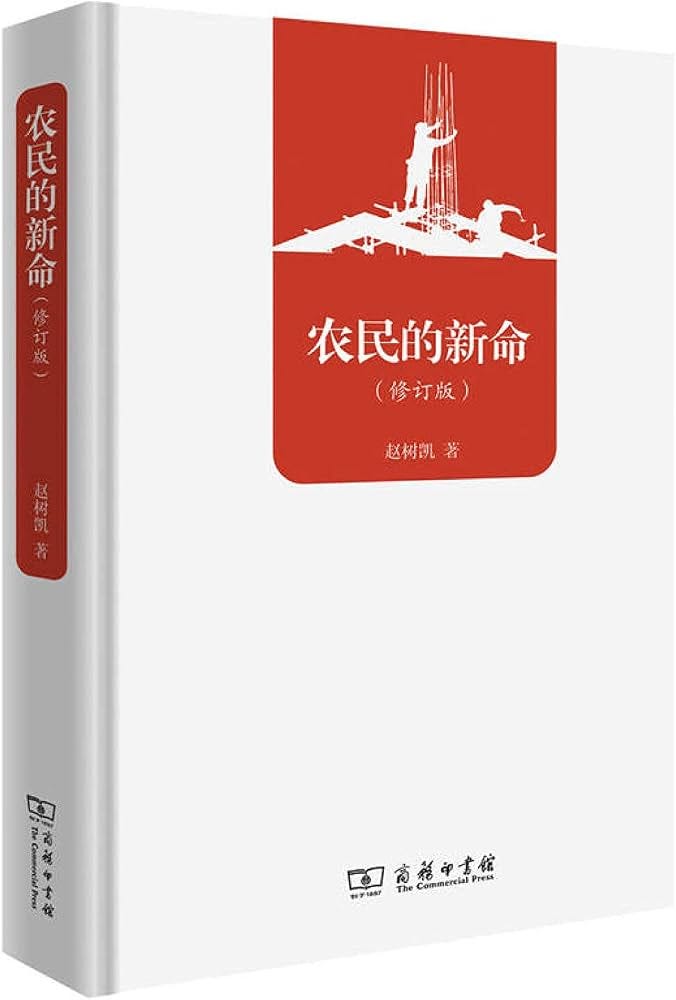
The essay originally appeared in the revised edition of Zhao Shukai’s 农民的新命 The New Fate of Chinese Farmers, published by the Commercial Press in August 2018. It is also available on the WeChat blog 九号院时刻 (No. 9 Courtyard Moment).
— Yuxuan Jia
赵树凯:民工潮中的“苛政”
Zhao Shukai: Oppressive Policies in China’s Migrant-Worker Wave
China’s “migrant-worker wave” first broke in the spring of 1989. After the Spring Festival that year, people suddenly began to notice rural migrants in vast numbers at railway stations, ferry terminals, on city streets, and elsewhere. The media, caught off guard, reported on the phenomenon extensively. Senior officials were equally surprised and somewhat unsure how to respond.
Why did the wave appear so suddenly? The usual explanation is that after 1987, the government adopted macroeconomic measures to cool an overheating economy and launched a programme of retrenchment and consolidation. As a result, many of the township and village enterprises that had sprung up over the previous four or five years were closed down or went bankrupt. Deprived of jobs close to home, large numbers of rural residents left in search of opportunities elsewhere.
What economic and social consequences would this sudden influx bring? Did it carry the risk of social crisis—or even political crisis? At the extreme, some compared these migrant workers to the displaced and itinerant populations of imperial times, arguing that they might directly threaten the stability of the regime, as bands of uprooted peasants had done in rebellions throughout Chinese history.
From 1995 to 2003, the central thrust of government policy was to restrict the movement of rural migrant workers.
In November 1994, the Ministry of Labour issued the Interim Provisions on the Administration of Interprovincial Employment of Rural Labour (Ministry of Labor Document [1994] No. 458). The rules first curtailed employers’ freedom to hire: “Employers shall not, as a general rule, directly recruit rural workers from other provinces at the place of employment.” Employers could recruit across provincial boundaries only when the local labour supply was insufficient. Even then, they had either to send staff to recruit workers where they lived or to entrust recruitment to an employment agency — for example, one run by the labour authorities in the workers’ place of household registration. When recruiting, employers also had to submit required documents to the labour and employment service agency in the workers’ home area and operate under the supervision of the labour authorities there.
More importantly, the rules directly restricted rural residents’ freedom to leave home in search of work:
“Before leaving home, rural workers recruited across provincial boundaries must present their identity cards and other necessary documents, register with the labour and employment service agency in the place of their household registration, and obtain an Employment Registration Card for Persons Leaving Home to Work. On arrival at the employing organisation, they must use their Employment Registration Card to obtain an Employment Permit for Nonlocal Workers from the local labour authorities. The permit and the card are valid only when presented together. Collectively known as the Migrant Employment Permit, they constitute valid documentation for employment away from one’s place of residence.”
On this basis, governments in a number of economically developed regions, especially major cities such as Beijing, Shanghai, and Guangzhou, introduced restrictions on the industries and occupations open to migrant workers. The guiding principle was that local firms could hire rural migrants only for dirty, unpleasant, undesirable, or dangerous work, not for jobs considered even modestly respectable. Star-rated hotels, for example, were generally prohibited from hiring rural migrants, even as waiters or other service staff. The finance and insurance industries were barred from employing them altogether. In some places, rural migrants could not even work as security guards.
Employers wishing to hire migrant workers needed administrative approval, faced restrictions on the kinds of jobs they could offer, and had to pay special charges for employing rural workers from elsewhere. Put simply, rural people coming to the cities were confined to jobs that urban residents did not want, while urban businesses had to pay a special management fee for hiring them.
Had these employment restrictions remained ordinary economic policy, they might not have caused rural people such serious harm. A system requiring every employer to seek government approval before hiring and every rural resident to obtain government documents before leaving home to work was simply too cumbersome to function in practice. An unreasonable policy does relatively little damage when it cannot be enforced.
The real danger was that the agencies responsible for enforcement revived the State Council’s 1982 Measures for Internment and Deportation of Urban Vagrants and Beggars and applied them broadly to rural migrant workers. The measures had originally targeted “beggars and other destitute people sleeping on the streets,” but were now extended to migrant workers. In 1991, the State Council issued its Opinions on Reforming Urban Deportation, expanding the system to cover members of the migrant population who lacked any of the “three documents”: an identity card, a temporary residence permit, and a work permit. What had begun as restrictions on rural labour mobility evolved into a coercive enforcement apparatus, led by the public security authorities and supported by the civil affairs and labour departments, whose purpose was to suppress the movement of rural people.
Fees and fines supplied the main impetus behind this enforcement system. The compulsory internment and deportation of migrant workers became an important source of revenue for public security, civil affairs, and labour departments. At a time when government administration was poorly regulated and public financial systems were underdeveloped, this income helped government agencies buy vehicles, construct offices, and provide staff benefits. It also became a means for many officials to enrich themselves.
In those years, vast numbers of rural migrants were forcibly detained and sent home. In practice, detainees were treated much like prisoners. Their money and belongings were often confiscated. They were then confined in deportation centres much like detention centres — police-run facilities in China that hold suspects and defendants during criminal proceedings — and forced to work for two or three weeks, sometimes longer. In return for this forced labour, they received a ticket back to their hometown.
For more than a decade, the system of internment and deportation operated alongside restrictions on rural labour mobility. The total number of migrant workers detained and forcibly sent home nationwide was never disclosed. Surveys conducted by my research team found that Shanghai, Beijing and Guangzhou each detained and deported more than 100,000 people a year. Shanghai crossed that threshold as early as 1993, while Beijing detained more than 150,000 people in 1999. The scale was greater still in the Pearl River and Yangtze River deltas.
The detainees included not only people who lacked one or more of the “three documents,” but also many who had all three. Nor was detention confined to people officially classified as “peasants”. University graduates, technical professionals, and government officials were also swept up. During my fieldwork, I even met a division-level official from a central government agency who had been detained as a migrant worker.
The detention process was brutal and arbitrary. Those taken into custody were usually forbidden to make a telephone call or contact anyone outside. After arriving at a deportation centre, they had two or three days to reach someone who could pay the fine and secure their release. If no one paid, they were sent away to perform forced labour. In this policy environment, the public security, labour, civil affairs, and other enforcement agencies had powerful incentives — both institutional and individual — to perpetuate the system. For several years, its abuses ran rampant. Then, in the spring of 2003, the death of Sun Zhigang became a major turning point.
Sun Zhigang was a twenty-seven-year-old university graduate employed in a technical position at a company in Guangzhou. On 17 March, 2003, he was detained while out on an errand. He was taken first to a police station, then to the Guangzhou Internment and Deportation Transit Centre, and finally to a medical station for detainees. He was beaten repeatedly in custody and died three days later. When the media exposed what had happened, the case provoked a public outcry. It drew intense attention within the government and across society, especially among intellectuals.
Some legal scholars argued that the discriminatory restrictions imposed on migrant workers were not merely unjust but unconstitutional. Their central criticism was that under the Legislation Law, coercive measures restricting citizens’ personal liberty could be established only by laws formally enacted by the legislature. Administrative bodies had no authority to create such restrictions through administrative regulations. In effect, the internment-and-deportation system violated citizens’ personal liberty by presuming them guilty. A number of intellectuals petitioned the Standing Committee of the National People’s Congress to conduct a constitutional review of the system. Three months after Sun Zhigang’s death, amid this mounting pressure, Premier Wen Jiabao signed State Council Decree No. 381, repealing the Measures for Internment and Deportation of Urban Vagrants and Beggars.
From the early 1990s onward, there had been fierce debate within the government over the policies and administrative methods applied to migrant workers, especially the restrictions on rural workers seeking urban employment introduced by the Ministry of Labour in 1994. Senior leaders themselves disagreed. Yet discriminatory restrictions ultimately became the dominant approach.
The competing positions on rural policy fell into two clear camps: one oriented toward the countryside, the other toward the cities. On employment, for example, those in the urban camp argued that jobs for city residents could not be protected unless rural people were kept out. This view gained particular force in the mid-to-late 1990s, after large numbers of state-owned enterprise workers were laid off or lost their jobs.
For a time, those of us who studied rural affairs devoted considerable effort to examining the relationship between rural migration and urban employment. We concluded that rural migration did not, in a fundamental sense, cause urban unemployment. On the contrary, it helped urban economies flourish and increased their capacity to create jobs. Even where rural and urban workers did compete for certain positions, there was no justification for using policy and institutions to discriminate against rural people or restrict their entry into the cities — much less to violate their personal liberty.
At the time, some government departments tried to elevate restrictions on rural residents seeking urban employment, such as the requirement that migrants obtain employment permits and registration cards, into State Council policy. This led to open disagreement between policy research bodies and administrative agencies.
In March 1994, I wrote a report for State Council leaders in which I sharply criticised the Ministry of Labour’s employment permit and registration card system. We knew at the time that the ministry’s policy had the backing of certain State Council leaders. Our position, however, found support at the People’s Daily. On 9 July 1995, the newspaper devoted more than half a page to my research report, “Rural Migration and Government Administration.” I had not submitted the piece for publication; the head of the newspaper’s Rural Affairs Department had seen my report and arranged to run it. Reports of this kind were usually submitted to the State Council, with copies sent to the People’s Daily, Xinhua News Agency, and other organisations.
An official at the People’s Daily later told me: “We agree with you and oppose the Ministry of Labour’s approach. But the ministry’s position was approved by State Council leaders, so we softened some of your sharper language before publication and made the criticism less forceful.”
After the Ministry of Labour introduced its restrictions on migrant workers in late 1994, I conducted field research in Shanghai, southern Jiangsu, Guangdong, and elsewhere. In Beijing, I accompanied migrant workers to a provincial liaison office to obtain migrant employment cards. The cards were about the size of a business card and cost eighty yuan apiece: you handed over the money and were given a card.
In mid-January 1995, after returning from fieldwork in Xiayi County, Henan Province, I telephoned the office of Jiang Chunyun, then the Politburo member responsible for agriculture and soon to be appointed vice-premier, to ask for an opportunity to brief him. A few evenings later, Jiang received me and spoke with me for an hour. I strongly criticised the Ministry of Labour’s rules, arguing that they seriously discriminated against rural people and had created widespread social conflict. Jiang oversaw agricultural affairs; the Ministry of Labour came under the authority of another vice-premier.
The year 2003 saw not only the nationwide rollout of agricultural tax reform, but also a fundamental reversal in policy towards migrant workers. The defining moment came in January with Document No. 1 of the General Office of the State Council (State Council General Office Document [2003] No. 1). Technically, this was only a document issued by the State Council’s General Office, rather than by the State Council itself or the Party Central Committee. Yet in its historical significance and its role in signalling a major change in policy, it stands comparison with the Party Central Committee’s No. 1 documents of the 1980s.
Entitled the “Notice on Strengthening the Management and Services for the Employment of Rural Migrant Workers”, the document centred on removing unreasonable restrictions on rural people seeking urban employment. It required:
“All regions and relevant departments should abolish administrative approval requirements for enterprises hiring migrant workers, eliminate restrictions on the occupations in which rural migrants may work in cities, and refrain from interfering with enterprises’ lawful autonomy in hiring migrant workers. Procedures governing rural migrants’ employment in cities should be rigorously reviewed and streamlined.
“Registration requirements created specifically for migrant workers must be abolished, and a system of administration based on a single temporary residence permit should gradually be introduced. Technical qualifications, health standards, and other requirements imposed by various industries and occupations, especially specialised ones, must apply equally to migrant workers and urban residents.
“When processing the paperwork for rural migrants seeking employment in cities or for enterprises hiring workers, no fees may be charged other than the cost of producing documents, as authorised under relevant State Council regulations. It is strictly forbidden to introduce administrative or institutional charges targeting migrant workers without proper authority, or to raise existing charges. Price-control and finance departments at every level must carry out rigorous inspections and ensure compliance, so that arbitrary charges against migrant workers do not continue in disguised form.
“The Measures for Internment and Deportation of Urban Vagrants and Beggars must be strictly observed. Migrant workers must not be added to the categories of people subject to deportation, and under no circumstances may they be forcibly repatriated or arbitrarily detained for investigation.”
This document marked a fundamental change in the direction of policy towards migrant workers, but the reality was not so simple. Both internment and deportation and the migrant employment permit system were bound up with deep and complex bureaucratic interests. While the abuses of internment and deportation occurred mainly in cities and other migrant destinations, the permit-and-card system, by contrast, reached into both city and countryside, and involved developed and less-developed regions alike. Resistance to dismantling it was therefore even stronger.
Once the document had been issued, the Ministry of Labour’s restrictive rules were on the defensive in policy and in the court of public opinion. In practice, however, they continued to be enforced. It was not until after 2006 that these discriminatory restrictions were largely abolished.

Wang Ou: Migrant workers, after the honeymoon

A young woman who once described her cheery days in Shenzhen later sits on a doorstep in a Guangxi village, exhausted, saying the happiest and brightest days of her life are behind her. Mothers leave before dawn while children are still asleep, or ask grandparents to take them out so they will not see the goodbye, dreading the day they return and the ch…
4:30 A.M. at a day labour market in China, a drink to start a day’s toil

China’s informal labour markets are fleeting theatres of toil—unmarked spaces that spring to life before dawn and vanish by the break of day, playing out daily in nearly every major city, from Shanghai to Hefei. In Guiyang, the capital of the mountainous, landlocked province of Guizhou, one such stage comes alive at 4:30 a.m. A stretch of bare concrete …
Giving immigrant workers urban identities: what can be done?

I believe it’s never too quick to grant permanent urban residency to migrant population. The current institutional impediments casts tremendous impacts on migrant families and their children, and every step to a better system is a step to better livelihoods and opportunities.
Liu Shijin Makes a Forceful Case for Raising Rural Pensions

Liu Shijin is a former Vice President (Vice Minister) of the Development Research Centre (DRC), a comprehensive policy research and consulting institution directly under the State Council, the central government of the People’s Republic of China. In recent years, he has been one of the most senior voices urging Beijing to raise the meagre pensions paid …
Chinese countryside’s quieter strains

China’s high-end industries keep chalking up technical breakthroughs. But one Spring Festival trip back to the countryside suggests that, at least in some parts of the country, many people are still waiting to feel the benefits. In a personal homecoming essay, the author describes a local economy where casual work has dried up, wages feel under pressure…


Interesting perspective. It is as if the rural Chinese workers (with their Hukou system) were treated like the immigrants (legal and illegal) from Mexico and Central America into the US. Policies are ambiguous and ever changing over a couple of decades.
Yuxuan, “an old bill that has never been fully settled” gives the history its economic meaning. An NBS survey estimated that 130.92 million migrant workers were living in urban areas at year-end 2025. In May 2026, the State Council set out an implementation framework to provide basic public services based on usual residence and gradually reduce hukou-linked barriers, explicitly connecting the reform to releasing domestic demand.
The worker moved long before the public-service obligation reliably followed. The policy calls for relevant transfers to take resident population into account and encourages provincial transfers to strengthen support for population-inflow areas. What fiscal rule would make the money follow the worker?