


China’s economy may be entering a mild but durable recovery, according to two economists at the China Finance 40 Forum (CF40), who argue that the long property-led downturn and industrial overcapacity are beginning to clear, allowing growth to stabilise even without a large-scale stimulus push.

The two economists are:
GUO Kai, Executive President and Senior Fellow of the CF40. Before joining the CF40, he was an economist at the International Monetary Fund in Washington DC and then worked at the People’s Bank of China in various capacities, including in the Monetary Policy Department and the International Department. His main research areas include the Chinese economy and its macroeconomic policies as well as international finance. He is the author of three popular Chinese economics books and multiple academic papers in various English and Chinese journals. He holds a PhD degree in economics from Harvard University.
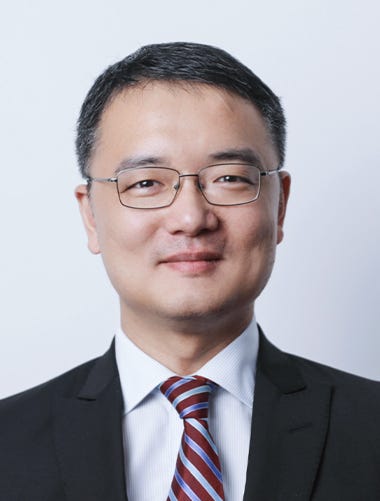
ZHU He, Research Fellow at the CF40. With over ten years of experience in macroeconomic research, Zhu He specializes in tracking domestic and international macroeconomic trends and capital market dynamics. He provides unique insights into economic policy and asset allocation strategies and is a key contributor to CF40’s Macroeconomic Policy Quarterly Report, which has gained significant attention from the market and policymakers. He holds a PhD in Economics from the Chinese Academy of Social Sciences and a postdoctoral degree from Peking University.

Founded in 2008, China Finance 40 Forum (CF40) is a leading independent think tank focused on policy research in macroeconomics and finance. Its core membership consists of 40 leading experts from government, financial institutions and academia around the age of 40. In 2021, the CF40 Institute was established to strengthen CF40’s research capacity. In 2024, the CF40 Institute introduced an original research product, CF40 Research, aimed at providing independent insights into China’s macroeconomy, policy trends, financial market dynamics, and global affairs. CF40 Research currently features English product series, including Policy Brief, Commentary, and Podcast.

The following conversation, first aired on a Chinese-language CF40 Research podcast, was published in transcript form on 7 April via the official WeChat blog of CF40 Research.
对话郭凯、朱鹤:中国经济,复苏了吗?
Guo Kai and Zhu He: Is China’s Economy Recovering?
As 2026 begins, sharply divergent views are emerging over how to read the true trajectory of China’s economy. Some point to improving indicators: the CPI and PPI are showing signs of stabilising and edging up, and the RMB has entered an appreciation cycle. Others argue that the property market is still declining, household income growth remains weak, and the foundations of recovery are far from secure. So what is really going on?
In the latest episode of the China Finance 40 Forum (CF40) podcast “WitTalk 研究有意思,” Guo Kai, Executive President of the CF40, and Zhu He, a research fellow at the institute, offered a set of judgments worth taking seriously: China’s economy is likely undergoing a mild recovery following a period of supply-side clearing. It is not a V-shaped rebound, but it may prove fairly sustainable. The deeper implication is that even without large-scale macroeconomic stimulus, China may not be far from emerging from its demand shortfall.
In this episode, the two guests also range widely, discussing fiscal policy, real estate, the oil shock, and the implications of AI.
The following is a lightly edited and abridged transcript of the conversation.
2026 growth target: lower, or more confident?
Host: Let’s start with the figures everyone cares about most. This year’s growth target has been set at 4.5% to 5%, slightly below the “around 5%” target of previous years. But the Government Work Report also adds an unusual phrase: “while striving for better in practice.” That raises a question: does this suggest lower expectations for growth this year, or greater confidence? Zhu He, could you help unpack that?
Zhu He: I actually approach this issue from three perspectives.
First, this year’s target is indeed set as a range. But does that necessarily mean it has been lowered? I don’t think so. To begin with, looking ahead to the 15th Five-Year Plan period, one unavoidable judgment is that China’s growth rate will likely step down somewhat. The central authorities have made it quite clear that the economy cannot maintain high growth indefinitely. So the 4.5% to 5% range may be signalling that future growth will gradually moderate, which is perfectly reasonable.
But second, does that deceleration have to begin this year? Does 2026 have to mark the point at which the target is lowered? I do not think that is necessarily the case.
That brings me to the third point, which relates to the phrase you mentioned: “while striving for better in practice.” In our reading, that wording carries two meanings. On the one hand, it sets a higher bar for policy implementation. On the other, it also reflects greater confidence.
Think back to 2025. At that time, the target was “around 5%”, but it came with the caveat that “Achieving this year’s targets will not be easy, and we must make arduous efforts to meet them”. This year, by contrast, the language is about “striving for better in practice”. That shift in wording itself suggests greater confidence about 2026.
Host: So when you speak of confidence, does that mean that within the 4.5%–5% range, the lower end is more like a floor, while the upper end is the actual target?
Zhu He: I believe the general direction this year is to aim for something close to 5%. The 4.5%–5% range is flexible: if there are all sorts of external shocks, of course the outcome could come in lower. But if things largely unfold as expected, then given the conditions and environment this year, there seems to be no compelling reason to deliberately set a lower growth objective.
Is fiscal policy really not proactive enough?
Host: Alright. So in your view, this is essentially a year of pushing towards 5%. A key test of the government’s resolve, and of the strength of policy support, is whether fiscal policy is forceful enough. Some foreign institutions argue that because this year’s deficit ratio and special sovereign bond targets are basically unchanged from last year, the marginal boost from fiscal policy may be weaker. They also note that the government still seems to be prioritising technology and industry, while support for consumption appears relatively limited. How do you view that argument?
Zhu He: That is indeed a fairly common view. It is broadly correct in describing the direction of fiscal policy: China has long placed considerable emphasis on science, technology, and industry. But it is hard to say that support for consumption has genuinely weakened. Especially when viewed from the broader perspective of fiscal policy, we have done our own calculations, and we do not think the strength of fiscal support in 2026 is materially weaker.
The key issue is this: since 2024, China has budgeted RMB 800 billion a year in special-purpose bonds for local government debt resolution; and since 2025, another RMB 500 billion has been allocated to recapitalise major banks. These sums are all counted as fiscal expenditure and are therefore included in assessments of fiscal support. However, from a research perspective, such spending is not directly comparable to expenditure that immediately boosts domestic demand, such as public wages, investment, or government procurement.
So if one wants to assess the true strength of fiscal policy, some adjustment in the metric is necessary. We think it makes sense to temporarily exclude funds used primarily for structural reform, such as debt resolution and bank recapitalisation. Once you do that, it becomes clear that fiscal support in 2026 is actually quite substantial. By our measure, budget expenditure is set to grow by 6.7% this year, which is a fairly high rate.
Host: Right. Especially given that the corresponding figure was only 1.1% last year, the contrast is quite clear. Guo Kai, what would you add?
Guo Kai: I’d just like to add one point. If you look closely at fiscal policy in recent years, there is another feature worth noting: the budget is one thing; implementation is another.
As Zhu He said, from a budgetary perspective, this year’s fiscal spending in support of domestic demand is not low in our view. It remains fairly proactive. To put it more bluntly, we think the judgment by some foreign institutions that China’s fiscal policy is not proactive enough is simply wrong.
But there is a second issue: the intensity of implementation. Take last year. On paper, fiscal policy was set on a relatively proactive footing. But in actual execution, according to the Ministry of Finance’s own data, only 91% of the expenditure budget was carried out. In other words, there is a great deal for manoeuvre in the implementation of fiscal policy, and this issue has to be viewed dynamically.
If growth performs relatively well this year, then perhaps fiscal implementation does not need to be pushed to the limit. But if the economy underperforms, or weakens for one reason or another, then fully executing the existing budget could still provide meaningful support. So in my view, enough money has already been earmarked. The final intensity of fiscal support will depend on actual conditions, and the outcome should still keep growth within the range of 4.5% to 5%.
Host: Let me push that a bit further with an extreme scenario. People always cite the 2008 RMB 4 trillion stimulus as the benchmark, and argue that unless spending is ramped up on that scale, the stimulus is not big enough. So under what circumstances—a sudden global financial crisis, say, or an extreme form of external decoupling—would it become necessary not just to fully execute the current budget, but actually add to it? Or do you think the current policy reserve is enough to offset such shocks?
Guo Kai: I think a supplementary budget would only be warranted in the event of a truly sudden and obvious shock, potentially one coming from abroad. That is one possible scenario. But under normal circumstances, I do not think there is any need to expand the budget further.
Why say China’s economy has already bottomed out?
Host: I see. And I take it that this also reflects your overall view of China’s economy this year. CF40’s recent research argues that the economy had already show initial signs of stabilisation in 2025, and that 2026 marks the start of recovery after the cycle’s turning point.
That does sound a bit counterintuitive. The macroeconomic data do not seem to tell that story very clearly—GDP started strong last year and weakened later on, while investment growth even turned negative. So how did you arrive at the view that the economy has already bottomed out and begun to recover? What is the evidence?
Zhu He: Let me start with a few examples, mainly at the macro level.
First, we observed that both CPI and PPI began stabilising and edging up at roughly the same time in the second half of last year.
Second, if you look at listed-company data, per capita wage growth slowed step by step in 2022, 2023, and 2024, but that step-down process stopped in 2025. This is not to say wages have suddenly surged, but at the very least they are no longer on a downward path.
Most importantly, when we talk about recovery, we need a clear assessment of its magnitude. Over the past 20 or 30 years, China’s economic cycles have often looked, in hindsight, like classic V-shaped reversals: the economy came under severe pressure, massive policy measures were introduced, and growth bounced back sharply.
That is not the kind of recovery we are talking about now. This time, the recovery doesn’t take off with a sudden surge; it is slower and milder. But it is still backed by fairly solid macro evidence. Beyond inflation and wages, there is also investment, which you just mentioned. We published a report arguing in detail that the decline in investment data last year had diverged from other macro indicators. We said then that if our judgment was correct, investment would rebound noticeably early this year. And that is precisely what has happened.
Guo Kai: I think there are several dimensions to this.
First, you cannot think about the 2025 economy in a vacuum. China was hit by a lot of major negative shocks that year. I will not list them all, but just take the new round of China-U.S. tariff friction: at one point, tariffs went as high as 145%, whereas in the first round of trade tensions in 2018, they peaked at 25%. Those were very large external shocks.
And yet, despite all that, China’s economy did not go through any obvious or rapid cooling. That suggests that the resilience of the Chinese economy is much stronger than it was a few years ago. This is crucial for assessing the current state of the Chinese economy.
Of course, we also conducted a great deal of research. We studied China’s manufacturing cycle. China is a manufacturing powerhouse, but in recent years, PPI had been falling persistently, reflecting problems such as “involution”. As Zhu He mentioned, however, PPI began rising month on month in the second half of last year.
Some have attributed that to “anti-involution” policies or upstream price increases. We do not see it that way. On closer inspection, what seems to have happened is that supply and demand in China’s manufacturing sector have begun to reverse: supply growth is no longer keeping up with demand growth. The rebound in manufacturing PPI reflects improving demand, including not only domestic demand but, importantly, external demand as well. We see that as a very significant signal of improvement.
Then there is the RMB exchange rate. For years it had been under depreciation pressure. That pressure suddenly disappeared after April or May last year, and by the end of 2025, the RMB had entered a fairly strong appreciation process. This shift was driven by millions of households and businesses “voting with their feet.” The RMB is strongly pro-cyclical: it tends to strengthen when the economy is doing well, and weaken when the economy is under strain. If the economy had not stabilised, it would be hard to explain such a rebound in the exchange rate.
So after carefully examining a great deal of evidence and putting it all together, our major conclusion is that after several years of adjustment, the Chinese economy seems to have passed a cyclical turning point and entered a phase of gradual recovery. It will not be a V-shaped rebound, but it does appear to have reached the bottom of the cycle and begun to move higher.
If the macro picture is improving, why does it not feel that way at the micro level?
Host: I can follow the logic, and I find it persuasive. But for many people, the lived experience may feel completely different. A common refrain online is: “Am I being averaged out again?” Why is it that the macro economy appears to be improving, while at the micro level, people do not feel it, or even feel things have become colder? Why is there such a big gap?
Zhu He: Speaking from my own experience, I have just taken advantage of the “trade-in” policy this year to upgrade my phone and laptop. I think the discrepancy between the macroeconomic picture and people’s micro-level perceptions can be viewed from two angles. One is structural, which is exactly the issue you mentioned of being “averaged out”: some people will feel conditions have improved, while others will not.
But the more important issue is the temporal dimension. The recovery we are seeing this time is relatively slow and not especially strong, though it is still a recovery. By contrast, changes in our own wages and daily lives happen gradually. It takes time for macro trends to filter through to individual experience. That lag may not be very long, but given the nature of this recovery, it is unlikely to be especially short either.
So based on my own research, I think there is reason for people to be somewhat more confident. The benefits may not reach each of us tomorrow. But if we look back a few years from now, it may well turn out that by 2026, we had already come through the hardest part.
Guo Kai: I think it is entirely normal that people do not yet feel the recovery at the micro level.
First, as Zhu He said, this recovery is still in a very early stage, and the slope is not especially steep. If your own circumstances have not improved significantly or have even worsened relative to last year, that is a perfectly understandable perception.
Take manufacturing. We think it has begun to enter a slow recovery. But if you break the sector down, only a small number of industries are showing a clearly visible rebound. In most sectors, the recovery is still very weak, and in many sectors, conditions remain extremely difficult. So your personal experience will vary enormously depending on your industry, your region, and your field.
Second, macro recovery unfolds in stages. The effect on people’s incomes and jobs often comes last. What shows up first may be prices: things begin to cost more. Then some firms see an improvement in profits. Then they start expanding investment and hiring. Only after that do they begin to feel able to raise wages and bonuses. That transmission can take several quarters, or even longer.
So it is entirely normal not to feel it yet. If everyone were already feeling it, we would not still be talking about a turning point—we would already be in the middle phase of recovery.
In the end, of course, our judgment will have to be tested against the data. But our current view is that the turning point has passed and we are now in the early stage of recovery.
Emerging from weak demand: not through stimulus, but through clearing
Host: But that brings us back to a contentious issue. If the recovery is this slow, why not use stronger stimulus to accelerate it? Put differently, can this kind of endogenous repair really bring an end to weak demand? Could China emerge from demand deficiency as early as this year?
Guo Kai: This may well be the single biggest point of observation and the biggest source of disagreement among people following China’s macroeconomy this year.
My own answer is yes, it can. The reason is this. One widely held view is that if China is to escape demand deficiency, it must do so through a large Keynesian demand-side stimulus. The thinking is that although macro policy has been reasonably supportive in recent years, it has not been strong enough to lift the economy decisively out of weak demand. Consequently, there is a strong view that, if this remains the case, demand deficiency will persist for a long time. We have now become somewhat sceptical—or shall we say, strongly sceptical—of that view.
We think China may have been going through a fairly classic real-business-cycle adjustment. What does that mean? It means a pronounced process of clearing, including in real estate and in manufacturing. During that process, you see immense downward pressure.
In property, that has shown up in falling house prices, weaker investment, fewer housing starts, and reduced land purchases. This process has already lasted three or four years. In manufacturing, many firms saw profits squeezed sharply, and responded by cutting investment and curbing capacity expansion. That too was part of an adjustment process.
Our judgment is that this clearing process has already passed its turning point. Under those conditions, we believe that even without large-scale stimulus, the economy’s own resilience and endogenous adjustment can generate a recovery. Of course, without the old boost from a rapidly rising property sector or the sharp demand expansion created by massive policy stimulus, the economy will not rebound in a V-shaped fashion. It is more likely to recover in a milder way. But it is still a recovery, and we think it is sustainable.
To put it more succinctly, there are two ways to solve a demand shortfall. One is to leave the supply side untouched and pull up demand through policy—the Keynesian solution, based on the idea that large market failures and frictions require an external policy shock to restart the economy.
The other is to work through deep supply-side adjustment. Once adjustment has gone far enough, investment bottoms out and begins to recover; consumption, having been compressed, begins to rebound as well. In other words, demand can recover as a result of supply-side adjustment. My view is that China has in fact been going through a supply-side adjustment cycle.
Host: If your reading is correct, does that mean there will still be another rate cut this year?
Zhu He: Given the current trajectory of the economy, we think the likelihood of a rate cut is diminishing, at least in the short term. If the recovery continues into the second half of the year and this begins to form a certain concensus, then by that point the rate-cut debate may largely fade away.
As for monetary policy, its main task is to maintain ample liquidity, and the central bank has in fact been doing that for several years. The pace of growth in total social financing has remained broadly acceptable.
Guo Kai: This is actually a very important question. To be frank, even within the CF40 research team there is still disagreement on it. For example, our senior fellow Zhang Bin continues to argue that rate cuts are important for expanding aggregate demand.
But I think there is a difference between what ought to happen and what is likely to happen. Whether rates should be cut is one question. Whether they will be cut is another. If you are asking for a forecast, I think the probability of another rate cut this year is fairly low.
Last year, even in the face of such major external shocks, China cut rates by only 10 basis points. If the economy evolves as we expect this year, the case for another cut weakens substantially. On top of that, the banking system is still under pressure from narrowing net interest margins. The compression in margins was checked somewhat last year, but margins remain very low, so the constraints on further easing are strong.
So whether you look at the cyclical position of the economy or the constraints from banks’ net interest margins, it is hard for me to see another rate cut this year—unless there is a major negative shock.
Where does the property market stand now?
Host: Taken together, both of you sound broadly optimistic about this year’s recovery. Zhang Bin was mentioned earlier, and we’re very much looking forward to having him join us for a discussion next time. But back to the topic at hand. When one talks about China’s economy, there is one subject that always looms large: real estate. Over the past few years it has been a major drag on domestic demand and confidence. Now that the macro economy is improving, where exactly does the property market stand? Zhu He?
Zhu He: This is how I see the property cycle. If we look back at 2025, the market had already changed quite significantly from where it was in 2022–2024.
First, some developers’ debts, especially the off-balance-sheet debt of private developers, had begun to enter a genuine restructuring phase.
Second, the share prices of some Hong Kong-listed property firms had stabilised and in some cases were even rising in tandem with the broader market.
Third, if you look at the housing sales area and inventory area, especially the inventory area, it is quite clear that stock was no longer continuing to build in 2025. From 2022 to 2024, inventory was rising, but in 2025, it was basically flat relative to 2024.
Taken together, these signs suggest that China’s property market had already begun a spontaneous clearing process by 2025 and was moving close to a bottom. We recently published a short property brief titled China’s Real Estate Market in 2026: Moving Towards Stabilisation after the Decline. Our view is that the market has not yet entered recovery, but it has at least moved towards stability. Since 2022, the contraction had been remarkably smooth and persistent. We think there is a fairly high probability that this process comes to an end in 2026. In other words, 2026 looks like a year in which the market settles into a bottoming phase.
Host: Guo Kai, what is your take?
Guo Kai: This is how I see it. There is actually a great deal of disagreement about where the property market stands. Our judgment, as Zhu He has just said, is that this year, it will at least stop falling and stabilise. In other words, prices may still slip a little further this year, but once that happens, the decline should more or less be over. That is our broad assessment.
The most basic reason is that, compared with international experience, China’s property market correction has already been unusually large in both duration and depth. No market falls forever. Once a correction has run its course, it eventually stops.
Second, our view on property is tied to our judgment about the broader economic cycle. Of course, that raises a chicken-and-egg problem. But we are confident about economic recovery, and if the economy is recovering, that itself provides better support for the property market.
Third, even from an asset-pricing perspective, if PPI turns positive this year as we expect, CPI remains in positive territory, and the GDP deflator shifts from negative to positive, then changes in real interest rates should also provide support to housing prices.
So this is not a matter of gazing into a crystal ball and declaring that prices must stabilise. It is simply that when we put all these factors together, it seems more likely that the market will stop falling than continue to slide.
That said, we are not talking about a uniform nationwide stabilisation. China’s housing market is highly differentiated. Many third- and fourth-tier cities may not feel any stabilisation at all, because they still have a large inventory overhang and weaker population and employment fundamentals than first-tier and strong second-tier cities. But in some first-tier and stronger second-tier cities, we do think that stabilisation will become more visible.
Recently, for instance, the second-hand housing markets in Beijing and Shanghai have shown something of a spring pickup. I think that could be a positive sign. Why? Because this year there have been no significant new measures aimed specifically at stimulating property, and macro policy has remained relatively steady rather than highly expansionary. If, in that environment, the market is beginning to show signs of a spontaneous revival, that may suggest that households with rigid demand, or those who have been wavering between buying and renting, are starting, at the margin, to consider buying. That would be a healthy development. Of course, we still need a few more months of observation.
Host: That is a lot to digest. But what you are saying is that property will stop falling this year—in other words, the decline hasn’t stopped yet. But the broader economy has already begun to recover. For more than twenty years, real estate has dominated China’s economic cycle. Does this mean it is no longer the economy’s main pillar?
Zhu He: We previously did a study on this. Since real estate belongs to the service sector, we looked at how the service share of GDP evolves across countries. At least based on our findings, in major economies, real estate is both a pillar industry and a sector that plays an important role in driving the economic cycle.
In China, at least through 2025, real estate has remained a cyclical driver. From 2022 to 2024, was the economic cycle not largely shaped by property? The difference is that if you compare today with the past twenty years, and especially with the 2021 peak, the sector’s weight in the economy has clearly declined. That is an objective fact.
Even so, it remains a pillar industry. And if we take a longer-term view—five or ten years—as long as people’s demand for better housing remains unmet, and as long as the aspiration for a better life continues to include improved living conditions, then property will not become nearly as unimportant as some people now imagine. It simply will no longer occupy the kind of absolute, untouchable dominating position it held over the past decade or two. That era has passed.
Guo Kai: I see it this way. From the perspective of any household, among food, clothing, housing, and transport, the biggest expenditure is still housing. Under almost any set of conditions and in almost any country, housing is likely to be the largest item of household spending. If that is true at the household level, then for the national economy, real estate and related industries cannot possibly be small. They have to remain highly important.
Our own research and what Zhu He mentioned earlier suggest that this round of housing adjustment has gone very deep—so deep, in fact, that it may have overshot to the downside. Over time, it will have to move back towards a more normal level. As long as people aspire to a better life and families continue to want better homes, the spending base will always be there. So I think the property sector will eventually be bigger than it is today, and its position as a pillar industry will not change fundamentally.
The only difference is that the old growth model, which depended on rapid property expansion and property-led investment to sustain growth and drive the economic cycle, will likely undergo a significant shift. In the future, China’s growth is likely to come from a more diversified set of sources: technology investment, the development of other service industries, and stronger consumption. It will be a more diversified model, less dependent on real estate alone. This is actually a healthier development model that we hope to see.
Host: But that needs a bit more clarification. When you say property will “return”, what exactly do you mean? Last year, for instance, property sales were a little over RMB 8 trillion, while in earlier years the market was often described as a RMB 10 trillion market.
Guo Kai: Sales value is a bit more complicated, so let me answer in terms of floor space.
We have done some estimates. Every year, many older homes in China need to be demolished and rebuilt. Many families are restructuring. Younger people marry and have children; older generations age. There is also still a large rural population that will eventually move into cities and buy homes there. Once you take all those basic needs into account, China still needs something like 1 billion square metres of new housing supply a year to meet normal demand arising from depreciation, replacement, life-cycle change, and household restructuring.
Last year, however, new-home sales were only around 700 million square metres, and the area now actually under new construction is well below even that. That clearly does not line up with a steady level consistent with the normal housing needs of 1.4 billion people. So under normal conditions, I would expect building, demolition, renewal, and sales to return to a more reasonable pace.
The service sector as the engine of future growth
Host: I will leave the property discussion there. It is not an easy subject because it touches directly on people’s personal interests, and I think Guo Kai’s candour is no small thing. I won’t summarise the specifics here; those interested can listen to this segment again. But to be clear, CF40’s argument is an academic inference based on international experience and historical data, not investment advice. If you’d like to learn more about the detailed research, you are welcome to download the report from the CF40 app.
Returning to the main point: if real estate remains a pillar sector but is no longer the overwhelming engine of growth, what then are China’s new engines of growth? Zhu He, perhaps you could start.
Zhu He: From an industrial perspective, a modern economy really has two main pillars: manufacturing and services. Agriculture now accounts for only a very small share of output in modern economies.
Last year we did two studies, one on changes in manufacturing, one on changes in services, trying to use the experience of successful developed economies to think about what China’s manufacturing and service sectors should look like in future. The conclusions, I would say, are fairly clear.
China’s manufacturing sector is now genuinely formidable—stronger than we realised. China’s manufacturing output is equal to that of the United States, Germany, and Japan combined, plus several smaller economies. But building such a large and powerful manufacturing sector has also come with some efficiency costs, that is, the service sector has not developed fully over a very long period.
So what does “full development” of services look like? We examined that too. The key question is this: as a country becomes richer, where does demand growth actually come from? Just as Professor Guo said earlier, on a personal level, when incomes rise, do people really just keep buying more phones and more computers? Those are manufactured goods. You might buy more clothes, too, but there are clear limits.
If you look around, especially at younger people, what you find is that where the bulk of spending occurs, and where people are most willing to spend money, is on services—and often on very classic, emerging forms of service. Even tourism now looks relatively traditional. People are spending on concerts, comic cons, and all sorts of newer services. That, we think, is where the future lies.
Of course, in our report, we simply framed this at a broader level and identified several unavoidable areas. First, elderly care. Quite apart from the fact that ageing is already a major reality in China, the current elderly-care industry is still far from providing adequate services. Yet this is perhaps the most standard form of service demand one can imagine.
Closely related to elderly care is healthcare, where there is still enormous room for growth in spending.
Third is real estate, which Guo Kai has just argued may actually have overshot to the downside.
Taken together, all of these belong to the broad service sector. And beyond them, there will probably be more and more new service formats emerging over time. That will create more jobs, especially for young people. These are the sectors and directions that, in our view, can provide sustainable growth momentum for China over the longer term.
Host: Guo Kai, would you add anything?
Guo Kai: I think the framework here is actually very simple. It comes down to “the people’s aspiration for a better life”.
At the earliest stage of development, that aspiration is basically about food and clothing. That corresponds to agriculture, which is why agriculture was the earliest pillar industry and engine of growth. In many developing countries, early growth was driven largely by a green revolution.
Once basic needs are met, demand shifts towards manufactured goods—cars, computers, televisions, what Chinese people once called the “three big-ticket items”. But the demand for those goods has physical limits. You can buy a car, perhaps another car, but only so many cars. You can have a computer at home, one in the office, a laptop—but there is an upper bound.
As incomes continue to rise and living standards improve, demand naturally shifts towards the broad service sector. People want better education for themselves or their children. They want better health. They want care in old age. They want fine music, art, concerts, and emotional fulfilment. All of that is service demand. Even the simple desire to live in a better home is part of the service economy.
So if one thinks in terms of the natural progression of human aspirations, the end point is always service. If services lag behind—if China remains strong only in manufacturing while failing to provide adequate services—then people’s aspiration for a better life is plainly not being fully met.
If you look at the biggest complaints people have about daily life today, they are not about there being too few manufactured products or those products being too expensive. The complaints are about education, healthcare, elderly care, and housing. Demand is already there; supply needs to move to where demand is. From that perspective, the answer can only be the service sector.
There is one more point Zhu He did not mention. There’s another area in China’s service sector with enormous potential: so-called producer services. In other countries, producer services are huge and very profitable. Think of Amazon’s cloud business or the services Google provides to support business operations. In many cases, that is where these firms make the largest share of their money.
In China, by contrast, the profit pool and growth space in this segment are still relatively limited. From a business perspective, producer services can serve both manufacturing firms and service firms, which means they themselves have tremendous growth potential. However you look at it, the new engine ultimately leads back to services.
The oil shock: could it be a blessing in disguise?
Host: Alright, you have clearly outlined the future growth trajectory. And earlier, Guo Kai also shared a deeper insight: that China is going through a slow recovery after supply-side clearing. It certainly sounds like we’re on a healthier path of endogenous growth.
But just as the domestic economy has begun to show tentative signs of improvement, the external environment has become more turbulent again. As we record this episode, the U.S.-Israel conflict with Iran has entered its third week, and international oil prices have risen from $67 a barrel before the conflict to $100. Could these external shocks derail the recovery that is just beginning to emerge?
Zhu He: I think this has to be considered from both the domestic and international sides.
On the one hand, higher oil prices will weigh on global demand because they raise costs across the board. It is a classic cost shock, and China’s external demand could therefore face some pressure.
On the other hand, China’s own energy mix matters. More than half of China’s energy still comes from coal, while crude oil accounts for only about 18% of primary energy consumption. Compared with countries where oil makes up 70% or 80% of primary energy consumption, the same oil shock has a much smaller cost impact on China. As a result, China’s relative advantage actually increases.
You could see something similar after the outbreak of the Russia-Ukraine war in 2022. China’s energy costs became highly competitive, and the sharp increase in exports was not just related to weak domestic demand, but also to China’s relative cost advantage in production.
Therefore, from this perspective, the popular argument that “higher oil prices depress global demand, which in turn hurts Chinese exports” needs to be revised. China’s export market share could actually rise.
Host: But is that relative advantage still there, no matter how high oil prices go? And what about the consumer side, because the rise in retail fuel prices is very real?
Zhu He: I am not saying there is no downside at all. At current prices, China’s domestic retail mechanism already caps refined-product price adjustments at a crude price of $130 a barrel; the floor is $40. In industry, as we said, China relies mainly on coal, with oil making up around 18% of primary energy use. Around 70% of that oil is imported. If we simplify and say crude accounts for 20% of total energy use, and 70% of that is imported, then the direct exposure is roughly 14%. That is the part affected by the first-round price shock.
But if oil prices rise substantially, substitution will also increase. In many sectors, people will switch to alternatives, especially coal. In chemicals, for example, this is why coal-chemicals producers are becoming excited. If petrochemical production becomes more expensive because oil rises, but coal-based inputs remain relatively stable, then China’s coal advantage becomes more valuable. China has no shortage of coal.
Host: And then there is also new energy.
Zhu He: Exactly. This is just our perspective from the standpoint of the energy mix; we’re talking about a dynamic process. If crude prices keep rising, substitution effects will become stronger. And once you factor in new energy, it further dilutes the 14% figure we just calculated. In the end, the actual impact may be below that.
Guo Kai: That is right. You ask whether rising oil prices are a positive or negative development for the global economy and China’s economy. The immediate instinct is to see it as a negative for both the global economy and China. But then the question becomes: how negative, really? Once you analyse it carefully, there are many factors that may greatly limit the damage. In a dynamic sense, it could even become a positive development.
As Zhu He said, among the major economies, China has the lowest reliance on oil: about 18% for oil alone, around 25% for oil and gas combined. So the energy cost shock China faces is smaller than that faced by others.
Look back at 2022. After the Russia-Ukraine war broke out, many industries in Europe became uneconomic because of soaring energy prices. Production shifted to China, and Europe ended up importing more from China. That kind of effect cannot be ignored. It may well happen again, and the longer the episode lasts, the more important those second-order effects could become relative to the direct impact of oil prices.
The second point is new energy. As Zhu He wrote in an article, China’s new-energy sector has already reached a stage where it can sustain its own expansion economically. If oil prices rise sharply and stay high, demand for new-energy products will most certainly increase around the world. That demand may not surge instantly, but over the course of five months or a year, it is bound to rise. That, too, would work in China’s favour.
So I think we need to distinguish clearly between the short-term shock and the medium- to long-term implications. In the short term, China may be among the less affected economies. Over the medium-to-long term, this may turn out to be a blessing in disguise.
Host: So would it be fair to say this: if the war ends within four to six weeks, as Trump has suggested, then the negative impact on China would be limited; but if it drags on for three to five months or longer, China could actually end up in a better relative position than other economies?
Zhu He: First of all, nothing Guo Kai has said should be interpreted crudely as “China wins again”. That is not the point. The basic reality is that it is still very hard to know when Trump wants this to end, or how exactly it will end. It’s all very difficult to predict. All we are saying is that the impact needs to be assessed and analysed within a more comprehensive analytical framework.
Suppose oil prices stay around $100 for one or two years. How should we interpret that? Returning to your most basic question—whether it could derail China’s recovery—our answer at present is fairly clear: most likely it will not. And there are certain mechanisms through which China could even benefit.
The reason is that over the past few years, China’s main economic risk has been low inflation. The economy has been trying to work its way out of that. Think about Japan in 2022 and 2023. One reason it emerged from a long deflationary environment was precisely the outbreak of the Russia-Ukraine conflict, which caused oil and food prices to surge. After the price hikes, the data clearly shows that, while not overnight, but certainly within a few months, the Japanese’s expectations of deflation had reversed. Things that had not risen in price for twenty years suddenly looked as if they might keep getting considerably more expensive.
Of course, China is not in that exact situation. But if the policy challenge is to break low-inflation expectations, then a manageable supply shock that nudges some prices higher can create an interesting dynamic.
Guo Kai: This might be a more macro-level description, and it’s especially counterintuitive. How could higher prices possibly be good? For ordinary households, holding everything else constant, higher prices are obviously not a good thing. But in a macro setting, the mechanism is different.
Suppose the economy is stuck in a low-inflation, low-wage-growth, low-consumption-growth state. It might have been a relatively stable equilibrium. Because prices are low, it does not matter so much that wages are not rising. Because wages are not rising, consumption remains weak. Because consumption remains weak, prices do not rise. It becomes a self-reinforcing cycle with real inertia behind it. That kind of cycle is not easily broken overnight. Sometimes it takes an external force to break it; policy alone may not be enough.
Now, a supply-side-driven price increase is not the most desirable kind of price increase. But it is still an increase. And once prices start to rise, inflation expectations can shift. Once expectations shift, existing interest rates look lower in real terms, the pressure to raise wages can increase, and the whole cycle may begin to break.
If, on top of that, the broader underlying trend in China’s economy is already one of recovery, then the result can be deeply counterintuitive: a shock that initially appears negative may in fact generate a positive macro effect by helping the economy exit the low-inflation loop more quickly.
How should we think about the RMB and gold?
Host: Understood. Aside from oil, there are several other interesting developments in global markets. The dollar is strengthening, yet gold has fallen. The RMB has also remained relatively resilient against other non-dollar currencies, staying below 7 to the dollar. Guo Kai, how do you interpret the logic behind these dynamics?
Guo Kai: The dollar’s behaviour is fairly classic. Historically, it has been a safe-haven asset, especially during geopolitical conflict. When war risk rises, investors tend to feel that holding some dollar-denominated assets is safer, so a stronger dollar is easy to understand.
Gold is a bit puzzling. There are probably a number of market adjustments involved. Many institutions may be rebalancing positions, either taking profits on earlier winners or cutting exposure because of risk concerns. In that process, both long and short positions may be reduced. Since gold had previously been a crowded long trade, its price would naturally come under pressure. There have also been recent rumours that some central banks, including those of Poland and Russia, have begun selling gold, which may also be affecting market moves.
The RMB, I think, is a separate story. After several years of relative weakness, it has begun to strengthen as China’s economy recovers. The currency itself is cyclical, so it has a natural tendency to firm in that environment. And whether one looks at purchasing-power parity or at the size of China’s trade surplus, the RMB appears undervalued. That creates a natural force pulling it back towards fair value, which is also helping to drive its appreciation.
Then there is the impact of the Iran-related tensions. Europe is clearly more exposed than China. Japan is more exposed. South Korea is more exposed. The United States, as a participant, is obviously exposed too. Relative to all of them, China stands out as the one least affected—a very stable choice. In that sense, the RMB has taken on some safe-haven qualities of its own. Several forces are pushing in the same direction, so renminbi appreciation, to me, is both logical and expected.
Host: You mentioned the renminbi’s “safe-haven” qualities in this round. Foreign capital is also increasing its allocation to Chinese assets, and people are talking a lot about a “re-rating” of Chinese assets. How do you see the value proposition and attractiveness of Chinese assets now?
Guo Kai: I think Chinese assets, especially when measured in U.S. dollar terms, are too cheap. The best measure of that is the RMB itself. China’s real effective exchange rate depreciated by around 15% between 2021 and last year. That reflected insufficient confidence in the Chinese economy and geopolitical factors that discouraged some capital from entering China, leaving the RMB significantly undervalued.
Our view now is that as the economic cycle turns, the assets that were dragged down to overly low valuations should begin to return to more normal levels. That process is, by definition, a re-rating. In that sense, RMB assets may still have considerable room to run. Overall, the backdrop for RMB assets remains quite favourable.
When it comes to AI, action beats anxiety
Host: We have discussed the external environment, but there is also a deeper force reshaping the global economy: AI. How do you see AI affecting the macroeconomy?
Guo Kai: To be honest, I do not know. And I suspect nobody really does.
What makes AI so interesting is that its micro-level impact is very obvious. On the one hand, a great deal of work that used to take a long time can now be done much more quickly with AI, which clearly boosts labour productivity. On the other hand, it also means that the same amount of work may no longer require as many people. If firms across the economy start hiring fewer people, that has obvious implications for employment and income.
Wherever AI is already having an effect at the micro level, the impact is striking. But at the macro level, the interesting thing is that the effects are still surprisingly hard to see. Whether for the U.S. or China, the data has yet to show a dramatic surge in productivity or large-scale unemployment.
Take software engineers in the U.S. There are many reports about coders being displaced by AI. But if you look at the employment data, software engineering employment is still rising. One reason is that many firms are also hiring engineers to install, integrate, and run AI systems.
So the micro effects are very visible; the macro effects are much less so.
How should we understand AI’s macro-level impact? People can have different views. My own view is that nobody really knows. It may be one of those historical episodes in the history of humanity with no real precedent. For now, all we can do is keep observing.
What I would say is that economies that can adjust quickly and that have decent social protection are likely to adapt better. Ultimately, this is a question of adjustment. And one thing China does quite well is adjust quickly after a shock. In that sense, China may be relatively well placed to adapt to AI disruption. On that point, I remain fairly confident.
Host: And if we bring this back to each of us as individuals, is there anything either of you would like to share?
Zhu He: Let me answer from my own work experience. Guo Kai just said that an economy needs to adapt. I would go one step further: individuals need to adapt even earlier.
My strongest feeling is that I am trying desperately to keep up with the pace of AI development, and even then, I can only just about stay close. So for listeners, if there is already some part of your work where AI can be applied—and I think that is true of the vast majority of jobs—the earlier you start trying it, the more initiative you retain, and the more quickly you will find your own way of working with AI. At the micro level, it is going to reshape most forms of work.
Guo Kai: Faced with this AI disruption, I think anyone who claims they don’t feel a sense of urgency or anxiety is just lying. I, for one, am extremely anxious.
You suddenly realise that many of the moats you thought you had can disappear overnight. Skills that took years to build—language skills, for instance—can suddenly be outperformed by AI. In other words, a large part of one’s human capital can very quickly be devalued.
So what does one do? I think the only answer is to adapt and learn. One advantage of AI is that it is incredibly easy to get the hang of, provided you are willing to try.
In the end, this wave is going to affect different people very differently. If you are adaptable, willing to learn, and open to change, your anxiety will probably ease a little, and you will still be able to find the areas where you can make a greater contribution, areas that may, in fact, create a great deal of value for you. But if you refuse to change, refuse to learn, and remain rigid, then once the tide of the times comes in, it may be very hard to avoid being swept along by it.
So I think all of us could do with a certain degree of tension, enough to motivate change, but not so much that it paralyses us.
Host: A healthy sense of urgency, but not so much that it prevents action. That is very practical advice.
Listening to both of you, one thing has struck me in particular. Faced with AI, we do have to learn how to use it, to let it help us solve problems and improve efficiency. But there is another point that matters just as much: the more powerful the tools become, the more important it is not to lose our own judgment and capacity for thinking.
Thank you, Guo Kai, and thank you, Zhu He. We have covered a great deal today. The core judgment from both of you is that China’s economy is undergoing a mild but sustainable recovery, driven not by brute-force stimulus, but by internal clearing. The process may not be rapid, but it could turn out to be healthier and more sustainable for that very reason.
Whether that judgment proves correct, and whether China can truly move beyond demand deficiency this year, remains to be seen.
Thanks again to both of you, and thanks to everyone for listening. Economics is not boring; research can be fascinating. See you next time.
China's Consumption Is Not Nearly as Low as It Appears: CF40 Policy Brief

There is a broad international consensus among economists, policy analysts, and multilateral institutions that China’s level of household consumption is significantly lower than what would be expected for a country of its economic size and development.
Yao Yang on the resilience of China's economy

Yao Yang is a Professor and Director of the China Center for Economic Research at Peking University. On June 23, he delivered a speech at an event hosted by Zhenghe Island, a network platform for elites.
Yu Yongding: There Is No “Consumption-Driven” Growth Model, and China’s Infrastructure Investment Is Far From Saturated

For a growing number of economists, both outside China and increasingly within it, the central question facing the world’s second-largest economy is its exceptionally weak domestic demand. Beijing, at least rhetorically, has moved in the same direction. Over the past two years, “


HI, I cited this piece my latest deep-dive, you might be interested to read:
https://dragonometry.substack.com/p/chinas-new-economic-model-the-good
Stabilization ≠ strong rebound.