


In 2025, the worst post I wrote was a speculative one: I guessed that the Communist Party of China Central Committee might use its recommendations for the 15th Five-Year Plan to signal a substantial increase in the urban and rural residents’ pension, a benefit received mainly by elderly farmers. That did not happen.
Now, at the end of March 2026, it is clear that neither the Government Work Report released earlier this month nor the 15th Five-Year Plan points in that direction. That is striking because calls to raise pensions for urban and rural residents became arguably the biggest social-policy story of this year’s Two Sessions, which adopted the two documents. Public attention was intense, the pressure was real, but at the level of top-line policy signaling, Beijing still stopped well short of endorsing the kind of meaningful increase many had hoped for.
To understand why the issue has become so charged, it is worth recalling that China’s pension system is not one system but two. One covers urban employees and functions as contributory social insurance, with benefits linked to wages, contributions, and years of payment. The other covers urban and rural residents outside formal employment, including most farmers. Participants in that scheme made very little contribution, so its benefits are, in practice, dominated by the state-funded “basic pension.” Because that basic benefit has long been set at a very low level, pensions for urban and rural residents remain meagre. In 2024, their average monthly pension was just $35, compared with $548 for private sector retirees.
What was once a marginal issue has therefore moved firmly into the mainstream of public debate. For many advocates, this is not just a question of government handout but of historical justice. Today’s rural elderly belong to the generation whose labor helped build the roads, reservoirs, embankments, ports, and other infrastructure that underpinned China’s early industrialization and modern prosperity. Yet many of them now live at the bottom of the pension hierarchy. Seen in that light, calls to raise rural pensions carry not only economic logic but considerable moral force.
Few commentators have pursued the issue as persistently as 彭远文 Peng Yuanwen, a veteran journalist across Chinese media outlets and my classmate in the 9th cohort of the Finance and Media Scholarship Program at the People’s Bank of China School of Finance (PBCSF) at Tsinghua University from September 2021 to June 2023.
Since January 2025, he has published more than 30 articles on China’s rural pension problem, ranging from explainers and rebuttals to commentaries tied to current events. Taken together, they amount to an unusually sustained effort to push a long-neglected issue into public view. Yuanwen was recently honored by a grassroots, non-governmental journalism award in China for his persistent effort.
And yet, despite the absence of any real policy breakthrough, Yuanwen has become more, rather than less, optimistic. That is what gives his essay much of its force. His confidence does not rest on concrete progress from the top, because there has been little of that. It rests instead on what he sees as a decisive shift in the terms of public debate: an issue once ignored is now widely discussed, a token 20-yuan yearly increase no longer passes as meaningful action, and the case for substantially higher pensions has moved from the margins toward the center of public argument. In his telling, the lack of immediate results is not proof of failure but a sign that the campaign has entered a new stage—one in which political change still lags behind social awareness, but may eventually be compelled by it.
The essay below was published there on March 12.

农民养老金:春天已来,秋天还会远吗?
Pensions for Farmers: Spring Has Come, Can Autumn Be Far Behind?
It was disappointing to see farmers’ pensions go up by only another 20 yuan this year. But I would not go so far as to say I feel disheartened, or that all hope is lost. In fact, I would say quite the opposite.
Let me put it this way: what was the hottest topic at this year’s Two Sessions? Without question, it was the call to raise farmers’ pensions. It overshadowed almost everything else, to the point that one could almost get the impression this was the only real issue on the agenda. In my twenty years of observing the Two Sessions, I have never seen anything like it.
By a rough count, at least nine NPC deputies publicly called for higher farmers’ pensions. And the online response was enormous: posts on the subject regularly attracted tens of thousands, even hundreds of thousands, of likes. The media, naturally, rushed in to cover the story, whether through original reporting or reposting. The issue was everywhere across the internet.
More importantly, the terms of the debate have changed. A 20-yuan increase is no longer an amount that can plausibly be defended. The conversation has already moved on to 300, 500, or even 1,000 yuan, with calls for those targets to be reached within three to five years.
That was not the mood in the past. As recently as last year, news achor Bai Yansong was still talking about “small but quick steps”. Now that phrase has become the biggest joke of his career, something he probably never saw coming.
On the very day the Report on the Work of the Government announced raising the minimum basic old-age benefits for rural and non-working urban residents by 20 yuan, Yicai ran a commentary titled “Farmers’ pensions deserve a bigger raise”. The very next day, Beijing News published another commentary: “To boost domestic demand, farmers’ pensions need to go up”. As far as I can recall, it has been rare in recent years for the media to express dissatisfaction immediately after the report’s release.
This is very much a product of the circumstances. In the space of just one year, a great deal has changed.
Over the past year, it was not only individual commentators like me who kept pressing the issue. A great many experts, scholars, and government officials also spoke out, and they did so consistently, from the beginning of the year to the end.
For example, at the start of 2025, Liu Shijin, the former Deputy Director of the Development Research Centre of the State Council, proposed a clear target and timetable: raise rural pensions to 620 yuan—the level of the Rural Minimum Living Standard Guarantee (Rural Dibao)—within three years, and then strive to increase it to 1,000 yuan within another two years. Over the course of 2025, this gradually became a consensus, which explains why so many NPC deputies made such remarks during this year’s Two Sessions.
Then there was Guo Shuqing, who said at the Boao Forum for Asia on 25 March 2025 that farmers’ pensions were too low: “I think the issue should be addressed as soon as possible. Perhaps, over the next five or six years, the pension for urban and rural residents could gradually be brought into line with the lower end of urban employees’ benefits.” To date, Guo is the most senior official to have publicly argued for an increase in farmers’ pensions. He has served as chairman of the China Securities Regulatory Commission, governor of Shandong, and chairman of the China Banking and Insurance Regulatory Commission, and was for many years a member of the Central Committee of the Communisy Party of China (CPC). His remarks created a noticeable surge of attention and helped push the issue into public view.
Following him were a series of economists, among whom I was most impressed by Ting Lu, Chief China Economist at Nomura, and Xing Ziqiang, Chief China Economist at Morgan Stanley.
Lu had already argued in 2024 that farmers’ pensions should be raised. In 2025, he repeated in multiple settings that no policy would do more to boost consumption today than reform of the social security system. In his view, the single most important reform for the next five years is to raise pension income for urban and rural residents. Xing made a similar case in recommending that during the 15th Five-Year Plan period, farmers’ pensions should be increased step by step until they reach 1,000 yuan a month to unlock consumption potential.
On the target, the roadmap, and even the funding sources, Lu, Xing, and Liu Shijin were broadly aligned. Over time, their position began to harden into a consensus in the economics community. Economists were, in fact, the single most important group pushing for higher farmers’ pensions in 2025. Others in the same camp included David Daokui Li, Professor of Economics and Director of the Academic Center for Chinese Economic Practice and Thinking (ACCEPT) at Tsinghua University; Luo Zhiheng, Chief Economist and President of the Research Institute at Yuekai Securities; and Xiang Songzuo, former Chief Economist at the Agricultural Bank of China.
It is widely recognised that insufficient domestic demand is the biggest challenge facing the Chinese economy. Among the various remedies on offer, increasing farmers’ pensions stands out as the most effective: it is easy to implement, and its effects would ripple through the entire economy. To economists, that is self-evident. And viewed through the lens of boosting domestic demand, it also offers ample room for argument and policy justification.
In terms of media coverage, the Economic Observer has put considerable effort into the issue, and Beijing News has also run multiple commentaries on it. But the most important outlet is undoubtedly Caixin. Caixin has followed social security issues for years, and no other media organisation can really match it either for professional depth or for influence among the people who matter.
Also worth noting is “Liaoyibo 聊一波”, the personal interview show of Wang Boming, Secretary-General of the China Securities Market Research and Design Center and former editor-in-chief of Caijing. Most of the figures mentioned above have appeared on it, and it has become an important platform for making the case for higher farmers’ pensions. The latest episode featured Xu Shanda, former Deputy Director of the State Tax Administration of China. Xu argued for establishing a basic pension system that would eliminate the gap between urban and rural basic pensions, a proposal at the institutional level.
Many people feel powerless. They think that as ordinary individuals, their voices carry little weight and they can’t make a difference. I do not see it that way at all. In my view, the participation of ordinary people is the most important factor of all.
Take one example. The biggest public reaction at the end of 2025 was triggered by a remark from the social security expert Zheng Gongcheng, member of the NPC Standing Committee, Vice Chairman of the Central Committee of the China Democratic League, and President of the China Social Security Society. He said that basic pensions should offer help to low-income groups, not add comfort to those already secure. That line struck a nerve. It set off a huge wave of discussion. Written coverage was widespread, but the circulation of short videos was even more striking, with many drawing millions, and in some cases tens of millions, of views. At this year’s Two Sessions, Zheng argued that priority should be given to substantially raising the basic pension for elderly rural residents, and he gave interviews to multiple media outlets. I believe public encouragement played a part in that. After all, everyone wants to feel that their voice is being heard and recognised.
The public shares and amplifies the issue; more influential figures then speak out; more media outlets follow up; and a virtuous cycle takes shape. The issue gathers momentum like a snowball rolling downhill. That is how the question of farmers’ pensions came to look like the single defining issue of this year’s Two Sessions. But this did not come out of nowhere. It was built on the accumulation of the past year or two.
The public actively shared and spread the word—more influential figures spoke out—and more media outlets covered the story, and a virtuous cycle takes shape. The issue gathers momentum like a snowball rolling downhill. This led to the remarkable phenomenon of the farmers’ pensions becoming the single defining issue of this year’s Two Sessions. This result was built on the accumulation of the past year or two.
What remains now is for the government to listen to these voices from society, take the final step, and bring this reform to a fitting close through sound governance. If the problem of farmers’ pensions is genuinely resolved, the impact on China will be profound. In the eyes of countless farmers and their children, it would rank as an achievement of the highest order, one that would eclipse any other political accomplishment and earn a lasting place in history.
So there is no reason at all to feel discouraged. Think back to where things stood just one or two years ago. At that point, most urban residents did not even know that farmers were living on pensions of only one or two hundred yuan a month. Now, it would be hard to find many people who still do not know. Back then, a 20-yuan increase could still be presented in mainstream media as a reasonably satisfactory figure. Now that argument has all but disappeared. To describe the shift in public feeling as undergoing a “dramatic transformation” is no exaggeration. That is how much has changed in such a short time. Why, then, should anyone feel discouraged?
Hu Shih often said that no effort is ever wasted. As he put it, “No effort simply disappears. Look, at moments and in directions we cannot yet foresee, the seeds we planted have already taken root, put out leaves, flowered, and borne fruit.” Each seed sown in spring will bring a harvest manyfold in autumn. The seeds have already been planted. They have already begun to take root and sprout. Looking across the fields now, they are already a sea of vibrant green. Friends, spring has come, can the harvest of autumn be far behind?

David Daokui Li calls for 1.25 trillion yuan pension increase for Chinese farmers
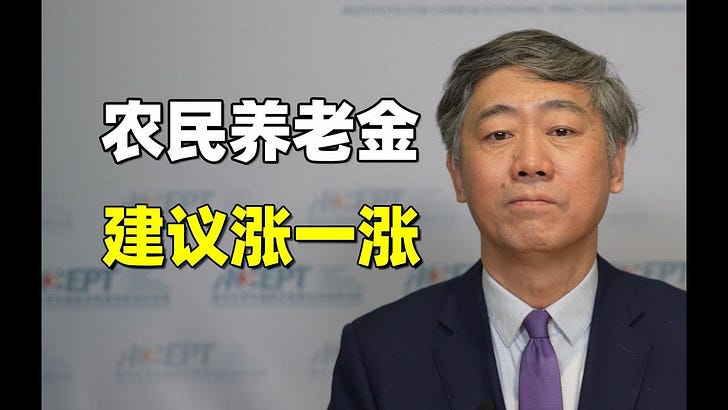
David Daokui Li is a Professor of Economics and Director of the Academic Center for Chinese Economic Practice and Thinking (ACCEPT) at Tsinghua University. He has been very active on Chinese social media, including opening a video channel on WeChat, China’s top messaging app, releasing a short video of him talking daily. He posts the same videos on his …
Meng Xiaosu: China’s state capital has a rural debt to pay

For decades, China’s modernisation has been underwritten by the countryside: cheap grain, cheap labour, and cheap land. Yet the welfare state built alongside that growth remains split down the middle.
Three types of hidden debt unaccounted for in China's official stats

The debts accumulated by Local Government Financing Vehicles (LGFVs), often referred to as China's hidden debts due to their association with government liability, are widely known among observers of China's economy. However, in a recent speech and Q&A

Truly, these are heartening words. Raising pensions for farmers is not merely a moral imperative, but a policy that makes perfect economic sense.
For generations, Chinese farmers have sown the seeds of food security and social stability, often with little recognition or long-term security. To support them in their twilight years is to honour the labour that feeds a nation.
Just as every seed planted eventually yields a harvest, investing in the welfare of those who tend the land will repay society many times over—strengthening consumption, reducing inequality, and affirming that no honest toil ought to go unrewarded.
«The other covers urban and rural residents outside formal employment, including most farmers. Participants in that scheme made very little contribution, so its benefits are, in practice, dominated by the state-funded “basic pension.” Because that basic benefit has long been set at a very low level»
The equity issue is not as simple as that because since at least around 2010 the CPC has made food self-sufficiency a big priority and therefore has made very big improvements to farmer incentives and incomes, for example agricultural product prices in the PRC are twice as high as international prices, and the land tax which had been paid by farmers for over 2 thousand years has been completely abolished, plus houses have been donated to farmers and significant grants have been given to improve them, plus farmers have much, much lower costs for basic living than urban residents. Also for thousands of years farmers have relied on children as pension assets and as we all know the "one child policy" has only applied to formal urban residents and not to farmers.
As to equity there is also the problem of "very little contribution": the CPC is determined in the phase of socialist transition to avoid a welfare state, which is why "that basic benefit has long been set at a very low level".
The argument about the basic pension level therefore cannot be made easily about farmers, but it is easier to make it for the large numbers of migrant temp workers outside formal employment which have made as large or larger a contribution to the PRC service economy as farmers to the PRC agricultural economy, and often worked and lived in appalling conditions much worse than those of most farmers and with no home ownership and in precarious low-pay conditions that prevented any savings.
Unfortunately I guess like everywhere else middle-class do-gooders can easily get behind non-contributory pensions for heavily romanticized farmers but tend to ignore the nobodies who deliver their takeaways or clean their houses or build and staff the warehouses.
The argument to be made is that the "basic pension" is simply too low to avoid the dire poverty of many old people whether farmers or migrant temps (and especially the latter).