


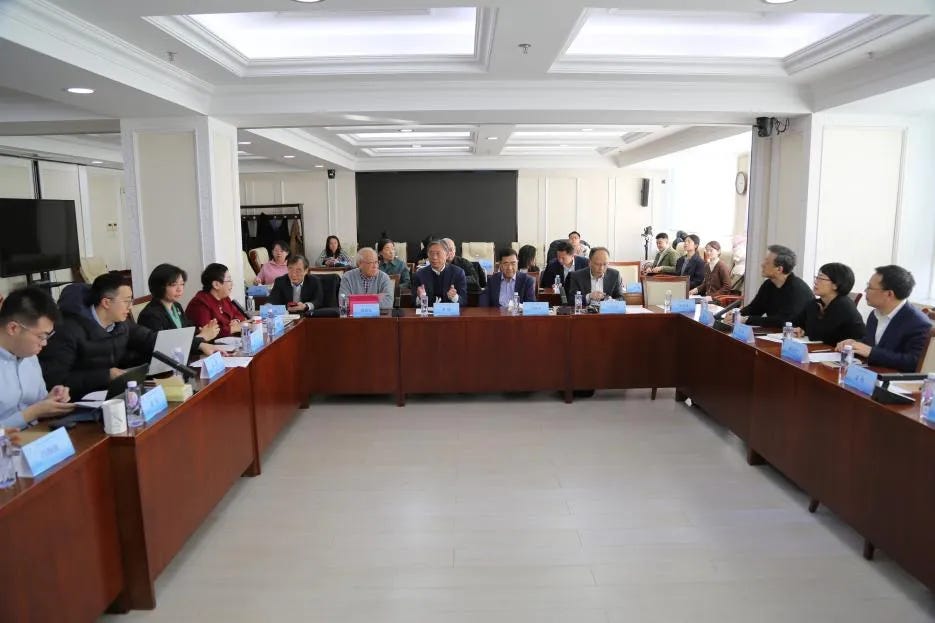
On 7 December 2025, nearly 50 Chinese scholars and policy researchers gathered in Beijing for the 2025年德国形势年终研讨会 “2025 Year-End Seminar on the Situation in Germany.”
A readout of the seminar was published on the WeChat blog of the Institute of European Studies at the Chinese Academy of Social Sciences (CASS) on 12 December. It’s also available on its website.
Feng Zhongping, Director of the Institute of European Studies and President of the Chinese Association for European Studies, has kindly authorised the translation. The readout is also available at the association’s website.
2025年德国形势年终研讨会
2025 Year-End Seminar on the Situation in Germany
On 7 December 2025, the “2025 Year-End Seminar on the Situation in Germany” was successfully held in Beijing. The seminar was co-hosted by the China-Germany Cooperation Center at the Chinese Academy of Social Sciences (CASS), the Institute of European Studies at CASS, and the Society of German Studies at the Chinese Association for European Studies.
Nearly 50 experts and scholars attended the meeting from CASS, the Party School of the CPC Central Committee (National Academy of Governance), the Chinese People’s Association for Friendship with Foreign Countries (CPAFFC), the China Institutes of Contemporary International Relations (CICIR), the China Institute of International Studies (CIIS), Peking University, Renmin University of China, China Foreign Affairs University, Beijing Foreign Studies University, Beihang University, Beijing International Studies University, University of Science and Technology Beijing, Fudan University, Tongji University, Shanghai International Studies University, East China Normal University, Shandong University, Heilongjiang University, Sichuan International Studies University, and Zhejiang International Studies University attended the meeting.
The participating scholars engaged in in-depth discussions on the developments and changes in Germany’s politics, economy, diplomacy, society, and security, as well as the evolving situation of China-Germany and China-EU relations.
The opening ceremony was hosted by Professor Yang Xiepu, Director of the China-Germany Cooperation Center at CASS. Professor Feng Zhongping, Director of the Institute of European Studies at CASS and President of the Chinese Association for European Studies, and Professor Gu Junli, Director of the Society of German Studies at the Chinese Association for European Studies, delivered speeches successively.
In his welcome address, Feng Zhongping extended a warm welcome and expressed sincere appreciation to the experts and scholars who had travelled from across the country. He stressed that Europe is a key focus of major-country diplomacy with Chinese characteristics and a crucial partner in advancing Chinese modernisation. He noted that Germany and Europe are making every effort to respond to the “Trump shock,” and that the value base underpinning the transatlantic relationship is wavering, yet Europe and the United States are unlikely to part ways. Despite challenges, Europe will continue to play a significant role in international affairs, drawing on its achievements in integration, its soft power in global governance, and, when pushed to the brink, its resolve to build hard power. He added that China and Europe still share extensive common interests, and that pragmatic, rational voices in Europe’s China policy are increasing. Both sides, he said, should deepen cooperation to inject stability into a turbulent world.
In his speech, Gu Junli noted that, as Europe’s largest economy and a core power, Germany is at a transitional crossroads where tradition meets the future, and that its steadiness and rationality carry particular significance for Europe. Against the backdrop of profound changes unseen in a century, he argued, sustaining pragmatic, rational, and open exchanges and cooperation between China and Germany is not only in the interests of both countries but also helps add a stabilising force to the world.
The seminar then proceeded to the first session, “Keynote Reports,” chaired by Professor Xiong Wei, Head of the Department of Diplomacy and Foreign Affairs Management, and Director of the Center for Area Diplomacy Studies at China Foreign Affairs University.
Jiang Feng, Professor and Chairman of the Council of the Shanghai Academy of Global Government and Area Studies (SAGGAS) at Shanghai International Studies University, highlighted based on extensive fieldwork that the German society is shrouded in fear: fear of a U.S. pullback, fear of Russian threats, and fear of competition from China. He assessed that, although Europe’s security architecture and the foundations of transatlantic ties have been severely weakened, the United States and Europe are unlikely to fully part ways. In his view, Germany is on the cusp of profound social and political turbulence, as a rightward shift in public attitudes and the rise of the Alternative for Germany (AfD) could spark a political earthquake. He also warned that Germany’s ongoing militarisation carries far-reaching implications. At the same time, he said, Berlin’s view of China is marked by a tension between “a new round of learning” and a deepening sense of value-based exclusivity. As the complementarity in China–Germany relations diminishes, he argued, the long-standing narrative that “cooperation outweighs competition” needs to be recalibrated.
Ding Chun, Professor and Director of Centre for European Studies at Fudan University, observed from an economic perspective that China–Germany trade and economic ties are taking on new features, marked by the coexistence of competition and cooperation and a two-way flow of investment. He noted that German companies are deepening localised R&D investment in China, particularly in the automotive and chemicals sectors, while Chinese firms are showing a strong appetite to invest in Germany. He also urged Chinese companies, as they expand overseas, to prioritise localisation and cultural integration.
Cui Hongjian, Professor and Director of the Centre for European Union and Regional Development Studies at Beijing Foreign Studies University, focused on Germany’s competitiveness and leadership. He argued that Germany should be assessed through a systemic lens: it is not enough to focus on a short-term economic downturn; its social resilience, institutional features, and the growing pains of transition must also be weighed. The Merz government faces a tough test in strengthening leadership, including domestic political constraints, difficulties in pooling and deploying resources, and the challenge of coordinating closely with France. He also cautioned against Germany simply blaming China for its loss of competitiveness, warning that this could push China–EU relations further towards strategic competition.
Zheng Chunrong, Professor and Director of the German Studies Centre at Tongji University and Deputy Secretary-General of the Society of German Studies at the Chinese Association of European Studies, struck a cautious note on China–Germany and China–EU relations, which he said are at a crossroads. He observed that the Russia–Ukraine conflict has prompted Europe to more tightly link China–EU relations with China–Russia ties, alongside rising concerns about coercion. Europe’s framing of China as a “systemic rival” reflects fundamental differences in governance models that are hard to bridge. U.S.–EU frictions have not automatically created openings for China–EU cooperation; to keep the United States engaged, Europe may align more closely with Washington on China policy, further narrowing the space for China-EU cooperation.
Jin Ling, Director of the Institute for Global Governance and International Organizations at CIIS, examined U.S.–Europe relations under “Trump 2.0,” arguing that they are increasingly shaped by diverging identities and interest-based transactionalism. She noted that Europe is stepping up efforts to strengthen defence autonomy, including initiatives such as the Security Action for Europe (SAFE). She also pointed to the digital sphere as an emerging flashpoint in transatlantic relations. Jin stressed that U.S.–Europe frictions do not automatically translate into opportunities for China–EU cooperation; improving China–EU ties depends on addressing their own structural constraints, while the recent stabilisation in China–U.S. relations has opened a window for dialogue.
The seminar then moved to the second session, “German Political and Social Situation,” chaired by Professor Wu Jiang, Party Secretary of the School of German Studies at Beijing Foreign Studies University. Eight speakers and two discussants offered in-depth analyses of Germany’s domestic political dynamics. Scholars noted that the grand coalition led by Friedrich Merz is facing growing governance constraints. They argued that the government has struggled to push forward policy agendas on immigration, welfare, and public finances, and characterised its approach as “lofty ambitions, disordered implementation, and weak follow-through.”
Participants also noted that the Social Democratic Party of Germany (SPD) has fallen into a systemic dysfunction, with a shrinking electoral base and weakening organisational capacity. At the same time, the far-right Alternative for Germany (AfD) has capitalised on populist narratives centred on issues such as immigration and energy policy. Its polling support is now firmly in second place and, in some surveys, has narrowed the gap with the leading party. Scholars also highlighted the rise of the left-wing conservative Sahra Wagenknecht Alliance (Bündnis Sahra Wagenknecht, BSW), which reflects the preferences of some voters for economically left-leaning policies combined with cultural conservatism, further contributing to the fragmentation of German politics. Against this backdrop, the Merz government has tightened immigration policy and stepped up deportations in an effort to respond to public pressure and blunt the AfD’s momentum.
As the session’s discussant, Gu Junli argued that the Merz government has yet to deliver breakthroughs in either domestic or foreign policy, and that Germany needs concrete governance outcomes rather than political posturing. Liu Liqun, Professor at the School of German Studies of Beijing Foreign Studies University, added that the rational interactions among Germany’s political parties should be interpreted within the broader contexts of globalisation and the rule of law, and urged researchers to cultivate a more expansive global perspective.
The third session, titled “German Diplomacy and Security,” was chaired by He Zhigao, Director of the Department of European Politics at the Institute of European Studies and Secretary-General of the China-Germany Cooperation Center at CASS. Twelve speakers and two discussants focused on Germany’s security diplomacy transition.
In the face of the Trump administration’s “America First” policy and heightened uncertainty over security commitments, Germany’s strategic anxiety has intensified. Participants noted that Germany is pursuing an unprecedented shift in security policy. This includes a sharp increase in defence spending, with targets set as 5 per cent of GDP; proposals to establish a National Security Council to better integrate security decision-making; efforts to strengthen societal mobilisation through conscription reform; the deployment of permanent troops in Lithuania; and deeper military involvement in the Arctic, extending Germany’s security horizon eastward and northward.
On China, the Merz government adopts a posture of strategic ambiguity. While the Federal Foreign Minister has taken a tough rhetorical line, the Federal Minister of Finance has emphasised cooperation, reflecting an attempt to balance domestic political pressures, relations with the United States, and economic interests. At the same time, Germany’s view of China is becoming increasingly securitised, with a growing consensus that frames China as a systemic rival and systemic challenge.
As a discussant, Zheng Chunrong said that understanding German foreign policy requires answering three questions: “What is happening in the world? Where is Germany heading? What should China do?” He also urged closer attention to Germany’s efforts to expand its influence in the Global South. Huang Liaoyu, Professor at the Department of German Language and Literature at the School of Foreign Languages and Director of the German Studies Center at Peking University, argued that Germany’s ongoing introspection has led it to confront endogenous problems within the Western democratic system. In engaging with Germany, China should enter political and moral debates with greater confidence and articulate its positions clearly.
The fourth session, “German Economy and Development,” was chaired by Associate Research Fellow Li Yisuo, Deputy Director of the China–Germany Cooperation Center at CASS. Six speakers and two discussants examined the challenges facing Germany’s economy and technological development. On the economic front, Germany’s prolonged technical recession has exposed structural weaknesses in energy costs, digital transformation, infrastructure, and bureaucratic inefficiency. While the Merz government has launched a large, debt-financed investment programme aimed at restarting growth, its impact remains uncertain, given constraints from partisan competition, labour shortages, and lengthy administrative approval processes.
In frontier areas such as artificial intelligence, Germany and the European Union have sought to assert regulatory leadership through the world’s first comprehensive Artificial Intelligence Act, reflecting a governance approach centred on rule-setting and standards leadership. Yet in industrial application and innovation investment, Germany and the EU have already fallen well behind China and the United States. The much-discussed Nexperia case has further illustrated Europe’s dilemma between technological sovereignty, supply-chain security, and dependence on China. As a key stakeholder, Germany plays a dual role, acting both as a party to the tensions and as a coordinator seeking to manage them.
As a discussant, Liu Mingli, Editor-in-Chief of Contemporary International Relations at CICIR, suggested that German studies should put Germany’s own characteristics more front and centre, sharpen the research questions, and draw lessons that could inform China. Zhao Ke, Associate Professor and Director of the Department of Russian and European Studies at the Institute of International Strategic Studies at the Party School of the CPC Central Committee, proposed taking a longer historical view of the German economy, including whether today’s difficulties are cyclical or structural, and what Germany’s true position is in the global economy.
In the closing session, Professor Xiong Wei of China Foreign Affairs University delivered the concluding remarks. He said the seminar had offered a panoramic assessment of Germany’s political, economic, social, diplomatic, and security landscapes, and had helped build a broad, substantive consensus on the defining features of Germany’s Zeitenwende (“turning point of the times”) as well as the growing complexity of China–EU relations. Despite the severity of current challenges, the deep interweaving of interests and the shared responsibilities between China and Germany, and between China and Europe, remain in place. Chinese and German scholars should continue producing in-depth, precise, and problem-oriented research to provide intellectual support for sustaining rational and constructive dialogue and engagement in a turbulent world.
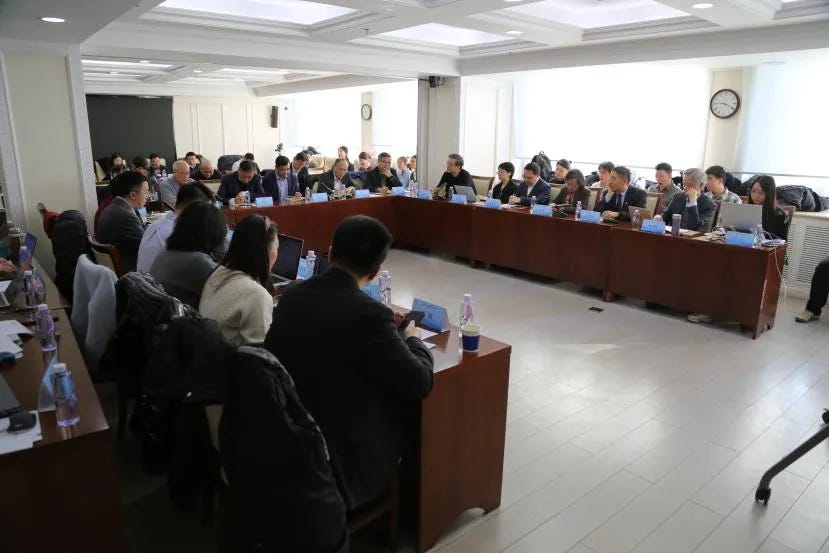
The successful convening of this seminar fully demonstrated the solid foundations and forward-looking scholarship of China’s German and European studies community, and contributed to the field’s continued development.


Don’t ask me why I comment on this, probably some influence of my father who fought during WWII communism somewhere near or around Sebastopol? He said the future and survival of Germany and Europe lays not in the west but in the east, of course the east is vast and unlimited far beyond only Russia.