


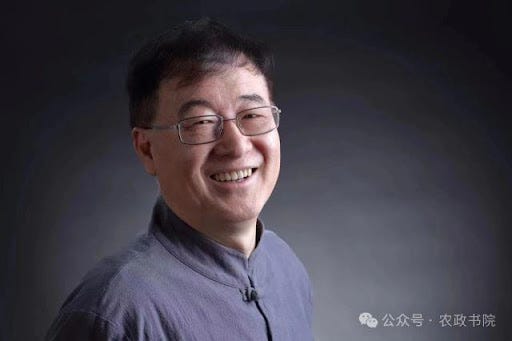
Zhao Shukai (赵树凯; b. 1959) is a Chinese official of rural policy and governance. From 1982 to 1989, he worked at the Rural Policy Research Office of the Communist Party of China Central Committee’s Secretariat (later reorganised as the State Council’s Rural Development Research Centre and subsequently the Research Centre of Rural Economy under the Ministry of Agriculture and Rural Affairs). Starting in 1990, he served at the Development Research Centre of the State Council, China’s government cabinet, holding roles including Director General of the Rural Department’s Organisation Research Office and Director General of the Information Centre.
The following article, originally published on 23 November on the WeChat blog 沽河虎山 (likely Zhao’s personal WeChat blog), offers a candid reflection on the futility of trying to control history from above: what began as a carefully designed collective vision for agricultural reform in the late 1970s quickly morphed into a series of unintended policy “accidents.” The shift from state-controlled communes to household-based farming emerged not from top-level planning, but from local initiatives and grassroots innovation, highlighting that the true agents of change were the farmers, not Beijing’s leaders. Senior leadership’s planning, disconnected from the realities of those affected, ultimately betrayed “a profound lack of respect” for the very people the reforms aimed to serve. —Yuxuan Jia
Zhao agreed to a translation but didn’t review it before publication. - Zichen Wang
赵树凯:“故事”,还是“事故”?
——农村改革史断想(1)
Zhao Shukai: “Design” or “Accident”?
—Reflections on the History of China’s Rural Reform (I)
At the age of eighty-five, Du Runsheng brought together the officials and experts who had helped draft the key policy documents of China’s rural reform, and edited their recollections into a volume titled A Virtual Record of China’s Rural Reform. In the preface, Du wrote: “Rural reform did not begin with a pre-designed blueprint. It was accomplished through the interactions across different levels and in different ways, among farmers, grassroots cadres, local governments, and central leaders.” (p.1. Du Runsheng, ed., A Virtual Record of China’s Rural Reform, Central Party Literature Press, 1999). This makes clear that China’s rural reform was an “unintended outcome.”
This brought to mind something I often heard Du say when I was working at the Central Rural Work Office in the 1980s. When talking about rural reform, he would frequently remark, “You tend flowers with great care, but they refuse to bloom; yet a willow you plant unintentionally grows into deep shade.” I can still picture it clearly: his slow, measured tone, followed by a light, playful “heh heh,” his distinctive laugh. The wording may sound colloquial, but it carries a deeper meaning.
Looking back at China’s rural reform, its “unintended” outcomes were striking in two respects.
First, in the relationship between industry and agriculture and between urban and rural areas, reform as envisaged from the top was supposed to start with state-owned enterprises. Yet it was rural reform, absent from the original blueprint, that ultimately broke through first.
Second, within the rural and agricultural system itself, neither the household contract responsibility system nor the dismantling of the People’s Commune had been part of the original agenda. Not only at the Third Plenary Session of the 11th CPC Central Committee in 1978, but even in early 1980, the top leadership remained deeply attached to the commune system. The “flower” they intended to cultivate was still the People’s Commune, which they believed should continue for at least another twenty years before evolving into an even higher stage of collective organisation—what Mao had described as “large in scale and highly collectivised.”
Instead, the household contract responsibility system suddenly took hold—a true “willow you plant unintentionally grows into deep shade”—and ultimately brought down the commune system. For the top leadership at that time, it was beyond imagination that household-based farming would one day become a long-term policy.
On March 13, 1980, acting on instructions from the top leadership, the State Agricultural Commission convened a special meeting to continue revising the Regulations on People’s Communes (commonly known as the “Sixty Articles”), with the intention of submitting the revised document to the Standing Committee of the National People’s Congress for approval. During the discussions, some participants even proposed renaming the Regulations on People’s Communes as the People’s Commune Law, in order to underscore the system’s long-term and formal status.
By then, however, developments in the countryside were moving quickly, and the household contract responsibility system was already shaking the very foundations of the commune structure. On July 17, at a meeting of the Secretariat of the Central Committee of the Communist Party of China (CPC), Wan Li remarked: “Let’s stop working on the so-called ‘Sixty Articles.’ We should focus only on a few policies relevant to current practice. Some policies are already outdated—for example, the integration of governmental and communal functions. That must certainly change.” (Meeting notes of the State Agricultural Commission)
Abandoning the People’s Commune system was a decision that senior policymakers were compelled to make, and one they had never anticipated. When the People’s Commune was launched in 1958, it arrived with great fanfare and enormous ideological momentum. Yet when it finally disappeared from the Constitution, it did so quietly and without ceremony. In the institutional history of rural China, the rise and fall of the People’s Commune was a genuine case of “a grand beginning and a feeble ending.”
This also reminds me of a small meeting back then, attended by Vice Premiers Tian Jiyun and Chen Muhua. At that meeting, Du Ruizhi—then a member of the Guangdong Provincial Party Committee Standing Committee and Director of the Provincial Rural Work Committee—remarked: “Rural reform was forced out of us by the farmers beating us with their carrying poles. They kept pressing us step by step, and the government kept retreating step by step.” As he spoke, he suddenly sprang up from the sofa and slapped his own backside to drive the point home.
Du Ruizhi, who had long served as Party secretary of Foshan Prefecture, Guangdong, was a major pioneer of rural reform in the province. Even before the Cultural Revolution, Mao Zedong had called him a prefectural Party secretary who “dared to say anything.” After this little performance, Du Runsheng gave his usual soft chuckle—“heh heh”—and said with evident affection, “This Little Du.” Du Ruizhi was his fellow townsman and had entered the revolution under his guidance, and Du Runsheng always called him “Little Du.”
What do these descriptions of rural reform—Du Runsheng’s claim that there was “no blueprint,” his saying that it was “a willow you plant unintentionally,” and Du Ruizhi’s remark that it was “forced out of us by farmers beating us with their carrying poles”—actually convey? I have often pondered this question. If their common implication is distilled into a single formulation, it might be this: rural reform was “a chain of accidents.”
Rural reform in the 1980s, despite ultimately reversing the course of history, was not the result of careful design or a meticulously crafted plan. It unfolded as a series of policy “accidents.” An “accident” is different from a “design”: design implies prior intention, whereas an accident erupts unexpectedly. If one insists on speaking of “design” in this context, it can only refer to this: a grand reform story subsequently pieced together through the successful handling of one policy accident after another.
If one looks closely at how China’s rural reform was decided, it becomes clear that it was full of “accidents”—“policy accidents” and “political accidents.” There has always been a tendency to recast this process as the product of far-sighted top-level planning: to disguise these “accidents” as elements of a carefully engineered grand design, to polish them into an inspiring “story” of leadership wisdom. The intention behind such efforts may be understandable, even well-intentioned. Yet no amount of cosmetic gloss can withstand the test of facts. Once history’s wind and rain set in and the details are laid bare, those grand, well-groomed narratives simply fall apart.
The reason the word “accident” comes to mind is that, whenever I think about the policymaking process of the reform, an image of a rear-end collision immediately appears. Policy development in those years resembled a succession of rear-end collisions on a highway. The first “car” to lose control was the household contract responsibility system. Once households gained autonomy, capable farmers naturally began hiring labour—immediately colliding with the long-standing policy that banned “hired labour.” With their new freedom and autonomy, farmers wanted to do more than simply till the land: they wanted to open factories, run businesses, or leave the village to seek opportunities across the country or move to the cities. This, in turn, crashed directly into policies that forbade farmers from engaging in non-agricultural work or moving freely. One after another, long-established policy barriers were broken through.
In this process, policymaking became reactive and improvisational—a sequence of correct on-the-spot responses to rapidly changing realities. The defining feature of policymaking during rural reform was a willingness to respect farmers’ own innovations and choices, to allow market competition and policy competition, rather than to rely on theoretical blueprints or leaders’ preconceived directives. This was the fundamental lesson of China’s rural reform.
As the most significant achievement of China’s reform era, rural reform was in fact composed of a series of “accidents” that unfolded far beyond what senior policymakers had planned: the household contract responsibility system grew into something far larger than they expected; the People’s Commune system collapsed to their surprise; the spread of hired labor became irresistible; and township and village enterprises rose with unexpected force. All these outcomes lay entirely outside the top leadership’s original design. This process is reminiscent of the Long March of the Chinese Red Army: Contrary to later portrayals that cast it as a strategic “advance to the north to resist Japanese aggression,” the Long March was essentially a vast retreat and dispersal after a series of military defeats.
When reform is described as a chain of “accidents,” some will inevitably disagree, perhaps feeling that such a characterisation diminishes the significance of China’s rural reform. Yet if the same idea is phrased as “crossing the river by feeling the stones,” it becomes easier to grasp. The act of feeling the stones is itself full of accidents: it demands cautious, correct responses on the spot, and inevitably involves moments when one “loses their footing.” What most deserves reflection is how to “feel the stones” more effectively. Policymaking is precisely such a process of feeling the stones, rather than one guided by grand, comprehensive designs. No individual, nor any authority, can script the history of human development as if it were a complete story.
“Crossing the river by feeling the stones” is fundamentally incompatible with a pre-drafted blueprint. On closer inspection, the phrase “feeling the stones” actually carries two quite different meanings: one refers to a practical working method; the other, to a philosophy of history. In the sphere of rural policy, if households were temporarily allowed to adopt the household contract responsibility system merely to resolve problems of subsistence, while policymakers, at a deeper level, still insisted that the future must lead toward a so-called “collective economy” and pinned their hopes on some eventual “leap” into collectivization, this could not be regarded as a genuine practice of “feeling the stones.” At its core, it remained an attempt to impose a utopia through political coercion. Put differently, the grand historical narrative centred on “collectivisation” and the “collective economy” was itself a utopian policy vision. Within such an appealing yet illusory narrative, farmers were reduced to mere instruments of history, subordinated to “collectivisation” and the “collective economy” rather than recognised as the true agents of historical development.
What did Du Runsheng mean by the “interactions across different levels and in different ways, among farmers, grassroots cadres, local governments, and central leaders”? How did these interactions arise and operate? This is a particularly important question. For such multi-level interaction to occur in a meaningful way, one essential precondition had to be in place: a broad political space. The logic is straightforward. If farmers were not granted political room to act—if only the centre was allowed to move while localities were not, if only cadres could act while farmers could not—then “inter”-action would be impossible. If farmers and grassroots actors could only move passively, merely carrying out decisions handed down from above without any capacity to create or choose proactively, then this would not amount to genuine interaction. And without such interaction, there could be no real reform.
Before the reform era, policymaking did not involve genuine interaction between farmers and the state, because almost all the “movement” came from above: higher authorities moved, leaders moved, while farmers were merely being moved. Under the pressures of political force, whatever “movement” farmers displayed was largely forced compliance—an act of silent endurance and reluctant accommodation. On the land of the People’s Commune, even raising pigs or chickens at home could be restricted or punished; free markets were shut down; production could not be undertaken autonomously; and everyday life offered virtually no personal freedom. Under such conditions, there was no foundation for the kind of farmer–government “interaction” that policymaking requires.
Only with the rural reforms of the 1980s did genuine interaction begin to emerge. Farmers and government interacted; grassroots and higher authorities interacted. The result of this interaction was that farmers gained the freedom to create and innovate. Their intelligence and capabilities could finally be brought into play, unleashing a dynamic force that reshaped China’s society.
To say that China’s rural reform originated in the great creativity of farmers is, in essence, to say that it arose from farmers’ rebellion against existing policies and institutions. Senior policymakers saw themselves as enlightened: they designed the People’s Commune system for farmers to obey, set rules for farmers to adapt to, and sought to comprehensively plan farmers’ production and daily lives. These policies were framed as “being for the farmers,” but in substance, they betrayed a profound lack of respect for them.
For a time, documents of the CPC Central Committee explicitly called for farmers to be subjected to “militarised organisation, combat-style action, and the collectivisation of everyday life,” and even proposed abolishing the family. In concrete terms, the household contract responsibility system amounted to farmers’ rebellion against this communal and collectivised order, forcing policy to yield and adjust. This is exactly what Du Ruizhi meant when he said that reform was forced out of the government by farmers “beating it with their carrying poles.”
As sociologist Zhou Xueguang noted: “The past forty years of reform and opening up can be seen as a “derailed” phase from the long-standing trajectory of Chinese history.” This metaphor of a train “derailing” approaches China’s reform from a macrohistorical perspective—like someone standing on a distant height, watching a train veer off its accustomed track. But if the rural reform decision-making process is observed from within the central policy apparatus, the scene looks quite different. It is like catching a glimpse, from inside the locomotive cab, of the operator’s moves, at times visibly flustered. In this sense, Zhou’s “derailment” metaphor and the idea of rural reform as “a chain of accidents” are two vantage points—external and internal—describing the same unfolding process by which rural reform came into being.
From a macrohistorical perspective, it is not only rural reform—as a specific historical episode—that can be regarded as accidental; the vivid and dynamic course of social development itself may also be seen as a chain of accidents. This reminds me of Karl Popper’s observation that “the human factor is the ultimately uncertain and wayward element in social life and in all social institutions. ” Popper also wrote: “The course of human history is strongly influenced by the growth of human knowledge...We cannot predict, by rational or scientific methods, the future growth of our scientific knowledge...We cannot, therefore, predict the future course of human history. This means that we must reject the possibility of a theoretical history。”
History’s progress constantly knocks down those who think they have mastered its “laws” and believe they can control its course. Barbara W. Tuchman made a similar point: “The human record is illogical … and history is a series of happenings with no inevitability about it.” [Tuchman is quoting Sir Charles Oman, actually —Yuxuan’s note] The insights of these scholars into the nature of history carry implications that merit careful reflection.
(November 2025)

Roy Prosterman's contribution to China's land tenure

The following is translated from a post of the WeChat blog Rural Reform Chronicle, of the 中国城乡发展国际交流协会 China Urban-Rural Development International Exchange Association, published on Saturday, March 8th.


The article causes me to smile. Life is usually a series of accidents, but if one works hard and accepts it, they frequently work out well.