


A screenshot circulating on the Chinese internet appears to show China’s top court stating that discrimination and rights violations based on sexual orientation, gender identity, and gender expression are unlawful in judicial practice.
The screenshot appears to show a written response from the Research Office of the Supreme People’s Court to a Chinese citizen who petitioned the court to clarify anti-discrimination principles in judicial adjudication.
In our opinion, the written response appears credible, but we cannot independently confirm its authenticity at this time.
Petition, known in Chinese as 信访 xinfang, is a centuries-old channel through which people in China have appealed directly to the authorities. In its modern form, it allows citizens to submit complaints, requests, or policy suggestions to state bodies, which are usually handled one-to-one and outside public view. The Communist Party of China and State organs, including the Supreme People’s Court, are generally required to register them and to inform petitioners whether and how they will be handled.
However, responses to petitions are generally not regarded as legally binding decisions, nor do they in themselves constitute new legislation or policy. They are usually understood only as a summary of existing measures and a very preliminary indication of possible next steps. In other words, they may offer some insight into how the responding authority views a given issue, but should not be read as formal policy change.
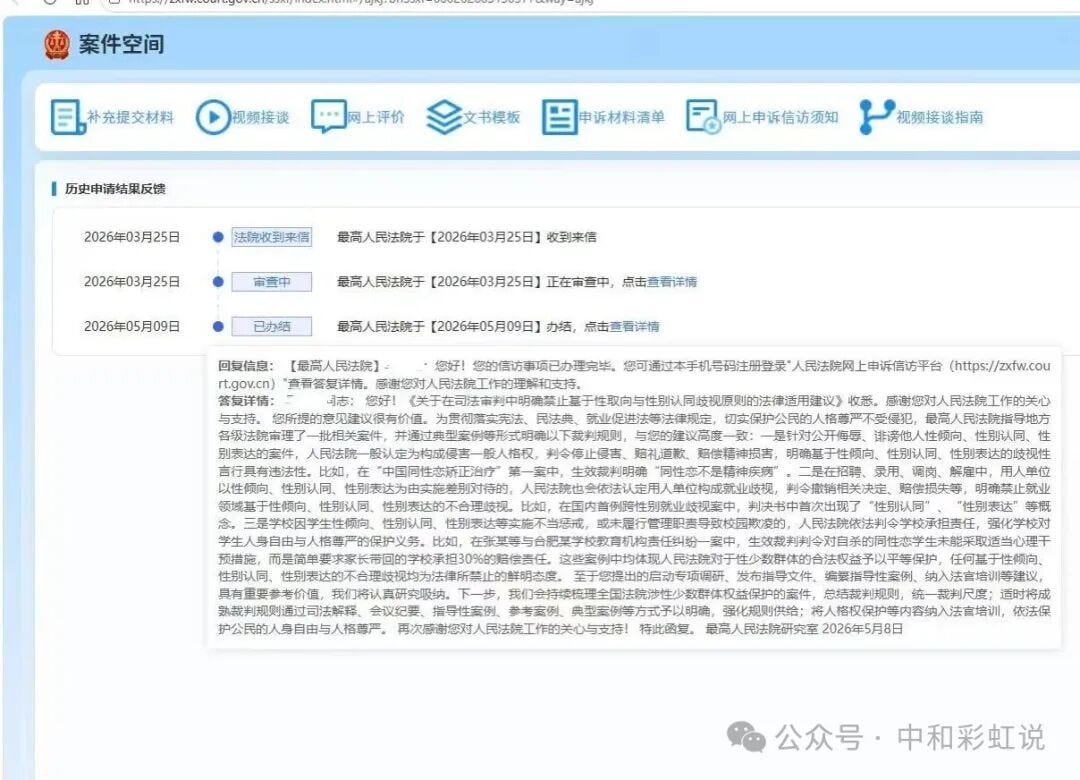
According to the screenshot, the petition was received on 25 March and answered on 9 May.
The alleged response said Chinese courts had already heard a number of related cases and used judgments and typical cases to set out legal rules. It cited three areas:
Personality rights. Public insults or defamation over a person’s sexual orientation, gender identity, or gender expression violate personality rights.
Employment. Employers may be found to have committed discrimination if they treat workers differently on those grounds in hiring, transfers, or dismissal.
Schools. Schools may be held liable if they punish students improperly or fail to stop bullying linked to a student’s sexual orientation, gender identity, or gender expression.
The purported response said these cases showed the courts’ “clear position” that “the lawful rights and interests of sexual minorities should be protected on an equal basis, and that any unreasonable discrimination based on sexual orientation, gender identity, or gender expression is prohibited by law.”
It also said the citizen’s petition, which is inaccessible and not shown in the screenshot —including dedicated research, guiding documents, guiding cases, and judicial training—had “important reference value,” adding that the top court’s Research Office would review relevant cases nationwide, summarise and unify adjudicatory standards, issue guidance when appropriate, and include personality-rights protection in judicial training.
The Research Office of the Supreme People’s Court, a department that assists with drafting judicial interpretations, participates in legislative research and consultation, answers lower courts on the application of the law, and compiles guiding cases.
The full English translation and the Chinese-language text of the response shown in the screenshot are provided below.
The screenshot was apparently shared in a group chat by the unidentified Chinese petitioner and sourced on Monday, 18 May, from 中和彩虹说 Zhonghe Rainbow Talk, a personal WeChat blog run by an LGBT-affirmative psychological counselor.
Response Message: [Supreme People’s Court]
Hello. Your petition has been processed. You may log in to the “People’s Courts Online Appeals and Petitions Platform” (https://zxfw.court.gov.cn) using the mobile phone number registered for this matter to view the detailed response. Thank you for your understanding and support of the work of the people’s courts.
Detailed Response:
Dear Comrade [Name],
Your submission entitled “Recommendations on Clarifying, in Judicial Adjudication, the Principle of Prohibiting Discrimination on the Grounds of Sexual Orientation and Gender Identity” has been received. Thank you for your concern and support for the work of the people’s courts. The opinions and recommendations you have put forward are of significant value.
To implement the Constitution, the Civil Code, the Law on Promotion of Employment, and other relevant legal provisions, and to effectively protect citizens’ personal dignity from infringement, the Supreme People’s Court has guided local courts at all levels in hearing a number of relevant cases. Through typical cases and other forms, the following adjudicatory rules have been clarified, which are highly consistent with your recommendations:
I. In cases involving public insult or defamation concerning another person’s sexual orientation, gender identity, or gender expression, the people’s courts generally find that such conduct constitutes an infringement of general personality rights. Courts may order the cessation of the infringement, a formal apology, and compensation for mental distress, thereby making clear that discriminatory words and acts based on sexual orientation, gender identity, or gender expression are unlawful. For example, in China’s first case concerning “conversion therapy” for homosexuality, the effective judgment clearly stated that “homosexuality is not a mental illness.”
II. Where an employer treats an individual differently in recruitment, hiring, job transfer, or dismissal on the grounds of sexual orientation, gender identity, or gender expression, the people’s courts will, in accordance with the law, find that the employer has committed employment discrimination, and may order the revocation of relevant decisions, compensation for losses, and other remedies. The people’s courts make clear that unreasonable discrimination in the field of employment on the grounds of sexual orientation, gender identity, or gender expression is prohibited. For example, in China’s first transgender employment discrimination case, the concepts of “gender identity” and “gender expression” appeared in a judgment for the first time.
III. Where a school imposes improper disciplinary measures on a student because of the student’s sexual orientation, gender identity, or gender expression, or fails to fulfil its management responsibilities resulting in campus bullying, the people’s courts will, in accordance with the law, order the school to bear liability in order to strengthen schools’ obligation to protect students’ personal freedom and personal dignity. For example, in the case of Zhang and others v. a school in Hefei concerning liability of an educational institution, the effective judgment ordered the school to bear 30 per cent of the compensation liability, as it had failed to take appropriate psychological intervention measures for a homosexual student who later died by suicide, and had instead simply required the student’s parents to take the student home.
These cases all reflect the clear position of the people’s courts that the lawful rights and interests of sexual minorities should be protected on an equal basis, and that any unreasonable discrimination based on sexual orientation, gender identity, or gender expression is prohibited by law.
As for your recommendations on launching specialised research, issuing guiding documents, compiling guiding cases, and incorporating relevant content into judicial training, these are of important reference value. We will carefully study them and seek to incorporate them as appropriate.
In the next step, we will continue to review cases nationwide involving the protection of the rights and interests of sexual minorities, summarise adjudicatory rules, and unify adjudicatory standards. At an appropriate time, we will clarify mature adjudicatory rules through judicial interpretations, meeting minutes, guiding cases, reference cases, typical cases, and other means, so as to strengthen the supply of judicial rules. We will also incorporate matters such as the protection of personality rights into judicial training, and protect citizens’ personal freedom and personal dignity in accordance with the law.
Once again, thank you for your concern and support for the work of the people’s courts.
This letter is hereby issued in response.
Research Office of the Supreme People’s Court
8 May, 2026
回复信息:【最高人民法院】▬▬您好!您的信访事项已办理完毕。您可通过本手机号的注册登录“人民法院网上申诉信访平台(https://zxfw.court.gov.cn)”查看答复详情。感谢您对人民法院工作的理解和支持。
答复详情:▬▬同志:您好!《关于在司法审判中明确禁止基于性取向与性别认同歧视原则的法律适用建议》收悉。感谢您对人民法院工作的关心与支持。您所提的意见建议很有价值。
为贯彻落实宪法、民法典、就业促进法等法律规定,切实保护公民的人格尊严不受侵犯,最高人民法院指导地方各级法院审理了一批相关案件,并通过典型案例等形式明确以下裁判规则,与您的建议高度一致:
一是针对公开侮辱、诽谤他人性倾向、性别认同、性别表达的案件,人民法院一般认定为构成侵害一般人格权,判令停止侵害、赔礼道歉、赔偿精神损害,明确基于性倾向、性别认同、性别表达的歧视性言行具有违法性。比如,在“中国同性恋矫正治疗”第一案中,生效裁判明确“同性恋不是精神疾病”。
二是在招聘、录用、调岗、解雇中,用人单位以性倾向、性别认同、性别表达为由实施差别对待的,人民法院也会依法认定用人单位构成就业歧视,判令撤销相关决定、赔偿损失等,明确禁止就业领域基于性倾向、性别认同、性别表达的不合理歧视。比如,在国内首例跨性别就业歧视案中,判决书中首次出现了“性别认同”“性别表达”等概念。
三是学校因学生性倾向、性别认同、性别表达等实施不当惩戒,或未履行管理职责导致校园欺凌的,人民法院依法判令学校承担责任,强化学校对学生人身自由与人格尊严的保护义务。比如,在张某等与合肥某学校教育机构责任纠纷一案中,生效裁判判令对自杀的同性恋学生未能采取适当心理干预措施,而是简单要求家长带回的学校承担30%的赔偿责任。
这些案例中均体现人民法院对于性少数群体的合法权益予以平等保护,任何基于性倾向、性别认同、性别表达的不合理歧视均为法律所禁止的鲜明态度。
至于您提出的启动专项调研、发布指导文件、编纂指导性案例、纳入法官培训等建议,具有重要参考价值,我们将认真研究吸纳。下一步,我们会持续梳理全国法院涉性少数群体权益保护的案件,总结裁判规则,统一裁判尺度;适时将成熟裁判规则通过司法解释、会议纪要、指导性案例、参考案例、典型案例等方式予以明确,强化规则供给;将人格权保护等内容纳入法官培训,依法保护公民的人身自由与人格尊严。
再次感谢您对人民法院工作的关心与支持!
特此函复。
最高人民法院研究室
2026年5月8日

Zhao Hong on state overreach, women's rights, cyberviolence & more

Zhao Hong 赵宏, Associate Professor with Tenure at Peking University Law School, specialising in public law and administrative law, has risen to one of the most frequent, brave, and high-profile public intellectuals on Chinese law in recent years. She also regularly contributes to 风声OPINION, a Phoenix New Media blog that features commentaries on current a…
Thanks, interesting. The real challenge is dealing with religious traditions. For example, the Catholic Church must allow women in the clergy? They must not refuse to bless same sex couples wanting to be married in church? Oh boy, maybe one day there will be more LBGT rights in China than in the West!
Is that self advocacy?