


In its 3 August Chaguan column, The Economist took aim at China’s defence against charges of “overcapacity”, arguing that Chinese firms owe much of their competitiveness to a system of state intervention in which “industrial might makes right”.
The essay below is a response to that argument.
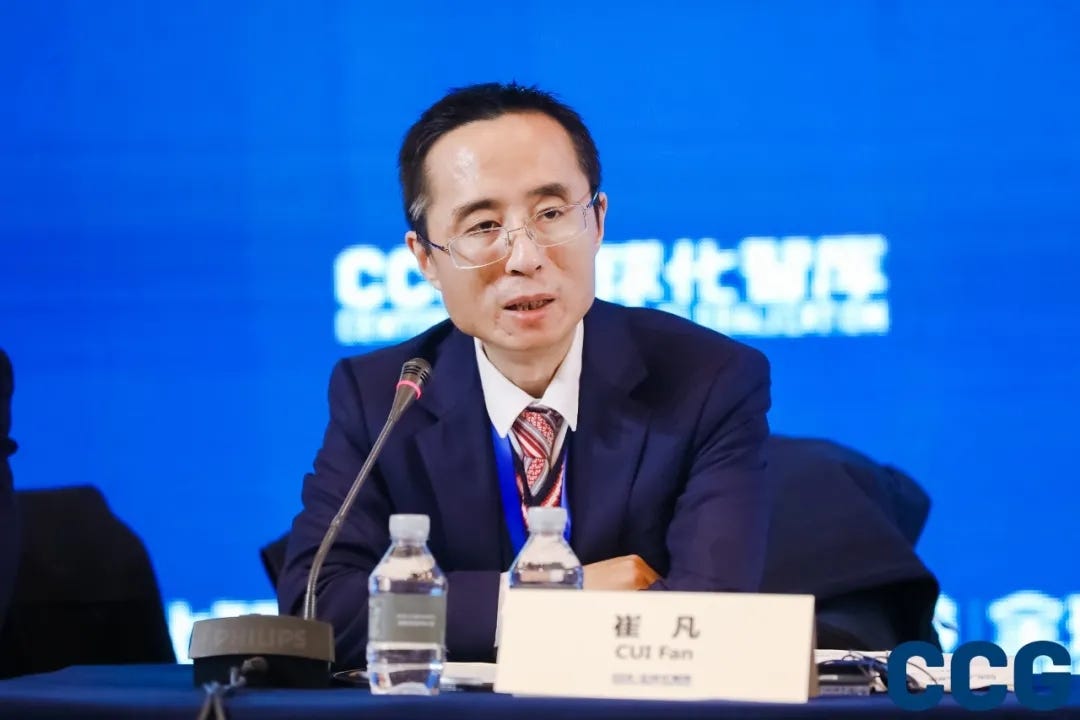
Cui Fan, Professor of International Trade at the University of International Business and Chief Economist at the China Society for World Trade Organisation Studies, argues that the current “overcapacity” narrative rests on a selective reading of China’s economic model, industrial policy, and domestic demand.
Cui acknowledges that China still has work to do: subsidies should be better regulated, industrial policy improved, and domestic demand expanded. But he also stresses that China seeks to resolve differences through equal-footed dialogue, mutual benefit, and mutual accommodation.
China will not, he argues, seek compromise by sacrificing its own competitive strengths, still less apologise for its own development. He adds that neither yielding to U.S. pressure nor “closing its market” to China will bring the EU healthy growth or lasting stability.
Cui’s article was published on 6 September 2026 on his personal WeChat blog. He has kindly authorised and reviewed the translation.
The views are his own and are not those of his employers, or organizations he is affiliated with.
中国当然不会为“产能过剩”道歉
China Certainly Will Not Apologise for “Overcapacity”
On 3 August, The Economist published an article titled “China won’t apologise for overcapacity,” commenting on China’s Position on the So-called Excess Capacity Issue, a position paper released by China’s Ministry of Commerce a few days earlier. Its standfirst made a jarring assertion: “Its industrial policy rests on a simple principle: might makes right.”
The article opened with a rather contradictory assessment of the Commerce Ministry’s position paper, describing it as both “rigorous” and “disingenuous”. It then proceeded in three parts. The first acknowledged that many of the facts cited and arguments made in the Commerce Ministry document were sound and intellectually honest. The second took a sharp turn to what it regarded as the “disingenuous” part, claiming that Chinese companies owed their competitiveness to state intervention. In the final section, the author adopted an emotional and anxious tone, before closing with the standfirst’s accusation that “industrial might makes right”.
On 30 June, the German magazine Internationale Politik und Gesellschaft (IPG) published an interview with German sinologist Marina Rudyak, who said: “The fundamental mistake we have made in dealing with China…was not to believe them. Or perhaps, at an even more fundamental level, we never seriously engaged with what they had actually said and written.” Although she was referring mainly to China’s economic planning, her observation points to a broader reality.
The position paper issued by China’s Ministry of Commerce has a clear purpose: to reject the legality and legitimacy of discriminatory restrictions imposed on China by certain countries under the pretext of “overcapacity”. At the same time, it demonstrates China’s unwavering determination to build a modern industrial system through openness and cooperation, and expresses China’s sincere willingness to work with countries around the world to foster an open and inclusive framework for cooperation across industrial and supply chains.
Contrary to what some critics claim, the document does not shy away from problems in China’s current economic development. It refers to “expanding domestic demand” three times and says “China is committed to a higher-level supply and demand equilibrium by continuously expanding domestic demand”. China’s Position on the So-called Excess Capacity Issue is entirely consistent with China’s basic state policy of opening up, its efforts to actively expand imports and promote balanced trade, and its strategy of further expanding domestic demand.
Over the past two years, I have discussed the issue of “overcapacity” with a number of journalist friends, leaving behind several written interview records. Press interviews, however, usually quote only a few sentences, while articles commissioned by newspapers and magazines are constrained by length. I have therefore brought together several of these interview exchanges and updated them in light of recent developments to present a fuller account of my views on the issues involved.
Q: Why did China choose to release this position paper on “overcapacity” at this particular moment? What considerations do you think informed the timing?
As is well known, 2025 was a turbulent year for the international trading system. The United States explicitly advanced a “Turnberry” system based on the principle of America First, using it to undermine the multilateral trading system. Through pressure on multiple fronts, the United States concluded a series of so-called reciprocal trade agreements with most of its allies — Canada being the only one that has so far refused to give in — as well as with a number of developing countries and regions.
Under these arrangements, other economies are required to grant the United States zero or near-zero tariff treatment and commit to large-scale investment in the United States, while Washington raises tariffs on them and, at the same time, asks them to help contain its economic rivals, chiefly China. Although the U.S. Supreme Court subsequently ruled that some tariffs imposed by the U.S. government were unlawful, Washington has continued to assemble a tiered tariff system through a range of alternative tariff measures combined with these so-called reciprocal trade agreements.
With the Turnberry system largely in place, the next step, according to the “grand encirclement” plan described by U.S. Treasury Secretary Scott Bessent, was to “approach China as a group”.
Seen in this context, the recent hype around “trade diversion”, the “China squeeze”, and the “Great Transshipment Scam” all fit neatly into this “grand encirclement” strategy. Taken together, they point to a clear aim: to use the overcapacity narrative, reinforced by the rhetoric of “China Shock 2.0”, to rally a broader range of countries behind discriminatory trade restrictions on China.
For a considerable period after 2010, China’s current account surplus remained at around 2 per cent of GDP, a healthy level. In 2025, the ratio rose to 3.7 per cent, but remained below the 4 per cent threshold commonly regarded internationally as a warning level.
At the same time, China has remained the world’s largest manufacturing economy for many years. It is steadily advancing new industrialisation and strengthening its position as a manufacturing powerhouse, while making major breakthroughs in new-energy industries, particularly the “new trio” — new-energy vehicles (NEVs), lithium batteries, and photovoltaic products.
Against this backdrop, talk of a so-called “China Shock 2.0” has gained ground in some countries. Those advancing this argument overlook the contribution of Chinese manufacturing to the global economy and to tackling global challenges such as climate change, using this as a pretext to roll out a series of discriminatory restrictions against China, with more already in the pipeline.
Beyond the forthcoming findings of the U.S. Section 301 investigation into so-called “structural excess capacity”, the most significant measures now under consideration are a range of restrictions being contemplated by the European Union.
Not long ago, a spokesperson for China’s Ministry of Commerce said that during China-EU consultations, the European side had threatened to “close its market as leverage.” Language this stark is unlikely to have been chosen without basis; it may well have originated with EU negotiators themselves.
The release of the position paper helps clarify the facts and set out China’s case. It also underscores China’s commitment to greater openness, closer international cooperation across industrial and supply chains, the basic rules of the multilateral trading system, and mutually beneficial economic and trade relations. In doing so, it helps lay the groundwork for dealing with possible new shocks to the global trading system.
Q: How should the issue of overcapacity be viewed comprehensively and objectively? What exactly does the Commerce Ministry’s position paper oppose?
Both insufficient aggregate demand at the macro level and excess supply at the micro level are common features of economic activity. Both are legitimate subjects for academic and policy debate.
Contrary to what some have suggested, the Commerce Ministry’s position paper does not simply deny the existence of overcapacity in China. Rather, it calls for “a rounded, objective, and just approach.”
The economic literature, as well as policy documents such as the U.S. Section 301 investigation into structural excess capacity, use the terms “excess capacity” and “overcapacity” interchangeably. Classical economic theories of excess capacity, however, generally examine the issue in the context of imperfect competition, focusing on the gap between equilibrium output and the scale of production that minimises long-run average cost. That differs considerably from what is meant by “overcapacity” in today’s debate, so those theories cannot simply be transplanted into the current discussion.
There is also no broad international consensus on how excess capacity should be defined. Simon Evenett and others have argued that the phrase excess capacity is “rhetorically useful, but hard to pin down, even harder to operationalise, and at the same time woefully misleading.” Excess capacity is a concept that describes a market outcome; that concept alone should not be grounds for intervention. The focus, rather, should be on policies that distort trade.
In other words, excess capacity is a concept that can be meaningfully discussed in academic terms, but it is not readily operational as a policy concept.
Indeed, Evenett, who has long studied and tracked trade policy, has offered a fairly clear assessment of the overcapacity narratives advanced by some countries today. In a recent discussion of China’s position paper, he noted: “Now, some seek to delegitimise the entire Chinese economic system by contending that it is based almost entirely upon state measures that allow excess capacity to persist in manufacturing sectors.”
This approach effectively treats China’s economic system as an original sin, turning a wholesale rejection of that system into a pretext for containing China across the board. It is precisely this ill-intentioned version of the “overcapacity” narrative that the Commerce Ministry’s position paper pushes back against.
Q: How should subsidies and industrial policy be viewed? How is China improving its industrial policy?
Criticism of China’s industrial policy is a central part of the “overcapacity” narrative directed at China.
“Allowing the market to play the decisive role in allocating resources and letting the government perform its functions better” is the basic principle China follows in managing the relationship between the market and the government. Yet the “overcapacity” narrative seeks to portray the Chinese economy as being driven primarily by state intervention, and Chinese companies’ competitiveness as resting largely on government subsidies.
The OECD, often described as a “club of developed countries”, has long been an enthusiastic architect of the Chinese “overcapacity” narrative. It recently developed a database on industrial subsidies. According to its report, the relative scale of government grants and corporate income tax concessions in China does not differ significantly from that in other economies, while China’s support through “borrowing at below-market interest rates” is comparatively high.
[Yuxuan’s note: The OECD report in fact shows that China’s overall level of industrial support is substantially higher than that of OECD economies. It also notes that firms in China receive a large proportion of their support through government grants and below-market borrowings, “with the latter proving especially large”. Its data do, however, suggest that China’s corporate income tax concessions are more comparable with those of other economies. The wording above follows the Chinese original.]
However, in selecting the risk-free base rate used to construct its benchmark interest rates, the OECD uses China’s Loan Prime Rate for corporate lending, as published by the People’s Bank of China, while using risk-free government bond yields or interbank offered rates for other economies. This deliberate inconsistency in methodology directly inflates the OECD’s estimate of Chinese subsidies by several times.
[Yuxuan’s note: The OECD’s June 2026 methodology note, About the OECD MAGIC database, does not specify which base rates are used for individual economies. However, earlier OECD work drawing on the MAGIC database constructs benchmark interest rates using an approach consistent with the methodology described in the Chinese original.]
In reality, industrial policy — subsidies included — is widely used around the world. A study led by Réka Juhász of the University of British Columbia, covering major economies from 2009 to 2020, found Germany, Japan, Brazil, and the United States among the most frequent users of industrial policy. China, despite being the world’s second-largest economy, ranked only eleventh.
Used appropriately and in accordance with the rules, subsidies can help correct market failures, support responses to environmental and climate challenges, encourage research and development, and promote more balanced regional development. What China opposes is the abuse of subsidies in violation of WTO rules.
Over the years, China has done extensive work to make its industrial policy more rigorous and rules-compliant.
Xu Lin, chairman of the China-U.S. Green Fund, spent many years at the National Development and Reform Commission (NDRC), working on industrial policy and participating in China’s WTO accession negotiations on related issues. In 2021, he published a lengthy article in Comparative Studies titled “From WTO Accession to CPTPP Accession: The Future of China’s Industrial Policy”.
The article reflects both the efforts of Chinese officials with first-hand experience of industrial policymaking to make China’s industrial policy more rigorous and rules-compliant, and Xu’s own thinking about its future direction. At the Caixin Summer Summit in June 2026, he further argued that China has developed a financing system in which industrial policy serves as a guiding baton — one that, in his view, can create significant problems. That point is worth taking seriously.
While I agree with most of Xu’s views, I believe some parts of his analysis merit further discussion.
Generally speaking, “specific subsidies” should not be treated as a category parallel to the WTO’s three categories of subsidies — prohibited, actionable, and non-actionable subsidies. Any of these three categories may include specific subsidies.
Prohibited subsidies mainly include export subsidies and import-substitution subsidies. Because they are contingent on export performance or on the use of domestic over imported goods, they are inherently specific.
For actionable subsidies, the complaining party must establish that the subsidy is specific. A subsidy is not specific if it is available to all industries and enterprises, or if eligibility is determined by economic thresholds based on “objective criteria or conditions” — for example, subsidies available to qualifying small and medium-sized enterprises. The complaining party must also demonstrate that the subsidy causes adverse effects.
Non-actionable subsidies include both non-specific subsidies and, subject to certain conditions, specific subsidies such as green, R&D and regional-development subsidies.
In effect, non-actionable subsidies are permitted. However, because negotiations over the detailed rules governing this category failed to produce agreement, the WTO provisions on non-actionable subsidies have long ceased to apply. Even so, subsidies that are not specific remain permissible under the WTO’s subsidy rules.
Given the legitimate rationale for green, R&D and regional-development subsidies, China has consistently called for the non-actionable subsidy provisions to be revived and for negotiations on the relevant disciplines to resume, so that such subsidies can be provided under clearer rules.
More broadly, every policy carries both costs and benefits, and industrial policy is no exception. One important criterion for improving industrial policy is to maximise its benefits while minimising its costs.
Direct cash subsidies and tax reductions or exemptions can both serve as instruments of industrial policy, as can financial tools. Jagdish Bhagwati’s “targeting principle” holds that a policy should address a distortion as directly as possible to minimise the costs associated with policy intervention.
Compared with direct subsidies and tax preferences, financial instruments have one distinctive feature: industrial policy is ultimately transmitted to enterprises through large numbers of professionals working in banks, securities firms, and investment funds. These financial professionals continuously assess and monitor business operations and are therefore more sensitive than government officials to changes in firms’ performance and to the practical effects of policy.
Industrial policy may serve as a guiding baton for bank lending, but at most it is only one among many. China’s Law on Commercial Banks, for example, requires commercial banks to operate according to the principles of “safety, liquidity, and efficiency”, while making their own business decisions, taking responsibility for their own risks, profits, and losses, and exercising self-restraint. Allowing industrial policy to provide guidance while still adhering to market principles can, in fact, improve the effectiveness of industrial policy.
Experts have rightly pointed out the costs of implementing industrial policy through the financial system, and these deserve close attention. At the same time, however, the costs and benefits need to be assessed comprehensively. The existence of such costs does not in itself justify dismissing the use of the financial system as an instrument of industrial policy altogether. I myself have repeatedly written research reports drawing attention to the costs associated with industrial policy.
Take local government investment guidance funds as an example. In recent years, Chinese authorities have introduced a series of measures to regulate and address problems including excessively high local reinvestment ratios [requiring government-backed funds to invest multiples of the public contribution in the sponsoring locality], the risk that such requirements may amount to investment subsidies, and the proliferation of county-level investment funds.
I have also called for deeper, practice-based research into how industrial policy is implemented and how well it works. When conditions are ripe, the State Council could consider introducing regulations on fiscal subsidies, requiring any new subsidy to go through proper justification, evaluation, and public disclosure; the form, scale, intended recipients, objectives, duration, phase-out mechanisms and effectiveness assessments of subsidies should all be established on a sound and rules-compliant basis. Further codifying the rigour and soundness of industrial policy through laws and regulations would also help lay the foundation for China’s future participation in negotiations on international subsidy rules.
Q: How should insufficient domestic demand and economic imbalances be viewed?
Another strand of the “overcapacity” narrative directed at China is the tendency to lump together China’s trade surplus, current-account surplus, relatively weak economic conditions, and supply-demand imbalances in certain industries, and label them all as “overcapacity”.
These phenomena can arise in different economies at different stages of the business cycle and of economic development. Yet the current “overcapacity” narrative is directed overwhelmingly at China.
The United States and the European Union have long run surpluses in services trade. The EU also has an agricultural trade surplus, while the United States maintained one for roughly sixty years before launching its trade war. Yet the U.S. and European “overcapacity” narrative focuses only on manufacturing — and above all on China’s fast-growing new-energy industries.
The claim by some countries that insufficient domestic demand in China has led to economic imbalances and overcapacity may sound plausible, but it does not stand up to scrutiny.
At the macro level, Germany’s current account surplus as a share of GDP has exceeded China’s every year since 2010, and in most years has also exceeded the internationally recognised warning threshold of 4 per cent. Japan and South Korea have likewise recorded higher ratios than China in the vast majority of years.
In 2025, China’s current account surplus stood at 3.7 per cent of GDP. Japan, Germany and South Korea — respectively the world’s third-, fourth- and sixth-largest manufacturing economies — recorded ratios of 4.8 per cent, 4.4 per cent and 6.6 per cent.
At the microeconomic or industry level, weaker domestic demand may, in the short term, lead to oversupply and higher exports in certain products or sectors. Over the longer term, however, the relationship between domestic demand and exports is far from straightforward.
The home-market effect in international trade theory suggests that, in industries characterised by economies of scale, a larger domestic market can strengthen export competitiveness and support greater exports. In other words, stronger domestic demand can, in such industries, go hand in hand with more exports.
In 2025, China sold 16.49 million NEVs, of which 13.875 million were sold domestically, and 2.615 million were exported. China’s new-energy vehicle industry therefore remains dependent on its domestic market. At the same time, Chinese NEVs accounted for approximately 68 per cent of global NEV exports.
For industries characterised by economies of scale and high R&D intensity, stronger domestic demand and a larger home market can enhance export competitiveness. Yet these are precisely the industries that certain countries most often cite as evidence of Chinese “overcapacity”. That sits uneasily with the claim that insufficient domestic demand in China is itself the cause of overcapacity.
Q: Given the state and evolution of the international trading system, how should China respond?
The discussion above shows that the claim that China’s economic development and industrial competitiveness are driven mainly by government subsidies does not stand up to scrutiny. Nor does the argument that insufficient domestic demand in China has caused overcapacity and global economic imbalances.
That does not mean there is nothing to improve. Fiscal subsidies should be further regulated, industrial policy made more rigorous and rules-compliant, and domestic demand should be firmly expanded. These measures will help strengthen the modern industrial system and promote high-quality development, and there is no reason not to pursue them.
However, I do not believe that these measures themselves will ease China’s frictions with certain countries.
The current round of disputes over “overcapacity” centres on the new-energy sector. In recent years, global average temperatures have begun to exceed 1.5°C above pre-industrial levels, and the consequences of global warming have become increasingly apparent.
Western countries were the first to raise the alarm over climate change. Yet some U.S. officials now dismiss global warming as a fabricated hoax. The European Union, meanwhile, is postponing its original timetable for phasing out petrol and diesel vehicles and considering raising its end-of-century warming threshold from 1.5–2°C to 3°C above pre-industrial levels, even as it abuses climate-related measures for trade-protectionist purposes.
Judging by the course of recent disputes, neither the United States nor the EU is likely to abandon efforts to contain China’s competitive industries, whether in recognition of the reasonableness and compliance of China’s policies or for the sake of tackling climate change.
In recent years, China has steadily strengthened the regulation of subsidies. To reduce trade frictions, it has eliminated WTO-consistent export tax rebates for products frequently involved in trade disputes, including photovoltaic products and lithium batteries. I have also seen experts call for export tax rebates on passenger vehicles to be removed as well.
Since the beginning of this year, the renminbi has appreciated by nearly 4 per cent. In my view, these measures are reasonable and demonstrate China’s efforts to maintain stable external economic and trade relations. These measures should take into account the needs of China’s trading partners, but the pace and extent of their implementation must above all be determined in light of the actual conditions of the Chinese economy.
Countries around the world can each develop comparative advantages suited to their own circumstances, and the desire of many countries to build up their manufacturing sectors is entirely understandable and legitimate. China is actively promoting closer integration of trade and investment, expanding outbound investment and international cooperation on production capacity. Through a sensible division of labour and cooperation across industrial and supply chains, more countries can participate in manufacturing and grow alongside China through mutually beneficial cooperation and fair competition.
Since the beginning of this century, in addition to China’s rapid growth, roughly two-thirds of developing countries have increased their share of the global economy. A considerable number of them have benefited from economic and trade cooperation with China. There is simply no basis for the so-called “China squeeze”. The shift from the “Great Divergence” to a “Great Convergence” is a development without precedent in recent centuries and represents genuine historical progress.
For both developing and developed countries, China’s outbound manufacturing investment should focus primarily on places with fair, stable, and open economic and trade policies and a sound business environment. Through openness and cooperation, China and its partners should work together to advance a more inclusive form of economic globalisation that benefits a broader range of countries.
Before the First Opium War, China had been the world’s largest manufacturing economy for a considerable period, and Britain did not catch up until the eve of the Second Opium War. Even today, China’s share of global manufacturing output remains slightly below its historical peak of 33.3 per cent in 1800, according to estimates by economic historian Paul Bairoch.
Manufacturing in eighteenth- and nineteenth-century China consisted largely of traditional handicraft production and developed within a relatively closed economy, making direct comparisons with manufacturing today difficult. Even so, given China’s population and the patterns of global industrial relocation, its current share of roughly 30 per cent of global manufacturing output is hardly unreasonable when set against the United States’ 44.8 per cent share in 1953 and Britain’s 22.9 per cent share in 1880.
China seeks to resolve differences through equal-footed dialogue, mutual benefit, and mutual accommodation, but it will not seek compromise by sacrificing its own competitive strengths, still less apologise for its own development. China will continue to promote a rational cross-border distribution of industrial and supply chains and international cooperation on production capacity. But if multilateral trade rules are violated and China’s interests are harmed, countermeasures should be expected.
The European Union is now the key variable in how the international economic and trade situation develops from here. If the EU insists on “closing its market” through measures that violate WTO rules, the multilateral trading system could suffer another serious blow. And if the WTO is further weakened, U.S.-EU trade relations are likely to face renewed uncertainty.
After all, the United States has never spared the European Union, targeting it in Section 301 investigations over forced-labour import restrictions and so-called structural excess capacity.
Neither surrender at Turnberry nor “closing its market” to China will secure healthy economic development or lasting stability for Europe. Upholding the multilateral trading system remains the fundamental means of safeguarding the European Union’s own trade interests.


The US uses tax forgiveness, tax write offs, or no taxes at all in return for private investment. Tariff are also an important form of subsidy and what is the MIC but one huge subsidy to private buiness and privae profits? The US also subsidizes the rich in many ways as it actively seeks all ways to de-subsidize the poor. All this talk from the US should be viewed for what it is, just another attempt to buttress its hegemony over the entire world and most of its population, Mike Liston
The clash of business interests is fundamental. No cooperation can reconcile them. It is silly to argue about legality and legitimacy. And the carrot and stick arguments attempting to lure and bully Western capital will not work. There is no win-win here.