


As the U.S. pulls back from parts of the international order it once helped to build, questions are growing over whether China will seek to fill the space Washington leaves behind. Speaking to The Paper, an influential Shanghai-based media outlet, Da Wei, one of China’s best-known international relations scholars, rejects that premise.
In his view, Beijing neither seeks nor intends to replace the United States in filling any so-called “vacuum”, nor should it be expected to do so. China’s position, he argues, is to integrate into the multilateral system and help improve it, not to replace one hegemon with another.
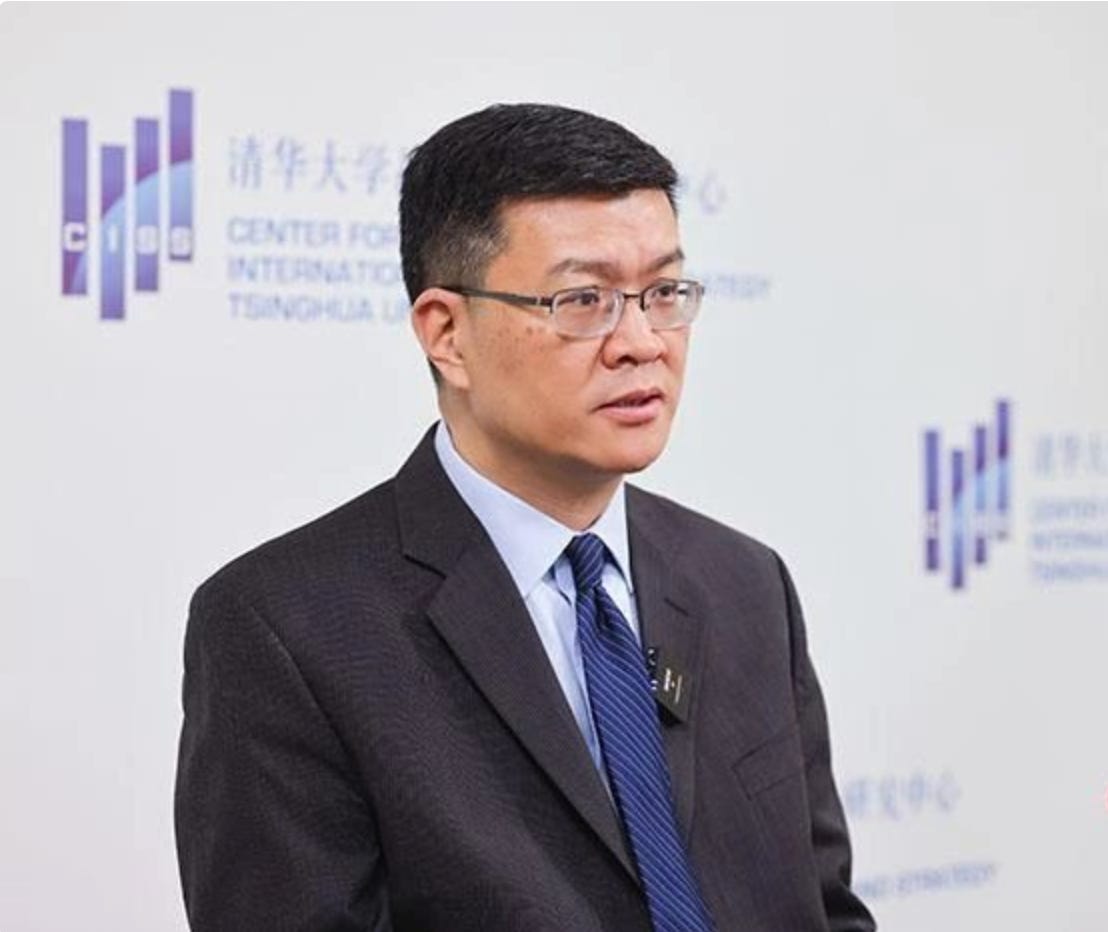
Da Wei is Director of the Center for International Security and Strategy (CISS) and a Professor at the Department of International Relations, School of Social Science, Tsinghua University.
The interview was published on 12 March 2026 by The Paper and is also available on CISS’s official WeChat blog. Da Wei reviewed the translation before publication.
达巍:中国不会也无意填补美国留下的“真空”
China neither seeks nor intends to fill any “vacuum” left by the United States
New Opportunities in China-U.S. Relations Require Direct Engagement Between the Two Heads of State
The Paper
Last month, the Chinese and U.S. presidents spoke by phone and stressed the need to “make 2026 a year where our two major countries advance toward mutual respect, peaceful coexistence, and win-win cooperation”. In your view, from the leaders’ phone call in February, to Trump’s possible visit to China at the end of this month, and then on to the APEC and G20 summits, what role can such high-frequency interactions between heads of state play in shaping both expectations for the bilateral relationship and its actual agenda?
Da Wei
There is no doubt that meetings between heads of state carry crucial strategic significance. In both China-U.S. relations and international affairs more broadly, national leaders—whether in China, the United States, or Russia—are playing an increasingly prominent role in shaping international relations. We are living in an era in which “leadership is key”. Compared with the more traditional model in which leaders, bureaucratic institutions, social groups, and economic forces jointly shape international relations, the personal role of leaders has now become especially important.
Against this backdrop, the importance of meetings between the Chinese and U.S. presidents is self-evident. This is particularly true at a moment when bilateral relations are at an important juncture and may be entering a window of opportunity. After a period of difficulties and fluctuations, there may now be some new openings in the relationship. That is precisely why the two leaders need to meet in person, so that new possibilities can emerge through direct engagement.
The Paper
You just mentioned that leaders’ personal influence is becoming ever greater. We noted that, after your recent visit to the United States, you said that there are at least four or five different views of China within the United States, and that Trump’s view is, relatively speaking, “more favourable”. How would you assess the sustainability of this “more favourable” view on Trump’s part?
Da Wei
Personally, I do not think Trump holds a particularly hostile view of China. His view of China is relatively neutral, and he is willing to engage in certain “deal-making”. Whether with regard to China’s leaders or to China as a country, Trump has also shown a certain level of respect. These factors constitute the more favourable side of Trump’s view of China.
I think Trump’s personal attitude towards China is, in all likelihood, sustainable. Looking back at his first term, his basic position had already become visible. However, although I have emphasised the personal role of leaders, no leader can be separated from their environment. His decisions and influence will be constrained by multiple factors, including the views of members of his team, differences in positions within government institutions, and broader shifts in the international landscape.
Therefore, Trump’s role cannot be understood too simply, as though personal will alone could reshape the external environment. For example, if he intends to move China-US relations in a positive direction while the broader environment is moving in a negative direction, the effect of his personal actions will be limited. Even so, I think that during his presidential term, Trump will most likely be able to maintain a certain degree of control over the overall situation.
I would also especially emphasise that once certain measures are put in place, they are often not easy to reverse. The tariffs imposed on China during the first Trump administration were not removed after the Biden administration took office and power changed hands; rather, they were further intensified.
This shows that both the broader environment and policy itself have considerable continuity. A change in leadership does not automatically mean a reversal of earlier policies. Once a precedent is set or a policy direction is established, it can easily outlast the term of any individual office-holder and display significant continuity.
The Paper
A follow-up question. Based on the two points we have just discussed—first, the possibility of frequent meetings between theChinese and U.S. heads of state this year, and second, Trump’s own attitude towards China—do you think these factors can help the two countries build a more durable framework for their relationship?
Da Wei
We cannot predict the future, but I do think this could open up a new possibility.
The Paper
From China’s perspective, how should China maintain the basic stability of China-U.S relations in the face of a highly uncertain domestic political environment in the United States?
Da Wei
On the one hand, China certainly hopes to use bilateral channels, high-level exchanges, and interactions at various levels to establish more institutional arrangements in specific fields such as the economy, trade, and military-to-military relations, to promote the stable development of bilateral ties.
On the other hand, more and more people recognise that stability in China-U.S relations cannot rest on goodwill from the American side, nor can it depend on chance or luck. If the relationship is to become more stable, it must ultimately be grounded in the strength of both countries, especially China’s own strength.
In that respect, sustained progress in economic development and technological innovation is particularly important. China already has considerable strength in the military sphere. In the current major power competition, if China can maintain solid momentum in the economic and technological domains, and convince the other side that it cannot secure overwhelming superiority over China and must instead accept the reality of coexistence, then I believe the relationship will become more stable.
China Must Continually Expand Its “Circle of Friends”
The Paper
Last year, you argued that U.S. tariff policy had, paradoxically, given rise to a kind of “WTO minus 1” scenario in global trade. Since then, with the United States taking more and more steps to pull back from international frameworks, some analysts have suggested that the world is now moving towards a “world minus 1” phenomenon. In your view, is this just a temporary transitional phase, or could it become a new normal?
Da Wei
The current international landscape cannot be reduced to a simple “world minus 1” formula. The reality is that the world is displaying a certain degree of fragmentation, along with trends towards multipolarity and regionalisation. These trends do not amount to a so-called “world minus 1” situation in which the rest of the world comes together to push the United States out.
In fact, as the United States has stepped back, other major forces in the world have also been going through their own processes of differentiation and realignment. There are tensions and disagreements among them, but at the same time, new opportunities for cooperation are also emerging. Europe, for example, is advancing free trade negotiations with South America and India. At the same time, there are differences between China and Europe, and between Russia and Europe. These are all part of the new shifts now underway, which is why I do not think “world minus 1” is an accurate description.
That said, it is true that current U.S. policies have affected the United States’s global position and contributed to a certain decoupling between the United States and the rest of the world. But “minus 1” is still not quite the right description because other parts of the international system are also fragmenting and recombining, a process often described as “multipolarisation”.
The Paper
How should China respond?
Da Wei
On the one hand, China’s relationship with the United States needs to remain stable, and cooperation should be maintained. On the other hand, it is equally important to develop relations with the world’s other major actors. This raises a question: what principles should China uphold, and what ideas should guide these relationships? Put simply, the objective should be to continually expand China’s “circle of friends” and to achieve overall stability in its relations with all parties, including the United States, Europe, India, and the wider Global South.
However, contradictions among states are unavoidable. Faced with that reality, China should firmly embrace multilateralism and globalisation. The key question is how to put these principles into practice in specific bilateral relationships, such as China’s relations with Europe and with Global South countries. Taking economic relations as an example, if one were to follow a purely absolute version of free trade, China’s powerful manufacturing capacity could produce an enormous trade surplus, and that would not be sustainable over the long term. Last year, China’s trade surplus reached the highest level in human history.
So the question China must consider is how it can work with other countries to build an inclusive and broadly beneficial form of globalisation, as well as an equal and orderly form of multipolarity. That means rebalancing bilateral relations. Principles are easy to state, but in real-world practice, what matters is whether interests can be coordinated and balanced in ways that make cooperation sustainable.
The Paper
Recently, leaders from countries including France, South Korea, Canada, the United Kingdom, and Germany have visited China in quick succession. Some commentators have described this as a form of “hedging diplomacy” in response to the uncertainty surrounding the Trump administration’s foreign policy. How do you see the strategic autonomy and balancing calculations behind this wave of visits to China? And what does this trend mean for Chinese diplomacy?
Da Wei
It reflects these countries’ desire to diversify their options. For a long time, Europe has relied heavily on the United States, but under current circumstances, it is looking to widen its diplomatic room for manoeuvre. China’s development opportunities also offer cooperation dividends to these countries.
However, it is also a fact that differences remain between China and Europe, whether with countries such as Germany and France individually or with the European Union as a whole. China cannot realistically bypass the EU framework and deal only with individual member states.
I believe China-Europe relations ought to improve. But at present, they are held back by two major obstacles: first, the issue of Ukraine; and second, structural contradictions in the economic and trade sphere. Neither of these two problems can be easily resolved in the short term.
Therefore, visits to China by European leaders reflect a shared willingness on both sides to improve relations, but high-level exchanges are not in themselves the end point; rather, they are an important opportunity to advance the resolution of problems. The effectiveness of these visits depends on whether the two sides can manage their differences and advance cooperation pragmatically. This still requires continued observation and effort.
Although both sides certainly have a genuine desire to improve relations, the significance of high-level visits lies in the opportunities they create to address underlying problems, rather than in the visits themselves directly improving ties. Whether dialogue can ease and manage contradictions will determine the actual trajectory of China-Europe relations.
Gaps in Global Governance Should Be Addressed Together With Other Countries
The Paper
Some argue that the United States’ recent wave of withdrawals from international organisations has created an opening for China to fill a gap in global governance. Do you agree with the idea of a “vacuum”? And should China move proactively to fill it?
Da Wei
China neither seeks nor intends to replace the United States in filling any so-called “vacuum”, nor should it be expected to play such a role. China is not a hegemonic power, and it does not aspire to become a superpower in the traditional sense. It has consistently defined itself as one of the world’s major countries, advocated multipolarity, and stressed that international affairs should be handled through consultation and participation by all countries.
Nor does China have the strength to fill gaps in global governance on its own. The world is multipolar, and issues should be addressed collectively through consultation. When it comes to gaps or deficits in global governance, China’s position is that existing mechanisms, including the United Nations, should be made to function more effectively and be reformed to better meet the needs of the times, rather than being replaced by any attempt to fill a supposed space left by the United States.
Finally, as for the line of argument in Western public discourse that China filling such a vacuum would mean the emergence of a new hegemony, I think that is too simplistic. It does not fit the reality of Chinese policy, and it projects a traditional Western view of power politics too directly onto China, which is not a sound approach. China’s development path is to integrate into the multilateral system and help improve it, not to replace one hegemon with another.
The Paper
In your view, what specific expectations does the world have of Chinese diplomacy in 2026, especially in terms of managing relations with the United States and its allies and participating in specific multilateral agendas such as reform of the United Nations and the World Trade Organisation?
Da Wei
I think these expectations can mainly be summarised as follows: first, there is an expectation that China will maintain stable relations with the major powers, especially the United States. Stability in China-U.S. relations matters not only to the two countries themselves; it also provides an important source of certainty for the wider world.
Second, amid today’s global turmoil, many countries do expect China to play a larger role. That is a reasonable expectation. I believe China will take on greater responsibility in global governance and make more substantive contributions. That means not only deeper engagement on specific issues, but also a clearer defence in international affairs of the principles China has consistently advocated.
The world today is facing growing disorder. The international order and its underlying principles are under strain. Some countries resort too readily to the use of force against others, even endangering the safety of other countries’ leaders. Behaviour of this kind seriously undermines international rules and order. In such circumstances, more countries need to step forward and firmly uphold the basic norms of international relations and the international rule of law. China should play a larger role in this respect and take a clear position.
Overall, the world’s principal expectation of Chinese diplomacy is that, amid global uncertainty, China will provide greater certainty for the world.
Da Wei: China Must Shoulder a Greater Historical Responsibility in Promoting the Reform of the International Order

The second August issue of 世界知识 World Affairs, a magazine published by World Affairs Press under China’s Ministry of Foreign Affairs, features a special series titled “The Multipolar World Is Coming at Speed,” commemorating the 80th anniversary of the victory in the Chinese People’s War of Resistance Against Japanese Aggression and the World Anti-Fascis…


A quick Google for “China fills the vacuum left by the US/West” turns up identical-sounding headlines going back 20+ years, every time the US faces a foreign policy setback, withdrawal, or perceived retreat.
"China might accept a sphere of influence for free, but it doesn’t want to pay for one ... China trumpets itself as a global power. It has invested heavily in its ability to shape established international organizations and created a new generation of China-centered international forums and global initiatives. China’s recent claims to leadership in the global south are also quite telling: This vague and geographically flexible category is useful precisely because it enables China to expand its ties with developing countries around the world. ... China’s leaders see integration with and increasing influence over the international system as indispensable to their country’s development and their regime’s legitimacy. China needs to export vast quantities of products around the world to sustain economic growth, and it has invested huge sums to develop foreign markets that can consume what Chinese consumers cannot."
–from "No, China Doesn’t Want Spheres of Influence," Aaron Glasserman, Foreign Policy, March 25, 2026