


On 24 July 2026, China’s Ministry of Finance and State Taxation Administration jointly issued new rules on the individual income taxation of offshore trusts. In plain English, the rules impose tax at key stages in the life of an offshore trust — including asset transfers, income generated within the trust, and distributions or termination — making it considerably harder for Chinese tax residents to use offshore structures to defer or avoid tax.
The move has quickly made international financial headlines, from the Wall Street Journal and the Financial Times to Bloomberg and CNBC. Most of the coverage has fairly noted both the long-standing use of offshore trusts by wealthy Chinese to reduce or defer their tax liabilities and Beijing’s growing incentive, amid mounting fiscal pressures, to raise revenue.
A week after the new rules were announced, David Daokui Li, Professor of Finance at Tsinghua University and Dean of its Academic Center for Chinese Economic Practice and Thinking (ACCEPT), addressed them in the short video transcribed and translated below.
Li welcomed the rules as a long-overdue step toward tax fairness. “This new rule has no real impact for ordinary people,” he said, for the rather straightforward reason that “we ordinary people don’t have any offshore trusts.”
He then turned the fairness argument in another direction. China’s tax rate on capital income currently tops out at 20%, he noted, while the top marginal rate on labour income reaches 45%. “That’s clearly unfair,” Li said, before proposing that the top rate on all forms of personal income be capped at 20%.
The video was published on Li’s personal Bilibili channel on 1 August 2026 and on his personal WeChat short-video channel the following day.
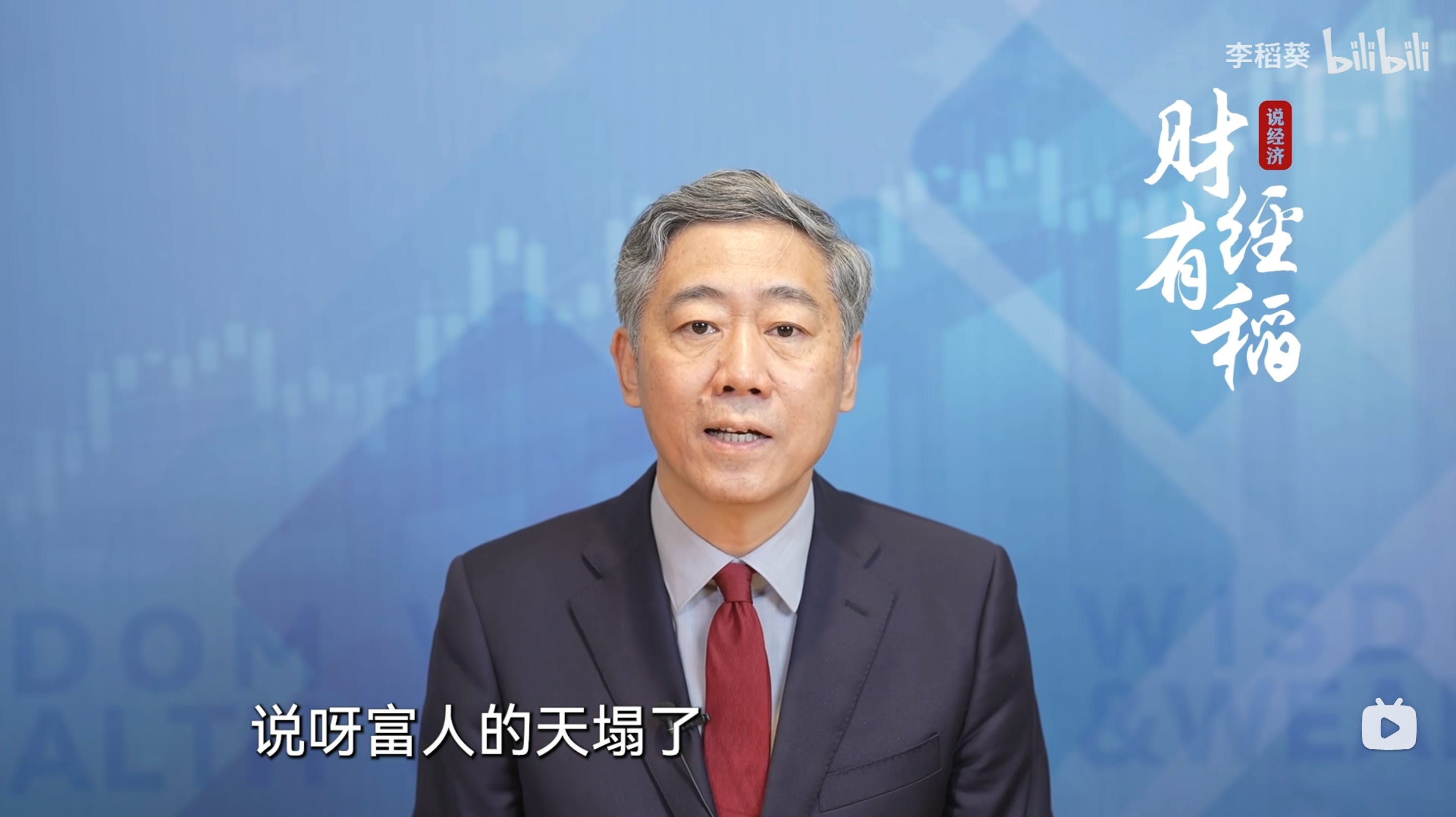
李稻葵:海外避税时代终结,离岸信托个税新规出台,信托避税通道被堵死【清华大学李稻葵】
Li Daokui: The End of Offshore Tax Evasion: New Individual Income Tax Rules Seal the Offshore Trust Loophole
Friends, there’s been talks going all around the internet, saying the state has crashed down on the rich and that wealthy people across the country are going to lose sleep. The reason is that the government suddenly issued new individual income tax rules for offshore trusts, completely sealing off the tax evasion channel that the wealthy had used for many years.
This news certainly has a really significant impact. The industry estimates domestic offshore trust assets at approximately 2.3 trillion to 2.7 trillion RMB. But to say that the wealthy are screwed is a bit of an exaggeration because the new rule targets something very specific:
It’s not aimed at a specific group of people, and it’s not banning offshore trusts either. What it targets is the practice of using offshore trusts to evade tax.
I’ll explain to you folks what an offshore trust is very quickly. To put it simply, it’s when some people put domestic equity, real estate, or funds and place them into a trust set up in places like the Cayman Islands or the British Virgin Islands, jurisdictions where there is virtually zero tax burden. Once the assets go in, legally speaking, they change hands and no longer belong to the individual who originally owned them.
Doing this gives them two benefits. First, asset segregation. If you rack up debt or go through a divorce, your assets in the trust are protected and no one can touch them. Second, tax evasion. As long as you don’t transfer the money you earned back to the county, the tax authorities can’t touch your money; so in theory, you go on never paying tax on the money you earn indefinitely.
This new rule targets precisely the latter. Going forward, offshore trust can still be used for asset segregation, and their legal function in wealth succession remains completely intact and unchanged, but using it to evade taxes no longer works.
Put simply, what should be protected is still protected and any taxes owed will be paid, down to the penny.
So how exactly did this new rule shut down this tax-evasion channel? It’s about taxing at every stage that could potentially be used to avoid paying taxes and taxing every asset or an entity on a look-through basis.
The moment you put assets like equity or real estate into an offshore trust, the government now treats it as though you’ve sold those assets, and you have to pay a 20% transfer tax upfront. And while the trust is active, you still have to pay a 20% tax on any dividends, interest, or other gains each year, whether or not the money ever lands in your own pocket.
Now, this is where the new rules really pack a punch. Previously, the biggest selling point of having an offshore trust was tax deferrals. Once you earn some money, you put it into an offshore trust, and as long as you don’t spend it, in theory you would never have to pay taxes on it. Essentially, you are putting your wealth into a safe that only ever goes up in value, never down. Now the government has slapped tax forms on these safes. When the trust is terminated, all the gains from liquidating all the assets will get taxed at 20% one more time.
Some people have asked: what if I switch my nationality or put the assets under someone else’s name and stay out of the picture, or what if I don’t distribute the gains directly and instead have the trust give me an interest-free loan to pay for an expense?
Well, sorry, but those routes have been completely closed off too. That’s the most ruthless part of the new rule, called the look-through approach. No matter how many shell entities are stacked underneath the trust, the tax authorities will identify who actually owns the trust. As long as your primary source of income comes from the Chinese mainland, you will need to pay taxes just like everyone else. The tax authorities will also look back over the previous three years. So if you transferred money out between 2023 and 2025, you still have to pay back taxes on it, and you’re only given a 90-day grace period.
Some of you might think this is the government ambushing the wealthy, but this is actually a misunderstanding. In fact, when the Individual Income Tax Law was first introduced, it clearly stated that Chinese residents are obligated to pay taxes on their income, whether it was earned in or outside of China. It’s just that for a very long time, this provision wasn’t properly enforced because information wasn’t transparent enough.
In 2014, China committed through the G20 process to implementing the Common Reporting Standard (CRS) and exchanging financial account information with other jurisdictions. In 2018, China completed the first exchange of information. The Cayman Islands, the British Virgin Islands, Singapore — all the offshore havens that Chinese residents love to cluster in — are now part of that network. Whether you have an account overseas, how much is in it, what transactions have gone through it — that data gets synced back and fed straight into China’s tax authorities on a regular basis.
In 2024, the full nationwide rollout of the Golden Tax System Phase IV in China has connected the data across tax, banking, foreign exchange, and industry and commerce. If a person’s domestic income clearly doesn’t match the scale of their overseas assets, the system will automatically trigger a red flag.
But having the information isn’t enough. There also needs to be a clear set of rules for taxing it. This new rule provides the final piece of the puzzle.
Globally, greater tax transparency and look-through regulation have long been the prevailing trend. As early as 2010, the United States enacted the Foreign Account Tax Compliance Act, or FATCA. It requires foreign financial institutions to report information on overseas accounts held by U.S. taxpayers. The European Union has also adopted the Anti-Tax Avoidance Directive (ATAD). It also requires profits earned by entities that residents establish in low-tax jurisdictions to be attributed back to the residents’ home countries for tax purposes.
China’s move now is not a sudden escalation. It is simply taking a long-overdue step in line with the broader global trend.
One last thing I want to say. This new rule has no real impact for ordinary people, because we ordinary people don’t have any offshore trusts. But its significance is still worth everyone paying attention to, because it’s about tax fairness. If there is a group of people whose wealth sits permanently outside the reach of taxation, then the rest of us — the low- and middle-income wage earners — are, in essence, footing the bill for that unfairness with every bit of tax we pay. Making wealth transparent is the first step toward fairness.
Speaking of fairness, this brings me to something I’ve talked about for a long time: right now, the tax on capital income tops out at just 20%, and there are plenty of loopholes in it that haven’t been closed. Meanwhile, labour income gets hit with a top rate that jumps all the way up to 45%. That’s clearly unfair.
My suggestion is to apply the same 20% ceiling to all types of personal income. Lower-income earners would pay lower rates, starting at zero and rising gradually to no more than 20%. Wouldn’t that be fairer?
If we did that, I don’t think as many people would even bother racking their brains over how to evade taxes. The nation’s tax base would grow, and tax revenue as a share of total government income would also increase. This should be the overall direction of reform.
David Daokui Li calls for 1.25 trillion yuan pension increase for Chinese farmers
David Daokui Li is a Professor of Economics and Director of the Academic Center for Chinese Economic Practice and Thinking (ACCEPT) at Tsinghua University. He has been very active on Chinese social media, including opening a video channel on WeChat, China’s top messaging app, releasing a short video of him talking daily. He posts the same videos on his …
David Daokui Li's case for more government bonds as fiscal relief

David Daokui Li is the Mansfield Freeman Professor of Economics and Director of the Academic Center for Chinese Economic Practice and Thinking (ACCEPT) at Tsinghua University. In a short video uploaded on September 19, Li advocated that "issuing long-term government bonds is the most prudent solution to address the current economic challenges."A transcr…
China's local govt debt in 2020 was 50% higher than WB, IMF estimates: David Daokui Li

Local government debt in China amounted to 90 trillion yuan (12.49 trillion U.S. dollars) in 2020, 50% higher than the World Bank and IMF estimates, according to a recent study by Professor David Daokui Li and Zhang He of the Academic Center for Chinese Economic Practice and Thinking (


I tend to agree that capital income tends to be taxed too little, not just in China. My greatest concern is that it eventually leads to a concentration of wealth and undermines democracy. This is already evident in the US and we are starting to see this in other countries that were previously democratic and egalitarian, like Australia, that privatised almost all public assets, further concentrating wealth in the hands of the few. I hope China can stay ahead of this “trend” and help the world reverse it.