


On September 10, Jennifer Kavanagh, senior fellow and director of military analysis at the Washington-based think tank Defense Priorities, published A Second Island Chain Strategy for Asia, calling for a fundamental rethink of America’s military posture in East Asia. Rather than continuing to defend its forward positions along the first island chain, she argues that Washington should shift its military posture towards the second island chain, reduce its commitments to regional allies and partners, and concentrate its resources on a narrower set of core national interests.
The proposal has sparked considerable controversy in American foreign policy circles, challenging longstanding assumptions about U.S. military primacy in the Western Pacific, the credibility of its alliances, and the strategic importance of Taiwan. Kavanagh’s argument is not simply that the United States should do less in Asia, but that its current military posture may no longer be the most effective or sustainable way to protect American interests.
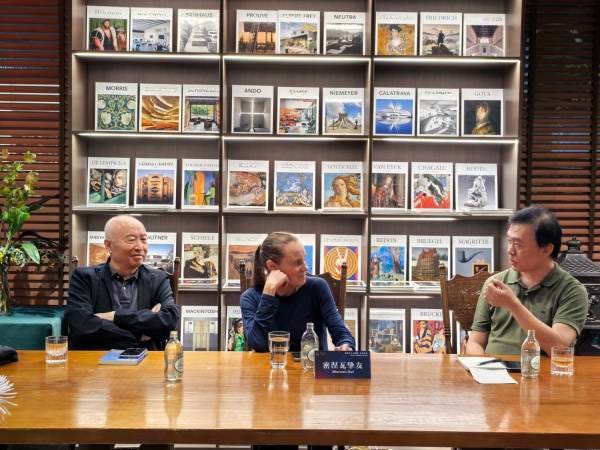
During a visit to China in September, Kavanagh participated in a non-governmental, informal discussion in Shanghai organized by Jia Min, a research fellow at the Shanghai Development Research Foundation, attended by Xiang Lanxin, Professor Emeritus at the Graduate Institute of International and Development Studies (IHEID), Geneva. The event was open to the public.
In an interview subsequently published by Guancha.cn on October 2, Jia reflected on their exchange and offered a perspective that complicates some of the assumptions surrounding Kavanagh’s proposal.
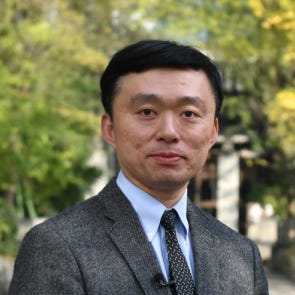
Jia makes two particularly interesting points. First, Kavanagh’s advocacy of strategic retrenchment should not be mistaken for sympathy towards China or “CCP.” Her starting point, he argues, is a reassessment of American national interests, not a desire to accommodate Beijing. Second, an American military withdrawal from the first island chain would not necessarily leave China better off. A diminished U.S. security presence could encourage Japan to pursue nuclear weapons, unsettle the regional balance of power, and create new sources of instability that Beijing would find difficult to manage.
Jia also placed Kavanagh’s proposal in the context of her earlier research on Truth Decay, published by RAND, where Kavanagh worked for a decade. That report explored the erosion of shared facts and public trust in American society, and considers how generational experiences, domestic political pressures, and competing conceptions of national interest shape the debate over America’s role in Asia.
贾敏:建议美国撤出“第一岛链”,美国人骂她“卖国”,但中国也需警惕
Jia Min: Jennifer Kavanagh Calls for US Withdrawal from the First Island Chain, Drawing Accusations of Betrayal in America — but China Should Be Cautious Too
Jennifer Kavanagh, a senior fellow and director of military analysis at the US think tank Defense Priorities, recently published a report entitled A Second Island Chain Strategy for Asia. Her bold proposal — a comprehensive shift in Washington’s Asia strategy away from the vulnerable “first island chain” towards the “second island chain” — has sparked fierce controversy in the United States and beyond. Excerpts published by Guancha.cn also prompted heated debate among Chinese readers.
As it happened, Kavanagh visited China in mid-September to attend the Beijing Xiangshan Forum before travelling to Shanghai. During her visit, Professor Xiang Lanxin, a scholar of international relations, and Dr Jia Min, a special research fellow at the Shanghai Development Research Foundation, invited her to a small gathering to discuss US strategic retrenchment and its relationship to American national interests. The conversation also touched on Washington’s broader global strategy and the future of China-US relations.
Speaking to Guancha.cn afterwards, Jia recalled how Kavanagh had struggled with the backlash against her report, but had also been touched by the warmth and encouragement she received from the Chinese public. The discussion, however, was not without its disagreements.
How should Kavanagh’s report be understood? Jia cautioned that her report does not make her “pro-CPC” or “pro-China”: she is arguing for America’s interests, and Taiwan is not the report’s central focus. Nor would a US military withdrawal from the Western Pacific necessarily work to China’s advantage. It could have consequences that few have yet considered.
Strategic retrenchment is a complex undertaking. As American power declines in relative terms, China faces a serious question: how can it protect its core interests while preventing a US withdrawal from creating a regional power vacuum that could intensify rivalries and lead to new conflicts?
Controversy in Strategic Circles, Goodwill from the Chinese Public
Guancha.cn: Dr Jia, I’d like to start with your recent meeting with Jennifer Kavanagh of Defense Priorities. Her report, A Second Island Chain Strategy for Asia, published on 10 September, has attracted considerable attention in the United States, Europe, the Chinese mainland, and Taiwan.
Reading someone’s work is one thing; meeting them in person is quite another. During your conversation, did anything she said, or perhaps something more subtle, give you a better sense of how American scholars and think tanks are thinking about US strategy, Asia, and China?
Jia Min: I’d read some of Kavanagh’s work before, though it had been quite a while. We got in touch recently through Professor Xiang Lanxin, a well-known scholar of international affairs and intellectual history.
In early September, Professor Xiang told me that a prominent American scholar was coming to China for a forum and several other engagements, and that she might have time to visit Shanghai. He asked if I’d be interested in hosting her and arranging some activities. I thought of the Buzu Thought Salon, which I organise, and decided to invite her to speak there.
Perhaps I should explain the name. The salon is a public forum for discussions of ideas and culture. Since we often talk about China-US relations, we chose a name that plays on the Chinese expression meizhong buzu, meaning “something to be desired”, while also suggesting “something lacking between America and China”. Kavanagh’s visit happened to coincide with our thirtieth session.
Her report hadn’t yet been published when I first received the invitation to host her. At the time, I was simply delighted at the prospect of welcoming such a distinguished scholar. When the report came out, I read it closely and found that its arguments were strikingly different from the prevailing views in American think tanks and academia. They were bold, even provocative, but backed by solid evidence and rigorous analysis, reflecting her intellectual rigour and clear-headed approach to research. That made me all the more eager to meet her.
Kavanagh arrived in Shanghai on the evening of 19 September, looking rather tired. I later learnt that she’d had a packed schedule in Beijing, attending the Xiangshan Forum and meeting many Chinese experts and scholars. So we scaled back the sightseeing we’d planned and focused on the salon at a bookshop the following evening. As an informal gathering, it gave her a chance to relax and speak freely.
The discussion was framed around the idea of American “strategic retrenchment”: how it relates to US national interests, what it means for America’s broader global strategy, and how China and the United States might get along in this context.
The topic generated considerable interest among the participants. Two examples come to mind.
One friend of mine runs a well-known winery. She’s very interested in China-US relations, and as soon as she saw the event poster, she asked me to save her a seat. She rushed back to Shanghai that afternoon, asked Kavanagh all sorts of questions about the bilateral relationship, and gave her a beautifully packaged gift set of gin.
Another friend, a veteran technology investor, was attending a course in Hangzhou. She caught a high-speed train back to Shanghai specifically for the event. When she noticed that Kavanagh’s throat was bothering her, she ordered some lozenges online and handed them to her during the discussion.
These small gestures touched Kavanagh. She hadn’t expected such warmth from Chinese participants, or that they would be so eager to engage with her. The experience gave her a more personal appreciation of the diversity and vitality of Chinese society.
It also says something about the Chinese public. People from all walks of life want to talk about China-US relations, world politics, and what’s happening inside America. They’re eager to communicate and make sense of where things are heading.
I won’t go through the report itself here — it’s available online for anyone who wants to read it. But Kavanagh told us quite candidly that she’d been under tremendous pressure since it came out. It had caused a huge stir in American strategic circles. She kept coming back to the word “controversy”.
Some of the criticism in overseas media has gone beyond the report itself to personal attacks on Kavanagh. Some of those comments have crossed the line and are simply unfair to her. During our discussion, we tried to offer her understanding, support, and goodwill, and encouraged her to stand by the policy conclusions she had reached through her research.
She certainly hasn’t backed away from them. She remains convinced that her proposals serve American national interests and could, to some extent, help put China-US relations on a more stable footing.
I think the discussion achieved what we’d hoped. Kavanagh was dealing with criticism and controversy, but she also found encouragement. We hope she’ll come back to China often, learn more about the country’s development, and get a better sense of how Chinese people see China-US relations, developments in American society, and the thinking behind US strategy. That kind of engagement can build trust and give her fresh ideas for her research.
We didn’t agree on everything that evening, of course, but that’s fine. The important thing is that people can talk openly and have an in-depth exchange of views.
I imagine it was quite different from the discussions she’s used to in academic and policy circles. Ours is a public forum that brings together people from business, technology, academia, and other fields. Participants tend to draw on their own experiences and speak from the perspective of ordinary people.
We wanted to show her that policy research isn’t just about advising those in power. It can also reach a wider audience and benefit from hearing what people outside government and academia have to say. That feedback can be valuable for future research and writing.
My friend who runs the winery, for instance, put it very bluntly: “I’m in the consumer business, so of course I want China-US relations to improve. Better relations mean more spending, more opportunities to grow the business, and better prospects for the future.”
It was a practical, heartfelt way of putting it.
The Report Does Not Make Kavanagh “Pro-China”
Guancha.cn: Did Kavanagh say anything during the discussion that went beyond the report itself and particularly struck you?
The report has attracted attention in China well beyond academic circles. It came out at a time of renewed high-level engagement between China and the United States, with Taiwan high on the agenda. That timing helped fuel the public debate.
Jia Min: The opening of the report makes her priorities very clear. She identifies two core US interests in Asia: defending the US homeland and safeguarding access to key economic markets and trade routes.
So her starting point is unmistakably American national interests. This isn’t a report written specifically to resolve the Taiwan question. It’s an attempt to address problems facing the United States itself.
You can see that in the questions she asks, the solutions she proposes, and the way she builds her argument. Taiwan is only one part of it. She calls for scaling back US military ties with South Korea, withdrawing US troops from Japan and replacing the current alliance with a narrower security partnership, removing the roughly 500 US military trainers stationed in Taiwan, and withdrawing US military personnel and equipment from the Philippines. It’s a comprehensive set of strategic proposals.
The report’s central argument is that, as China’s military power continues to grow and the United States finds it increasingly difficult to sustain its forward-deployed forces, Washington needs to make a strategic adjustment to its overseas military posture and devote more resources to domestic development. She firmly believes that such a shift would best serve America’s national renewal and long-term interests.
It’s important to recognise that none of this makes Kavanagh “pro-CPC” or “pro-China”. Her arguments are grounded firmly in America’s national interests. Some of her proposals on Taiwan don’t make her “one of us”. There’s no need to overstate their significance, let alone get carried away.
In fact, if American forces really did begin pulling back from the Western Pacific, the move could set off unforeseen consequences. This is another issue that deserves serious consideration.
It’s important to move beyond the labels attached to Kavanagh. She’s neither a “pro-CPC, anti-American” scholar nor a hawk. She’s an independent-minded scholar of the 1980s generation, with views and ideas of her own.
Second, her arguments are still far from fully understood and need to be considered in a broader context. What has led an American think-tank scholar to criticise US defence policy and propose such changes? A sound judgement requires a fuller understanding of her thinking. Focusing on just one aspect of her argument or a few isolated passages can easily lead to misunderstandings.
When she visited China last year, hardly anyone here knew who she was. This time, she’s attracted a great deal of attention, and people everywhere want to meet her. For an academic, being thrust into the spotlight so suddenly, with all the pressure that brings, can’t be easy. I think we should appreciate that.
From Truth Decay to Withdrawal from the First Island Chain
Guancha.cn: When you discussed this report previously, you said your main interest wasn’t really the second island chain or the Taiwan question. Instead, you raised two questions: what’s happened to facts and truth, and what’s happened to trust?
We talked about the loss of trust in international relations before the 2024 US election. How important do you think trust is in relations between major powers today? Have your conversations with Kavanagh, and your reading of her work, helped you find any answers or evidence?
Jia Min: To understand that, we need to go back seven or eight years, to Kavanagh’s earlier research.
During Trump’s first term, she was a senior analyst at the RAND Corporation. Together with Michael Rich, who was RAND’s president at the time, she produced a study called Truth Decay. It attracted a lot of attention and even made Barack Obama’s summer reading list that year.
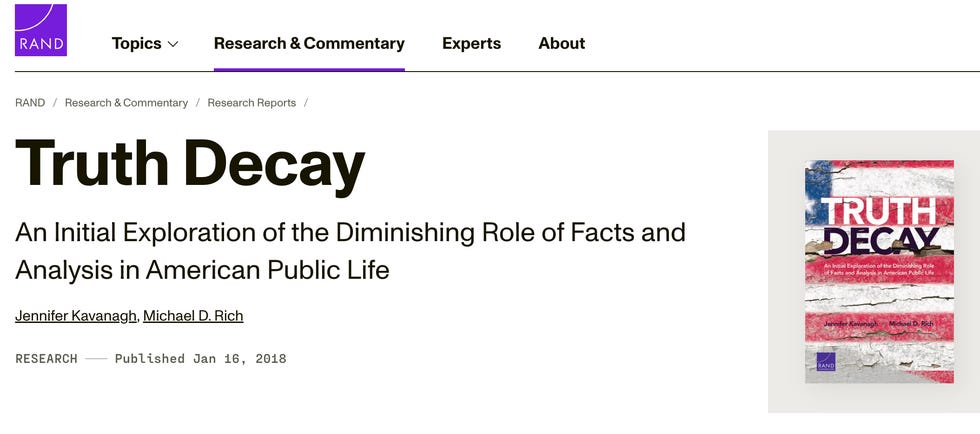
Truth Decay wasn’t about military or foreign policy. It was about what was happening within American society.
The basic idea is that Americans are finding it increasingly difficult to agree on facts and truths. And a direct consequence is that it’s much harder for them to find common ground in public debate. The result is growing division and confrontation, leading to the political polarisation much talked about in the United States today.
As that cycle continues, trust between the public, the government, and different groups in society begins to break down. In other words, “truth decay” leads to “trust decay” in American society. I think this is one of the most serious problems American society has faced in recent decades.
When I met Kavanagh, I tried to connect Truth Decay with her more recent work on US military strategy, including her proposals on NATO and the Western Pacific. I asked whether there was a common thread running through the two — an underlying logic that had developed over time. She said I’d understood her correctly: the connection was indeed there.
Everyone is talking about her latest report, but few seem to have noticed how closely it relates to her earlier thinking.
Take the assumption that maintaining a large US military presence along the first island chain must serve America’s national interests. Is that necessarily true? Does that consensus really hold up to scrutiny?
For a long time, few people seriously questioned it. Through her research, Kavanagh has found that a complex web of competing interests lies behind this supposed consensus.
One of the main goals of A Second Island Chain Strategy for Asia is to encourage the United States to devote more resources to domestic priorities. When a country overextends itself, pouring excessive resources into forward military deployments and positions on its periphery, it inevitably drains resources from home. At some point, strategic retrenchment becomes a necessity.
Yet some influential groups in the United States oppose withdrawing from the first island chain. There are lobbying groups, vested interests, and pressure from other countries and regions. But do these really serve America’s national interests?
Consider Nancy Pelosi’s visit to Taiwan in 2022. Some think-tank experts and partisan figures portrayed it as proof of unwavering American support for Taiwan. But was the visit actually in America’s national interests? And should that interpretation automatically be accepted as the truth?
That’s the point: what people take to be the truth can itself be questioned. Kavanagh is challenging assumptions that have long been taken for granted. She’s trying to show that without a genuine consensus grounded in facts, Americans cannot clearly identify their country’s national interests, let alone work towards national renewal.
I think her arguments deserve serious attention. At the very least, they should be treated with respect and subjected to rigorous debate.
Seen this way, there’s a clear continuity in her work. Through her research and policy proposals on foreign and defence policy, she’s revisiting some of the ideas she explored in Truth Decay.
Kavanagh agreed strongly with my reading of her work. She felt I’d grasped the connection between the different stages of her research.
I see Truth Decay as a study of America’s domestic problems in the era of “Trump 1.0”, while A Second Island Chain Strategy for Asia examines America’s foreign policy in the era of “Trump 2.0”. The two are closely connected. Foreign policy is rooted in domestic politics. Without a clear understanding of a country’s domestic politics, it’s difficult to develop fresh perspectives on its foreign policy.
Some American scholars accuse Kavanagh of “selling out” American interests, but I don’t think that’s fair at all. She identified some of the root causes of American society’s problems years ago. To portray her current work as a betrayal of America is to misunderstand what she’s been trying to do.
Is There a Window of Opportunity for China-US Relations?
Guancha.cn: Towards the end of her report, Kavanagh argues that Washington should communicate extensively and continually with Beijing to avoid misunderstandings about how US military forces will ultimately be deployed. She says these changes should be framed within the broader concept of “constructive strategic stability”, which the two countries have identified as the direction of their relationship.
At the same time, she stresses that a smaller US military presence should not be mistaken for a complete withdrawal from Asia. Washington should reaffirm its enduring interests in the region and make clear that its more limited deployments are intended to promote stability, not signal that America is abandoning the region.
In China, there’s also been discussion recently about the need to “add new dimensions to the vision of building a constructive China-U.S. relationship of strategic stability”. What might that mean in practice? Could Kavanagh’s report be seen as a proposal worth discussing — not necessarily something to adopt wholesale, but a contribution to the debate about what constructive strategic stability should involve?
There’s another question I’d like to raise. Whether in Kavanagh’s report or in discussions among American scholars about China-US dialogue on artificial intelligence, one sometimes gets the impression that Americans are looking to the Cold War relationship between Washington and Moscow as a model for managing relations with China, particularly when it comes to arms control and nuclear negotiations. Do you think that comparison makes sense?
Jia Min: Before I answer, there’s something I’d like to add.
Kavanagh proposes that the United States shift part of its military presence from the first island chain towards the second, scaling back its military commitments in the region. That would change America’s relationships with Japan, South Korea, Australia, and Taiwan. But there’s one aspect of her argument that should make China particularly wary.
She raises the possibility that if Washington reduced its military commitment to Japan and gradually replaced their mutual defence alliance with a narrower security partnership, Japan might respond by acquiring nuclear weapons or nuclear-powered submarines. From China’s perspective, that would cross an absolute red line. It would upend the post-war order in Asia and destabilise the entire geopolitical security landscape of Northeast Asia. China could never accept that.
In Northeast Asia, Russia, China, and North Korea all have nuclear weapons. Japan and South Korea are the two major countries without nuclear arsenals of their own. Of course, America’s alliances place Japan and South Korea under the US nuclear umbrella. American nuclear submarines sometimes call at South Korean ports, and US nuclear-powered aircraft carriers operate from bases in Japan.
If Washington downgraded its security relationship with Tokyo, Japan might conclude that, as a major regional power facing external military threats, it had every reason to acquire nuclear weapons or nuclear-powered submarines of its own. That could have enormous consequences for the region’s geopolitical balance.
So it would be a mistake to focus solely on the report’s proposals to reduce US military commitments to Taiwan and conclude that the report as a whole is favourable to China. That is not the case. This issue deserves serious discussion.
What makes the report valuable is that it opens up a debate about assumptions that have long been treated as settled truths. It gives people with different views a chance to make their case. I think that’s a healthy development.
Now, to return to the question of constructive strategic stability between China and the United States. Although the two countries have introduced the concept, they still differ in how they understand and interpret it.
From the American perspective, “strategic stability” is hardly a new concept. It originally referred to a form of stability that emerged from nuclear competition between the United States and the Soviet Union.
In the 1960s, the two superpowers were locked in an intense nuclear arms race. Gradually, they came to recognise that unchecked competition could end in mutual destruction. That led them to communicate more closely and establish mechanisms such as the hotline between Washington and Moscow. In military affairs, they gradually developed a degree of mutual understanding and trust.
So in the US-Soviet context, strategic stability was largely about nuclear weapons and military competition. It was very much a Cold War concept, and the Americans were among its principal advocates.
But the Cold War framework cannot simply be applied to China-US relations today. The concept of strategic stability developed between the United States and the Soviet Union is far too narrow to capture what constructive strategic stability between China and the United States entails. Indeed, the two are fundamentally different.
The term may be the same, but its meaning is not. The Cold War understanding of US-Soviet strategic stability should not be used as a model for interpreting China-US relations today.
In other words, China and the United States both need to play an active role, or at the very least work together, to broaden and deepen the dimensions to the vision of constructive strategic stability. That’s a fundamental difference from the Cold War approach.
There’s no shortage of areas where the two countries can cooperate. People-to-people exchanges, youth exchanges, and cooperation at the local level are just a few examples, and work in these areas is already under way.
Take artificial intelligence. China and the United States are the only two countries at the forefront of AI development. Each has its own strengths, and the gap between them is narrowing.
Ahead of the latest meeting between the Chinese and American presidents, the US sent a delegation to China for visits and exchanges. They got to see some things, though there were others they didn’t have the chance to explore.
Now, if the US claims to have such a huge technological advantage, why does it still feel the need to send people to China? Because China has a vast and rapidly evolving range of real-world AI applications, some of which may go beyond what the Americans had imagined. That’s why they’re so eager to find out what China is doing. Clearly, both sides have practical reasons to engage with each other.
At the same time, the growing use of AI in the military, technology, finance, and other sectors brings serious risks. China and the United States need to put aside their differences and talk frankly about those risks. I think such dialogue and cooperation could make a real difference in the years ahead.
Emergency response is another area where the two countries could work together. In September, a severe natural disaster struck the border region between China and Nepal, affecting people in both countries and elsewhere. Climate change was closely linked to the underlying causes.
AI can play an indispensable role in preventing natural disasters. Could China and the United States explore new forms of cooperation in this field and, in doing so, add new dimensions to the vision of building a constructive China-U.S. relationship of strategic stability?
Ultimately, the point of building such a relationship is for China and the United States to do something useful for humanity and contribute to building a community with a shared future for mankind. Seen in that light, there’s a tremendous amount the two countries could do together.
I’m not worried that we’ll run out of areas for cooperation. The challenge is making it happen: tackling practical problems one field at a time and turning ideas into action. That would be far more worthwhile than simply talking about “stability” without taking concrete steps to achieve it.
Guancha.cn: In fact, many people believe there’s a limited window of opportunity in China-US relations right now. Trump is already more than halfway through his second term, with the midterm elections approaching. And there’s no telling how American politics might change after 2028.
Given that the window may be relatively short, where should China and the United States concentrate their efforts to add new dimensions to constructive strategic stability? Can the two sides bring greater certainty to their relationship, so that its key priorities and commitments are less vulnerable to abrupt changes whenever a new US administration takes office?
Jia Min: The biggest hope for a breakthrough right now is on Taiwan.
During the talks in Beijing in May, the Chinese leadership made clear to President Trump that Taiwan was a major and sensitive issue in China-US relations and urged Washington not to play with fire. Trump offered some reassurance in response. He said that the United States did not want to “have somebody go independent” and that he had no desire to travel 9,500 miles to fight a war. He subsequently delayed some arms sales to Taiwan.
So China will continue to raise the Taiwan question in its dealings with Washington, putting forward its views and proposals. Its position remains firm, though there is room for flexibility in how it is expressed.
The hope is that the current US administration can make a breakthrough on the Taiwan question while this window of opportunity remains open. That includes questions surrounding America’s military deployments in the Asia-Pacific and its so-called military commitments, which brings us back to the issues raised in Kavanagh’s report.
I don’t know whether any of her proposals will ever become US policy. But at the very least, she’s put the elephant in the room. She’s raised a question that can no longer be ignored. The report has already made waves, and I hope it will lead to a much wider debate among US think tanks and strategic community.
I think this is a useful start. Whether the debate can gain momentum will depend on the timing. After all, the midterm elections are now the biggest issue in American politics. If Trump and the Republicans suffer losses, or even lose their majorities in both houses of Congress, the administration will face serious constraints on its ability to govern, and the direction of its policies will become much more uncertain.
But in the long run, whether Republicans or Democrats are in power, the United States will have to engage with China and work to manage the relationship. Given China’s size, strength, and capabilities, Washington can hardly afford to ignore it.
Strategic Retrenchment Is Extremely Complicated, Making China-US Dialogue All the More Important
Guancha.cn: You’ve warned that a US withdrawal from the first island chain wouldn’t necessarily work to China’s advantage. It could open a Pandora’s box, bringing greater uncertainty to East Asian geopolitics. Indeed, Japan, the Philippines, and Taiwan are already moving towards closer coordination.
A Russian scholar previously argued in a commentary for Guancha.cn that America’s relative decline and strategic retrenchment could pose serious risks to the international order and the regions concerned. In that context, cooperation between China and the United States to minimise the negative consequences of an American withdrawal would be particularly important.
What’s your take on this?
Jia Min: Let me draw an analogy, imperfect though it may be.
After the Second World War, the decline and break-up of the British Empire left the world with two major problems whose consequences are still felt today.
First, when Britain withdrew from India, it restored self-government but also oversaw the partition of British India into India and Pakistan along religious lines. This laid the groundwork for conflicts that have troubled the subcontinent ever since, and serious geopolitical tensions persist in the region to this day.
Second, Britain’s withdrawal from the Middle East after the Second World War also left behind a host of unresolved problems. Many of the region’s present-day borders, ethnic tensions, and religious conflicts have their roots in decisions made by Britain at the time.
Broadly speaking, Britain and the United States share an Anglo-Saxon cultural tradition. So if America begins to retreat from the international order it helped establish after the Second World War, what might that mean for the geopolitical landscape of East Asia?
Ideally, China would be able to “fill” some of the vacuum. But what if Japan stepped in instead, particularly forces associated with a revival of Japanese militarism? The consequences would be much harder to predict.
Strategic retrenchment is an extremely complex undertaking that calls for careful, objective, and thorough examination. I can’t offer a definitive conclusion at this stage. It’s a question that requires long-term consideration.
As America’s relative power declines, China needs to consider seriously how to protect its core interests while preventing the resulting power vacuum from fuelling rivalries among regional powers and triggering new conflicts.
This makes it all the more important for Beijing and Washington to strengthen communication on major regional security issues and strategic decisions with far-reaching implications.
Adding new dimensions to the vision of constructive strategic stability means broadening the dialogue beyond the issues already on the table, with more exchanges at different levels and on a wider range of subjects. Discussion, and even debate, between the two sides is necessary.
Of course, China-US relations cannot simply be reduced to a matter of dividing up spheres of influence, as some media outlets and think tanks have suggested. Beyond the major powers, there are many middle and smaller powers that will inevitably play a role. Some may even try to exploit tensions between major powers. The major powers must be careful not to let smaller countries exploit or even hold them hostage.
The Philippines is an obvious example. Manila has repeatedly provoked incidents in the South China Sea, emboldened in part by its belief that it can count on defence cooperation arrangements with the United States and Japan. Washington, of course, will continue to caution Manila against provoking a conflict with China, as such a confrontation could ultimately draw the United States and China into direct conflict, at enormous cost. The authorities in Taiwan have similar intentions, seeking to use outside powers to advance their own interests.
But the Trump administration understands perfectly well that it must not risk a confrontation for the sake of others’ narrow interests, particularly at the cost of destroying the hard-won trust it has recently established with the Chinese leadership. The Philippines may well be hoist with their own petard.
Generational Change and Its Impact on US Domestic and Foreign Policy
Guancha.cn: Kavanagh was born in the 1980s. Her generation grew up enjoying the benefits of globalisation after the Cold War, but also lived through 9/11, the wars that followed, and the financial crisis.
One striking feature of her, judging from the report, is that she seems relatively free of strong ideological leanings. Instead, her thinking reflects a form of nationalism shaped by globalisation, though one quite different from that associated with the MAGA movement.
How does Kavanagh’s generation differ from the Cold War generation, which still wields considerable influence in American politics, business, and academia? Could people like her eventually become the mainstream in American society? How should their views be understood? And does this reflect a broader generational shift in the United States?
Jia Min: That’s a very good question. As I understand it, Kavanagh was born in the 1980s. She studied at Harvard as an undergraduate, then earned her PhD from the University of Michigan. She’s spent her career working in think tanks and research institutions.
We did talk about generational differences at the salon, including how Chinese and American people born in the 1980s might engage with one another.
Kavanagh told me that China had benefited greatly from globalisation over the past three or four decades. After joining the World Trade Organization, China experienced rapid economic growth and enjoyed a relatively stable society.
But the American experience was very different. For much of the past two or three decades, the United States has been almost constantly at war. For many Americans, that period began with 9/11, followed by the wars in Iraq and Afghanistan, the financial crisis, the withdrawal from Afghanistan, and a succession of other upheavals.
So although American society remained broadly prosperous and stable as Kavanagh was growing up, it was also living through an era of “forever wars”. The lasting impact of this experience on people’s state of mind should not be underestimated. It’s an important part of understanding her generation.
They’ve grown up with one crisis after another, which has made them particularly sensitive to change. They’re also more inclined to look back nostalgically on America’s past glory, while their disappointment with the present can sometimes take rather irrational forms.
I’ve been interested in generational differences in America for a long time. According to a theory developed by an American scholar, history unfolds in cycles of roughly 80 years, each comprising four generations.
The first is the Prophet generation. Its members are generally born at the beginning of a relatively prosperous era and may rise to positions of leadership later in life. Trump is a typical example.
The second is the Nomad generation, broadly comprising those born in the 1960s and 1970s. They grew up in relative material comfort but often lacked a clear sense of direction and could be reluctant to take responsibility.
The third is the Hero generation, which includes people born in the 1980s and 1990s, like Kavanagh. They enjoyed relatively comfortable lives growing up, but as they enter middle age, they find themselves facing crises that force them to rise to new challenges.
Finally, there’s the Artist generation, broadly corresponding to younger people born in the 1990s and 2000s. They may have grown up in a society that places greater emphasis on the expression of ideas.
I told Kavanagh that Chinese and American people born in the 1980s belong to what this theory calls the Hero generation.
Today, both countries face a range of crises. People in their middle years, who form the backbone of society in China and the United States, need to come up with solutions to the problems of our time. Those solutions may differ considerably from what previous generations have proposed. Some may even break with conventional thinking. But at this point in history, why not have the courage to put forward bold, unconventional ideas?
I also mentioned an American politician born in the 1980s who I believe will play a greater role in the years ahead.
Kavanagh immediately asked, “You mean Vance?”
I said yes.
She said she had quite a few criticisms of Vance and was unhappy with some of his positions, which she felt could be inconsistent.
Still, they belong to the same generation. People born in the 1980s are increasingly entering the mainstream of society. In fact, many are already in positions where they can shape policy, advocate new ideas, and make their voices heard in public debate.
As this generational shift unfolds, China and the United States need to listen to each other and seize every opportunity for dialogue. Both countries have benefited from globalisation, but Chinese and Americans born in the 1980s have had very different experiences.
After 9/11, America entered a prolonged period of war, while China enjoyed relative stability and development. Those contrasting experiences make mutual understanding and dialogue all the more important.
I personally gained a great deal from inviting Kavanagh to the salon. Speaking with her gave me a sense of the unease and restlessness in American society, as well as a clearer understanding of her views on certain issues.
For China’s part, it’s important to approach the deeper anxieties and preoccupations of American society with greater empathy and an open mind. That would help lay the groundwork for more productive and substantive dialogue in the future.
I’ve long believed that China and the United States should work towards a “generational consensus”. Shared interests are obviously important, but beyond that, it’s worth asking whether people of the same generation in the two countries can find common ground on a range of issues.
Take people born in the 1980s. Whether Chinese or American, we share many of the same anxieties: raising families, caring for ageing parents, and making ends meet. Could these common concerns provide a basis for consensus?
Younger Chinese and Americans, particularly those born in the 1990s and 2000s, also share similar views on many issues. They’re learning from each other through social media platforms such as RedNote and TikTok, travelling to each other’s countries, and experiencing first-hand the pace of change and everyday life in China. Isn’t that a form of generational consensus in itself?
Of course, people born in the 1960s and 1970s grew up in another age. The United States was the dominant power, while China was still catching up.
Those born in the 1980s have watched the gap between the two countries narrow in certain areas. People born in the 1990s and 2000s have grown up seeing China and the United States on an equal footing in some fields. That sense of living through the same historical moment, and the common ground it creates, is something other generations could not have experienced.
I believe this kind of generational consensus could become, and perhaps is already becoming, an important foundation for dialogue on constructive strategic stability between China and the United States. That’s why I’m relatively optimistic.
Guancha.cn: As someone born in the 1980s myself, I can relate to what you’re saying. Reading Kavanagh’s report, with its wealth of evidence and data, I can understand why an American scholar like her would take the position she does.
Of course, understanding her perspective doesn’t mean taking satisfaction in what the report says or labelling her “pro-China”. The point is to understand the thinking and reasoning behind her position.
Jia Min: Exactly. One thing that distinguishes this report is that it moves away, to some extent, from the heavy emphasis on ideology and values that characterised a lot of earlier research. That was a fairly common way for the previous generation of scholars to make their arguments.
Generational change really does affect policymaking, but I don’t think it has received enough attention. Different generations have different perceptions of the times they live in and different capacities for empathy, which in turn affect their ability to act together.
There’s a reason for the emphasis on a new starting point in China-US relations, beginning with exchanges between children and young people and broader people-to-people engagement. This is grounded in practical considerations.
Kavanagh hopes her arguments will be understood back home, but right now she’s under considerable pressure. When she returns to the United States, she’ll still have to debate her critics and defend her views. She later wrote to thank us for organising the salon and for the discussion we’d had, saying that she, too, had found the exchange valuable.
That brings me back to the question I raised earlier: can people of the same generation, but from different countries, find common ground?
We organised the event because fundamentally, we believed it was in China’s interests. There’s no need to pretend otherwise. Kavanagh, for her part, wants America to become better, stronger, and more prosperous. If both sides are working towards the development and interests of their respective countries, that could itself provide a basis for a constructive consensus.
There’s no need to regard the other side as “one of us”. The aim is simply to approach each other with empathy, seek mutual understanding, and make progress together. Isn’t that the essence of the Chinese idea of “harmony without uniformity”?
Today, I think it’s important to understand America with empathy. American society has plenty of problems, but that’s no reason to ridicule it. In examining America’s problems, China should also reflect on whether similar problems could arise at home and how they might be prevented. The aim is to learn from America’s experience, including its mistakes, and avoid falling into the same traps.
Such exchanges should be mutual and work in both directions. It’s not simply a matter of China learning from the United States; America can learn from China too.
For now, these remain aspirations. But aspirations cannot be realised through words alone. Turning them into reality takes strength and practical effort.