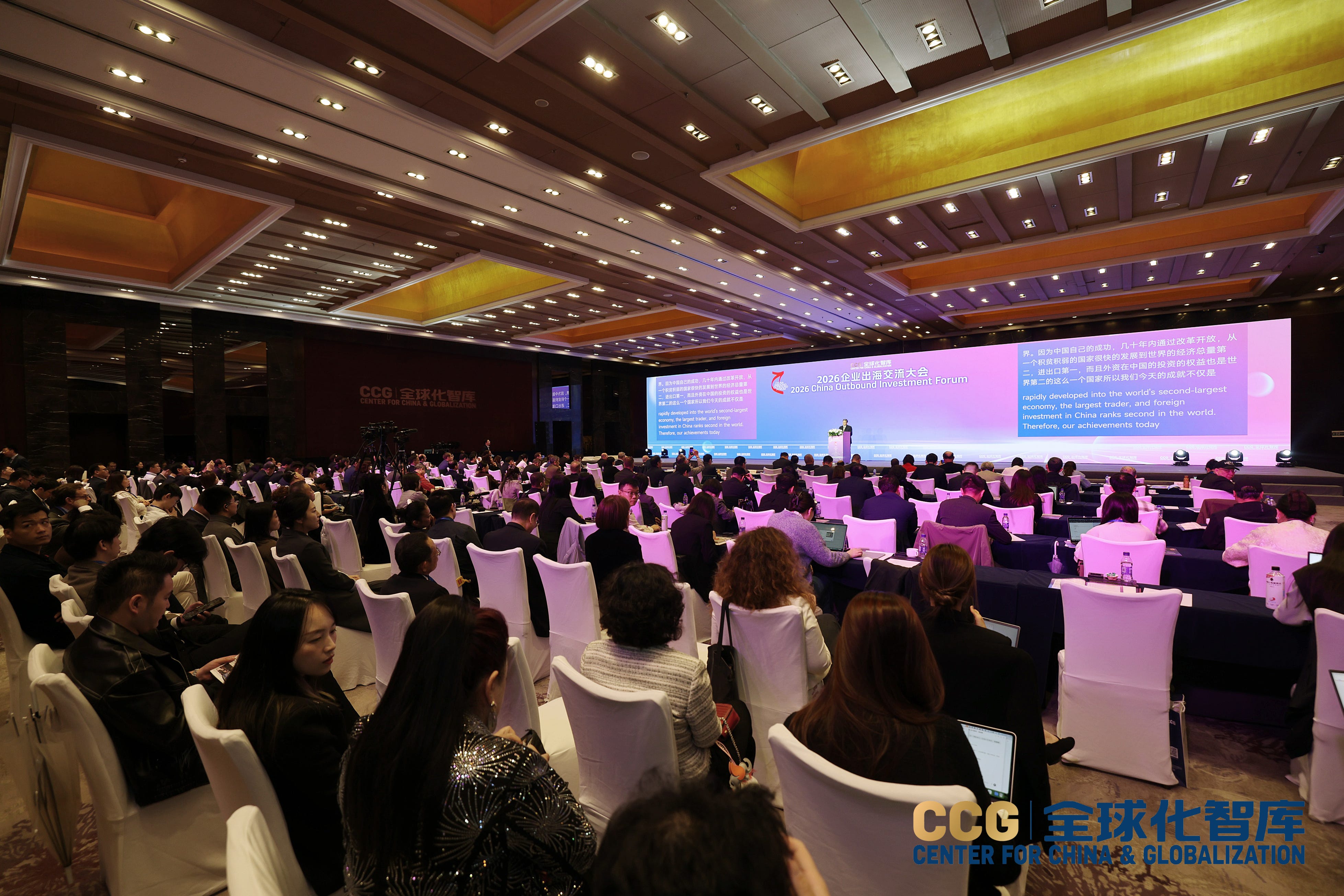
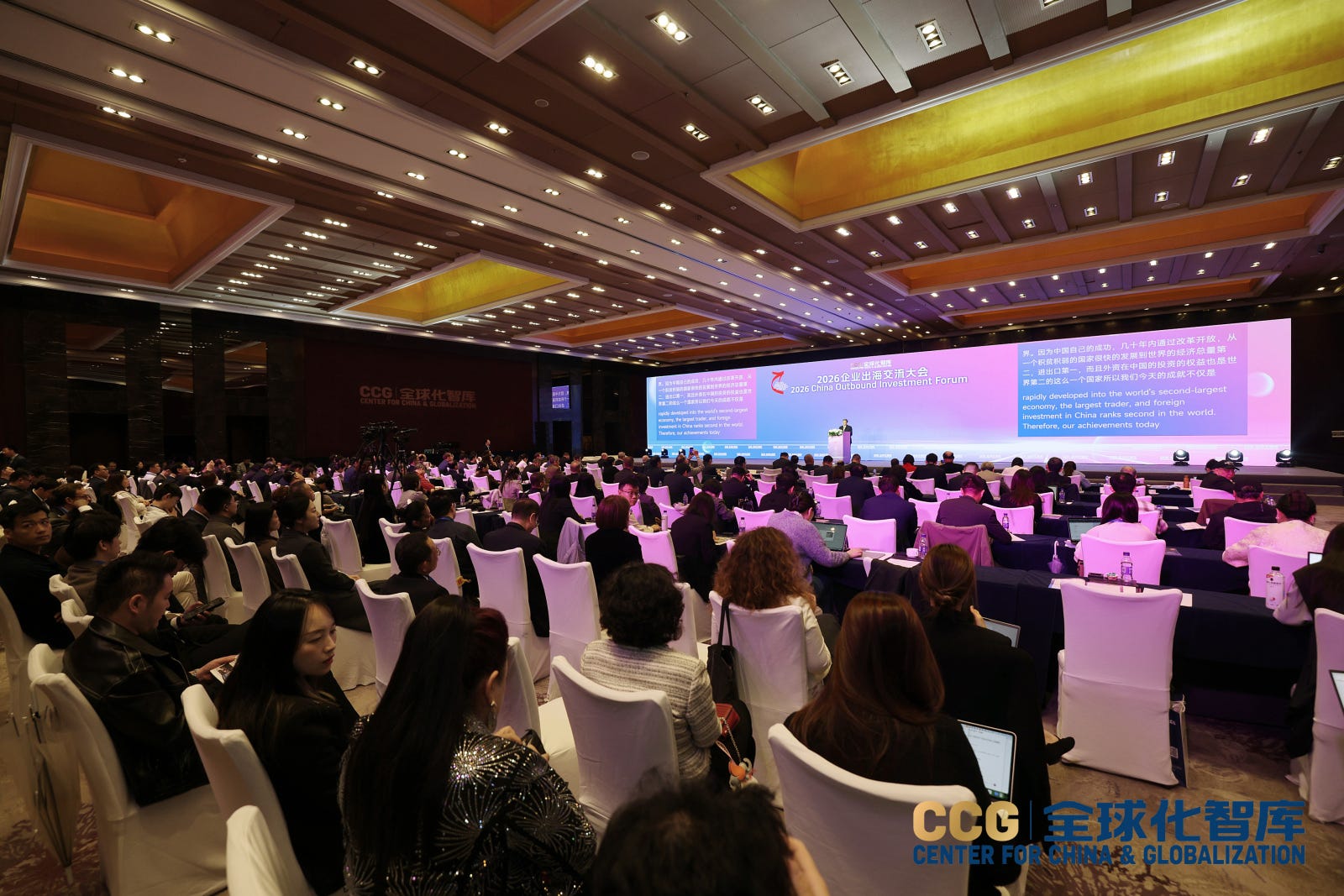
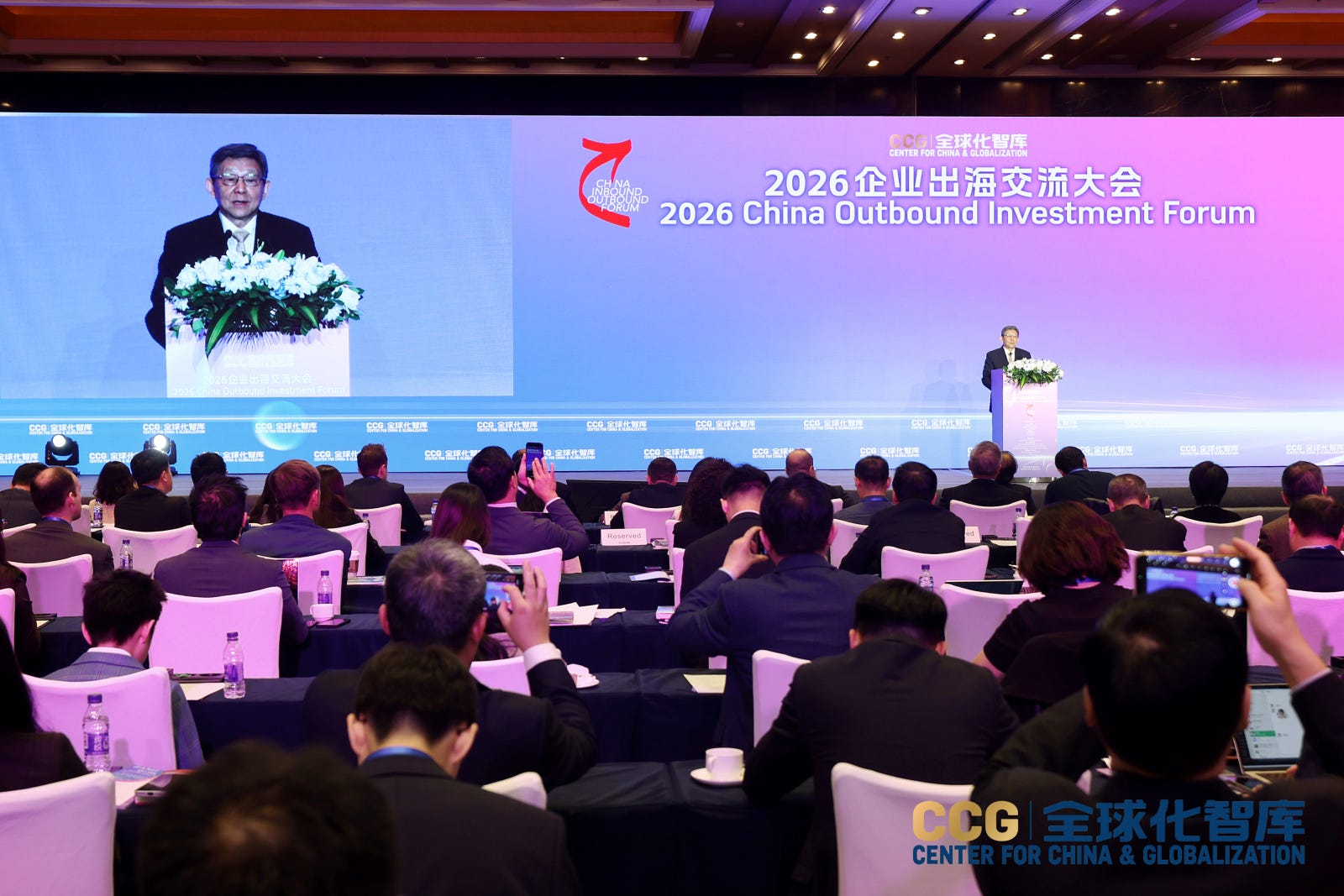
At the 2026 China Outbound Investment Forum hosted by the Center for China and Globalization (CCG) in Beijing on Saturday, October 17, Chen Deming offered wide-ranging reflections on why Chinese companies should go global, the choices they face in international markets, and the implications of artificial intelligence.
In his remarks, Chen, CCG’s Honorary Chair and former Commerce Minister of China, said that Beijing still has work to do to make life easier for Chinese companies investing abroad, particularly by securing investment agreements with other countries. He also rejected the idea that China’s trade surplus is simply a result of “overcapacity” and insisted that AI would not replace human intelligence.
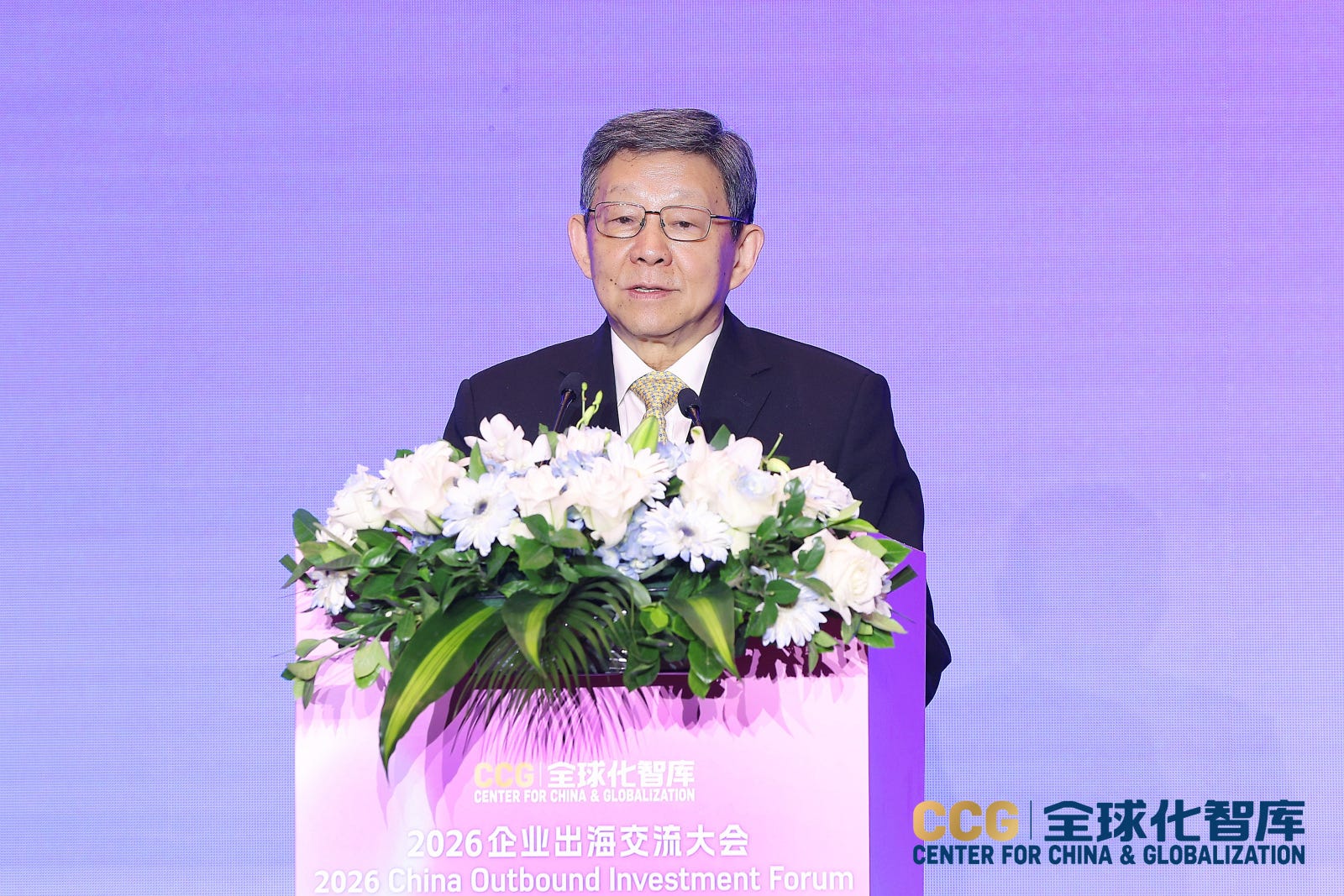

This transcript is based on a recording at the event and has not been reviewed by the speaker.
Remarks by Chen Deming, Former Minister of Commerce of China
I came to this CCG forum because I wanted to hear from business leaders about their experiences of going global.
A couple of days ago, I was in Singapore attending an international forum where much the same issues were discussed. I hadn’t prepared a speech for today, so last night I put together a few thoughts that I would like to share with you.
First of all, I think CCG has been doing some very valuable work over the years in exploring how Chinese companies can go global. I believe this is a very worthwhile direction to pursue.
But as everyone knows, it is really only in the past couple of years that Chinese companies going global has become a subject of such great interest, both at home and abroad, among business leaders and governments alike.
Why is that? Because history has increasingly demonstrated how necessary and important it is for Chinese companies to go global.
I learned a great deal from the presentations just now, although many of the speakers naturally focused on their own products and business approaches.
But there is one question I would like to discuss. Why should Chinese companies go global?
I think the first reason is China’s responsibility as a major country. In today’s globalised economy, China should share its knowledge, capabilities, and successful experiences with the rest of the world through the outward investment of its companies.
Look at China’s own success. Through several decades of reform and opening up, China has rapidly transformed itself from a poor and weak country into the world’s second-largest economy, the world’s largest trading nation in terms of imports and exports, and a country with the world’s second-largest stock of foreign investment.
These achievements are not simply the result of the advantages of China’s system or the hard work of the Chinese people. They also owe a great deal to the support China has received from the international community. That should never be forgotten.
And now that China has developed its own capabilities, it should give them back to the international community.
If other parts of the world remain troubled by geopolitical conflicts and instability, and their economies cannot develop, that is not good for China either.
So my first point is that China, as a major country, has responsibilities beyond its own borders.
Second, there is the situation of China’s domestic economy.
After decades of development, China has made tremendous progress, but there are still bottlenecks and difficult problems to overcome. In particular, the current situation of strong supply and weak demand is another reason for Chinese companies to consider going global.
Why do I say “strong supply and weak demand” rather than “overcapacity”?Because what this situation really reflects is weak demand and insufficient consumption, alongside substantial production and supply capabilities.
If it is simply described as overcapacity, it creates the impression that China’s excess production alone is responsible for international trade surpluses and deficits. That is not something China accepts.
Supply and demand are extremely difficult to balance across the entire world economy, let alone calculate precisely. The real question is how to increase consumer demand around the world. And that requires investment.
Many Chinese companies have already been through years of intense competition at home, and now they are entering foreign markets. This is a very important development.
So, to put it simply, Chinese companies have good reasons to go global: China’s responsibilities as a major country, the success it has achieved through reform and opening up, and the current imbalance between strong supply and weak domestic demand.
The second issue I would like to discuss is what the government should do to support companies going global. In other words, what are the government’s functions and responsibilities?
Earlier this morning, Vice Minister Chen Jian, who was responsible for outbound investment at the Ministry of Commerce for many years, gave us an excellent presentation. He discussed the State Council’s regulations, as well as specific rules issued by the Ministry of Commerce and other government departments.
There is one point I would particularly like to emphasise: China still needs to sign more specific bilateral investment agreements with key countries and regions. This is something I’ve come to appreciate through my own experience.
China had long sought to negotiate a bilateral investment treaty with the United States. During the Obama administration, negotiations on the treaty text had essentially been completed, with the provisions agreed upon by both sides. The two countries were approaching the final stage of reconciling their respective negative lists when Donald Trump took office as the 45th president of the United States.
His administration then brought the entire negotiation process to an end, and the talks have not resumed to this day.
Now that Trump is back in office as the 47th president and is calling for businesses to return to the United States, I wonder how different things might have been if China and the United States had concluded an investment treaty with a clearly defined American negative list.
At the international forum in Singapore, discussions also kept coming back to China-EU relations. How did the EU move from having a trade surplus with China to running a deficit?
I discussed this question with a former US secretary of defence and two former prime ministers, one from Denmark and the other from Australia.
I made two points.
First, China-EU trade cannot be judged solely by the often-cited figure of a €1 billion daily trade deficit on the EU side, because that only covers trade in goods. In services, China runs a trade deficit with the EU amounting to tens of billions of euros, and that needs to be taken into account as well.
Second, it would be wrong to describe the EU as economically backward. It is a very strong economic bloc. Even after factoring in its trade deficit with China, the EU still runs an overall trade surplus with the world. So Europe has considerable potential for further development.
Of course, US tariff policies have created difficulties for the EU’s exports to the United States, its largest export market. That makes the economic complementarity between China and Europe an especially valuable opportunity.
There is no point in quarrelling and walking away from the negotiating table. Both sides have to find ways of working together.
During those discussions, some European participants asked me why Chinese companies were not investing more extensively in Europe. Why, they asked, were some Chinese investments limited to processing and assembly? Could Chinese companies bring their supply chains with them when investing in Europe?
That struck a chord with me, particularly after hearing Chairman Jiang of Far East Holding Group speak today about Chinese companies expanding overseas together with their supply-chain partners.
But there is another point I want to make to my EU counterparts. China and the EU had been discussing an investment agreement for many years, going back to my time as Minister of Commerce.
When the negotiations were close to completion, President Xi Jinping personally called Charles Michel, then President of the European Council and Ursula von der Leyen, President of the European Commission, hoping that the agreement could move forward through the necessary legal procedures as soon as possible.
China would have to complete its own legal procedures, while the EU would have to go through the European Commission.
But then, over a very small issue between the two sides, the agreement was put on hold. So to this day, China and the EU still don’t have an investment agreement.
That means Chinese companies don’t know what the EU’s negative list is, what legal protections, investment incentives, and environmental standards are in place for them.
(While he was speaking, Chen requested that a portion of his speech be limited only to the room. This part has been omitted from this transcript.)
So, from the government’s perspective, once China has put its overall regulations in place, it is very important for the relevant government departments to negotiate and sign investment agreements with key countries and regions. Without these agreements, Chinese companies can encounter obstacles when investing abroad.
Take cross-border data flows in e-commerce, for example. Or national security concerns. How can security concerns be balanced with the need to promote investment and development? How can differences between the policies of the home country and those of the host country be addressed? These are all questions that need to be discussed.
China needs to take its own security interests into account while also considering the development needs of Chinese companies going global.
I was particularly struck by Chairman Jiang’s remarks just now. He talked about companies bringing their supply-chain partners overseas together, taking small steps and learning through trial and error, and developing local talent. These are not magic formulas. They are lessons he has learned through decades of practical experience. Every company going overseas needs to think about these things.
But the point I want to make today is that the government still has a lot of practical work to do, particularly in securing bilateral investment agreements with key countries and regions to protect Chinese companies investing overseas.
My third point concerns overseas investment in the age of AI. Ms Miranda Wang from PMI spoke about this earlier, and I think this may be a very important subject.
We also heard from Mr Kai-Fu Lee, who is an expert in this field. I would first wish him every success with his software in China and overseas. I may have some slightly different views from him about how AI can guide Chinese companies going global, but these are my personal thoughts.
I think there are many ways for Chinese companies to invest overseas.
Since we’re talking about going global today, the first step could be trading goods, testing the waters, and opening up new markets. Investment comes next.
The third step is to build a complete system of overseas operations. Chinese companies may not be fully ready for that yet. It will take a collective effort, including closer coordination among companies and guidance from national macroeconomic policies.
But overseas investment has already become much more diversified. Greenfield investment does not necessarily have to be the main option. Chinese companies can acquire controlling stakes or minority shareholdings. They can enter into cooperative business arrangements, provide technical services, or license patents. These are all ways of entering international markets.
In some countries in particular, such as the United States, there is resistance to direct Chinese investment. But Chinese companies can still license their patents or provide technical services to American businesses. In fact, this is already happening.
So I think that in the AI era, with more information available, Chinese companies have more options to consider when investing overseas. They can carefully assess investment opportunities themselves or ask independent third parties to conduct research and assessments. Talent is also very important.
But what I really want to say is that AI won’t necessarily replace human intelligence.
In my view, human society has passed through the agricultural age and the industrial age. It is now approaching, or perhaps already beginning to enter, an age of intelligent society.
This transformation may take not just 50 or 100 years, but much longer. What is known about AI today is only the beginning.
On 6 September this year, ChatGPT released its new GPT-6 model, which was regarded as having reached the stage of AGI, or artificial general intelligence. If that marks an initial step from AI toward AGI, many more changes can be expected.
Take the relationship between CPUs and GPUs, for example. CPUs are the processors used in conventional computers, while GPUs, such as those developed by Nvidia, are specifically used for AI computing.
Previously, when large amounts of computing power were being used to build and train AI models, the ratio of CPU to GPU requirements was around one to eight. But with the emergence of AGI, AI is no longer simply responding to human questions one at a time. It can continue reasoning, process information, and search for signals from around the world, even when it is no longer directly engaged in a conversation with a person. That increases its interaction with the outside world and places greater demands on CPUs.
As a result, the ratio of CPU to GPU requirements has shifted to around one to four, and it may eventually reach one to two or even one to one. This represents a major opportunity for Chinese companies investing overseas.
When it comes to computing power, China is still behind the United States, partly because of American restrictions and sanctions. But in applications, particularly in the physical world, I don’t think China is moving any slower.
So when Chinese companies go abroad, they can bring their existing open-source software and their strengths in real-world applications to support development in other countries.
But human beings will not be replaced by AI. The future will be a society where human intelligence and artificial intelligence coexist.
If AI advances so quickly that technological progress exceeds what human beings can cope with, what would happen to the world? Humanity would not allow that to happen. The consequences could be frightening.
So when President Xi Jinping met with President Trump in the United States, they agreed that the two countries should discuss AI governance and that governments need to play a role.
Without government oversight, what would happen if AI technology were fully applied to warfare? Imagine tens of thousands, or even hundreds of thousands, of drones flying together like a black carpet across the sky, each carrying missiles and capable of identifying its targets. What kind of warfare would that create?
Nobody wants to be replaced by AI. From a theoretical perspective, human beings are carbon-based life forms. Through sunlight, water, and the food that comes from plants and animals, people obtain energy and are able to create many things. But there is no such thing, at least at present, as an independently existing silicon-based form of life.
One of the defining characteristics of life is the ability to reproduce itself. Today’s AI systems, as well as computers and robots operating in the physical world, still depend on electricity. They cannot yet generate their own electricity. They cannot replace the electricity that humans supply to keep them running.
So in the future, artificial intelligence and human intelligence will have to work and evolve together. If AI development completely exceeds humanity’s ability to cope with it, human beings will seek to bring it under control.
That brings me to another point raised earlier by Professor Kai-Fu Lee: management.
Recently, my former mentor, Professor Zhou Sanduo, the founding dean of the business school at Nanjing University, completed a new book. Many of the management textbooks used in China today were written by him. He’s now 93 years old, and I believe his new book will be published next month.
Forgive me. I’m not trying to advertise my mentor’s book. The reason I mention it is that it has made me think about management in the AI era.
I would compare the changes taking place to a Copernican revolution. In terms of efficiency and many other aspects of management, AI may well become more capable than human beings.
But think about this. Without people taking initiative, and without the mutual understanding and close cooperation between people, AI cannot get the job done. Human emotions and respect for life are not things AI can address.
That is why I am convinced that the society of the future will be one where artificial intelligence and human intelligence develop together. Everything being said today is provisional. Fifty or a hundred years from now, if some of you are fortunate enough to live that long, you may look back and see how much the world has changed from what is being discussed here today.
I firmly believe that human civilisation will endure. After all, the Earth itself has about another 4.5 billion years of life ahead of it, and the oceans will remain for another billion years or so. At the very least, humanity should continue to exist throughout that time.
So when Chinese companies go global and think about serving businesses and people in other countries, they need to take a broader view. What approaches will work best? How can global consumption be increased? How can productive capacity be expanded? Thinking about these questions can lead to more comprehensive decisions.
Companies should not allow themselves to become constrained by AI. But neither should they reject AI and stick to their traditional ways of doing things.
I have great confidence in the capabilities and determination of the Chinese people. China’s progress in using open-source technologies across different fields has surprised many American scientists. Even Jensen Huang, speaking in Taiwan, expressed surprise at what China has achieved. I think China has done very well in this respect.
So I sincerely hope that all the entrepreneurs here today will embrace new ways of thinking in the AI era and achieve even greater success as they go global.
I also hope the Chinese government will continue working with other countries to conclude bilateral and multilateral investment agreements, establish clear negative lists, and spell out investment incentives, the responsibilities of host governments, and even the circumstances under which compensation may be required. All these things need to be clearly defined.
I wish you all every success. Thank you very much.
(End of remarks. The forum then broke for lunch.)