

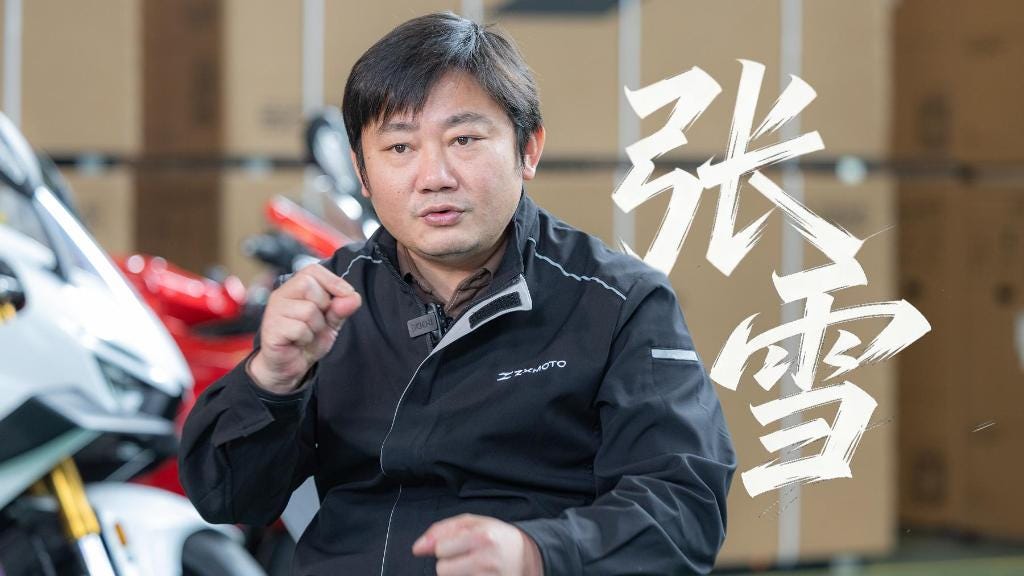
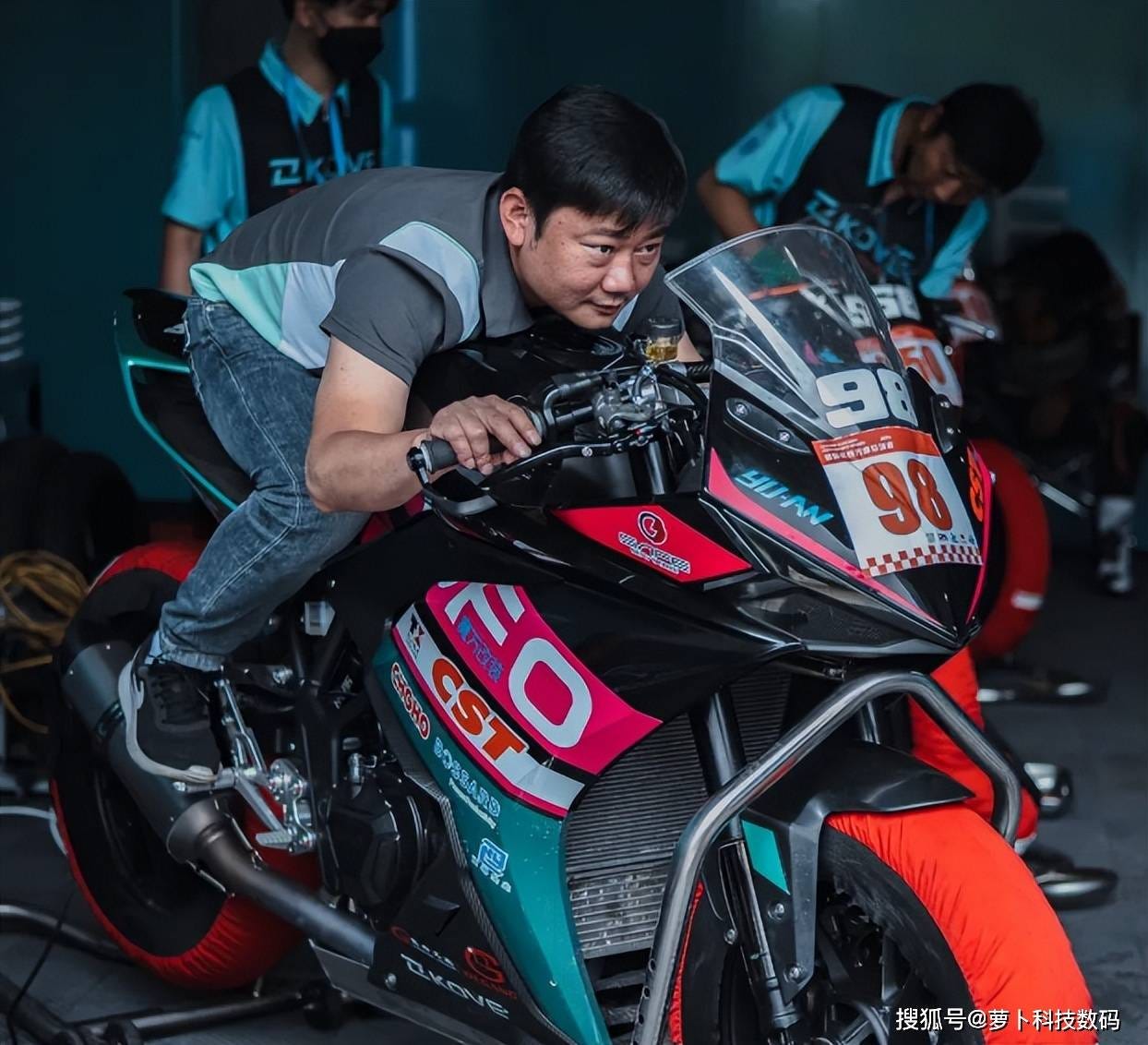
Zhang Xue’s motorcycle brand, ZXMOTO, made history at the Superbike World Championship (WSBK) by securing victories in both WorldSSP (Supersport) races at the Portugal round on 28-29 March 2026. This marks the first time a Chinese-made motorcycle has triumphed in a major international competition, defeating industry giants like Yamaha and Honda, igniting national pride and heated discussions.

The victory, with a commanding 3.685-second lead, quickly went viral across Chinese social media. Soon, Zhang’s achievement was highlighted in interviews with Xinhua News Agency, the state news agency, and the China Media Group, the state broadcaster.
Zhang’s win was all the more remarkable against his humble background. Born in rural Hunan and without formal engineering training or even a secondary school education, Zhang developed his skills in motorcycle repair shops, defying conventional pathways to success.
In many ways, Zhang’s journey highlights a larger issue within China’s academic and industrial sectors, argued a recently viral article on Chinese social media.
The commentary, published on the WeChat blog Dream on 5 April 2026, draws on a comparison between the author’s doctoral supervisor, who made many “breakthroughs” on motorcycle engines within China’s academic research ecosystem, yet never been able to produce a commercially successful product, while Zhang, who, despite lacking formal academic credentials, managed to create a championship-winning motorcycle.
The article emphasises how China’s academic system, with its focus on publication and grant metrics, sidelines the gritty, exhausting trial-and-error process essential for real-world innovation. The fear of failure, which can derail academic careers, discourages risk-taking and experimentation. As a result, while academic institutions excel at producing theoretical breakthroughs, they often fail to translate those ideas into marketable technologies.
The larger question the commentary raises is: how can China bridge the gap between its academic research and practical innovation? If China wants to compete globally, it must support creators like Zhang—individuals who are not bound by the constraints of institutions but are driven by the desire to create something real and lasting.
By 13 April, the original post had been viewed more than 100,000 times, not including the many reposts across other WeChat blogs. The author of the article is anonymous.
—Yuxuan Jia
我的博导也是干摩托车发动机的,他为什么没干出来
My doctoral supervisor also works on motorcycle engines. Why has he never made one that could win?
When Zhang Xue’s bike won at Superbike World Championship (WSBK), my phone got carpet-bombed from two directions at once: the academic world and the industrial world.
One person shared the championship headline with the caption, “A grassroots comeback story.” Another forwarded an analysis of Zhejiang Venture Capital leading a 90 million yuan Series A and sighed, “So state capital has finally put its glasses on.”
Then someone DMed me: “Isn’t your doctoral supervisor also in motorcycle engines? How come he never made anything like this happen?”
Ouch. That hurt.
My supervisor is a doctoral adviser in internal combustion engines at one of China’s elite 985 universities. A professor. A State Council special allowance expert. Principal investigator on major national projects. Papers piled high. Patents in the dozens. He studies things so microscopic that he can give you thirty pages on the turbulent combustion mechanism inside a cylinder.
And yet after thirty years of this, never mind a world title, he has not even produced a genuinely decent Chinese motorcycle engine.
Meanwhile, Zhang Xue, who did not even finish secondary school and started out repairing bikes, managed in a few short years to shove a Chinese motorcycle onto the top of the world.
So what exactly is the missing ingredient here? Is it really a PhD diploma?
I. Why the professor’s engine lives forever in PowerPoint
Let me start with a true story.
While I was doing my doctorate, my supervisor took on an industry-funded project from a major original equipment manufacturer (OEM) to develop a 350cc twin-cylinder engine. The budget was several million yuan, and the morale was sky-high. We ran combustion simulations in ANSYS, performance optimisation in GT-Power, produced hundreds of CAD drawings, and wrote more than 10,000 pages of technical reports.
A year later, the project was wrapped up. The review panel loved it. “Internationally advanced in theoretical level.” “Technically sound and feasible.”
And then?
Nothing.
The drawings went to sleep on a hard drive. The reports were tucked away in a cabinet. That engine was never built, never mind fitted into a bike, road-tested, or let loose anywhere near a racetrack.
Why?
Because between the drawing and actual prototype lies a swamp of tooling, casting, machining, heat treatment, assembly, dyno runs, and on and on. Every step costs money. Every step needs people. Every step needs suppliers. Universities are not set up for that, while companies regard the risk as too high. When the project money runs out, the whole thing quietly expires.
In the university valuation system, “built it” does not count as an achievement. “Published it” does. So who is going to waste precious time on grubby little things like prototyping and tooling?
My supervisor used to tell us, “We do scientific research, not products. Our job is to explore mechanisms, not build engines.”
Fair enough. But after thirty years of “exploring mechanisms”, may I gently ask how, exactly, not a single usable engine has ever materialised?
Zhang Xue does not have this distinction between “research” and “product”. He wants an engine that runs and wins. If he cannot build it, he cannot sleep. If the supply chain is weak, he goes and fixes it. If the moulds are too expensive, he finds a way to pay for them anyway. If the dyno run fails, he tears it apart and starts again.
To him, an engine is not a symbol in a paper. It is a lump of metal that has to be touched, tuned, tightened, and made to work.
II. The university’s “good student trap”
My supervisor is not uncommon. In fact, among Chinese university teams working on engines, the number that can genuinely turn out a real product is vanishingly small.
The reasons are complicated, but the heart of it is simple: universities and industry are playing two completely different games of evaluation.
In academia, your worth is measured in papers, grants, prizes, and titles. The more cutting-edge, theoretical, and “esoteric” your work appears, the easier it is to publish in top journals, win funding, and climb the ladder. Whether the thing can actually be used, whether it works well, whether anyone would pay for it— that’s not important.
In industry, there is one test: can the thing you make perform, can it win, can it make money?
My supervisor has spent his whole life playing the first game, and he has been very successful. But his success is academic success, not product success.
Zhang Xue, from the start, was never invited into the first game. He had to play the second. And yet the second is the one that produces real value.
This is not to say academic research is meaningless. Genuine theoretical breakthroughs matter, of course. The question is: how much university research actually amounts to a real theoretical breakthrough, and how much is produced for the sole purpose of generating yet another paper?
My supervisor’s research area is “spray combustion mechanisms in direct-injection engines”. Very frontier. Very publishable. But the fuel he studies is iso-octane, not real petrol. The injector is a custom-built, idealised unit, not a mass-produced component. The combustion chamber is a simplified, optically accessible model for visualisation, not a real cylinder head.
In other words, it is nowhere near a real engine.
And that, ironically, is precisely why this kind of research—far from reality and close to publication—does so well in winning grants and producing SCI papers.
So who is left to do the filthy, exhausting, long-cycle, hard-to-publish work of real engine development?
III. Writing grant proposals and building machines are two different species of talent
My supervisor has another strength: he is magnificent at writing project applications.
National Natural Science Foundation of China, key R&D programmes, the 863 programme, the 973 programme—whatever the funding scheme, he writes proposals like a concert pianist. The technical roadmap is elegant. The innovation points are crisply extracted. The expected outcomes glitter like New Year decorations.
The reviewers take one look and think: solid foundation, clear thinking, strong innovation, give him the money.
Then the project gets done, and the actual output often trails the original proposal by several orders of magnitude.
This is not just his problem. It is practically endemic in academia. “Proposal-writing” has become a craft in its own right, with only a passing acquaintance with the actual business of doing research. One could even argue that the more gorgeous the proposal looks, the more one should brace for disappointment.
Zhang Xue cannot write proposals. He has never even written an undergraduate dissertation. But he can build machines.
He can assemble an engine blindfolded. He can hear a glitch and tell you where the problem is. He can run a few laps and know exactly what needs tuning. He can spend three days and nights in a supplier’s workshop just to shave a part tolerance down from 0.05 mm to 0.02 mm.
My supervisor cannot do those things. More to the point, he doesn’t want to.
In the academic reward system, being good at building machines counts for nothing. You do not make professor by improving machining accuracy by 0.01 mm. You get promoted by publishing an SCI paper with an impact factor of 3.
So the people who really can build machines either go into companies or start their own businesses. The people who stay at universities are the ones who can write the proposals.
And that creates a tragic mismatch: universities are full of people who are excellent at writing proposals, funded by the state to study problems ever farther removed from real demand, while the practical problems that actually need solving are left untouched because no one wants to and is not equipped to tackle them.
IV. In universities, trial and error is a luxury item
Zhang Xue’s success was built on a mountain of failure.
He got pushed around by investors. He borrowed money to make payroll. Prototype tests blew up. Bikes crashed on the track. Every failure could have wiped him out. He took the blow, got up, and kept going.
That loop of trial, learning, and iteration is an essential part of engineering innovation.
But in academia, trial and error is a luxury item.
For one thing, grant-funded projects do not really tolerate failure. Foundation money comes with budgets, timelines, milestones, and inspection targets. If you spend it on trial and error and then arrive at the review deadline with nothing to show, that does not go down well.
For another, academia does not really let you fail either. You need a steady stream of papers, a constant round of grant applications, and the continuous accumulation of academic reputation. One major failure can leave you limping for years.
So university researchers naturally choose low-risk, high-output topics, use mature methods, make tiny tweaks, and publish safe papers. The genuinely high-risk, high-return breakthroughs are left alone because almost no one can afford to touch them.
Zhang Xue does not carry that burden. He does not need papers. He does not need grants. He does not need promotion reviews. He just needs to build an engine that wins. If it fails, it fails. He tries again.
Having nothing to lose turns out to be just the thing breakthrough innovation needs.
V. The industrial chain’s little “vacuum zone”
At this point, someone may ask: if universities cannot do real machine development, why do companies not step in?
That leads to one of the deeper structural problems in Chinese manufacturing: the vacuum in the middle of the industrial chain.
Take motorcycle engines. Between basic research and mass production, there is a huge engineering gulf. Universities do the research. Companies do the mass production. But who translates the research into an engineering solution that can be mass-produced?
In other countries, that role is often taken by engineering development firms or by central research institutes inside large companies. They do not handle mass production directly, nor do they engage in pure basic research. Instead, they focus on the engineering work of getting from principle to prototype.
But in China, such institutions are extremely rare. Large firms want short-term returns and have little appetite for long-cycle engineering development. Universities cannot do real machine work. Start-ups have the drive, but not the resources.
Zhang Xue is, in essence, a sort of engineering developer. He took existing technical principles and, through endless engineering tests and iteration, turned them into an engine that can run and win.
But there are too few people like that. And they often do not get the support they deserve.
My supervisor once tried engineering development. He assembled a team and wanted to turn a lab prototype into an engineering prototype that could be mass-produced. Yet halfway through, they realised the cost was far beyond what was expected. Tooling would cost millions. Dyno runs would cost millions. Road testing would cost millions more. The university would not pay. The company would not invest. So the project died.
My supervisor sighed and said, “Forget it. Better to write proposals.”
And so the prototype reverted to several papers preserved in a laboratory.
VI. The institutional question: who pays for the Zhang Xues?
Zhang Xue succeeded because he ran into Focus Capital and Zhejiang Venture Capital Group.
One was willing to put in 20 million yuan at the angel stage. The other led a 90 million yuan Series A. And Zhejiang Venture Capital, despite being state-backed, astonishingly did not impose any requirement to reinvest locally. They let him stay in Chongqing instead of forcing him to move to Zhejiang.
That is extremely rare.
Most capital will not back a hard-tech founder who did not finish secondary school, will not back a company showing losses on paper, and will not back a technical route that takes five years to validate.
Later, one of Zhejiang Venture Capital’s investment managers said they invested because they saw his obsession with technology and his determination to make it succeed.
But this kind of investing that comes down to backing the person depends heavily on the judgment and courage of individual investors. It cannot be systematised or scaled.
What is needed is a system that gives the Zhang Xues of the world some soil to grow in.
That does not mean every grassroots founder should be handed 90 million yuan. It means the evaluation system, the financing system, and the support system should be able to recognise people and firms that are “not highly credentialled but startlingly capable”, “currently loss-making but hugely promising”, or “working on a non-consensus path that is nonetheless the right one”.
At the moment, the system plainly does not do this. Before Zhang Xue won the championship, Chongqing had not given him “a single cent”. He had to borrow money to pay his staff.
Meanwhile, doctoral supervisors collect millions in public funding every year to work on “advanced technologies” that will never be used in the real world.
Isn’t this ridiculous?
VII. Coda: the professor’s awkward moment
My supervisor also watched the news of Zhang Xue’s championship that day.
He was silent for a long time. Then he said, “That kid is the real deal.”
I asked him, “Professor, do you regret it? If you had not stayed in academia, if you had gone into industry instead, could it have been different?”
He cut me off. “Regret what? I’m suited to writing proposals. If you asked me to do tooling, run supply chains, and argue with suppliers, I couldn’t do it. Everyone has their lot in life.”
It was honest and clear-eyed. But there was bitterness in it, too.
It is not that he did not want to make something real. It is that he could not.
Because the system does not let him. The evaluation system does not reward it. Capital does not trust that he can do it.
Zhang Xue made it happen not because he is necessarily cleverer than my doctoral supervisor, or because he worked harder, but because he happened to occupy one of the few positions from which such a thing was possible: outside the system, free of academic assessment pressure, nothing to lose, and lucky enough to meet investors who understood him.
But China cannot keep relying on the luck of the occasional Zhang Xue.
What is needed is a system in which every capable “Zhang Xue”, regardless of education, regardless of whether they are inside the establishment or outside it, has a real chance to build something that works.
That means reforming the evaluation system so that actually solving problems is valued more than publishing actual papers. It means opening financing channels so that “non-consensus innovation” can get support. It means rebuilding the university-industry ecosystem so that academic theory and factory-floor practice truly align.
Otherwise, the next Zhang Xue may still be in some repair shop, unnoticed.
And supervisors like mine will go on writing proposals, publishing papers, and sighing at PowerPoint decks.
Engines do not spin up on their own. They need people willing to get their hands dirty.
China’s hunger for the unvarnished

At the end of March, China fixated on two men. One was mourned. Zhang Xuefeng, the country’s most famous adviser on university majors and admissions, died suddenly on March 24 after collapsing while exercising at work. The other was celebrated. ZXMOTO, founded by Zhang Xue, a former mechanic, won twice on a world championship circuit, turning a niche mo…

A little bit of context about ZXMOTO's achievements, which, while genuinely impressive and a breakthrough for the sport in China, are not quite as momentous as Chinese media have made out.
The top level of international competition is Moto GP, followed by Moto2 and Moto3 (roughly equivalent to F1, F2 and F3). Then comes WorldSBK (GT3/DTM). And below that is WorldSSP (think GT4 or a national touring car series) - and it's at this level where Valentin Debise won two races for the Chinese team.
My intention is not to discredit here, but "world championship" and comparison to Yamaha and Honda in the opening paragraph gives the impression right from the start that China has risen to the top of the motorcycle pyramid, which is not the case - at least not yet! It's important (IMO) to set realistic expectations because Chinese sports media has a long history of breathlessly over-celebrating achievements which are short-lived (Zhou Guanyu and Su Bingtian are two examples that come to mind), needlessly setting up disappointment further down the road.
This gap between research and commercialisation isn’t unique to China, it exists in all societies. And I would argue that a lot of random variables affect commercialisation, we need to avoid “survival bias” and attribute commercial success solely to effort.