


Gao Peiyong is an Academician (学部委员) of the Chinese Academy of Social Sciences (CASS), a title reserved for the highest echelon of its scholars, and previously served as a Vice President of the government-run CASS, meaning he is at the Vice Minister level in the Chinese hierarchy.
Speaking at Peking University on 17 January 2026, he offered a blunt diagnosis of China’s weak-demand problem: Beijing has pushed hard on stimulus, but households remain cautious because job prospects, income growth, and expectations feel uncertain. The real levers, in his view, are distribution reform, a fuller shift towards public finance, and a modern, universal social security and transfer-payment system.
An edited transcript of his speech was published on 19 January on the website of Peking University’s Guanghua School of Management, and is also available on the school’s official WeChat blog.
高培勇:促消费,关键是激发居民消费内生动力
Gao Peiyong: Boosting Consumption: The Key Is to Stimulate the Endogenous Driving Force of Household Consumption
On 17 January, 2026, the 27th Peking University Guanghua New Year Forum was held at the Peking University Hall. The theme of this year’s forum was “Domestic Demand Led Growth, Coordinated Efforts for Expansion, and Launching a New Journey for the ‘15th Five-Year Plan.’” Gao Peiyong, an Academician 学部委员 of the Chinese Academy of Social Sciences, attended the forum and delivered a keynote speech.
In a speech titled “Boosting Consumption: The Key Is to Stimulate the Endogenous Driving Force of Household Consumption,” Gao Peiyong argued that efforts to boost consumption must confront four “new challenges”. First, during the 15th Five-Year Plan period, China needs to keep economic growth within a reasonable range. Second, as consumption becomes both the primary engine of growth and a stabilising anchor, its importance is increasingly salient. Third, the contradiction of strong domestic supply and weak domestic demand has become more pronounced, with the central bottleneck lying in weak consumption. Fourth, today’s shortfall in consumption demand has a distinctive profile: it combines rising volumes with falling prices, and is driven mainly by weaker expectations and subdued confidence rather than a conventional supply–demand imbalance.
He emphasised that consumption is, in essence, a function of income and wealth accumulation, and that it is necessary to distinguish between near-term “consumption potential” and long-term “consumption capacity”. In his framing, policy support should focus on releasing near-term potential, while reform innovation should concentrate on strengthening long-term capacity.
Addressing weak consumption, he argued, amounts to a profound transformation of the distribution system. It requires coordinated action across demand, supply, and expectations, as well as better alignment between the two systems of policy measures and structural reform. He highlighted a set of concrete directions, including reshaping the fiscal and taxation framework, accelerating a comprehensive shift towards public finance, remedying weaknesses in the provision of basic public services, building a modern system of social security and transfer payments, and strengthening expectations management. The objective is to unlock households’ endogenous momentum to consume, thereby providing solid support for the goal of basically realising socialist modernisation by 2035.
Below is an edited transcript of his speech.
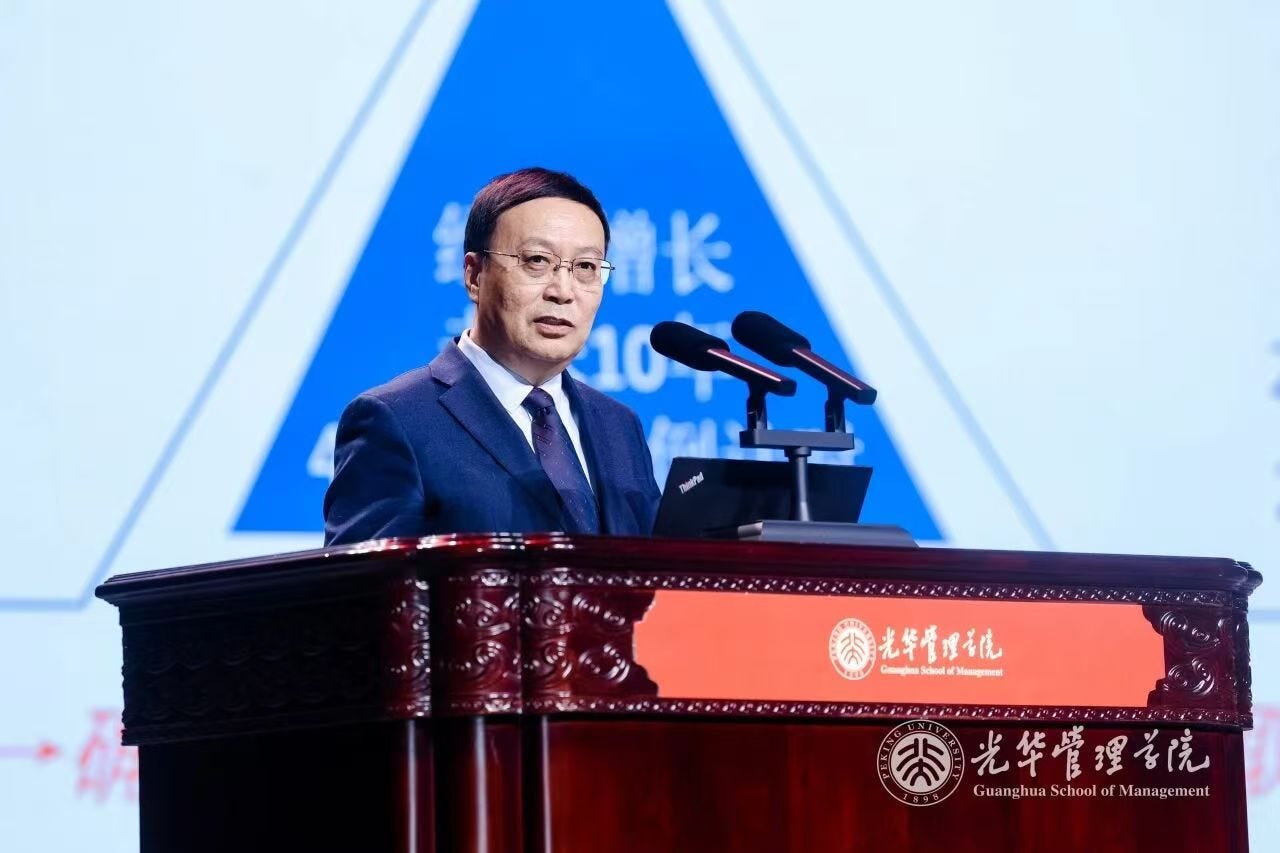
Distinguished guests, teachers, and students:
Hello everyone. The title of my remarks today is “Boosting Consumption: The Key Is to Activate the Endogenous Momentum of Household Consumption.”
Boosting consumption, also described as expanding or stimulating consumption, is not a new topic. But at this particular moment, as the 15th Five-Year Plan period begins, the task looks different in one important respect: policy efforts to boost consumption should focus more directly on strengthening households’ endogenous willingness and capacity to consume. That is the core point that needs to be made clear.
I. Facing squarely four new challenges
The Annual Central Economic Work Conference has put forward the concepts of long-standing and new challenges. In the case of boosting consumption, what are the new challenges behind this familiar agenda?
The first is the challenge to keep economic growth within a reasonable range during the 15th Five-Year Plan period. The 20th National Congress of the Communist Party of China set the goal of basically achieving socialist modernisation by 2035. With only ten years remaining until 2035, the 15th Five-Year Plan period is a critical phase for laying the groundwork and scaling up efforts.
The Fourth Plenary Session of the 20th Central Committee of the Communist Party of China further proposed that the 15th Five-Year Plan period should deliver decisive progress towards basically achieving socialist modernisation. This is not merely a qualitative aspiration; it also comes with firm quantitative requirements. One key benchmark is that per capita GDP should reach the level of moderately developed countries. Using 2025 figures, the entry threshold is roughly US$25,000 to US$26,000. China’s per capita GDP in 2024 was US$13,500. In other words, per capita GDP would need to roughly double over the next ten years to meet that benchmark.
This implies that China’s development agenda has entered a “countdown” phase. Any discussion of boosting consumption must therefore start from a clear premise: over the next decade, growth needs to be kept within a reasonable range.
The second challenge is: What will drive and sustain growth within a reasonable range? A broad consensus has now formed that consumption is both the primary engine of economic growth and a stabilising anchor. Put plainly, keeping growth within a reasonable range depends mainly on domestic demand—and, within domestic demand, first and foremost on consumption. Any discussion of boosting consumption has to engage with this proposition directly.
The third challenge is that, within the realm of domestic demand, the most prominent constraint at present is weak consumption. The Central Economic Work Conference noted that “the contradiction of strong domestic supply and weak domestic demand is acute.” The clearest expression of “weak demand” is, precisely, sluggish consumption.
The 2025 trajectory of growth in total retail sales of consumer goods illustrates this clearly. Growth reached 6.4% in May 2025, then fell steadily, dropping to 1.3% by November. December data have not yet been released, but the trend points to a level around 1%, or slightly above. [In December, the total retail sales of consumer goods in China rose by 0.9% year on year. The data was released on 20 January, three days after Gao’s speech. —Yuxuan’s note]
2025 was the year in which China’s fiscal and monetary policies were mobilised most intensively to support consumption, with the associated policy costs likely reaching historical highs. When the relationship between policy inputs and outcomes is taken into account, weak consumption necessarily emerges as the central issue. If the objective is to expand domestic demand, the priority must be to overcome this weakness in consumption.
The fourth challenge is that today’s shortfall in consumption demand has distinctive features of its own. Taking total retail sales of consumer goods as the core indicator, insufficient consumption can be divided into four scenarios: volume and prices rising together; volume and prices falling together; volume rising while prices fall; and volume falling while prices rise. The weakness in consumption demand in 2025 falls squarely into the third category—volume rising while prices fall.
Data released by the Ministry of Culture and Tourism on 21 October 2025 can serve as supporting evidence. In the first three quarters of 2025, domestic residents made 4.988 billion trips, an increase of 18% year on year, while total tourism spending reached RMB 4.88 trillion, up 11.5%. These headline figures appear robust, but the gap of 6.5 percentage points between the two growth rates is telling. Average spending per trip actually declined, from RMB 1,024 in 2024 to RMB 970.
II. Telling four “new stories” well
The domestic travel data cited above show a distinctive pattern in current domestic consumption: volume is rising, while prices are falling. This suggests that China’s economy has new stories to tell, and that consumption, as part of the broader economic picture, also has new stories. The basic logic behind these new developments needs to be explained clearly and made widely understood.
The first “new story” concerns insufficient consumption demand under the intertwined dynamics of rising volume and falling prices. When discussing total retail sales of consumer goods, the scale of consumption, and related indicators, it is essential to separate the “volume” and “price” components. In essence, consumption is volume times price. At present, the main source of consumption weakness lies mainly in falling prices, and these price declines are not the result of changes in market supply-and-demand relations.
The second “new story” is to look beyond the surface and identify what sits behind insufficient consumption demand—namely, expectations and confidence. The tourism market provides a clear example: the core reason per-capita spending has fallen is not shifting supply-and-demand conditions, but weaker market expectations and subdued consumer confidence. What looks like weak demand on the surface is, at its root, weaker expectations; what appears to be insufficient consumption is, in substance, insufficient confidence.
The Government Work Report delivered at the 2025 National People’s Congress identifies one particularly prominent contradiction: “Sluggish domestic demand was compounded by weak public expectations .” Linking weak domestic demand with weak expectations in discussing the prominent challenges facing China’s economic performance is something that warrants special attention.
The third “new story” that needs to be told well is the relationship between pressures on employment and income, weaker expectations, and insufficient demand.
What has led to weaker market expectations and a lack of confidence across society? The draft proposals on the 15th Five-Year Plan issued by the Fourth Plenary Session of the 20th CPC Central Committee explicitly note that current economic performance faces the challenge of “considerable pressure weighing on employment and personal income growth” The Central Economic Work Conference contains similar language.
It is precisely these pressures on employment and income growth that have weakened households’ expectations about future job prospects and income growth, thereby suppressing current consumption demand.
The fourth “new story” is the need to view consumption through three dimensions: demand, supply, and expectations. The Annual Central Economic Work Conference in 2021 made an important judgment with a historic turning-point significance: “China’s economic development is facing pressure from demand contraction, supply shocks and weakening expectations.”
Re-reading this statement at today’s historical juncture, it is more than a list of problems and contradictions. More importantly, it provides a framework for understanding them. Whether the task is to discuss consumption or to assess the broader economic situation, the approach must differ from the past: demand, supply, and expectations need to be examined together, as part of an integrated analysis.
III. Reaffirming four basic common understandings
In exploring how to boost consumption amid profound changes in the economic landscape, several points basic to economic reasoning need to be reaffirmed and kept firmly in view.
First, consumption is a function of income and wealth accumulation. Changes in the pattern of income and wealth accumulation shape the direction of households’ expectations and confidence. When pressures on employment and income alter expectations and lead to insufficient consumption, efforts to boost consumption must start with improving the underlying pattern of income formation and wealth accumulation.
Second, it is important to distinguish between consumption’s near-term “potential” and its long-term “capacity”. Near-term potential refers mainly to situations in which households have the money to spend but choose not to, or spend less; what can be done is to release that consumption demand. Long-term capacity mainly concerns situations in which households have no money or not enough money to consume; the policy task is to strengthen their real purchasing power. The two challenges require targeted measures with differentiated priorities.
Third, policy support and reform innovation each have their own roles. The Central Economic Work Conference proposed that “we must enhance the synergy between reform and policies, and promote sustained improvement in economic performance and market expectations.” Applied to boosting consumption, this means achieving a dual-engine approach, with reform innovation on one track and policy support on the other, and a clear division of labour between the two.
The core function of policy support is to release near-term consumption potential, and it is difficult for such measures to break through short-term boundaries. Policies such as trade-in programmes for home appliances and automobiles can only tap immediate consumption potential. Reform innovation, by contrast, focuses on strengthening households’ long-term consumption capacity. For low-income groups, this is the fundamental path to boosting consumption.
The Central Economic Work Conference highlighted two key measures in this regard: first, to implement an urban and rural households’ income growth plan, strengthening long-term consumption capacity through reform innovation; second, to closely combine investment in physical assets with investment in people.
Fourth, boosting consumption requires drawing simultaneously on two systems: policy and reform. The Central Economic Work Conference emphasised that “policy support and reform and innovation must be advanced in tandem.” Policy adjustments are primarily geared towards short-term and cyclical pressures, and operate through counter-cyclical or cross-cyclical stabilisation. Reform, by contrast, addresses long-term institutional and structural constraints, providing fundamental support for consumption growth.
IV. Boosting consumption is, in essence, a profound transformation of the distribution system
Taken together, efforts to boost consumption, centred on stimulating households’ consumption vitality, amount in essence to a profound transformation of the distribution system, unfolding across five key dimensions.
First, reshape the fiscal and taxation operating framework. Through adjustments to both existing expenditures and new allocations, government spending on economic development projects should be reduced, while spending on people’s livelihoods should be correspondingly increased. This structural rebalancing would free up fiscal resources for greater use in livelihood-related areas, bringing about a fundamental shift in the composition of fiscal expenditure.
Second, building on past development achievements, accelerate a comprehensive shift towards public finance. Beyond regular fiscal revenues, deficit financing has become a major source of additional funds. Over the past two years, more than RMB 10 trillion has been raised through fiscal deficits and the issuance of government bonds. As consumption increasingly serves as both the main engine of growth and a stabilising anchor, it is necessary to consider directing this deficit financing primarily towards people’s livelihoods.
Since the concept of public finance was put forward in 1998, [when the National Fiscal Work Conference, for the first time, put forward the goal of establishing China’s basic framework for a public finance system. —Translators’ note] the structure of fiscal expenditure has been continuously adjusted. How to optimise the expenditure structure and increase investment in public services and people’s livelihood remains a major task.
Since the launch of reform and opening up, China’s fiscal system has gradually evolved from one centred on state ownership towards one accommodating multiple forms of ownership. The next step is to further expand its coverage. Second, fiscal policy needs to move towards equal treatment, shifting from a predominantly urban-based fiscal framework to an integrated urban–rural system. Third, fiscal expenditure should return to its public nature, with a stronger emphasis on public service–oriented finance.
Third, speed up efforts to address shortcomings and weak links in the allocation of basic public services. For example, the coverage of social security and transfer payments remains selective rather than universal; the benefits they provide vary in generosity rather than being uniform. Another long-standing issue is that fiscal spending has been directed heavily toward investment in physical assets, while investment in human capital has been relatively neglected. As a result, the redistributive function of basic public services remains insufficiently strong, and the goal of equalisation is still some distance away.
Fourth, establish a modern social security and transfer payment system. Gradually eliminate urban–rural and status-based differences, and achieve full coverage and non-discriminatory provision of social security and transfer payments, so that the benefits of public finance are shared by all members of society.
Fifth, incorporate expectations management as an important component of macroeconomic governance. In the face of profound changes in the economic landscape, expectations management must be incorporated into the macroeconomic governance system. Three areas of work are required: first, bringing expectations factors into the macroeconomic analytical framework; second, bringing expectations factors into the setting of macroeconomic policy objectives; third, bringing reform innovation into the operational toolkit of macroeconomic management.
Strengthening the expectations management mechanism has already been placed on the national reform agenda for macroeconomic governance. The Central Economic Work Conference has closely linked it with boosting public confidence, and stabilising public confidence is a crucial foundation for stabilising the economy.
On the basis of these reforms, and with the goal of basically realising socialist modernisation by 2035, there remain many research questions to address and many tasks that require steady, sustained effort. These will form an important part of the policy agenda from 2026 onwards.
Thank you, everyone!


