


Many observers believe China’s pharmaceutical industry is on the cusp of a major boom, if it has not already begun. Against this backdrop, Beijing’s policy priorities for the next five years are attracting particular attention. China’s Ministry of Industry and Information Technology (MIIT) has invited experts and industry leaders to offer their interpretations of the 15th Five-Year Plan for Pharmaceutical Industry Development, which sets out the country’s policy priorities for the pharmaceutical industry over the 2026-2030 period.
Below is our English translation of a commentary by Gordon G. Liu, Dean of the Institute for Global Health and Development at Peking University, a Boya Distinguished Professor at the National School of Development, Peking University, and a member of the Chinese Academy of Medical Sciences.

Liu argues that institutional innovation, rather than technological advances alone, will be crucial to China’s pharmaceutical development. He highlights AI’s potential to expand healthcare access and China’s ability to become globally competitive in generating evidence on medical AI. He also calls for a greater Chinese role in global health governance, particularly through cooperation with developing countries on medicine supply, local production, and public health capacity-building.
Liu’s essay was published on the MIIT website on 28 September 2026.
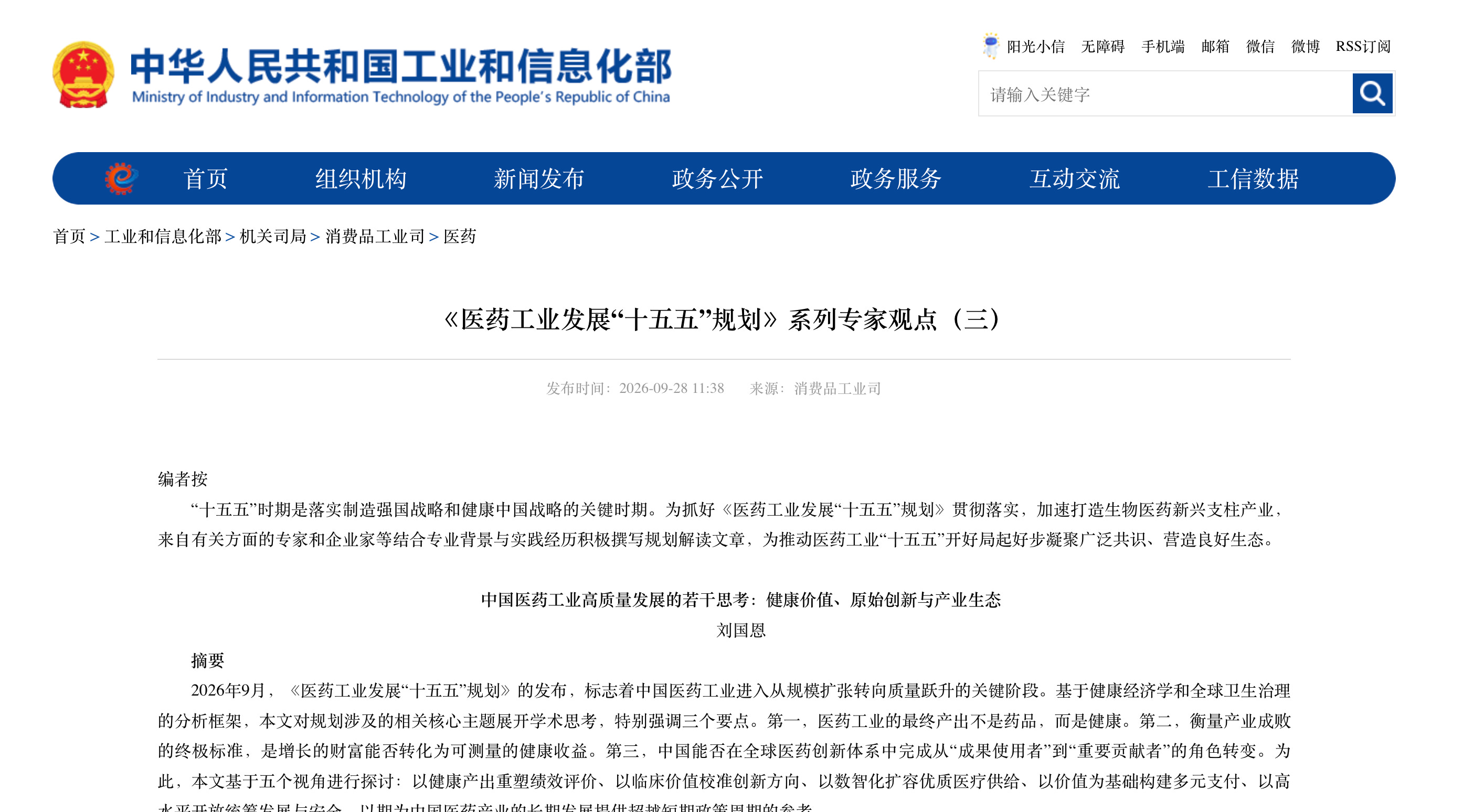
中国医药工业高质量发展的若干思考:健康价值、原始创新与产业生态
Reflections on the High-Quality Development of China’s Pharmaceutical Industry: Health Value, Original Innovation and the Industry Ecosystem
Editor’s Note
The 15th Five-Year Plan period is a critical time for advancing China’s strategies to become a manufacturing powerhouse and build a Healthy China. To support the implementation of the 15th Five-Year Plan for Pharmaceutical Industry Development and accelerate the development of biomedicine into an emerging pillar industry, experts, entrepreneurs, and other professionals have drawn on their expertise and practical experience to contribute articles interpreting the plan. Their contributions are intended to build broad consensus and foster a supportive environment for the pharmaceutical industry as it enters the new planning period.
Abstract
The release of the 15th Five-Year Plan for Pharmaceutical Industry Development in September 2026 marked a critical turning point for China’s pharmaceutical industry as it shifts its focus from expanding in scale to improving in quality.
Drawing on insights from health economics and global health governance, this article examines key issues raised by the plan, emphasising three central points. First, the pharmaceutical industry’s ultimate output is not medicines, but health. Second, the true measure of the industry’s success is whether the wealth it generates translates into measurable improvements in health. Third, China faces the challenge of moving from being a user of global pharmaceutical innovations to becoming a major contributor to the global pharmaceutical innovation system.
The article examines these issues from five perspectives: making health outcomes the basis for evaluating industry performance; aligning innovation with clinical value; using digital and intelligent technologies to expand the availability of high-quality healthcare; developing diversified, value-based payment systems; and balancing development and security through greater openness to the world. Together, these perspectives aim to inform the long-term development of China’s pharmaceutical industry beyond the immediate priorities of short-term policy cycles.
I. Introduction
Few industries combine strategic importance with such a direct impact on people’s well-being as the pharmaceutical industry. It connects basic science and advanced manufacturing with healthcare services and public health. It is both a source of national competitiveness and a factor in the sustainability of the social security system.
In September 2026, China released the 15th Five-Year Plan for Pharmaceutical Industry Development, setting out plans to accelerate the development of biomedicine into an emerging pillar industry of the national economy. For the first time, the plan sets quantifiable targets for 2030, including a 25 per cent share of the global total of first-in-class drugs and average annual growth of 20 per cent in the innovative drug industry.
These clearer policy objectives also bring deeper theoretical questions into focus. Around the world, pharmaceutical industries face similar structural challenges: The cost of innovation continues to rise while research and development efficiency declines, a phenomenon known as “Eroom’s law”; population ageing and changing disease patterns are driving up health expenditure and putting pressure on the sustainability of payment systems; geopolitical shifts are reshaping global supply chains, creating tensions between efficiency and security; general-purpose technologies such as artificial intelligence are being adopted at an accelerating pace, even as evidence of their health benefits remains limited.
China faces these challenges alongside difficulties of its own: the pressures of transforming a vast market, the challenge of moving from generic drugs to original innovation, and geographical disparities in healthcare provision and the ability to pay.
This article considers five fundamental questions that extend beyond short-term policy cycles: How should industry performance be measured? How should innovation priorities be determined? How can the benefits of technological advances be realised? How can payment systems provide the necessary support? And what position should the industry occupy in the global division of labour?
II. The Performance Question: What Should the Pharmaceutical Industry’s Ultimate Output Be?
The pharmaceutical industry has traditionally been assessed using indicators such as output value, investment intensity, the number of approvals, and speed to market. Yet these measure intermediate inputs and outputs rather than the final outcome.
This is more than a semantic distinction. It goes to the heart of policy design. When performance is judged by intermediate indicators, companies naturally focus on bringing products to market faster, expanding their portfolios, and increasing their scale. Only when evaluation focuses on the final outcome will resources be directed towards improving health itself.
From a health economics perspective, the pharmaceutical industry’s ultimate output should be improvements in population health: longer lives, a lower burden of disease, higher labour productivity, and avoidance of catastrophic health expenditure for households.
Health is a form of human capital and a fundamental driver of development. Better health can extend people’s productive working lives, raise productivity, and strengthen the resilience of households and society by reducing the burden of disease.
The continued rise in life expectancy in China has shown how advances in pharmaceutical and medical technologies can translate into better health outcomes. Looking ahead, health policy must move beyond treating disease to encompass the entire continuum of prevention, diagnosis and treatment, rehabilitation, and health management, reflecting the international shift towards integrated healthcare systems.
Making health outcomes the ultimate measure of performance also calls for a different understanding of rising health expenditure. As economies develop and incomes rise, demand for healthcare naturally increases. Rather than simply representing higher costs, this reflects society’s growing recognition of the importance of investing in human capital.
The policy objective should therefore be to improve the marginal productivity of healthcare resources, not to suppress legitimate demand for healthcare. This means reducing low-value and unnecessary services while directing resources towards prevention, urgent clinical needs, and interventions that significantly improve health outcomes.
This is the central principle behind the global shift towards value-based healthcare. It should also serve as a lasting benchmark for any pharmaceutical industry policy, regardless of the planning cycle.
A basic conclusion follows: the maturity of a country’s pharmaceutical industry evaluation system reflects how far its pharmaceutical policy has evolved from an industry-centred to a health-centred approach.
III. The Innovation Question: From Competition in Numbers to Alignment with Value
Global pharmaceutical innovation faces a widely recognised paradox: research and development spending continues to rise, yet the number of new drugs produced has remained relatively stagnant.
China’s position presents a particular challenge. It now ranks second globally in the number of new drugs under development, but its ability to lead in original innovation still falls short of the highest international standards.
From January to September 2026, the total value of overseas licensing deals for innovative Chinese drugs exceeded US$120 billion, up 36 per cent year on year. This reflects growing international recognition of the quality of Chinese pharmaceutical research and development. But larger licensing deals do not necessarily signal a corresponding improvement in the capacity for original innovation. Overseas licensing is a means, not an end. Using the number and value of licensing deals as proxies for innovation performance risks obscuring structural weaknesses in upstream capabilities, including target discovery, translational medicine, and global clinical operations.
The central issue is how to align innovation priorities with value. If companies are incentivised primarily for how quickly they can develop licensable assets, their most rational strategy is to concentrate on established targets and mechanisms, making only incremental improvements. Only when innovation is assessed by its clinical value – whether it addresses unmet medical needs, improves quality of life, or reduces the lifetime burden of disease – will resources flow towards areas that offer substantial social benefits but lack sufficient commercial incentives. These include major diseases, rare diseases, paediatric medicines, diseases affecting older people, and drug-resistant infections.
More fundamentally, the capacity for original innovation depends on the quality of the institutions that support it. Pharmaceutical innovation requires substantial investment, involves long development cycles, and carries considerable risk. Sustaining it requires stable and transparent regulatory expectations, patient capital willing to tolerate failure over the long term, and effective coordination across the entire process from basic research and translation to clinical development, regulatory review, and commercialisation.
International experience has repeatedly shown that the competitiveness of an innovation ecosystem depends fundamentally on the quality of its institutions rather than on the scale of resources invested.
For China, the journey from catching up to keeping pace and ultimately taking the lead will depend not simply on overcoming technological barriers, but on institutional innovation.
IV. The Technology Question: How Can Artificial Intelligence Strengthen Health System Capacity?
Artificial intelligence is reshaping drug discovery, clinical trials, manufacturing, and healthcare services. Its significance for the pharmaceutical industry has gone well beyond conventional digital transformation.
Two misconceptions deserve particular attention. The first is to view AI simply as a tool for making research and development more efficient. The second is to focus on whether a technology is technically feasible rather than whether it delivers meaningful value.
For China, AI’s greatest potential to transform the pharmaceutical and healthcare sectors may lie not in the laboratory, but in service delivery.
High-quality healthcare resources remain scarce and unevenly distributed, while patients continue to flock to major hospitals in large cities. The root problem is that advanced medical knowledge and clinical expertise are difficult to replicate at low cost.
With doctors leading the process and appropriate regulatory oversight in place, AI could help primary healthcare institutions and early-career doctors by integrating medical knowledge, clinical guidelines, and practical experience. This could reduce the dependence of high-quality healthcare on a small number of specialists, enabling the development of digital capabilities that can be replicated and scaled up.
If realised, this shift could deliver public health benefits far exceeding the cost savings and efficiency gains AI brings to research and development, thereby contributing directly to the higher-level goal of health equity.
This leads to an important principle for evaluating new technologies: every new pharmaceutical or medical technology should undergo a comprehensive health technology assessment (HTA). Put simply, HTA asks not only whether a technology works clinically, but also whether it offers value for money, improves equity, and delivers real benefits to patients.
The value of medical robots, for example, lies not just in their precision, but also in their ability to reduce harm to patients, shorten the time doctors need to develop expertise, and extend access to high-quality healthcare through remote collaboration. Similarly, the value of digital therapeutics lies not in the algorithms themselves, but in whether their clinical endpoints can withstand scrutiny through both randomised controlled trials and real-world evidence.
If technology assessments focus solely on engineering specifications, policy risks being guided by demonstration applications rather than evidence.
China has comparative advantages in its large patient population, extensive clinical resources, and diverse settings for applying new technologies. By developing real-world data infrastructure alongside data governance systems, China is well positioned to become internationally competitive in generating evidence on AI applications in pharmaceuticals and healthcare. It could also contribute assessment methods and empirical evidence that other countries can draw on.
The benefits of general-purpose technologies can be shared across open systems, while the ability to generate evidence is becoming a new frontier of competition.
V. The Institutional Question: How Can Payment Systems Realise the Value of Innovation?
The pharmaceutical industry operates within a distinctive economic cycle: returns on today’s research and development depend on tomorrow’s payment arrangements. Payment systems are therefore not only part of health policy but also a component of innovation policy. This is a key distinction between pharmaceutical economics and industrial economics in general.
This cycle now faces two pressures. On the payment side, population ageing is driving up health expenditure. Basic medical insurance funds, designed primarily to cover essential healthcare needs, are struggling to cover all innovative technologies and the full range of healthcare needs. On the innovation side, sustained investment depends on adequate returns. Without reliable mechanisms for assessing and rewarding value, long-term, high-risk investment in research and development is difficult to sustain.
Simply driving down prices may ease pressure on insurance funds in the short term, but at the cost of weakening incentives to innovate. Allowing high prices to go unchecked, meanwhile, puts excessive strain on payment systems and worsens health inequalities.
Experience in advanced economies suggests that the solution lies in allocating resources based on clinical value and health outcomes. Pharmacoeconomics and HTA can be used to assess value, allowing high-value innovations to earn reasonable returns while low-value, undifferentiated products are gradually phased out through market competition and payment policies.
Equally important is bridging the “last mile”: regulatory approval or inclusion on a reimbursement list does not necessarily mean that patients can actually obtain a medicine. Barriers in prescribing, hospital drug availability, distribution and payment processes can prevent reimbursement commitments from translating into actual patient access. Better coordination between medical insurance, healthcare, and pharmaceutical policies is fundamentally about repairing the mechanisms through which the value of innovation reaches patients.
Structurally, a single payment system cannot achieve both sustainability and accessibility. Basic medical insurance must remain focused on covering essential healthcare needs, with commercial health insurance, medical assistance, and charitable aid providing additional layers of support. This diversified approach is particularly important for high-value innovative drugs, medicines for rare diseases, and advanced therapies.
Commercial insurance has limited value if it merely reimburses medical expenses. If it plays a more active role through product design, health management, and risk sharing, it can become a vital link between innovation, healthcare services, and patient needs.
A well-functioning hybrid payment system combining basic medical insurance with commercial health insurance is not only an institutional challenge for China, but could also serve as a model for middle-income countries around the world. Innovation in payment systems is itself an international public good that can benefit the pharmaceutical innovation ecosystem.
VI. The Global Question: Position and Responsibility in an Open System
Pharmaceutical innovation is highly globalised, relying heavily on the cross-border movement of knowledge, talent, capital, clinical evidence, and manufacturing capabilities. However, geopolitical shifts have presented countries with a common dilemma: efficiency or security?
Global experience since the pandemic has shown that disruptions in the supply of critical raw materials and excipients, advanced pharmaceutical manufacturing equipment, and analytical and testing instruments can bring the entire innovation chain to a standstill. As a result, control over critical technologies and the resilience of industrial and supply chains have become a matter of security, not just industrial policy.
Yet seemingly obvious solutions can be misleading. Closing off from the outside world and pursuing self-sufficiency may be an instinctive response to this dilemma, but it is not necessarily the right one. Essentially, industrial security does not mean replicating every stage of the supply chain domestically. Rather, it means occupying an indispensable position in global networks and maintaining reliable supply capabilities. Indeed, resilience in individual parts of the system depends on deep integration into global networks of cooperation.
China’s role in the global pharmaceutical industry is undergoing a historic transformation. Early signs are emerging of its shift from a user of global innovations to a major contributor. The next stage could focus on three strategic priorities.
First, China could bring together global innovation resources through internationally coordinated research and development, international multicentre clinical trials, and registration and certification in overseas markets.
Second, it could contribute to international rule-making through original pharmaceutical products and standardised evidence.
Third, China could take a more active role in global health governance, turning the growing international presence of its pharmaceutical industry into a means of providing global public goods. This would involve cooperation with developing countries on medicine supply, public health capacity, local production, and workforce training. Affordable and sustainable pharmaceutical solutions have strategic value beyond their commercial benefits in addressing shared challenges such as major infectious diseases, population ageing, and climate-related health risks.
This changing role also brings new responsibilities. A major pharmaceutical nation has an obligation to promote global health equity commensurate with its capabilities. This is both a moral imperative and a matter of long-term interest. A country’s credibility in global health governance is among the most valuable intangible assets of its pharmaceutical industry, and one of the hardest to replicate.
VII. Conclusion
What sets the pharmaceutical industry apart is that its ultimate product should be human life and health. Therefore, its performance metrics, approach to innovation, technology assessment, payment systems, and role in the global economy cannot simply follow the same frameworks as other manufacturing industries.
Output value can measure the size of an industry, but only health outcomes can measure the value of the pharmaceutical industry. Licensing deals can indicate the pace of internationalisation, but only the capacity for original innovation can determine its standing. Inclusion on reimbursement lists can indicate the reach of policy, but only patients’ actual access to medicines can measure its success.
China’s pharmaceutical industry is undergoing a historic transformation from being large to becoming strong. Its vast market, extensive clinical resources, comprehensive industrial system, and steadily growing capacity for innovation provide the foundation for such transition.
More fundamentally, this transformation depends on institutional capacity: the ability to connect research and development, evaluation, production, application, and payment, and to align science, industry, healthcare, and payment systems around a common standard.
This principle should transcend both the five-year planning cycle and national borders. After all, the achievements of an industry whose ultimate output is health cannot be measured solely by a country’s GDP. If China’s pharmaceutical industry remains guided by this principle, its growth will not only benefit China but also contribute to the well-being of humanity as a whole.

Gordon G. Liu: Can AI reduce the price of healthcare?

Gordon G. Liu is BOYA Distinguished Professor of Economics, Dean of the Institute for Global Health and Development (GHD), and Director of the China Centre for Health Economic Research at Peking University.
Gordon G. Liu: community clinics, rational drug use, and surgical robots could help China achieve accessible healthcare

Gordon G. Liu is BOYA Distinguished Professor of Economics, Dean of the Institute for Global Health and Development, and Director of the China Centre for Health Economic Research at Peking University.
Gordon G. Liu on China's healthcare reforms: overcrowded clinics, underpowered pharma

Most Chinese patients tend to seek primary care at tertiary hospitals—the top tier of China’s three-level healthcare system—even for minor ailments. This has resulted in overcrowding at higher-level hospitals and the continued underdevelopment of community-based medical services. Institutional barriers that restrict practitioners from working across mul…

