

Over the past several years, winter air quality in North China—especially in Beijing—has improved markedly. “Beijing blue” is no longer a rare indulgence. Beijing’s municipal authorities said the share of days with “good or moderate” PM2.5 levels reached 95.3%, up from 55.9% in 2013.
One major (and socially consequential) ingredient behind those cleaner skies has been the rural “clean heating” campaign in the Beijing–Tianjin–Hebei region: banning dispersed coal burned in household stoves and replacing it with natural gas or electricity. Beginning around 2017, millions of rural homes in and around the capital were ordered to dismantle small coal furnaces and switch to “cleaner” heating, with generous subsidies at the outset—and with strict administrative enforcement to prevent households from reverting to coal.
This winter, however, the policy’s fault line has become impossible to ignore in parts of Hebei. Subsidies were designed to taper, and in many places they have fallen sharply or disappeared. Villagers near Beijing have been reported keeping their gas meters barely moving—bundling under quilts rather than switching on boilers—because they simply cannot afford the bills.
This is not the kind of “at what cost?” story that online pro-China voices often caricature as a Western-media trope. It became a domestically resonant—and politically awkward—debate intense enough to push related terms onto Weibo’s local trending lists
What’s also notable is that several of China’s biggest official outlets moved early. On January 4, 2026, the Xinhua Viewpoint released a short video commentary—oddly, produced by the state-run news agency’s audio-video department—arguing that rural heating must “keep the warmth line” as well as “calculate the environmental ledger.” In the following days, other outlets echoed calls to fix cost-sharing and subsidy mechanisms.
However, some reports and commentaries have since been censored. For example, the following report, published this week, by Zhang Ling of the Economic Observer newspaper, is still available on several web platforms but has been removed from the newspaper’s official blog on WeChat. Similarly, a commentary by Farmers’ Daily is no longer on that newspaper’s platform but remains available elsewhere. (Many Chinese internet portals and legacy media websites routinely display content produced by peers.)
河北农民的这个冬天
This Winter for Hebei’s Farmers
by 张铃 Zhang Ling of the Economic Observer newspaper
The Xiaohan (“Minor Cold”) had just passed. In a village in Baoding, Hebei Province, average temperatures had dropped below zero. In the daytime, elderly villagers gather by sunlit walls to bask in the warmth—some in pairs, some in small groups, some in larger clusters—sitting, standing, or squatting. They wear layers: an autumn undershirt, a sweater, a padded cotton coat, and a down jacket, topped off with a fleece hat. When there’s a topic, they trade remarks back and forth; otherwise they simply stay there in silence, no one speaking.
“Have all the households turned on their heating?” this reporter asked at one sunlit wall where 13 elderly people were gathered.
“No!” several answered in unison.
“We turn it on at night. During the day we sit in the sun—no need to turn it on,” someone replied.
“Only his family keeps it on every day. He worked in the city—his pension is 4,000 yuan a month!” someone said, pointing at an elderly man perched on a three-wheeled vehicle.
Why not turn on the heat? The elderly villagers counted on their fingers: the village switched to natural-gas heating five years ago. For the first three years, there was a subsidy of 1 yuan per cubic meter; for the past two years, it has been gone. Now gas costs 3.18 yuan per cubic meter. It takes 20 cubic meters a day to feel warm—more than 60 yuan per day. Over an entire heating season, that comes to 5,000–6,000 yuan—more expensive than food.
What about income? Each person in the village has about 1.5 mu of land (about one-tenth of a hectare), mainly planted with wheat and corn. Over a year, the land for a two-person household brings in about 3,000 yuan. Rural pensions are about 200 yuan per person per month; for an elderly couple, that totals roughly 5,000 yuan a year. Some children provide a bit of money, but some children are not financially comfortable themselves.
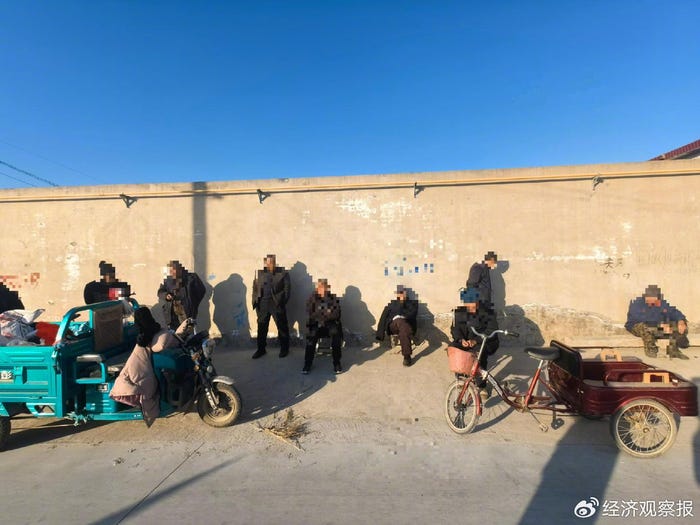
Large-scale rural conversion to natural-gas heating in Hebei began in 2017. At the time, heavy pollution episodes were frequent in the autumn and winter across the Beijing–Tianjin–Hebei region and surrounding areas, and “clean heating” in rural areas was considered an important tool for air-pollution control.
“Clean heating” refers to banning the traditional use of dispersed coal for heating and replacing it with natural gas or electricity; in areas where coal-to-gas or coal-to-electricity conversion is not feasible, “clean coal” is used as a fallback.
This has been a sweeping transformation in everyday life. Central and local (Hebei provincial and sub-provincial) governments invested funds on the order of tens of billions of yuan to support heating equipment and energy subsidies. But as the policy has been implemented over more years, subsidies have declined year by year.
According to notices issued by the Beijing Municipal Development and Reform Commission and the Tianjin Municipal Development and Reform Commission, in 2025 the first-tier price for gas used for rural coal-to-gas heating in Beijing was 2.61 yuan per cubic meter; in Tianjin it was about 2.86 yuan per cubic meter. In most parts of Hebei, the rural coal-to-gas price was about 3.15 yuan per cubic meter.
In this village in Baoding, there were no subsidies left for the 2025 heating season. “Planting this little bit of bangzi (corn) isn’t even enough to pay for burning gas,” an elderly villager said.
Multiple experts interviewed by Economic Observer suggested that, in the long run, natural-gas heating should be steered toward more energy-efficient heat-pump heating, and that rural home insulation retrofits should be treated as a high priority to reduce heating energy use and costs. At the same time, local governments should adapt to local conditions, combining technologies such as air-source heat pumps, biomass energy, and solar energy into complementary clean-heating solutions.
“If You Drop by Someone’s Place, They Feel You’ve Come to Sponge Off Their Heating”
In a village in eastern Hebei, at 12:30 p.m. the midday sun poured into the room. The wall-mounted boiler’s water was heated to 30°C. Zhang Jun, a rural resident, wore a short padded jacket, a quilted coat, a fleece cardigan, a thin sweater, and thermal underwear—yet he still didn’t feel warm. His home completed the coal-to-gas conversion in 2021; the coal stove had already been sold off as scrap metal. He doesn’t dare set the temperature high: even at its warmest, the indoor temperature only reaches 17–18°C.
He scrolled through payment records on Alipay: from December 4, 2025, to January 3, 2026, he paid gas bills six times, totaling 1,300 yuan. In addition to gas, his family also burns firewood and heats a traditional kang (heated brick bed platform).
Zhang Jun’s household was allocated 6 mu of land to grow corn. “Over a year, if you can net 300 yuan per mu, that’s already pretty good,” he said. As soon as it turned 1 p.m., he put on his hat and left home. Though he is 68 by traditional reckoning, he still takes day-labor jobs paying 200 yuan per day.
In one elderly household in the Baoding village mentioned earlier, the wall-mounted coal-to-gas boiler in the kitchen was wrapped in a foam box, completely hiding the unit. An 80-year-old resident said that to operate the gas system, he would first have to remove the foam covering—something he hasn’t done in the last two years.
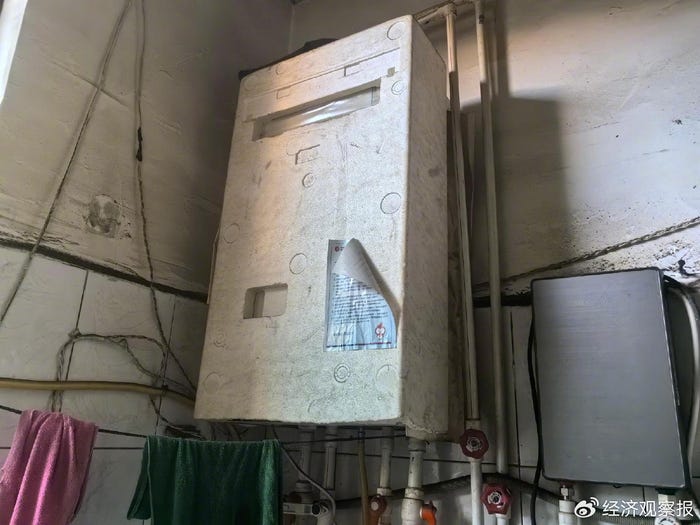
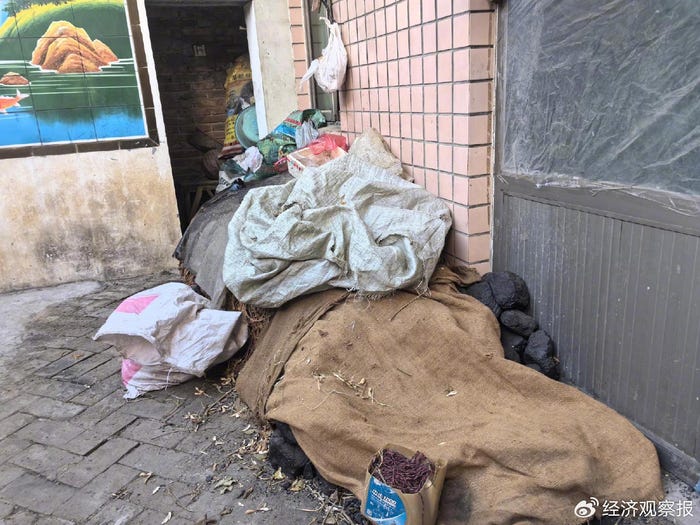
A few years ago, when there were subsidies, the elderly man removed the protective cover and used gas at night but not during the day (note: winter day–night temperature differences in Hebei can exceed 10°C). That winter cost him about 3,000 yuan. As subsidies shrank, he started collecting firewood to heat the kang. In a corner of the yard, there was also some dispersed coal—secretly purchased in the past two years—covered with burlap. He said: “I’m not afraid of the village authorities coming to inspect. I have to stay alive somehow!”
Xiaomi, who also lives in the Baoding village, turned on natural-gas heating in early December. By day 37, she had spent 830 yuan. She typically sets the wall-mounted boiler to 39°C, leading to the indoor temperature being 11.9°C—hands don’t freeze, but she still has to wear a thick coat. To raise the indoor temperature to 18°C, she would need to set the boiler to at least 60°C, and the heating cost would double.
Thirty-five kilometers from Xiaomi’s home is Old Ma’s family. Their house is 200 square meters. To maintain an indoor temperature of 18°C, they need to burn more than 20 cubic meters of gas per day. In their village, gas costs 3.17 yuan per cubic meter, so daily heating costs more than 60 yuan. Every year, Old Ma waits until his eldest child—who is in college—comes home for winter break before turning on the gas. Normally, he only turns on the air conditioner for a while when his younger child, who is in primary school, needs to do homework. Old Ma feels this winter is a warm one; without heating, it’s barely tolerable. On sunny days, the thermometer shows the indoor temperature can peak at 9°C.
Old Ma’s household income mainly comes from odd jobs, totaling 40,000–50,000 yuan a year. Money is hard to earn, and expenses are heavy: the family’s basic medical insurance costs about 2,000 yuan per year; the eldest child’s private university tuition costs more than 30,000 yuan per year; even primary school for the second child requires spending. Their income only covers these rigid expenses.
Old Ma would like to burn coal, but it’s difficult: first, he doesn’t dare; second, he can only buy the more expensive “clean coal”; third, the household boiler was dismantled two years ago, so he can’t even light it. Environmental enforcement in his village is strict: smokier bituminous coal is forbidden, and even burning firewood is not allowed. Loudspeakers in the village broadcast warnings—if any household is seen emitting smoke, officials come to investigate.
Old Ma’s village has about 500 households, and in this winter, more than half have barely turned on their heating. In the past, villagers liked to visit one another, chatting around the stove; now it rarely happens. “These days, if you drop by someone’s place, they feel you’ve come to sponge off their heating,” Old Ma said with a chuckle.
In Xu Hong’s village, most households underwent coal-to-electricity conversion. Xu Hong’s home was retrofitted in 2021; installing one set of electric heaters cost 700–800 yuan. “We had to install them—they kept urging us every day,” she said. But she found them hard to get used to. The heaters work by heating thermal-storage bricks inside the unit; the air felt even drier than when burning coal. She and her family have respiratory issues, and after using the heaters, their throats and lungs felt uncomfortable—so they used them very rarely. In the past two years, subsidies declined, and electricity prices rose; one heating season would cost nearly 4,000 yuan. Xu Hong and many others in the village removed their electric heaters.
Xu Hong began burning “clean coal” instead. However, in her village, each household is limited to purchasing half a ton—yet a household typically burns about two tons a year. She had to ask two households that do not live in the village to buy on her behalf. Villagers began collecting branches in the fields; along village roads and on empty lots, bundles of firewood and planks were piled everywhere. “When inspectors come to check fire hazards, we’ll carry the firewood into the house,” a villager said.
Xie Peng’s family, in the same village as Xu Hong, has not removed their electric heaters. But during the day, the elderly couple burns firewood in an old coal stove; the radiators connected to the stove feel mildly warm, while the electric heater pressed close to the radiator remains icy cold.
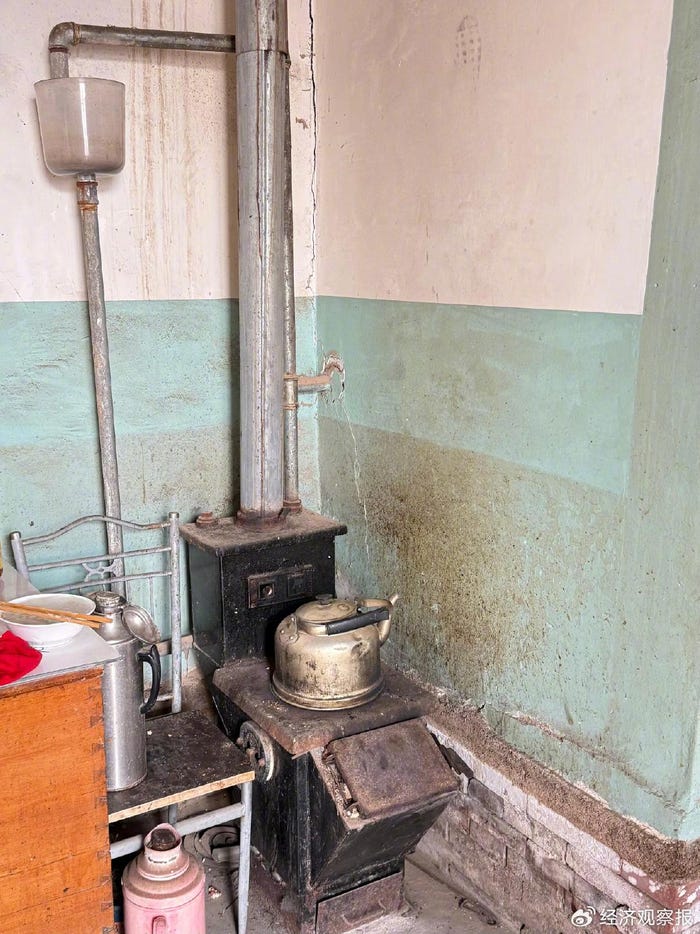
“With no kids at home, who keeps it on all the time? Adults can just use thicker quilts. We only turn it on after it gets dark—around eight o’clock—then turn it off around eleven or midnight,” they said. Local coal-to-electricity pricing uses time-of-use electricity rates. Some villagers learned from the local power company’s customer service that from 8 a.m. the rate is 0.57 yuan per kWh, and from 8 p.m. it is 0.3 yuan per kWh.
The couple now live in an old, single-story house with only three rooms. Cracks have appeared in the load-bearing wall beneath the beams and have extended all the way to the doorframe. This is their old house; they moved back in only when the weather turned cold in early December. They also have a newer six-room brick house with a set of electric heaters installed, but the area is too large and the temperature is hard to raise.
The Village Chief’s Top Priority
Old Zhang is the head of a village in eastern Hebei. Environmental protection is almost the most important part of his work—high-pressure and time-consuming.
After lunch or dinner, Old Zhang rides a three-wheeled vehicle from house to house to check whether anyone has a stove burning dispersed bituminous coal, whether any household is emitting smoke, and whether anyone is burning crop straw in the fields. The dispersed-coal sellers left the village two years ago. In 2024 there were some covert sellers; in 2025 none had been found. Old Zhang thinks that may be because enforcement has been stricter than in previous years.
Old Zhang patrols for two to three hours every day. He patrols on weekends, on holidays, and even during the Lunar New Year. If someone burns coal and the village fails to discover it or report it, the county will discipline the village Party secretary, and the township’s responsible leader will also be disciplined—typically a formal warning.
When village cadres go to meetings at the township or county level, they also say that rural residents find heating difficult; they hope gas costs can be lower and subsidies can continue. But no one has a solution. They gather to complain, yet the tasks from above must be completed—inspections must still be conducted.
Old Zhang said many village homes are built tall and spacious, but insulation is poor. To keep a home truly warm for an entire winter can cost 7,000–8,000 yuan. In the winter of 2024, he ran heating for three months: he heated only the rooms he lived in, not the rooms he didn’t; he shut it off whenever he could during the day. Even so, he spent more than 5,000 yuan. There are several impoverished households receiving special government assistance in the village who never use natural gas, relying instead on electric blankets. In 2025, higher authorities distributed a batch of clean coal specifically for impoverished households; the village distributed it free of charge—more than one ton per household, basically enough for the winter.
In the past two years, several better-off households have switched from natural gas to air-source heat pumps. The heating effect is better, and the cost is lower, but the installation cost is tens of thousands of yuan, and many villagers consider it too expensive.
A salesperson specializing in installing air-source heat pumps in villages told Economic Observer that for a new house of about 150 square meters, equipment costs around 20,000 yuan. After installation, the cost for one heating season typically does not exceed 4,000 yuan.
In the Baoding village mentioned earlier, about 100 meters from where the 13 elderly villagers sat in the sun, the village Party secretary Old Li was busy in his office with preparations for the village committee election. The village has several hundred households and more than a dozen wubao households; everyone must vote.
Walking out of the village committee courtyard, Old Li saw the elderly villagers sunbathing in the distance. He said many households don’t turn on heating, especially elderly ones. At night, when it gets too cold, they use electric blankets or small space heaters; many also heat the kang. In autumn, nearly every household collects firewood. At night, they burn a few sticks into the kang flue, and the bed platform won’t be cold enough to freeze someone.
Old Li said the village does not regulate heating the kang. He does it himself. Burning coal, however, is not allowed. In recent years, village cadres posted notices in WeChat groups banning coal, broadcast coal bans over village loudspeakers, and conducted door-to-door inspections; if found, coal is confiscated. The village used to have two coal-selling households; both have since switched to farming. From the year coal was banned, cadres notified sellers: next year you cannot sell; even if a truck brings coal in, you are not allowed to sell it.
For a period of time, Old Li was going to meetings at the township almost every day. At every meeting, these issues were repeatedly emphasized. After each meeting, he returned to the village to patrol; the township government also sent people down every few days to inspect. Higher authorities once gave Old Li a safety inspection checklist, including whether boiler wiring and piping met standards, whether there was a natural-gas alarm, whether there were dual ignition sources at the stove, and so on. But whether villagers actually used the wall-mounted boiler was not within the inspection scope.
Banning coal is one of the most important tasks for most village Party secretaries. “Coal can’t get in anymore—there are people guarding every village entrance,” a village Party secretary in eastern Hebei told Economic Observer.
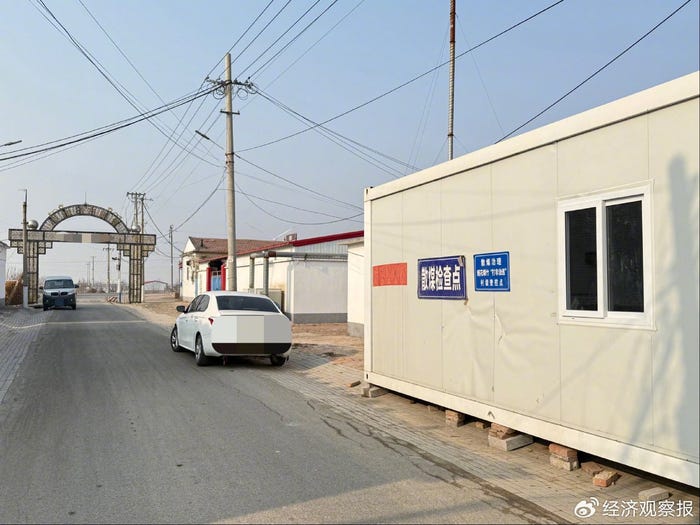
A reporter from Economic Observer visited four villages in one county in eastern Hebei and saw that under each village entrance archway there was a colored steel-sheet booth with a blue-and-white sign reading “Dispersed Coal Inspection Point.” Nearby walls or public bulletin boards posted red notices: “All units and individuals are strictly prohibited from illegally selling or using any type of dispersed coal.” The notices said violators would be traced and held legally responsible, and provided a hotline for reporting. The signature date was October 2025.
Subsidies Taper Off
During the 2026 New Year holiday, discussion about heating for elderly people in rural Hebei trended on social media. Old Zhang noticed it and also reported conditions in his village to higher authorities. His village completed the coal-to-gas conversion before the pandemic. At the time, households only needed to pay 500 yuan to install the wall-mounted boiler; the gas company also gave each household 500 yuan worth of natural gas for free—effectively making the installation cost-free. For the first three years there was a subsidy of 1.2 yuan per cubic meter. Many households used gas then. In the past two years, subsidies have disappeared (Economic Observer’s note: subsidy policies still exist, but disbursement has been delayed), so more households have stopped turning on the gas.
A coal-to-electricity resident in a village in eastern Hebei recorded the changes in his household’s electricity subsidies: because he converted one year later than other villagers, he fully enjoyed only two years of full subsidies. In spring 2021 and spring 2022, he received electricity subsidies of 1,595 yuan and 1,558.6 yuan respectively; in spring 2023 the subsidy dropped to 916 yuan; in spring 2024 it was 763.2 yuan.
Fiscal subsidies have been gradually “tapering off,” and heating has gradually become more expensive.
A person close to the National Development and Reform Commission told Economic Observer that in earlier years, the central government set certain requirements for clean heating. Hebei’s tasks were relatively heavy: to meet targets for the clean-heating rate, it needed to “get rid of coal.” But at the beginning, the most suitable technological pathway had not been found, and in some places there were one-size-fits-all approaches in implementation. Starting a few years ago, some rural parts of Hebei began to see people unable to afford gas because of high costs and secretly burning coal.
This person also mentioned that the Ministry of Finance provided three-year subsidies to five batches of 88 pilot clean-heating cities nationwide. Subsidies were issued to local governments, which then passed them down; some local governments also added their own matching subsidies.
According to the China Dispersed Coal Management Report 2025 released by Peking University’s Institute of Energy, as of the end of 2024, five batches of clean-heating projects in northern China had been implemented, covering 88 cities. The central government cumulatively invested 120.9 billion yuan, leveraging more than 400 billion yuan in various local investments. About 41 million households were retrofitted, reducing dispersed-coal use by 80 million tons. The clean-heating rate increased from 65% at the end of 2020 to about 83%.
In July 2018, the Office of the Hebei Provincial Leading Group for Gas-Replacing-Coal and Electricity-Replacing-Coal issued 《关于调整完善农村地区清洁取暖财政补助政策的通知》the Notice on Adjusting and Improving Fiscal Subsidy Policies for Clean Heating in Rural Areas. It stipulated that subsidies for equipment purchases under coal-to-electricity and coal-to-gas conversions would be split half-and-half between the province and city/county levels. Operating subsidies during the heating season would be borne one-third each by the province, city, and county, and would be subsidized based on actual usage. For coal-to-electricity, the subsidy was 0.12 yuan per kWh, up to 10,000 kWh and 1,200 yuan per household. For coal-to-gas, the subsidy was 0.8 yuan per cubic meter, up to 1,200 cubic meters and 960 yuan per household. These subsidies were to be trialed for three years.
According to publicly disclosed reply information from the Hebei provincial government, after the three-year subsidy period expired, Hebei’s provincial level adopted a tapering approach and provided two additional years of subsidies: the first year tapered to 50%, the second year to 25%. City and county governments formulated specific operating-subsidy measures based on local conditions.
Accordingly, the extent and timing of subsidy tapering differed across localities.
Some local governments with stronger fiscal capacity extended subsidies to nine years. According to public information from the Tangshan municipal government and the government of Julu County in Xingtai, local coal-to-gas subsidies have been extended to nine years, calculated from the year of installation. Subsidies taper to 50% in years 4–6, and to 25% in years 7–9. Under this calculation, users who converted in 2017–2018 would receive a subsidy of 0.2 yuan per cubic meter in 2025.
A few places increased subsidy amounts. For example, Tangshan High-Tech Zone issued a policy in 2025 stating that this particular local government would raise the subsidy for 2017–2018 coal-to-gas users to 0.4 yuan per cubic meter.
Government subsidies for clean coal have also been tapering off. A resident in the aforementioned village in eastern Hebei recalled: “Around 2017, when I first started using clean coal, a ton cost just over 500 yuan. In 2024 it was 1,100 yuan, and in 2025 it’s 1,030 yuan.”
Hebei’s Development and Reform Commission issued the 《河北省采暖季洁净煤保供方案(2018—2020年度)》Hebei Province Clean Coal Supply Guarantee Plan for Heating Seasons (2018–2020), which stated: “For the 2018 heating season, the subsidy standard for (clean coal) is tentatively set at around 500 yuan per ton. Under the principle of cost-sharing among province, city, and county, provincial subsidies are 100 yuan per ton, with no more than 200 yuan per household; city/county subsidy standards and cost-sharing methods shall be determined independently based on local coal prices, fiscal capacity, and the public’s affordability.”
In the 《河北省2022年采暖季洁净煤取暖工作实施方案》Hebei Province 2022 Heating Season Clean Coal Heating Work Implementation Plan issued later by the same commission, the “around 500 yuan per ton” standard no longer appeared. The principle for subsidies was adjusted to “basically not increasing the public’s heating burden, and within what fiscal capacity can bear.”
Separately, information from the 2024 Xingtang County media center stated that for clean coal, “provincial subsidy 70 yuan/ton, municipal subsidy 210 yuan/ton, county subsidy 641.49 yuan/ton.”
Where Will Rural Heating Go?
He Jijiang, executive deputy director of the Center for Energy Transition and Social Development Research at Tsinghua University’s School of Social Sciences, believes that from an energy-saving perspective, coal-to-gas is not an efficient solution. He and many peers have not favored it since 2016: “Natural gas is relatively expensive to begin with, and during peak periods it may not even be sufficiently supplied.” Once subsidies are canceled, natural-gas heating will lose competitiveness altogether.
By contrast, he more strongly supports coal-to-electricity—an approach adopted in most rural parts of Beijing.
Coal-to-electricity refers to heat-pump heating driven by electricity, where one kWh of electricity can be converted into roughly three times that amount in heat. Heat pumps include hot-water types and hot-air types: the former are suitable for whole-apartment installation and cost about 10,000–20,000 yuan; the latter are suitable for installation in single rooms and cost about 3,000 yuan.
In use, the cost of heat-pump heating mainly depends on electricity prices. In Beijing, for example, the heating-season electricity price is 0.3 yuan per kWh; with fiscal subsidies, farmers effectively pay 0.1 yuan per kWh.
He Jijiang said that under Beijing’s (post-subsidy) electricity price, for an apartment of a bit more than 100 square meters, heating for the whole winter with a heat pump costs about 3,000 yuan; for a 20-square-meter space, it can be controlled to about 1,000 yuan.
He told Economic Observer that the difference between coal-to-gas and coal-to-electricity is that the former has lower installation-stage costs but higher operating-stage costs, while the latter is the opposite.
In many places, installation costs are borne by the government. “Coal-to-electricity’s upfront investment is expensive—more than 10,000 yuan per household. If the government budget is insufficient, it can’t help many households. Coal-to-gas is cheaper upfront. With the expensive plan, you can only do 5,000 households; with the cheaper plan, you can do 20,000 households.” He Jijiang believes local governments mmight have chosen coal-to-gas due to fiscal constraints at the time.
From an emergency-response perspective, He Jijiang argues the government should strengthen monitoring, ensure gas supply, settle subsidy payments promptly, and try to provide more subsidies. In the long run, converting natural-gas heating to heat-pump heating is a more rational approach. In the short term, for low-income elderly people whose children are not around, there are supplementary measures costing only a few hundred yuan: add a layer of transparent plastic film to the outside of windows; use water-heated blankets on beds; install a plastic greenhouse-like enclosure outside a south-facing door to improve insulation—simple to install and effective for warmth retention.
Wang Quanhui, a veteran researcher focused on rural energy issues, also emphasized the importance of insulating rural houses. He said most rural homes have no insulation measures: “Urban homes all have insulation measures, with energy-saving rates reaching 65%–75%. Rural houses without exterior insulation only reach 30%–35% efficiency. With energy-efficiency retrofits, rural homes can reach 50%–60%, and heating energy costs can be reduced by 70%–100%.”
Some villagers have already begun adding insulation boards.
In the Baoding village, villager Xiao Zhao’s house faces south. Sunlight pours in during the day, making the room warm and bright. Xiao Zhao said the house was newly built two years ago and had insulation boards added—40 yuan per square meter. For four rooms, the total cost was 4,000 yuan, and it is much warmer than older houses.
A worker specializing in building insulation for villages told Economic Observer that rural homes can be insulated on interior walls or exterior walls. Interior-wall insulation requires covering a larger surface area, raising the total cost by about half. Insulation work is not difficult and can be completed in at most three days.
As for clean-heating technologies, Wang Quanhui said there are now multiple options. Beyond converting coal to natural gas, there are coal-to-electricity technologies, air-source heat-pump technologies, bundled direct-combustion biomass technologies, biomass pellet heating, “photovoltaic–storage–direct–flexible” (integrated) technologies, and solar-house technologies. If localities adapt to local conditions and address heating through a combination of energy-efficient rural housing and multiple complementary clean-energy technologies, the results will be better.
(At the interviewee’s request, all names in this article are pseudonyms except He Jijian and Wang Quanhui.)
Leading professor calls for massive govt subsidy to families at key forum

Zhang Jun is Distinguish Professor of Humanities and Social Sciences, Dean of the School of Economics, and Director of the Research Institute of Chinese Economy at Fudan University.
Excellent piece of reporting.
@水瓶纪元 also has this original reporting in Chinese: https://aquarianhq.substack.com/p/hebei-meigaiqi