

Hu Bo is Director of the South China Sea Strategic Situation Probing Initiative (SCSPI), and Research Professor & Director of the Centre for Maritime Strategy Studies, Peking University.
In a recent article, Hu argues China has more than enough capacity to manage and control the situation in the East and South China Seas, advocating “shelving disputes” as a deliberate policy with patience and confidence. Beijing may be on the back foot diplomatically and in public opinion, he adds, but not enough to endanger the status quo: so long as China stays resolute, no country can impose its will on China.
The article first appeared in Issue 1, 2026 of 现代舰船 Modern Ships, a magazine run by China State Shipbuilding Corporation Limited (CSSC)’s in-house think tank. It was also published on SCSPI’s official WeChat blog on 11 January.
Hu Bo reviewed the following translation before publication.
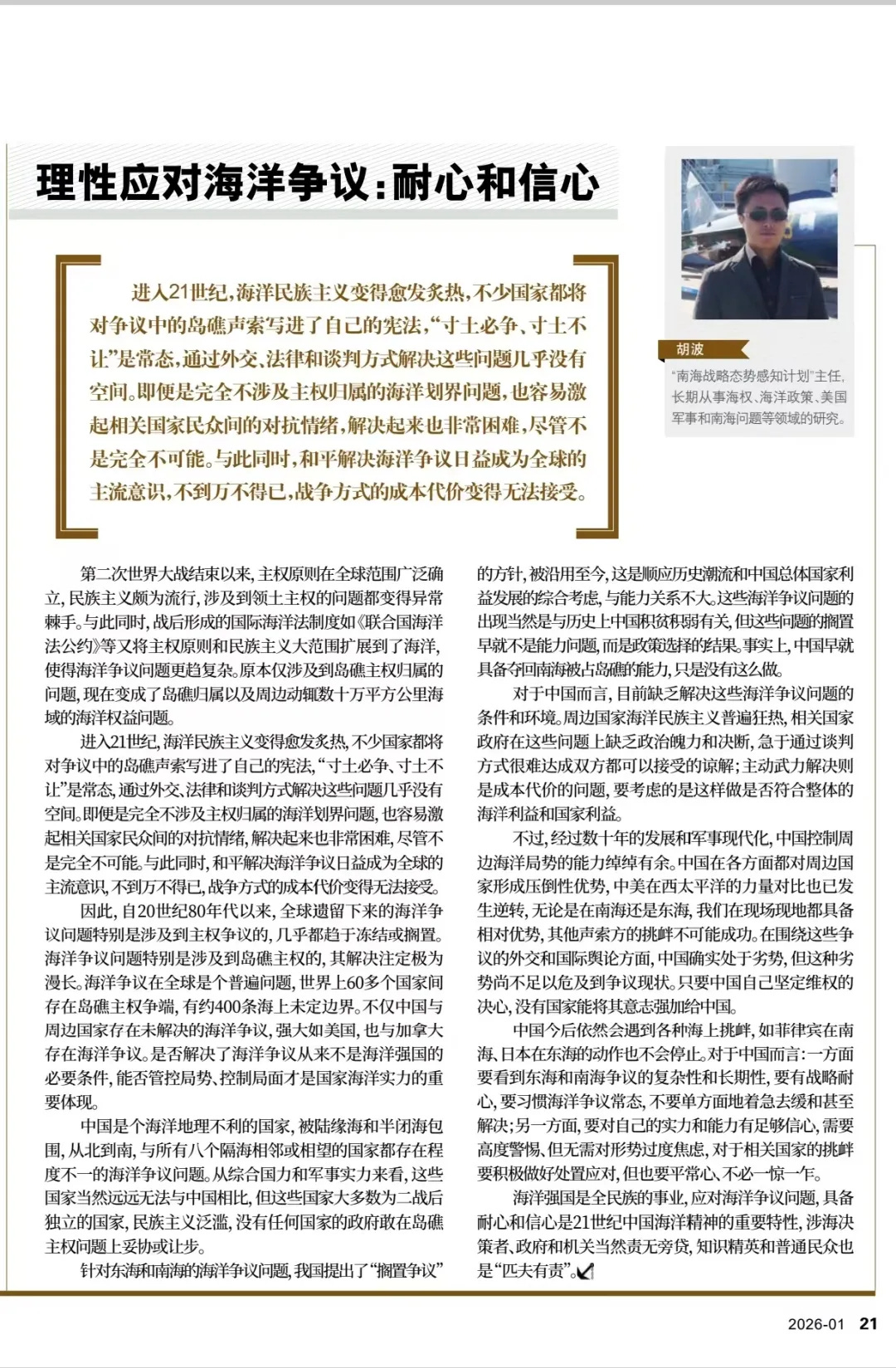
理性应对海洋争议:耐心与信心
A Rational Approach to Maritime Disputes: Patience and Confidence
Since the end of the Second World War, the principle of sovereignty has been widely established around the world, and nationalism has remained potent, making any issue involving territorial sovereignty particularly thorny. At the same time, the post-war international law of the ocean regime, for example, United Nations Convention on the Law of the Sea (UNCLOS), has pushed sovereignty and nationalism deep into the maritime domain, further complicating maritime disputes. What was once a question of sovereignty over islands and reefs has now become a dispute not only over their ownership, but also over the maritime rights and interests in the surrounding waters, which can span hundreds of thousands of square kilometres.
In the 21st century, maritime nationalism has intensified. Some states have even written claims to disputed islands and reefs into their constitutions. “Not an inch of territory will be yielded” has become a common refrain, leaving almost no room for diplomacy, legal processes, or negotiation. Even maritime boundary delimitation disputes that do not involve territorial sovereignty can quickly inflame public antagonism between the states involved, making them extremely difficult—though not entirely impossible—to settle. Meanwhile, peaceful settlement has increasingly become the global norm; short of the most extreme circumstances, the costs of war are no longer acceptable.
As a result, since the 1980s, many long-standing maritime disputes worldwide—especially sovereignty disputes—have effectively been frozen or shelved. Disputes over islands and reefs, in particular, are bound to take a very long time to resolve. Maritime disputes are widespread: more than 60 countries are involved in sovereignty disputes over islands and reefs, and there are roughly 400 unresolved maritime boundaries. China is not alone in facing unsettled maritime disputes with its neighbours; even a major power such as the U.S. has maritime disputes with Canada. Resolving maritime disputes has never been a prerequisite for becoming a maritime power; the real test of maritime capability is whether a state can manage tensions and keep the situation under control.
China is geographically disadvantaged at sea. Hemmed in by marginal and semi-enclosed seas, it faces maritime disputes of varying intensity with all eight countries across the surrounding waters, from north to south. These countries are, of course, far weaker than China in overall national strength and military capability. Yet most are post–Second World War states where nationalism runs high, and no government can afford to compromise or make concessions on sovereignty over islands and reefs.
In response to the disputes in the East China Sea and the South China Sea, China adopted a policy of “shelving disputes”, a guideline that remains in place today. This is a comprehensive judgement aligned with historical trends and China’s overall national interests; it is not a question of capability. The emergence of these disputes is certainly linked to periods when China was poor and weak. But the decision to keep them shelved long ago stopped being about capacity and became a matter of policy choice. China has long had the ability to retake occupied features in the South China Sea; it has simply chosen not to do so.
For China, the conditions for resolving these disputes are not yet in place. Maritime nationalism in neighbouring countries is widely fervent, and the governments involved often lack the political will and resolve to move on such issues. As a result, it is hard to reach a mutually acceptable understanding quickly through negotiations. Using force proactively, meanwhile, is a question of costs and consequences, and whether it would serve overall maritime interests and national interests.
However, after decades of development and military modernisation, China has more than enough capacity to manage and control the maritime situation in its surrounding waters. China holds an overwhelming advantage over neighbouring countries on nearly every front, and the balance of power between China and the U.S. in the western Pacific has also reversed. In both the South China Sea and the East China Sea, China enjoys a relative advantage on the ground and in the immediate operational theatre, and other claimants’ provocations cannot succeed. In diplomacy and international public opinion around these disputes, China is indeed at a disadvantage, but not to a degree that threatens the status quo. As long as China remains resolute in defending its rights, no country can impose its will on China.
China will continue to face maritime provocations in the years ahead, such as actions by the Philippines in the South China Sea and moves by Japan in the East China Sea, which are unlikely to stop. This calls for two things.
First, China must recognise the complexity and long-term nature of the disputes in the East China Sea and the South China Sea, maintain strategic patience, and treat maritime frictions as normal, rather than rushing unilaterally to ease tensions or even to resolve them.
Second, China must have confidence in its own strength and capabilities: stay highly vigilant, but avoid undue anxiety; respond firmly and effectively to provocations by the relevant countries, while doing so calmly without alarmism.
Becoming a maritime power is a national endeavour. In managing maritime disputes, patience and confidence are essential to China’s maritime ethos in the 21st century. Maritime decision-makers, the government, and state institutions naturally bear primary responsibility, but intellectuals and ordinary citizens also have a duty to play their part.

Hu Bo: The Decline of U.S. Maritime Hegemony Exposed by Nimitz Aircraft Crashes

Hu Bo is Director of the South China Sea Strategic Situation Probing Initiative (SCSPI), and Research Professor & Director of the Centre for Maritime Strategy Studies, Peking University.
Transcript: Hu Bo on South China Sea

The South China Sea is again in the headlines, and I’m posting the transcript of my Peking Playbook podcast interview with Hu Bo, Research Professor and Director of the Center for Maritime Strategy Studies of Peking University and Director of the South China Sea Strategic Situation Probing Initiative (SCSPI)
Hu Bo: de-hegemonisation of the international maritime order and the risk of regression

This is our fourth article translated from the special series in this year’s 16th issue of 世界知识 World Affairs, a Chinese-language magazine published by World Affairs Press under China’s Ministry of Foreign Affairs. The series features contributions from some of China’s “foremost scholars,” according to the magazine, on the theme

No one actually lives in any of the islands so territorial disputes could be shelved indefinitely. But I would argue for some notion of “shared sovereignty” or at least a commitment by all claimants not to take any action unilaterally and administer the sea and its resources for the joint benefit of the region.