


Hu Bo, Director of the South China Sea Strategic Situation Probing Initiative (SCSPI) and Research Professor and Director of the Centre for Maritime Strategy Studies at Peking University, has argued that Beijing seeks to maintain rather than change the status quo in the South China Sea, and that every step taken by Beijing was a response to the Philippines.
The following is the transcript of Hu’s presentation at the 2026 Manila Dialogue on the South China Sea on November 17, 2026.
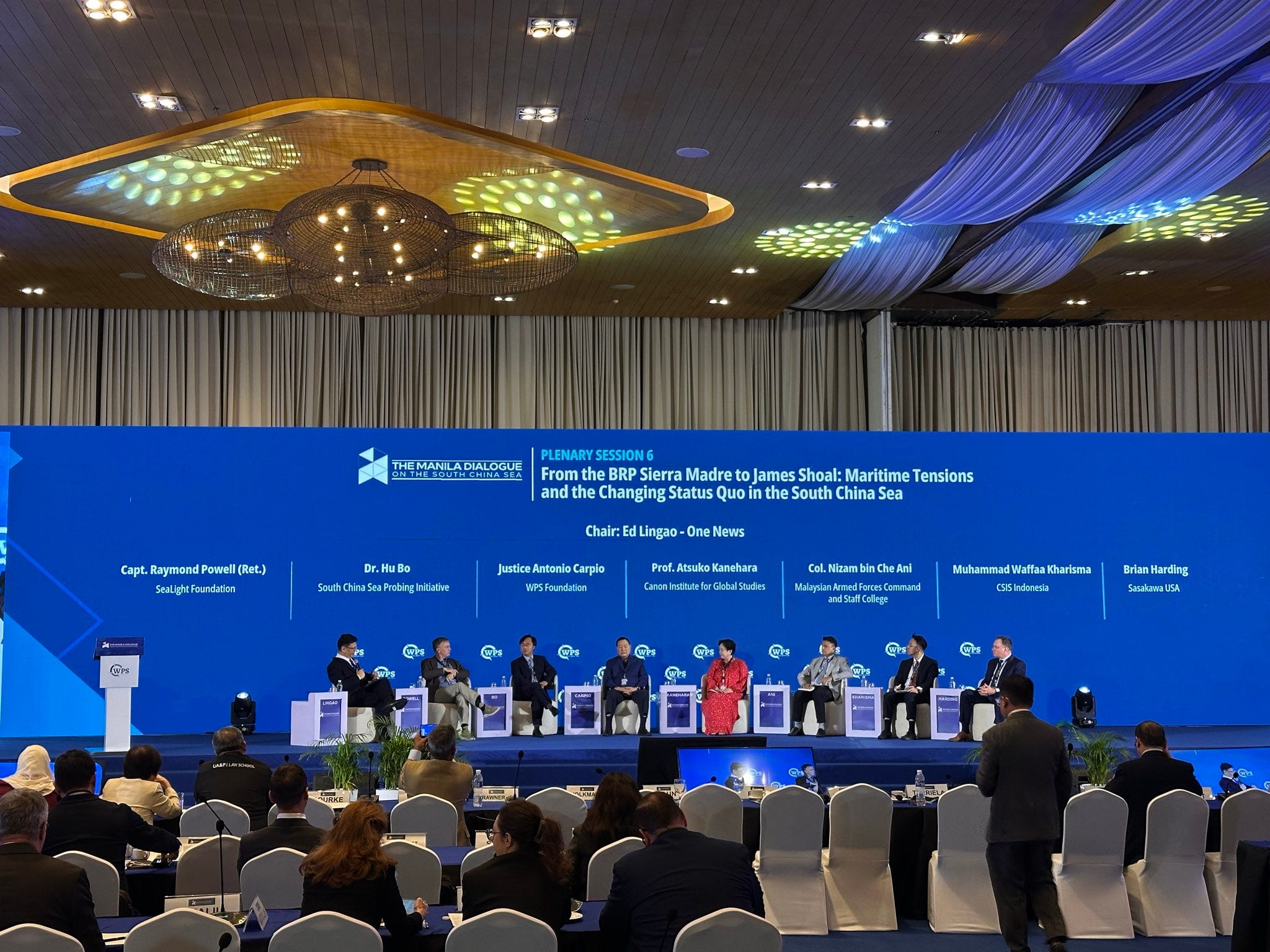
The video of Hu’s remarks is also available on SCSPI’s official YouTube channel. The transcript is based on this recording and has been lightly edited for clarity, with Hu's collaboration.
In these two days, we have heard a lot of China’s threat and China’s bullying. So let me tell you a different story.
Before we start, I think we should know that we are living in the international sovereignty system. International relation process is the circle of action and reaction. I would like to share three misunderstandings on China’s claims and China’s policies in the South China Sea.
The dash line, or the nine-dash line, just defines the scope of China’s claims in the South China Sea. It is not the legal basis for China’s claims.
If you notice China’s official statements, you will see that we have four kinds of claims.
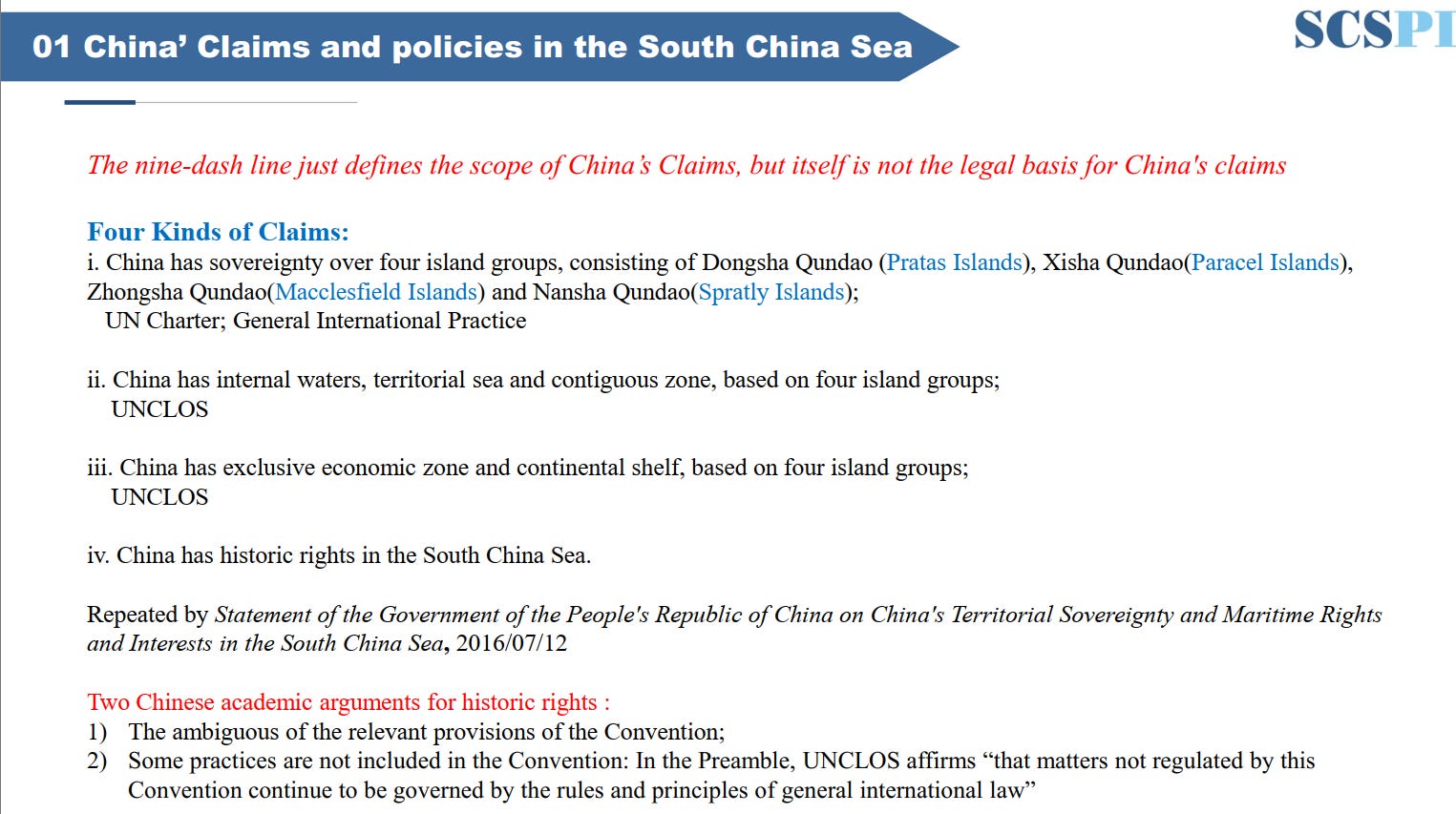
The first claim is that China has sovereignty over four island groups including Paracel Islands and Spratly Islands and others, and this kind of sovereignty is based on international practice and the UN Charter. Many have been talking about distance, but distance has never been the legal basis for sovereignty claims.
Secondly, after the UNCLOS came into practice, China had a claim of territorial sea and 【Thirdly】EEZ (exclusive economic zone) generated by UNCLOS based on the four island groups.
Finally, China has historic rights in the South China Sea.
Beijing has never used the nine-dash line to claim 90% of the South China Sea as China’s territory. That’s fake news. I also want to remind Mr. Ray Powell that you couldn’t claim the sea as your territories. We just claimed the four island groups as our territories, inheriting the claims from the Republic of China.
Also, the arbitration ruling has stated that all features in the South China Sea couldn’t generate 200 miles of EEZ. We should know that even during the negotiation of the UNCLOS, after 10 years of negotiations involving thousands of representatives from more than 100 countries, no agreement could be reached on what kind of features could generate 200 miles of EEZ. How can five arbitrators decide that? Who gave them the courage?
As to the historic rights, there are also two Chinese academic debates on that. In order to save time, I will not interpret that. You can see it in this screen.
The second misunderstanding is that China restricts foreign maritime activities in our EEZ, but we don’t have this kind of law. In practice, we just intercept when foreign maritime activities approach too much on our territorial sea or airspace.
The third misunderstanding is that China wants to change the status quo. The real reality is that China wants to keep the status quo.
I think even now Beijing follows Deng Xiaoping’s principle of shelving disputes. We recognize that the occupation state in the Spratly Islands happened in history, and we would not use force to return them back. But we couldn’t accept new losses.
The Second Thomas Shoal is not on the occupation list that Beijing recognized. I will talk about it later.
China has never fired the first shot. Many of you are talking about the water cannon, but you may not know that China has never fired even a single bullet to our neighbour for more than three decades. But the Philippines shot down Chinese Taiwan fishermen in 2013. Also, there have been open-fire incidents happening among ASEAN member states. For instance, Vietnamese fishermen have had very bloody conflicts with law enforcement forces of Malaysia and Indonesia in recent years.
So, in this regard, I think China’s performance is much better than that of other claimants. We also emphasize the stability in the neighborhood relationship with their neighbors. But China is also a sovereign state. When facing challenges to its sovereignty and maritime rights, China has a reason to respond and must respond.
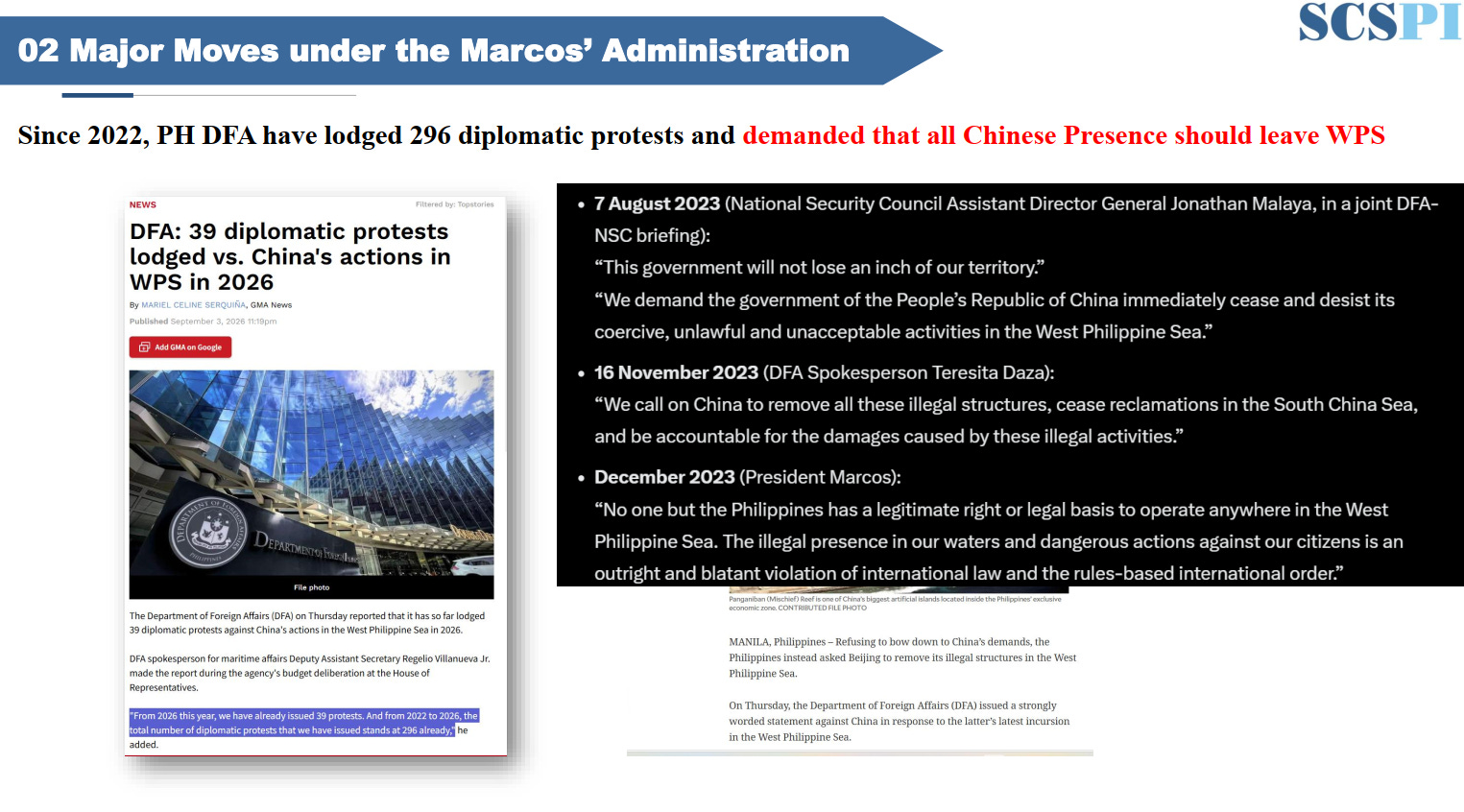
Under the current administration of the Philippines, ever since late 2022 and up to now, I think the Philippines has protested against Beijing more than 500 times, demanding that all Chinese presence — all the personnel and vessels — should leave the West Philippine Sea. It’s a very ambitious demand.
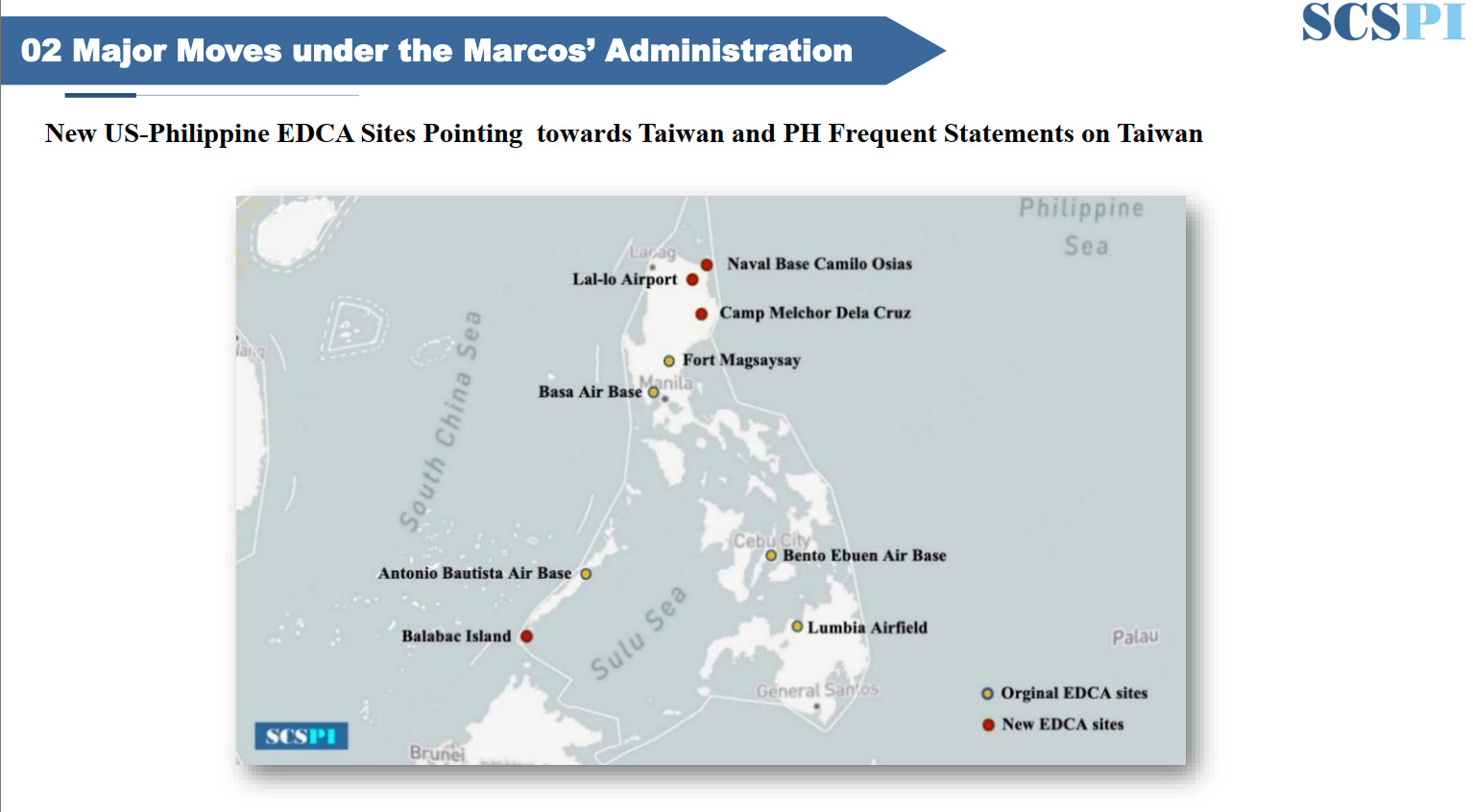
There are also the new EDCA (Enhanced Defense Cooperation Agreement) sites, especially two of them pointing towards Taiwan, as well as the Philippines’ high-level officers saying that the Philippines has 250,000 Filipinos in Taiwan, so Taiwan’s contingency is the Philippines’ contingency. If Beijing uses the same logic, we can say that we have a lot of Chinese citizens in the Philippines and we have a lot of economic interests in the Philippines. So, the Philippines’ contingency is China’s contingency. So, I think this kind of thing is totally nonsense.
Also, the Philippines has proposed to extend its continental shelf beyond the 200 miles of the EEZ.
And there are two laws, which I think is very important, to trigger China’s response on the Scarborough Shoal.
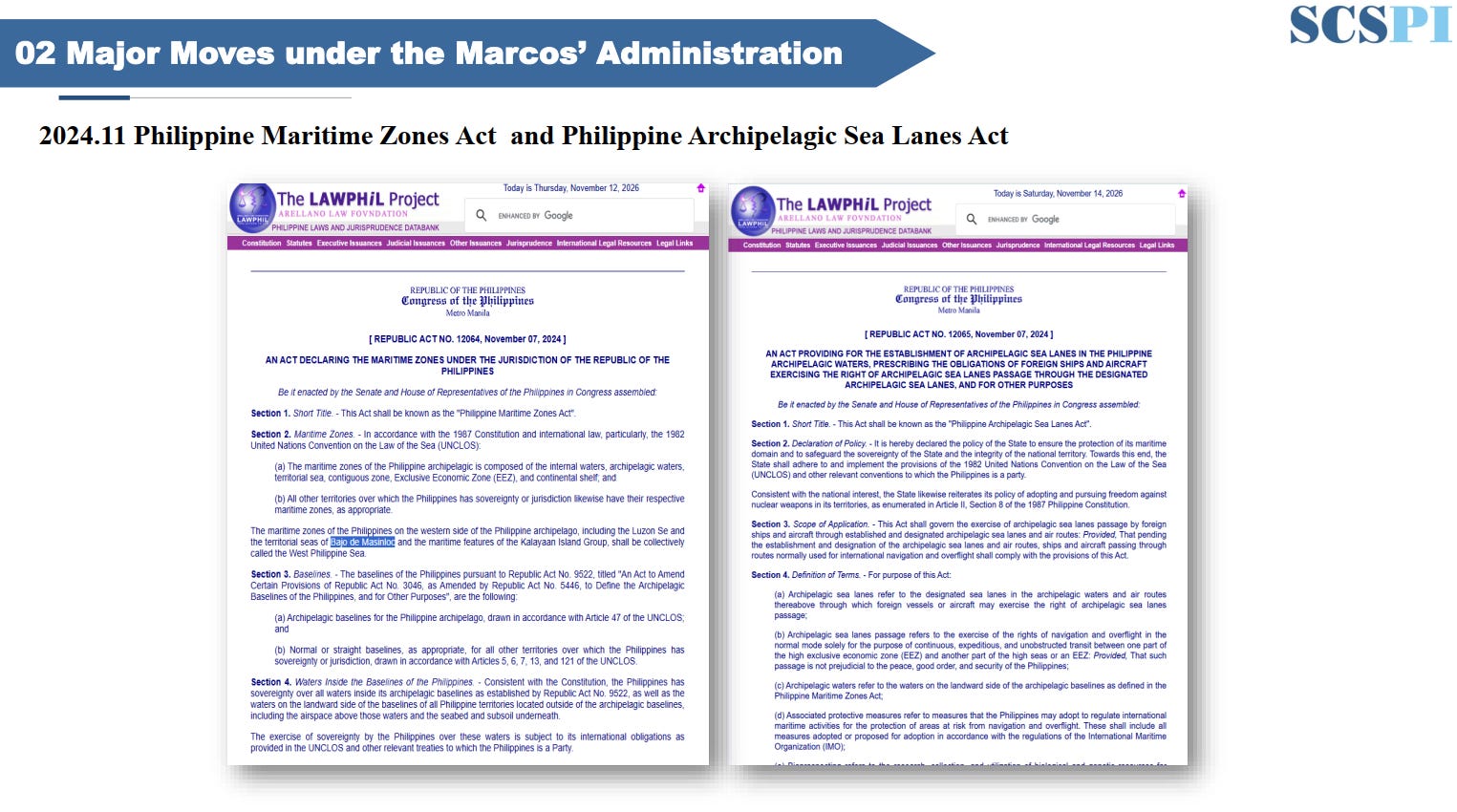
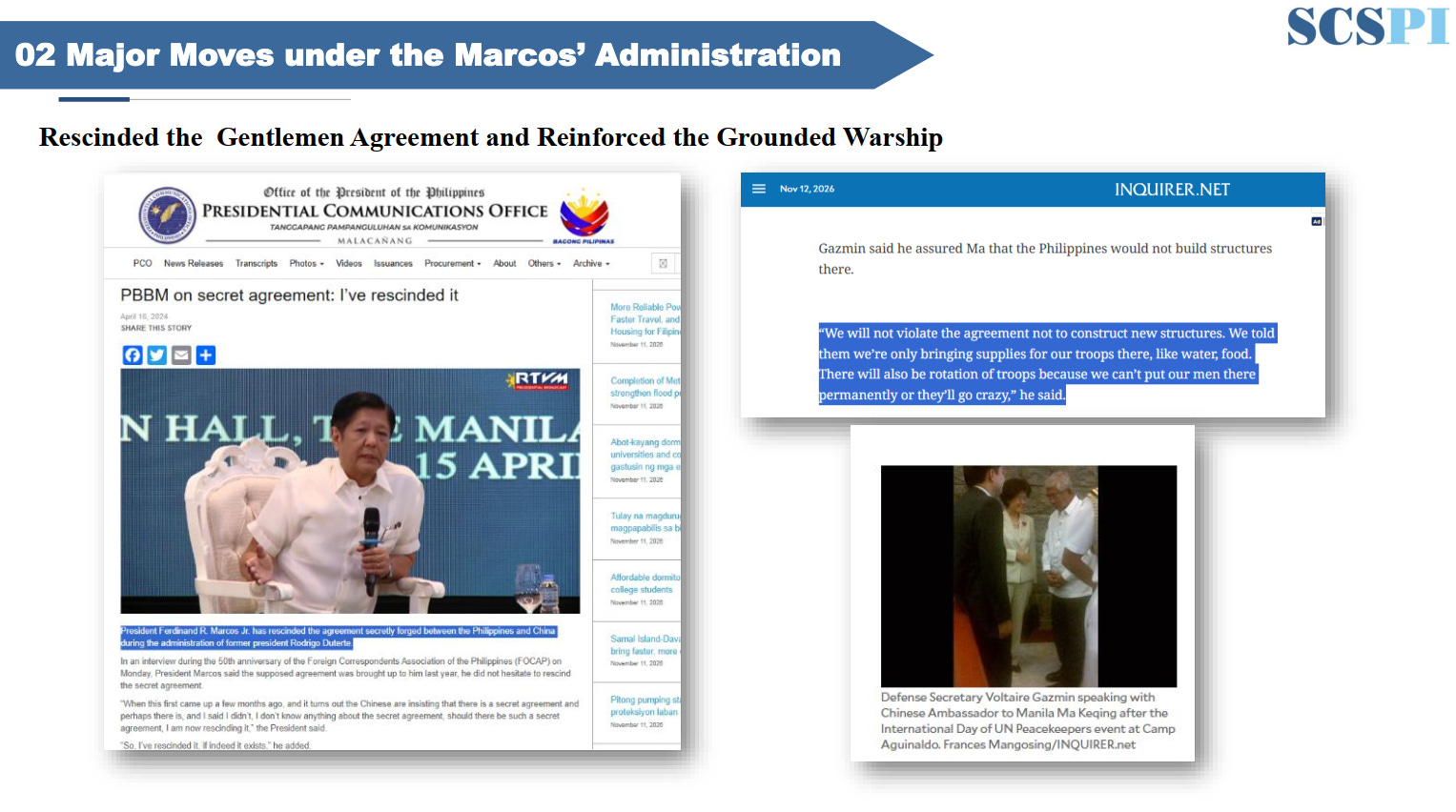
The current Philippine administration, from the beginning, denied any kind of “gentleman’s agreement” with Beijing, but this kind of gentleman’s agreement existed even during the Aquino III administration.
And the Philippines has shown the intention to occupy all the features in the West Philippine Sea.
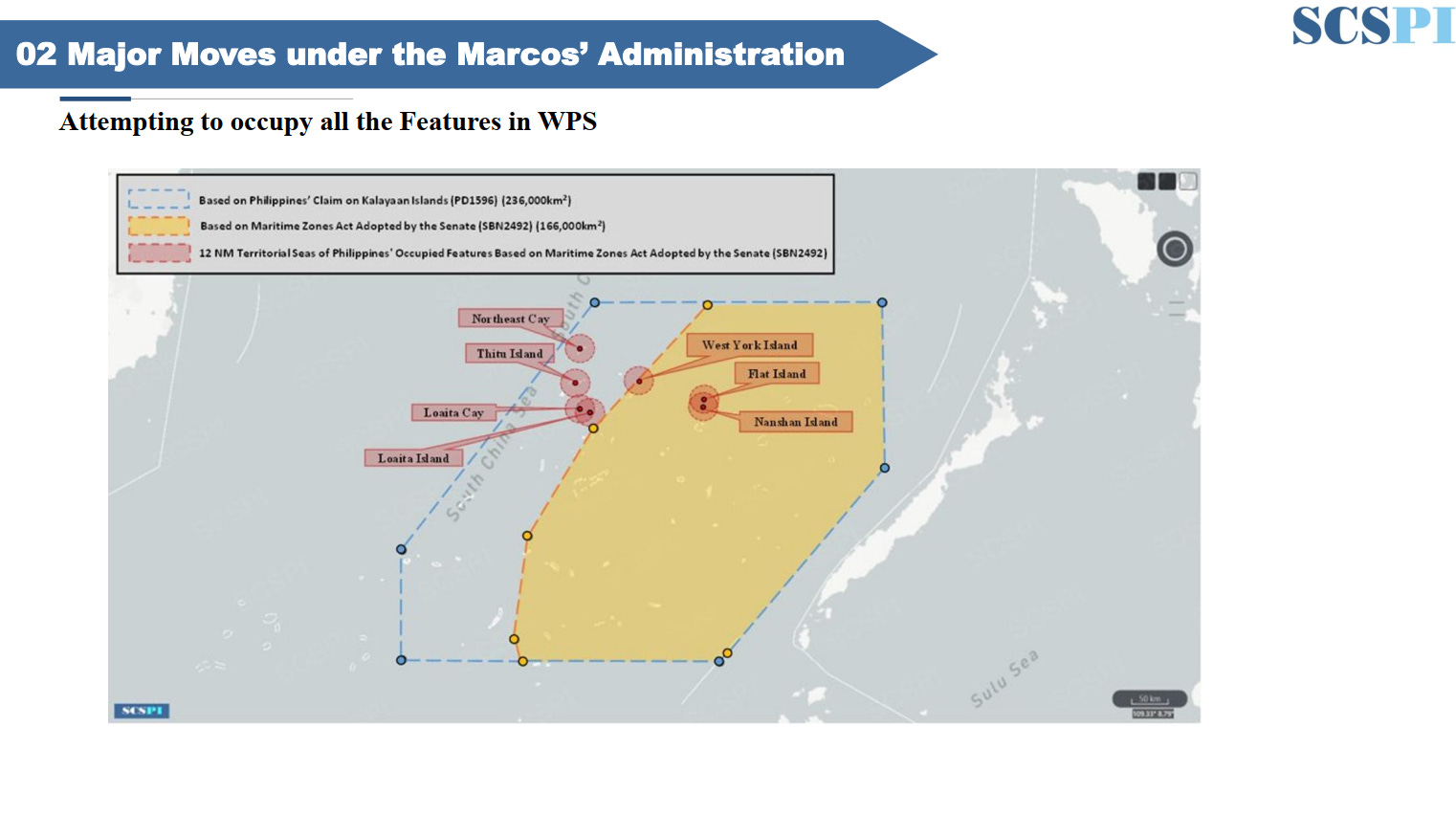
In the following part, we will review the cases one by one. The first case is the Second Thomas Shoal.
The Philippines grounded [a ship in] the Second Thomas Shoal in 1999. At the beginning, the Philippines told Beijing that they were just temporarily grounded. But they continued to ground it in this feature. Before 2022, Beijing and Manila had some understanding and a gentleman’s agreement that ordinary resupply is no problem but no building materials.
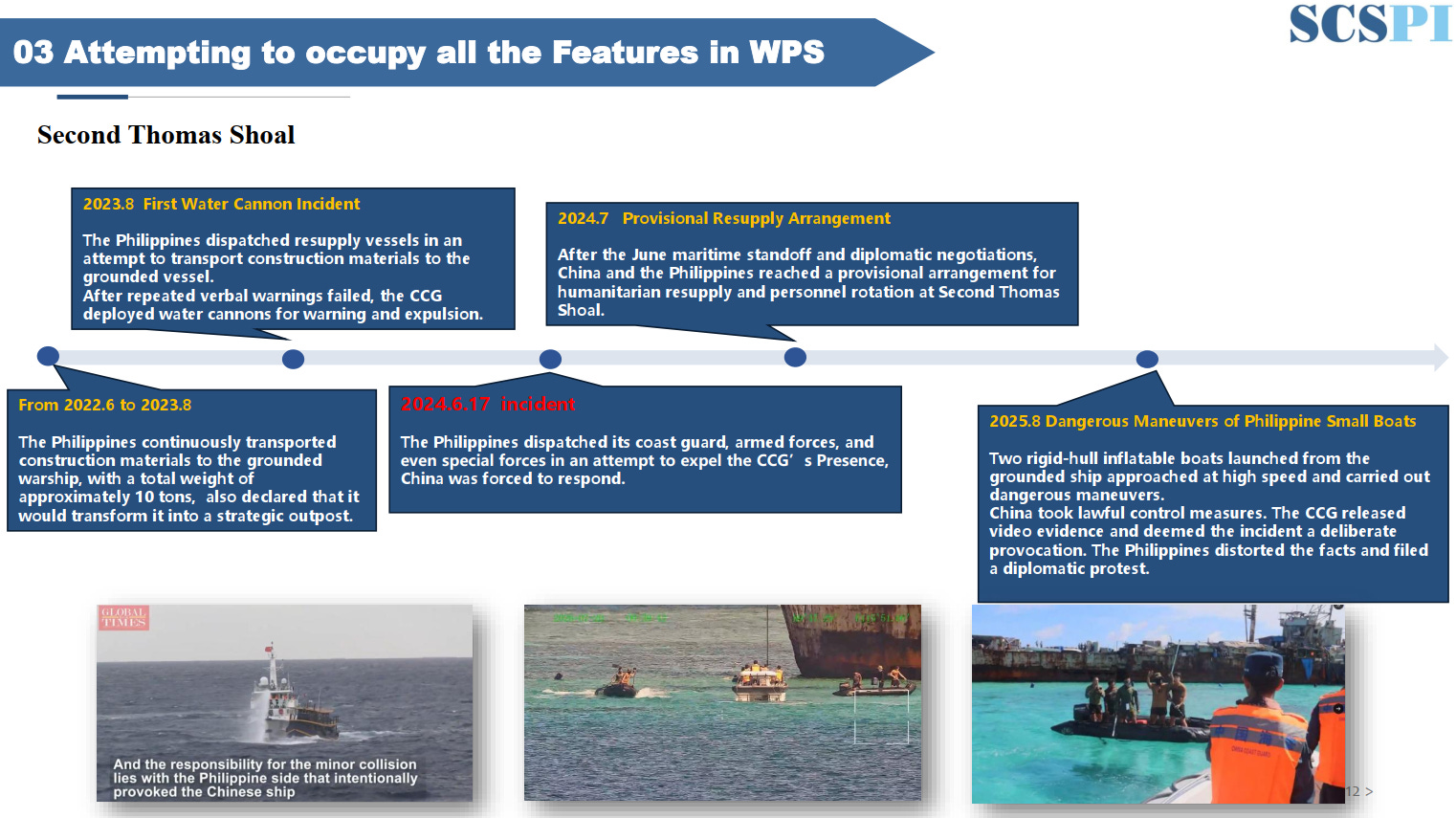
But when this administration came into office, they denied this kind of arrangement. Also, they wanted to challenge China’s bottom line on the Second Thomas Shoal. The amount of building materials transported was around 10 tonnes. Beijing waited a long time, almost a year, to persuade the Philippines to change its course. Beijing responded to the Philippines operation only in August 2023. We waited a long time.
But after the incident on June 17, I think the Philippines realised that they should have some mutual understanding with Beijing. So we have another, we could say, gentleman’s agreement on the resupply.
So, generally, I think the situation of the Second Thomas Shoal is calming down compared with other features. One thing I should say is that the Second Thomas Shoal is different from Thitu Island and the other seven features the Philippines occupied. Beijing has never recognised the occupation state of the Second Thomas Shoal.
This is the Sabina Shoal. I think the confrontation just came out in this current administration.
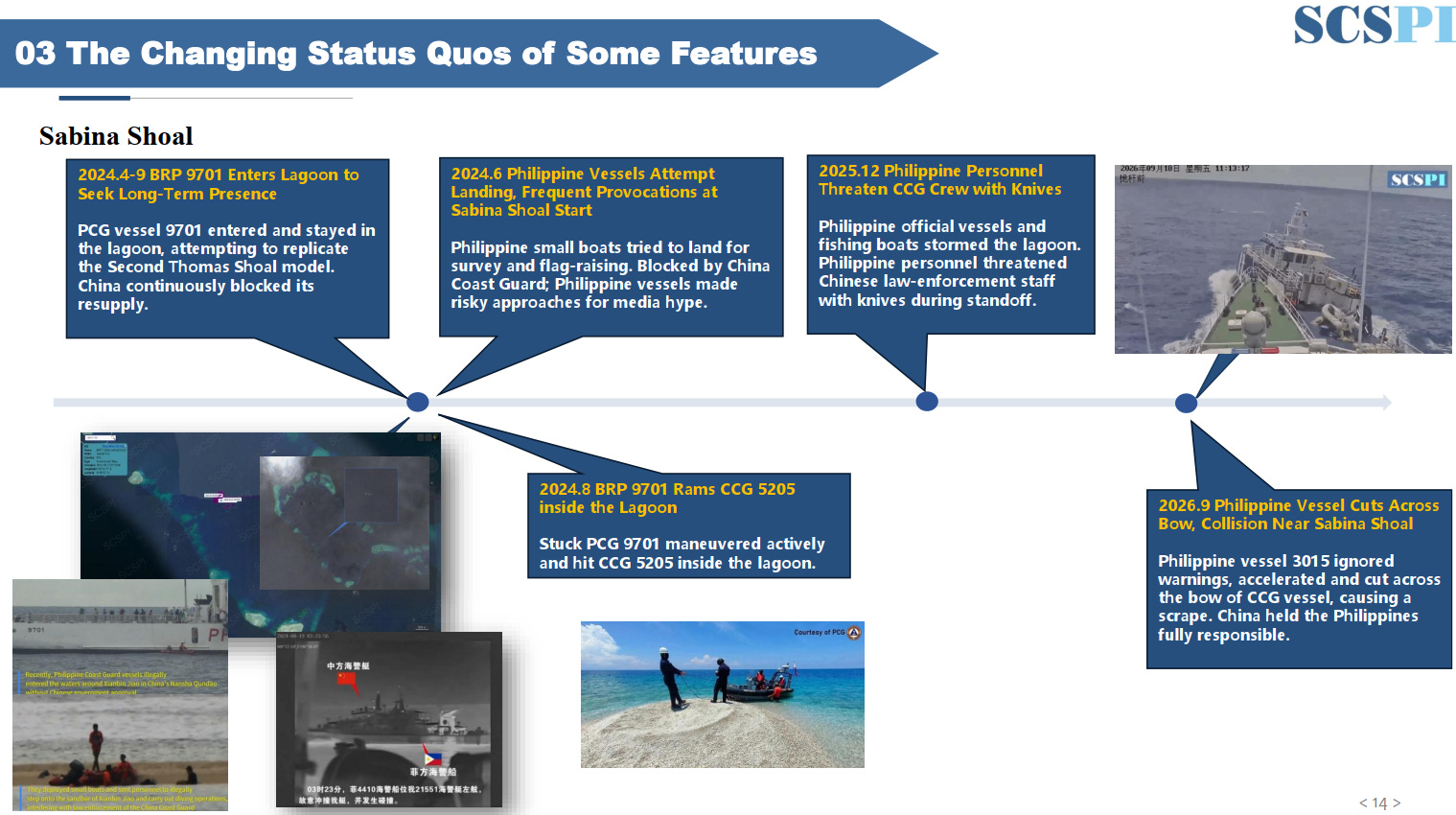
The heated period is between April and September 2024. But finally, I think Beijing and the Philippines both know that neither has the intention to occupy this feature. There have been some incidents even this year, but generally I think the tensions around Sabina Shoal has been decreased.
Beijing has never recognised that there was dispute in the Scarborough Shoal. Beijing just recognised that there are disputes in the Spratly Islands. That’s Beijing’s position.
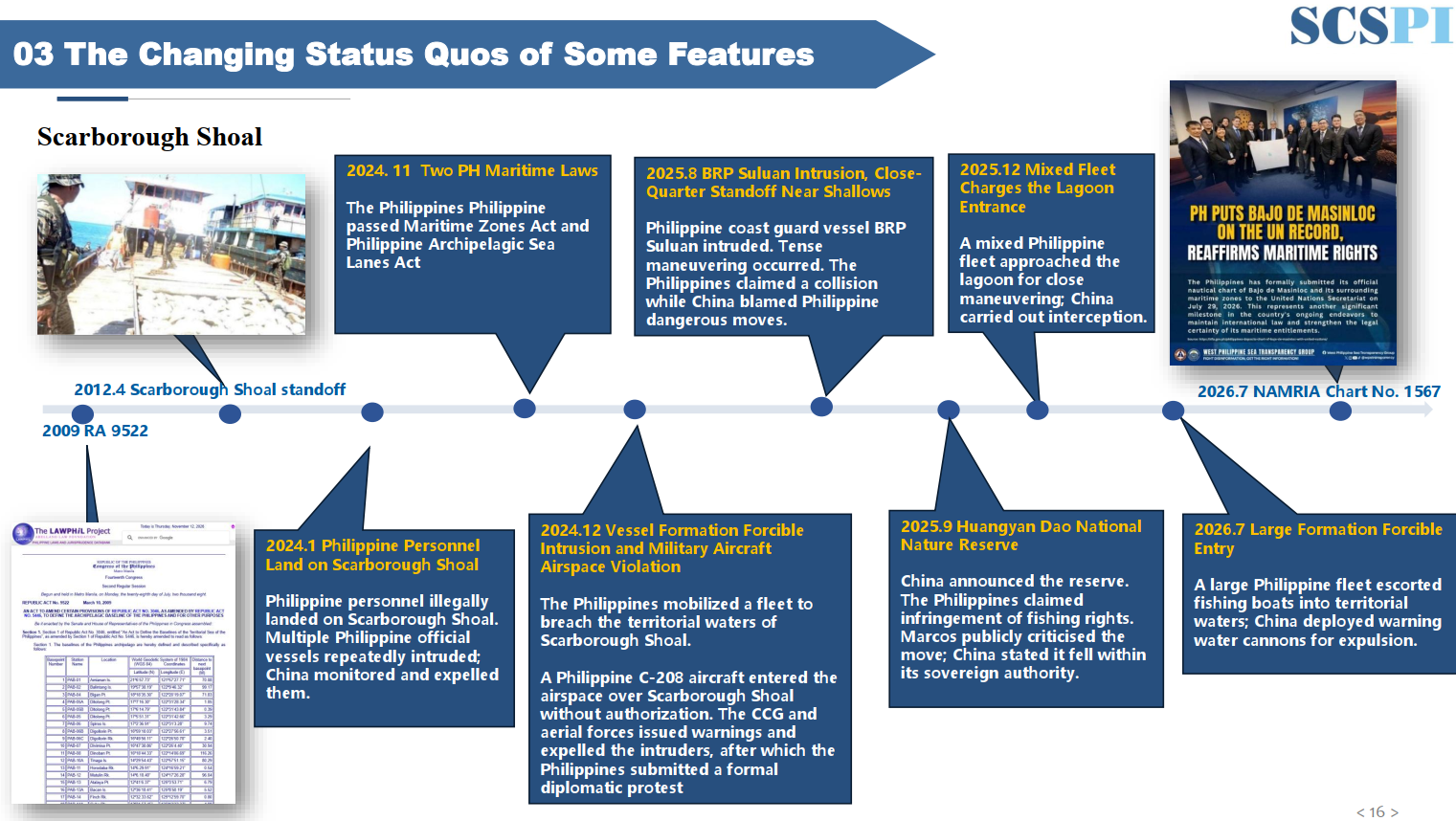
And in the Scarborough Shoal, the incident happened in 2012. During that incident, the Philippine naval officers tortured Chinese fishermen in the lagoon of the Scarborough Shoal. Beijing responded by sending law enforcement vessels there. After the incident, Beijing was worrying about that the Philippines might repeat this kind of intrusion, so Beijing kept high alert and deployed one or two coastguard vessels around the Scarborough Shoal.
But the situation remained generally controllable just after this current administration came to office. I think the Philippines wanted to use the fishermen and law enforcement forces to jeopardise China’s control of the Second Thomas Shoal. After the Philippines established two laws, Beijing responded by establishing the baseline of the Scarborough Shoal.
You will see that every step taken by Beijing was a response to the Philippines. So I told our Philippine friends in our last dialogue in Manila: don’t give Beijing chances anymore.
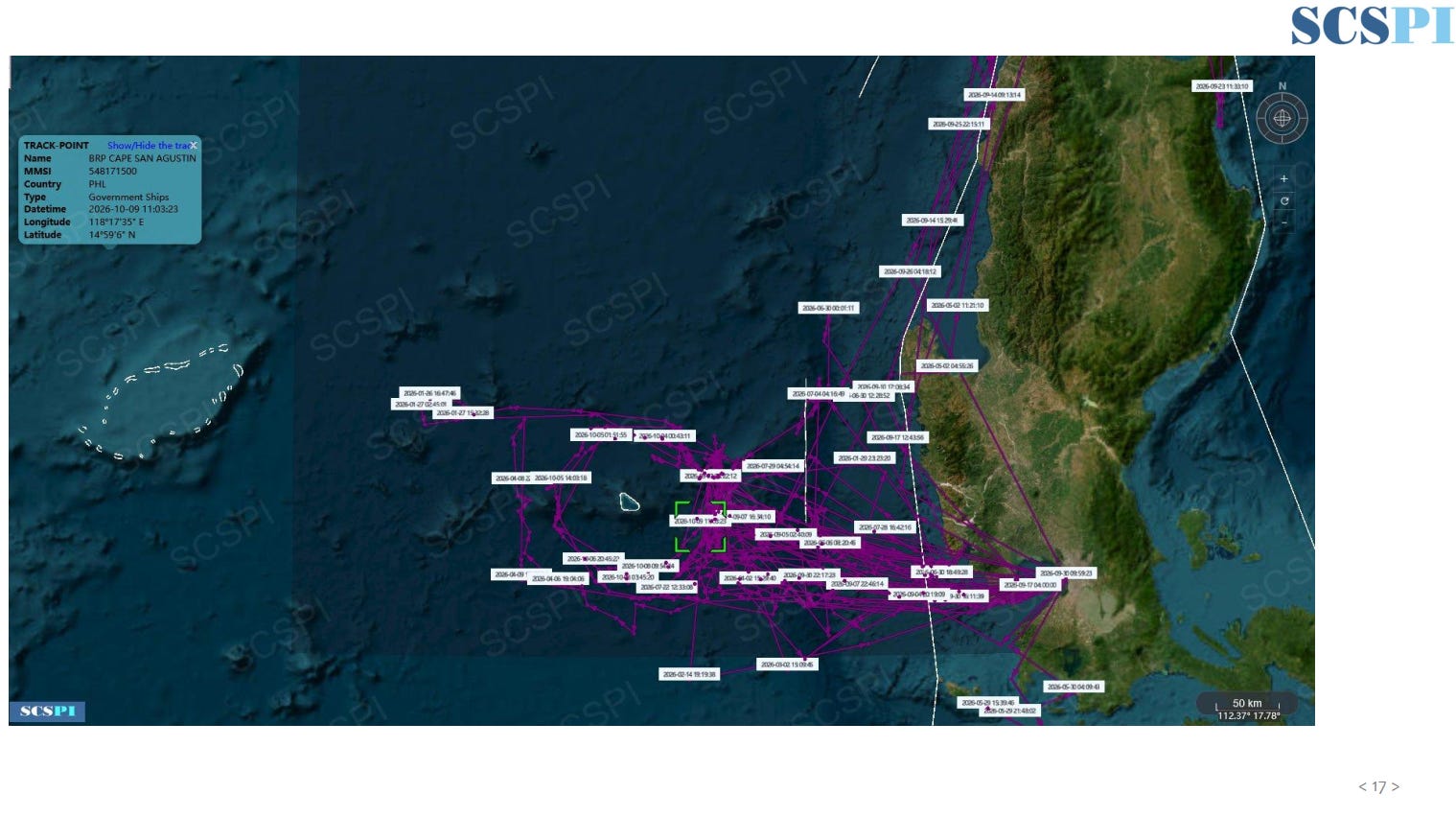
And the Philippines uses government vessels to interfere with the territorial sea and airspace of the Scarborough Shoal, and there are fishermen at the forefront. There are almost daily encounters involving air incursions from the Philippines government aircraft. So every two or three days, there are these kinds of sorties.
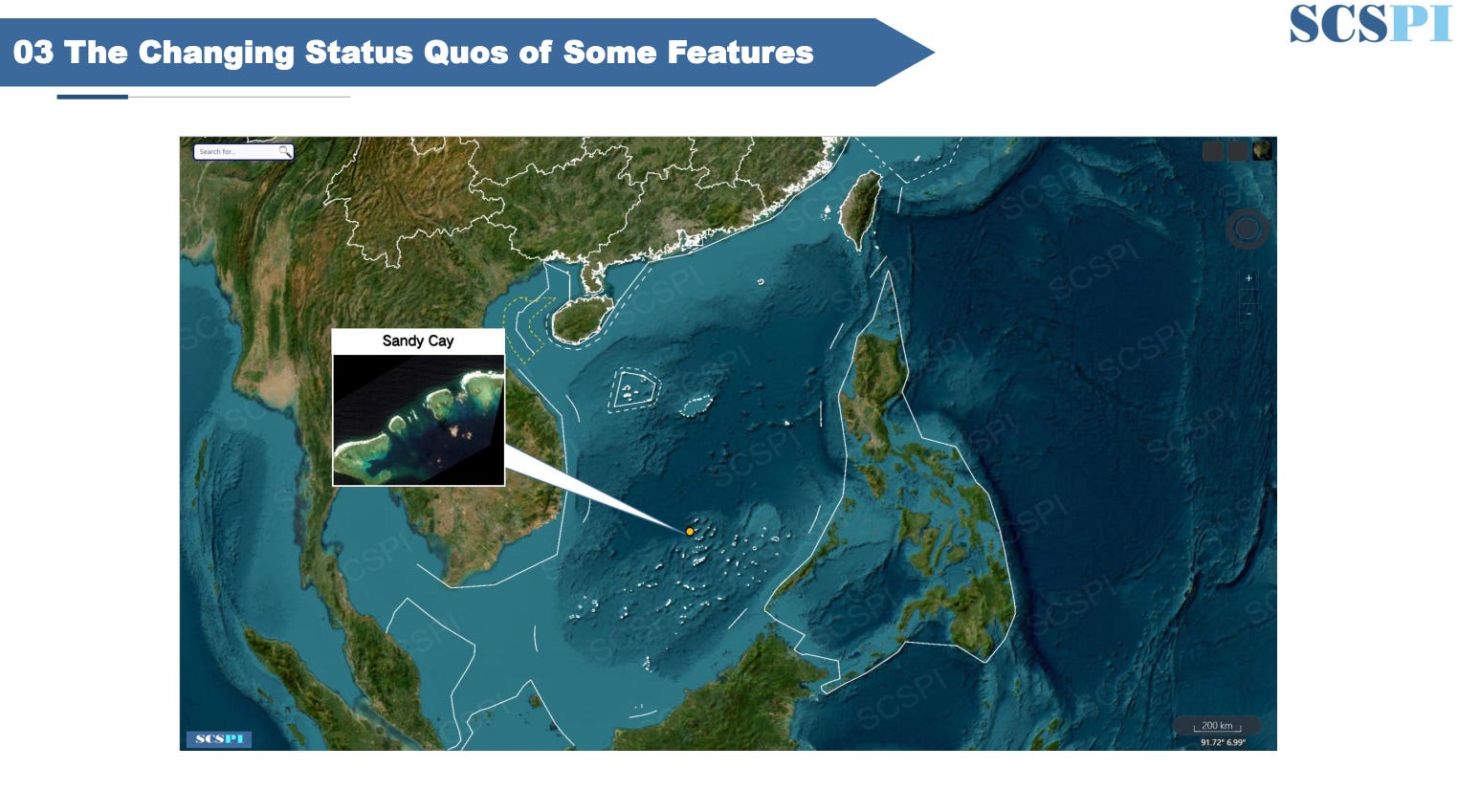
The following one is the Sandy Cay. Beijing and Manila have different understandings of the geographic situation. Beijing thinks that the Sandy Cay is a single part, an independent feature. But Manila thinks that this feature is part of the Thitu Island. This kind of misunderstanding has existed for more than 10 years.
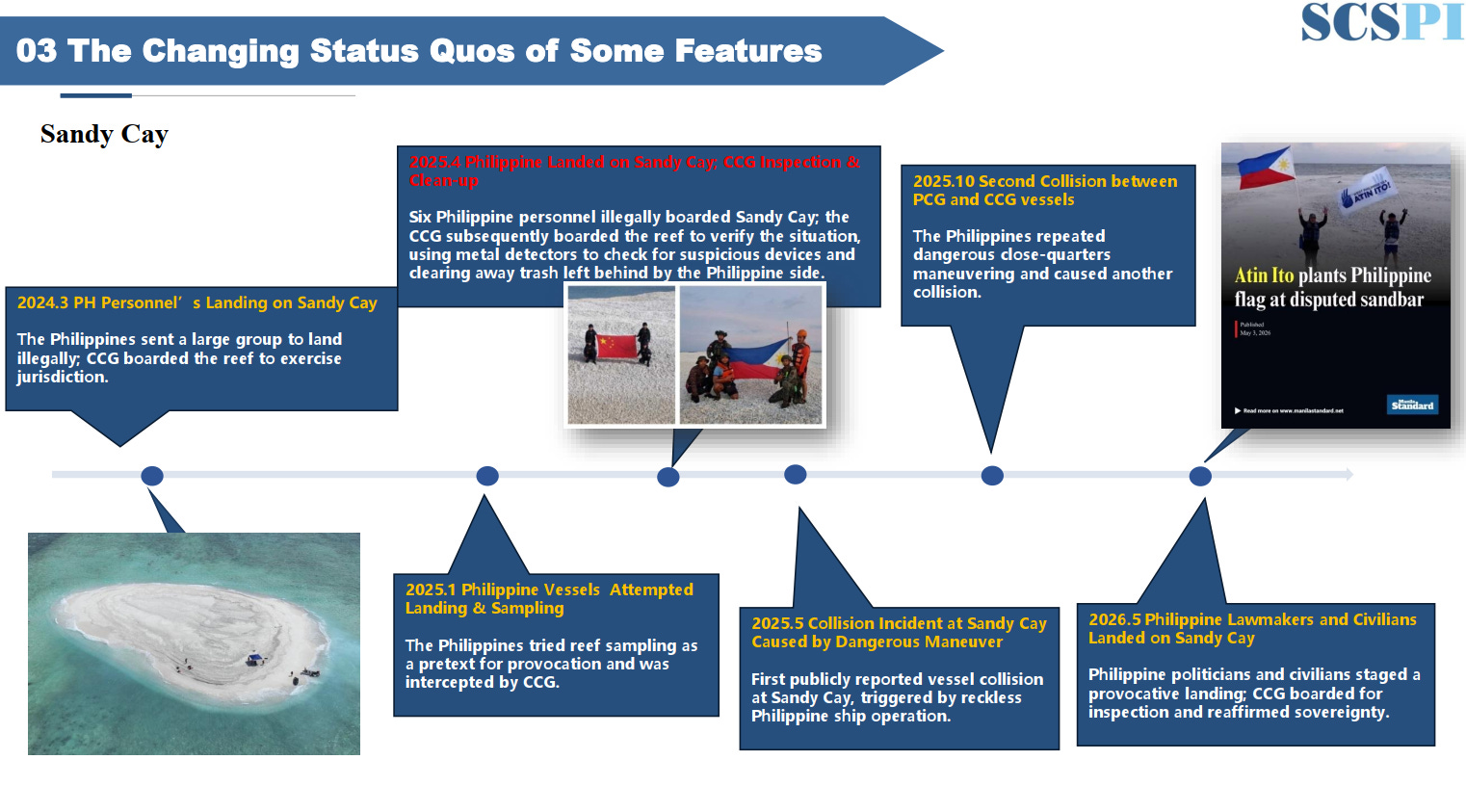
But in the past two or three years, the Philippines has shown their intentions to occupy Sandy Cay. I think that touches upon Beijing’s bottom line and red line in the South China Sea. As I told you at the beginning, Beijing recognises the occupation state that happened in history but couldn’t accept any new occupation or losses, no matter whoever you side with.
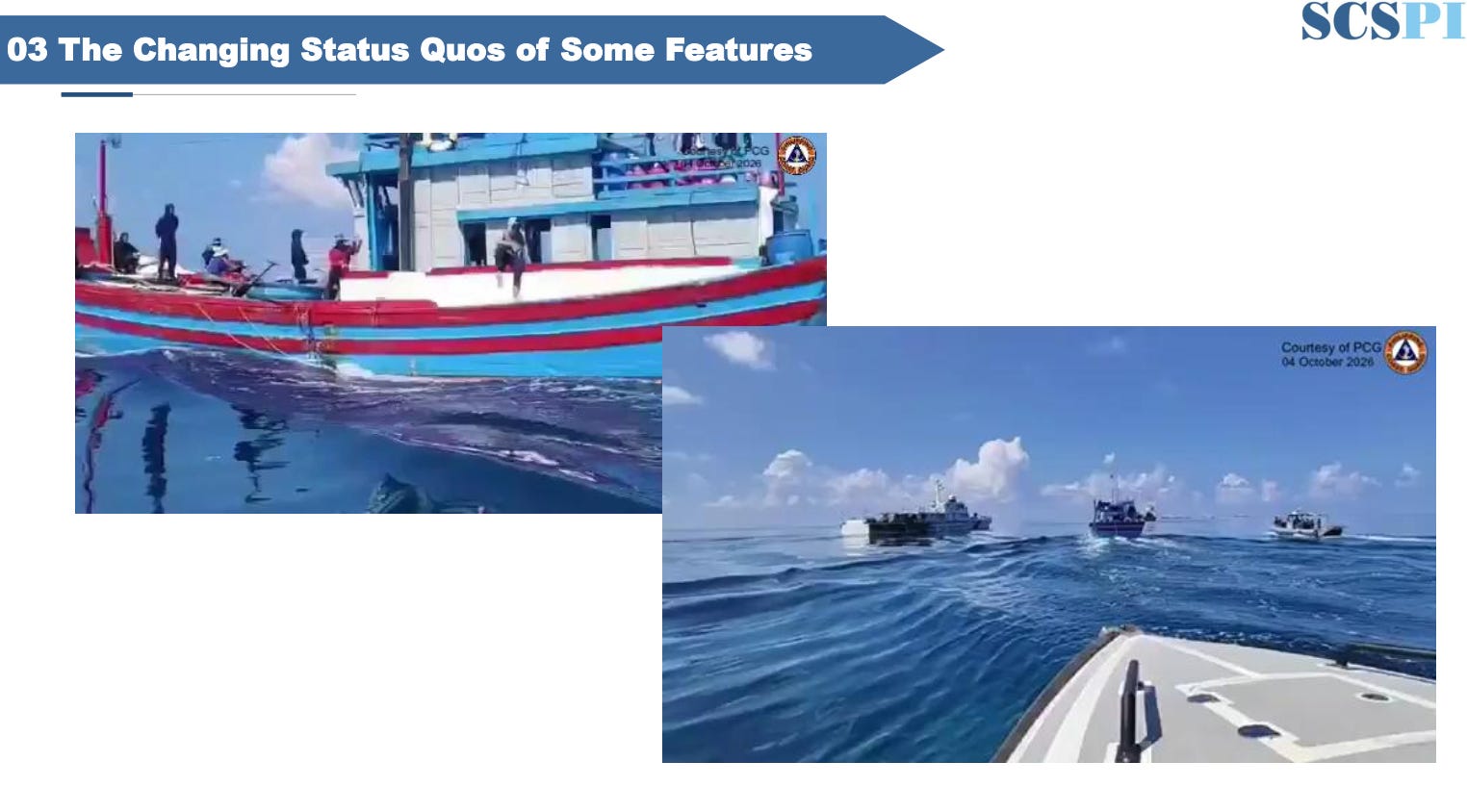
This kind of conflict exists not just between Beijing and Manila but also between the Philippines and other claimants. These are Vietnamese fishing vessels, and they are in conflict around Sandy Cay.
I should give you some good news: the current frictions mainly exist among some disputing parties, and any relevant disputes have not affected other countries’ navigation and overflight freedoms in the South China Sea.
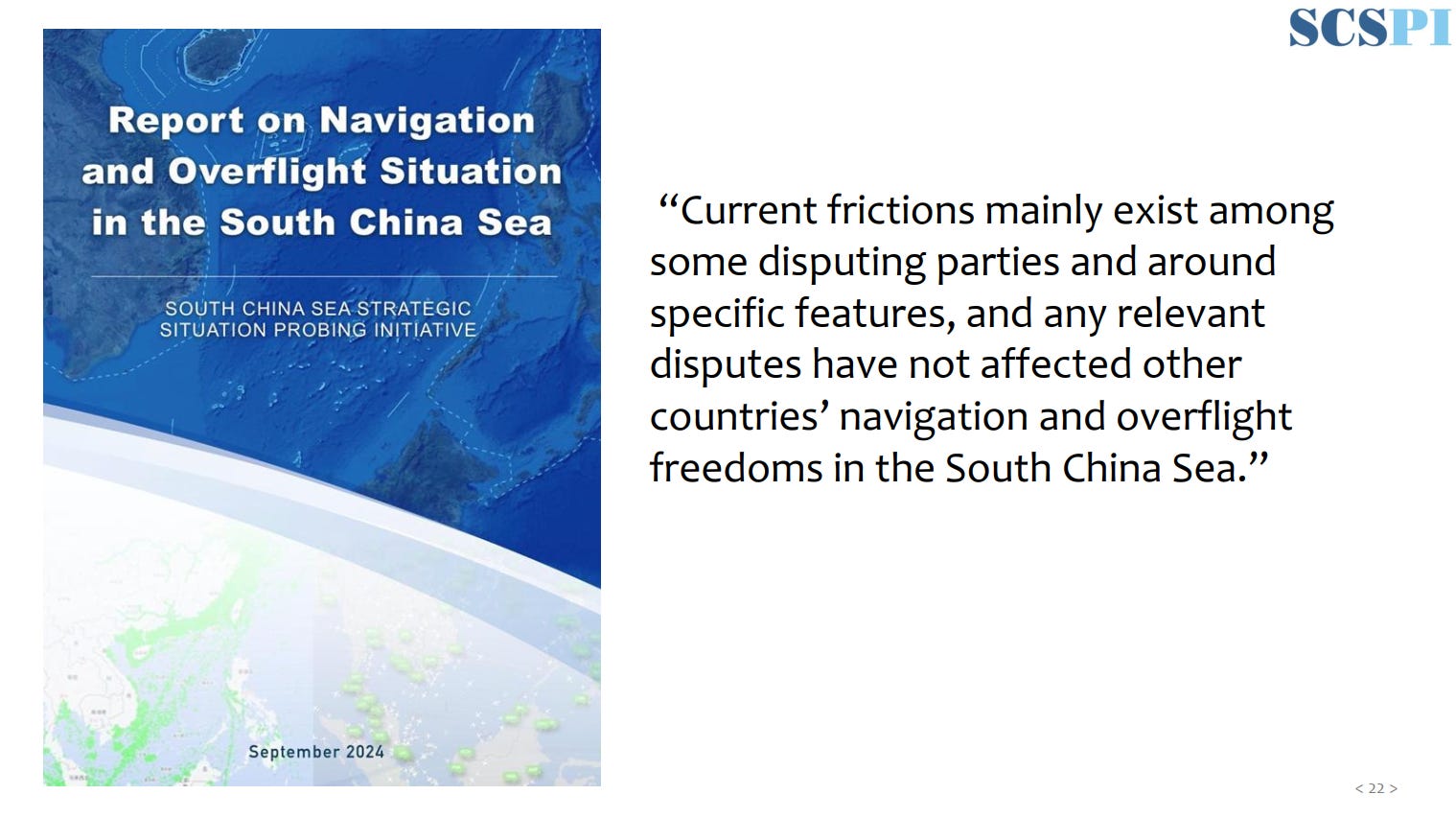
If you are interested, you can read this report. Thank you so much and welcome to follow SCSPI.


Hu Bo: Japan–Philippines Maritime Delimitation Talks and China’s Response

On 28 May 2026, Japan and the Philippines agreed to launch formal negotiations on their maritime boundary east of Taiwan, prompting strong objections from Beijing and a series of Chinese maritime enforcement operations.
Hu Bo: The Decline of U.S. Maritime Hegemony Exposed by Nimitz Aircraft Crashes

Hu Bo is Director of the South China Sea Strategic Situation Probing Initiative (SCSPI), and Research Professor & Director of the Centre for Maritime Strategy Studies, Peking University.
Hu Bo: AI and the future of sea power

Hu Bo is Director of the South China Sea Strategic Situation Probing Initiative (SCSPI), as well as Research Professor and Director of the Center for Maritime Strategy Studies, Peking University. He also serves as Director of the Center for Marine Big Data and Intelligent Research
Hu Bo: de-hegemonisation of the international maritime order and the risk of regression

This is our fourth article translated from the special series in this year’s 16th issue of 世界知识 World Affairs, a Chinese-language magazine published by World Affairs Press under China’s Ministry of Foreign Affairs. The series features contributions from some of China’s “foremost scholars,” according to the magazine, on the theme

