

Guo Ping is one of the longest-serving senior executives at Huawei. Born in 1966, he joined the company in 1988 and has held an unusually broad range of senior positions, including head of supply chain, chairman and president of Huawei Device, chief legal officer, rotating CEO, deputy chairman of the board, and rotating chairman. He is now chairman of Huawei’s Supervisory Board, which the company describes as its highest supervisory body.
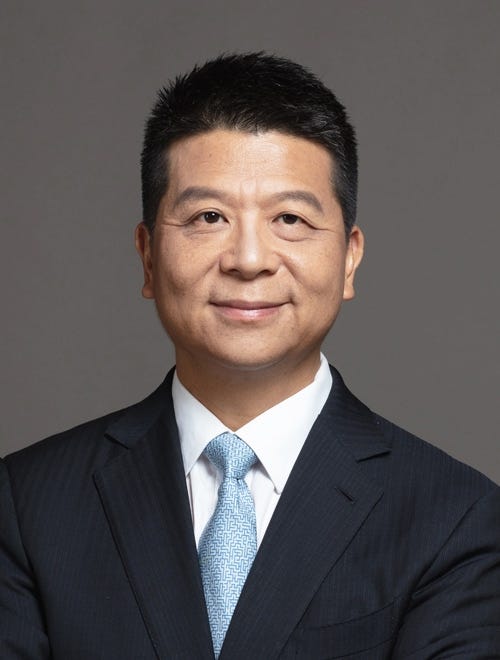
That background makes the following conversation particularly interesting. Guo is not simply commenting on one product line. He has worked across R&D, supply chains, devices, corporate management, and Huawei’s top leadership, and in this newly-published lengthy discussion with newly recruited employees he offers something close to a tour of Huawei’s current strategic thinking.
Several passages stand out. Guo says Huawei has no plans for broad business expansion and will remain focused on connectivity and computing. In ICT and computing, he says Huawei’s ambition is to “become Nvidia”: its competitive advantage should not depend on possessing the best proprietary large language model, but on allowing virtually any model to run efficiently on Ascend, Kunpeng, SuperPoDs and Huawei clusters. By contrast, he argues that Huawei’s device, intelligent-driving, and cloud businesses do need competitive models of their own.
He is also unusually explicit about Huawei’s weaknesses. China, he says, remains relatively behind in compute, while Huawei itself continues to face constraints in advanced semiconductor manufacturing. His answer is not to deny those disadvantages but to argue that Huawei can compensate through system architecture, closer integration of design and manufacturing, clusters, SuperPoDs, and what Huawei calls the Tao (τ) Law, which seeks to substitute “time scaling” for conventional geometric scaling. He even says that the upcoming Ascend 950 series could narrow the gap with competitors despite process limitations.
Just as revealing is the way Huawei’s leadership is thinking about AI inside the company. Guo divides the future workforce, somewhat starkly, between a small number of people who will “build AI” and the much larger number who will “use AI.” He argues that the scarce skill in the latter category may not be programming but the ability to define and formulate good questions — one reason, he says, that people trained in literature and philosophy may become increasingly valuable. He also describes AI as possibly “the last technological revolution of human society,” a working assumption that, in his telling, now justifies changes to Huawei’s organization, processes, talent system and management.
There are also passages likely to attract attention for reasons beyond technology. Guo describes Huawei as seeking a “third path” for a sanctioned company: neither disappearing into the “jungle” nor ending up “in prison,” but surviving and remaining competitive. His discussion of corporate responsibility is strikingly Friedmanite.
Milton Friedman famously declared in 1970 that “the social responsibility of business is to increase its profits.” Guo does not speak in quite the same language of shareholder value, but the family resemblance is hard to miss: he argues that “business is the greatest form of charity,” that commercial success is itself a company’s greatest social responsibility, and that Huawei best serves society by remaining competitive, creating value for customers, employing and paying people lawfully, and paying its taxes. He makes the contrast, within the realm of corporate social responsibility, especially blunt by calling for Huawei to reject what he terms baizuo — literally “white left” — thinking, a pejorative Chinese internet expression generally directed at Western progressivism .
The following summary was published on September 10, 2026, in Xinsheng Community (心声社区, literally “Community of Voices”), Huawei’s employee communication platform. Launched in 2008, Xinsheng was designed as an internal forum where employees could discuss company policies, technology, management and their own experiences. Huawei itself has described it as a “Roman Forum” for the company. According to Huawei’s 2023 annual report, the platform was receiving around 110,000 visits a day that year, including roughly 90,000 from Huawei employees and 20,000 from outside visitors. Some of its content, including senior executives’ speeches, interviews and internal discussions, is made publicly accessible.
The platform occupies an unusual place in Huawei’s corporate culture. Ren Zhengfei, its founder, has described it as a venue for open internal criticism and debate, part of what he sees as the company’s mechanism for correcting its own mistakes. In 2019, amid intense international scrutiny of Huawei, Ren even told reporters that if they genuinely wanted to understand the company, they should read Xinsheng Community.
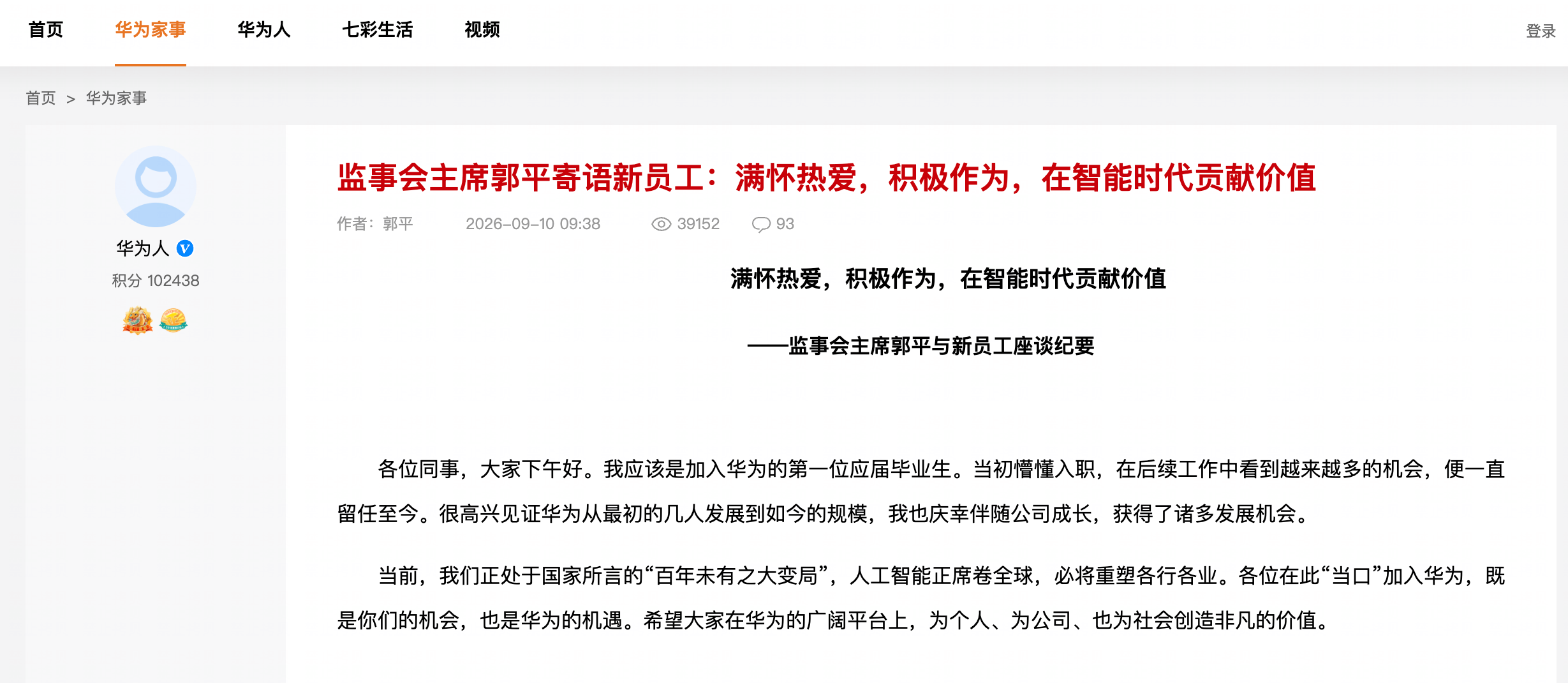
满怀热爱,积极作为,在智能时代贡献价值——监事会主席郭平与新员工座谈纪要
Stay Passionate, Take Initiative, and Create Value in the Intelligent Age ——Summary of Huawei Supervisory Board Chairman Guo Ping’s Discussion with New Employees
2026-09-10
Good afternoon, everyone.
I believe I was the first fresh university graduate to join Huawei. I joined the company knowing very little, but as I worked I kept seeing more and more opportunities, so I stayed, all the way until today. I am very glad to have witnessed Huawei grow from just a handful of people into the company it is now. I have also been fortunate that, as the company grew, I was given many opportunities to develop myself.
We are now living through what our country calls “changes unseen in a century.” Artificial intelligence is sweeping across the world and will undoubtedly reshape every industry. You are joining Huawei at precisely this juncture. That represents an opportunity for you, and it is also an opportunity for Huawei.
I hope that on Huawei’s broad platform, you will create extraordinary value for yourselves, for the company, and for society.
Q&A
01
Go Deep in Our Areas of Focus and Create Greater Value
Q: Over the past few days of orientation, we learned that the company’s revenue has recovered to its historical peak level. Will the company adjust its business strategy in light of the current situation?
Guo Ping: In March 2021, Huawei released its annual report showing revenue of more than 890 billion yuan in 2020, an all-time high. In the years that followed, confronted with extreme external pressure and sanctions, we fought tenaciously to survive under very difficult circumstances while maintaining business continuity and competitiveness.
Looking ahead, Huawei’s core strategy is focus. We will continue going deep in the areas we are good at — connectivity and computing. We have no plans to expand into additional businesses.
We hope to achieve better performance, provide digital infrastructure solutions to customers around the world, provide diverse options for the development of artificial intelligence, and contribute to the rise of China’s electronics industry.
That is our vision for the future: go deeper in the fields we have chosen and create greater value.
Q: After suffering major blows including sanctions, Huawei has returned to a trajectory of rapid growth. But the external environment remains extremely uncertain. If Huawei faces further suppression in the future, will it be better able to cope with it?
Guo Ping: That is quite a philosophical question.
First of all, we have been living under pressure for a long time. That is an established fact, not a hypothetical scenario.
You need not worry too much. What can truly prevent Huawei from developing is not the external environment, but our own internal capabilities.
China has a dynamic market and demand generated by a population of 1.4 billion. That is sufficient to sustain Huawei’s survival, although of course Huawei does not develop only within China.
What concerns us is whether we remain competitive relative to our domestic and international competitors: whether we can provide competitive products and services and create value for customers.
I would not encourage you to pay excessive attention to grand narratives. Focus more on the work in front of you. Do your own job well. As your experience and understanding grow, you will naturally accumulate more experience in solving problems.
Q: With supply-chain costs rising, how should Huawei adjust pricing strategies across different parts of the supply chain? And could Huawei’s smartphone sales eventually surpass Apple’s?
Guo Ping: Apple’s CEO is a master of supply-chain management in our industry and someone from whom we should learn. I myself once ran Huawei’s supply chain.
Given the constraints Huawei currently faces on the supply side, maintaining supply is our bottom line. We need to do an even better job managing what IBM taught us about the on-time kitting rate and procurement lead times, accelerate turnover, reduce inventories, and make sure no link in the supply chain breaks.
Huawei does not make surpassing any particular company its development objective. We focus on doing our own job well.
The global market, including the device market, can accommodate many companies and many kinds of products. Huawei is committed to increasing the core value of its products, giving consumers an experience worth what they pay, and becoming a brand that consumers love and trust.
Production volume and market rankings are not goals we deliberately pursue. They are natural consequences of having competitive products.
In supply chains, we need to keep learning humbly from Apple, including the competitiveness, flexibility and resilience of its supply chain.
We and our suppliers are mutually dependent partners. When things are at a peak, if you take other people’s feelings and interests into consideration, then when things are at a trough, others will also be more willing to take your circumstances into consideration.
Q: I interned at Huawei’s Guangdong representative office last year. My impression was that competition in the carrier market has become more difficult than in previous years. From the perspective of senior management, how do you see the future development of the carrier business? And in what form, and when, will the 6G era arrive?
Guo Ping: Of all Huawei’s businesses, the carrier business is the one in which we are most globally competitive, and it has the highest input-output efficiency.
But the carrier business also faces unique challenges.
Rules governing spectrum resources are determined by the ITU, the International Telecommunication Union, while wireless and other technical standards are developed by organizations such as 3GPP.
Simply following established standards and remaining competitive within them is only the most basic level.
Huawei entered the market as a latecomer by being better, faster, more efficient and more economical, and in this way gained market share. We then gradually became an important contributor to industry standards.
Looking forward, Huawei wants to contribute to exploration that goes from zero to one, while also using our strong execution capabilities to continue delivering better, faster and more economical solutions.
Of course, market development is influenced not only by technology, but also by geopolitics, security, influence, control and other considerations. So in addition to technological implementation, Huawei must pay attention to standard-setting, the structure of the market and the advantages that come from leadership.
The evolution of wireless standards is a continuous process.
Huawei hopes to promote a single unified global standard and to continue being an important contributor to that standard, an implementer of it, and a participant that succeeds commercially within it.
Q: Huawei has sold a cumulative 20% stake in Yinwang 引望. Will Huawei reduce its management of Yinwang in the future? How do you see the future relationship and forms of cooperation between Yinwang and Huawei?
Guo Ping: Yinwang is a company controlled by Huawei that has established capital ties with a number of partners. The intelligent automotive components business provided by Yinwang is an extension of Huawei’s ICT business.
Huawei has businesses involving intelligent agents that benefit from data-flywheel dynamics. The most prominent examples at present are smartphones and intelligent driving.
AI agents need the support of a data flywheel.
In the telecom-carrier business, the network belongs to the carrier and Huawei assists the carrier in achieving autonomous network operations.
In intelligent vehicles, however, Huawei provides intelligent-driving services directly through Yinwang.
For quite a long period of time, I expect Huawei will continue to bear responsibility for leading Yinwang’s development.
Q: Does the Intelligent Automotive Solution 车 BU plan to expand overseas in the coming years? How should we prepare?
Guo Ping: Huawei’s intelligent automotive components business has been global from the very beginning. It has never been limited to China.
But automobiles are highly regional products and are particularly sensitive geopolitically. Intelligent vehicles in particular involve issues of data, security and privacy.
Huawei’s intelligent automotive components are a global business, but Huawei has chosen not to manufacture cars.
Whether an automaker chooses to sell only in China or to go global depends on the strategy of that automaker.
Q: With technology developing so rapidly, is the company making forward-looking investments in future markets in order to seize opportunities? Even if they cannot make money in the short term, would Huawei invest in areas in the way that Elon Musk explores outer space and Mars?
Guo Ping: Huawei’s vision is to realize customers’ dreams in the field of electronic information. That is our core pursuit.
Looking back, in the early 1990s China had a telephone penetration rate of only about 2%. Around 1995, a mobile phone — what people called a dageda 大哥大 — could cost 10,000 yuan to 20,000 yuan, while the average monthly salary of an urban employee was only a few hundred yuan.
Huawei has devoted itself to realizing users’ dreams in electronic information.
That may sound ordinary, but we have already achieved many breakthroughs. Communications that were once available only to a small number of people have become something enjoyed by the public around the world.
In connectivity, we serve not only China but the entire world, connecting people with people and people with things. Our business has expanded from simple telephone calls to supporting data, voice and video.
Those are the achievements we have made in the fields we selected.
Huawei has no plans to manufacture satellites or spacecraft. Those are not our businesses.
We intend to do the best possible job in our chosen areas of connectivity and computing and realize our customers’ dreams.
That is already a very great objective, and the market is more than large enough.
02
Play to Our Strengths and Avoid Our Weaknesses: Constant Change and Enduring Vitality in the AI Era
Q: How do you think the development of AI will improve the efficiency of employees in office work and R&D? Will it lead the company to adjust systems for recruitment, training and performance evaluation? And given that the company is making an all-out strategic shift toward AI, what advice do you have for new employees on integrating, growing and developing after joining Huawei?
Guo Ping: I believe all of you have noticed that the world’s leading companies are paying enormous attention to AI and actively putting it into practice.
We also regard making AI a reality as Huawei’s greatest opportunity.
At present, the core players in compute, talent and data are primarily in the United States and China. We believe Huawei can represent the highest level China has to offer and provide a robust alternative for China and for the world.
The second opportunity is that Huawei has businesses, including smartphones and intelligent driving, that operate through data-flywheel-driven technological iteration.
Using artificial intelligence to build world-class, globally competitive AI agents is an important opportunity for us.
As for employee behavior, I imagine many of you already experienced this while studying.
If humans compete with AI at solving problems or producing standard answers, humans will have difficulty winning.
But AI still does not possess the ability to proactively ask questions in the same way. How to formulate questions skillfully and how to keep asking follow-up questions are extremely challenging capabilities.
So after you join Huawei, employees’ patterns of behavior will change profoundly. Managers’ styles of management and our evaluation systems will change accordingly.
I have discussed this with university professors. In the future, perhaps a very small number of the most brilliant people in society will “build AI,” while the majority of people will “use AI.”
The scarcest capability when using artificial intelligence is not mastery of a particular programming skill. It is the ability to describe and formulate a problem precisely.
That is why people trained in literature and philosophy are increasingly valued.
Once you enter the workplace, you will directly confront the enormous transformation created by artificial intelligence — and this transformation has only just begun.
Q: The AI industry is booming, and the company has recruited a large number of AI specialists. But model training and inference remain concentrated in only a few departments, while traditional businesses such as ICT have less involvement. How can Huawei better combine AI talent with traditional industries so that such people create the greatest possible value?
Guo Ping: “AI talent” is a very broad concept.
For the ICT industry, applications of artificial intelligence will focus more heavily on inference.
Take carrier networks. From 2G through 5G and into future networks, network elements are extremely diverse and complex, and operations and maintenance are very expensive.
If cars can achieve intelligent driving, can our networks use artificial intelligence to achieve autonomous operations and maintenance?
That requires applied AI talent.
But the talent structure has to be diverse. People who build AI need extremely strong creativity in order to ensure the competitiveness of our products and solutions.
Of the three major elements of artificial intelligence, China is relatively behind in compute.
But when it comes to data, China has industrial applications covering almost every category. We therefore have advantages in data applications, inference applications and application scenarios.
In talent, the two sides are broadly comparable.
In this competition, and particularly after all of you join Huawei, I hope that talent and an environment that allows talent to develop well will drive Huawei to establish advantages in this field.
Q: At the strategic level, how does the company view developing its own large models? What are the short-term and long-term objectives?
Guo Ping: Huawei focuses on connectivity and computing, but different business units have different requirements when it comes to proprietary large models.
For our ICT and computing businesses, Huawei’s objective is to become Nvidia.
Huawei’s core advantage should not lie in owning a proprietary large model.
It should lie in helping customers build excellent large models and ensuring that any large model in the world can run efficiently on Huawei’s Ascend, Kunpeng, SuperPoDs and clusters.
For our device business and intelligent-driving business, by contrast, it is preferable to have our own large models.
Most mainstream open-source large models open only their weights. Companies still face many difficulties when they subsequently conduct additional training or fine-tuning. There is also a time lag in the release of open-source data.
So in devices and intelligent driving, proprietary large models offer greater advantages.
For Huawei Cloud, as cloud and artificial intelligence become increasingly integrated, a cloud business without a competitive large model will itself lack competitiveness.
Huawei Cloud therefore must possess a proprietary large model in order to maintain its competitive advantage.
Huawei’s large-model strategy is closely tied to the objectives of its individual businesses.
We will continue investing, but we will take different approaches depending on the business scenario.
Q: My understanding is that Nvidia’s moat comes from advanced process technology, hardware-software co-design and the CUDA ecosystem. What advantages does Huawei already possess in semiconductors that could become moats, or have the potential to become moats? What capabilities would Huawei like to develop in the future but still lacks today?
Guo Ping: When I was a student, Intel introduced the IDM model, integrating design and manufacturing.
TSMC later invented the foundry model, separating design from manufacturing.
Huawei faces constraints in advanced process technology. That makes it even more necessary for us to promote closer integration between design and manufacturing and use comprehensive advantages to compensate for shortcomings in process technology.
In its earlier years, Apple’s processor process technology was not necessarily the most advanced either, but through architectural restructuring and software optimization, it was able to deliver an excellent user experience.
Ms. He Tingbo has proposed what she calls the Tao (τ) Law. At its essence, it replaces geometric scaling with time scaling, tightly integrating areas of process technology and manufacturing that had become separated, and improving competitiveness under constrained conditions.
This path could have value for the global semiconductor industry as a whole. But because Huawei faces more severe process constraints, exploring this path is more urgent for us.
As for moats, I recommend reading the transcript of the four-hour discussion with DeepSeek founder Liang Wenfeng.
One of the points made there is that technological iteration is accelerating in the AI era. That could weaken moats such as Nvidia’s CUDA ecosystem, while artificial intelligence itself may enable breakthroughs or even substitutes.
Our Ascend 950 series, despite process constraints, is narrowing the gap through architectural innovation and has the potential eventually to catch up with our competitors.
The key is whether we can deliver the customer experience and solve the customer’s final problem, rather than simply piling up specifications.
It is like smartphones: users care about the value created by performance.
Huawei is using systems-architecture thinking to reorganize the elements of competition and to build an overall advantage through clusters and SuperPoDs.
This is also an example of Huawei playing to its strengths and avoiding its weaknesses.
I hope that after joining the company, each of you will also learn to play to your strengths and avoid your weaknesses, both in your personal development and in your work, and thereby create value.
Q: I previously read your article “Constant Change and Enduring Vitality” 《常变与长青》 and was deeply impressed. If Huawei wants to remain enduringly successful, how should it achieve “constant change”?
Guo Ping: Huawei has always been undergoing change. The purpose is to adapt to the development of the times and build competitiveness.
Every transformation is based on assumptions about the future. Assumptions — to predict the future and make decisions — is the most important starting point.
Microsoft once assumed that every person would need a computer equipped with an operating system. That assumption helped create Microsoft.
IBM, which was the giant at the time, believed that the market potential for personal computers was limited and that the world would need only five mainframe computers.
Huawei’s current assumption is that artificial intelligence may be the last technological revolution of human society.
We need to establish competitive advantages in this revolution.
To do so, our organization, processes, capabilities and talent all have to match that objective.
No one can remain correct forever during a process of transformation.
If we make a mistake, we need to put aside our pride, correct it quickly, catch up with the trend of the times and try to lead it.
Transformation is not something we perform for other people to see.
It is necessary for survival and development. It is a mission that our era requires us to accomplish.
Q: In compensation, employee protection and social responsibility, what differences do you see between Huawei and other leading technology companies?
Guo Ping: What is great about Huawei is that we create value for customers through our own products and services.
We do not rely on donations, nor do we rely on lobbying to stop somebody else.
So we absolutely have to reject “baizuo” — “white left” — thinking.
Huawei has one path, and only one path: use our products and services to create value for customers.
I believe business is the greatest form of charity, and commercial success is the greatest social responsibility.
Pay taxes according to the law. Employ people according to the law. Provide corresponding and dignified compensation according to the law.
Those are the greatest contributions a company can make to society.
If we allowed the company to decline or go bankrupt, causing major upheaval for our hundreds of thousands of employees and their families; if our suppliers suffered serious harm; if our customers suffered serious harm; if customers could not maintain business continuity or protect their investments — that would be socially irresponsible.
So business is the greatest form of charity.
Keeping Huawei competitive forever is Huawei’s greatest contribution to society.
Of course, Huawei will support charitable causes within its capabilities. But we do those things because they come from our hearts and because we genuinely want to do them, not for media publicity.
Q: Faced with technological iteration and industrial transformation, what core capabilities should new employees develop in order to maintain long-term competitiveness?
Guo Ping: One thing that is extremely important after you join Huawei is the ability to keep learning.
The knowledge you acquired at university may already be obsolete on the day you begin work.
When you receive an assignment you have never encountered before, you cannot say, “I never studied this,” and use that as an excuse.
The workplace cares about your ability to solve problems and deliver results.
So you need the courage to take responsibility, but you also need the capability to do the job.
After entering the workplace, you should not expect to find ready-made answers in books.
You need to integrate what you have learned, internalize it and apply it flexibly.
The ability to keep learning is the most basic capability required for survival and development in the workplace.
03
Only Passion Can Sustain You to the End
Q: In your eyes, what kind of company is Huawei? Has your understanding of Huawei changed during different periods?
Guo Ping: Before Huawei came under comprehensive sanctions in 2019, it was a company that went from victory to victory.
We started with only a handful of people acting as distributors for other companies’ products. From the 1980s until today, we seized almost every major opportunity in our field and successfully converted those opportunities into results.
A company placed under sanctions normally has only two possible destinations.
One is “in jungle” — forced to survive as a fugitive in the wilderness.
The other is “in prison” — trapped inside a cage.
Huawei is trying to open up a third road: doing everything possible to stay alive.
That in itself is already quite remarkable.
We hope to retain a keen sense of smell, identify future opportunities and use our execution capabilities to convert those opportunities into reality.
Even if we make mistakes, we want to retain the ability to correct them, allowing us eventually to catch up and overtake others.
Simply recognizing an opportunity does not guarantee that Huawei will succeed.
Take large models. Huawei started relatively early, but we did not establish a dominant position.
There is no reason to become discouraged by that.
Leading technology companies both inside and outside China have invested enormous sums and many have yet to achieve major breakthroughs. Instead, companies such as Anthropic, Kimi [Moonshot AI] and DeepSeek have made breakthroughs.
This demonstrates that large companies have advantages, but they also have disadvantages.
The form of an enterprise needs to keep changing and renewing itself if it is to adapt to the future.
The same logic applies to individuals.
At university, my major was computer organization and architecture. But today’s technology is completely different from what we studied then.
That is why, no matter how difficult the circumstances, Huawei must recruit outstanding new graduates every year.
We need fresh blood and new ways of thinking to face the future.
I hope you will not see Huawei simply as a job. I hope that while you are here, you can contribute to changing the company, the industry, and even the world.
Q: Huawei places great emphasis on a culture of self-criticism. When putting that into practice within a team, how should we strike the right balance — being willing to confront shortcomings without creating anxiety or damaging morale?
Guo Ping: Self-criticism comes from an individual’s own understanding. It is not a struggle session.
It is based on reviewing events that have already happened, with the objective of drawing lessons and clarifying how to improve in the future.
So self-criticism emphasizes self-understanding, self-review and self-improvement. External forces can only play an auxiliary role.
The key word, therefore, is “self,” not “criticism.”
The individual has to actively recognize the problem and summarize, distill and reflect upon what happened.
Without that self-awareness, if all that remains is other people criticizing you, it becomes a struggle session.
That would completely depart from the original purpose of self-criticism.
Q: You have worked at Huawei for more than 30 years and experienced very different stages in the company’s development. What has allowed you to remain so engaged through difficulties and changes? And how should new employees maintain motivation over a long career?
Guo Ping: Although I have spent a very long time at Huawei, I have continually worked on challenging assignments.
For example, I once served as a deputy chief engineer in R&D.
When that project ended, Mr. Ren [Zhengfei] transferred me to take charge of the manufacturing headquarters. That organization covered manufacturing, procurement, integrated planning and other functions.
Apart from a brief internship during my undergraduate graduation project, I had no relevant experience.
Faced with that challenge, I had two choices.
One was to avoid it because I lacked the capability.
The other was to face the problem directly and solve it.
I chose the latter.
Huawei’s expectation for rank-and-file employees is “do the work you love”: choose a position you love and are capable of doing.
For senior managers, however, the requirement is “love the work you do.”
As a manager, you have to solve the problems faced by the company.
Personal growth should begin with doing the work you love and doing your own job well.
When the company recognizes your ability, or when it faces a particular difficulty, you then need to shift toward loving the work you are asked to do and completing it excellently.
There are two main career-development paths at Huawei.
One is to go deep in a professional field and become a technical expert. That is vertical development.
The other is management, which is more of a zigzag path.
Management positions are not something that can simply be arranged for you. They are driven by demand.
There has to be a need and an opportunity somewhere, and you have to be capable of doing the job.
In the process, you gain additional experience and capabilities.
Q: As chairman of the Supervisory Board, you are responsible for evaluating managers and developing the pipeline of future managers, and you have seen many people grow into leadership positions. From your perspective, what characteristics do people who go far at Huawei have in common? What advice do you have for employees who have just joined?
Guo Ping: Mr. Ren once said there are two basic conditions for working at Huawei over the long term: honest labor and competence in your job.
Those remain the requirements for every employee today.
A company or organization with a future should positively reward people who make contributions.
And the best reward is to give them opportunities.
Take me as an example.
I joined Huawei as a new graduate. I was able to do my job and produce results, and so I was given opportunities to take on greater responsibilities.
While you were in school, teachers may have encouraged you to develop comprehensively and compensate for your weaknesses.
Once you enter the workplace, my advice is different: play to your strengths and avoid your weaknesses.
Take the things you are good at and do them to the extreme.
Turn the things you love into outstanding contributions, allowing your strengths to become stronger and stronger.
You contribute to the company, and the company gives you more opportunities in return.
That is how the individual and the company grow together.
Q: You have said before that “choice matters more than effort, and making choices requires capability.” For fresh graduates who have just joined Huawei, how should they remain flexible enough to adapt to changes and transfers within the company while still doing their current jobs well? When personal interests conflict with organizational needs, what criteria should they use?
Guo Ping: The development of a human life is not linear.
It is determined by a small number of critical junctures.
Take my own experience.
Getting into university in the 1980s, choosing to study computer science, going south to Shenzhen, and joining Huawei — these were all critical junctures in my life.
There were critical moments after I joined the company as well.
I originally thought I would simply settle down and work in R&D. Then I was presented with the opportunity to take charge of the manufacturing headquarters.
That was a challenge.
You cannot fully plan the path of your life.
Every person has to make choices based on their own judgment.
When confronted with a choice, think carefully.
Am I capable of doing this?
Does it fit with the future I envision?
If the answers are yes, then even if you fail, you will have no regrets.
The direction of your life is determined by your choices at critical junctures.
Choose correctly, and you move forward with the momentum.
Choose incorrectly, and when you are young you still have the capital to start again.
If you have capability, there is nothing to fear.
You dare to seize opportunities.
And even if you fail, youth itself remains your greatest source of confidence and gives you enough room to begin again.
So the most important thing is to possess the courage to choose.
The same logic applies to the development of a company.
Huawei initially distributed other companies’ products.
At the time, many distribution companies failed to develop their own products. When the companies whose products they represented disappeared, the distributors disappeared with them.
But Mr. Ren decided that Huawei should develop products of its own.
We moved from fixed-line communications into wireless, then optical transmission, data communications and devices.
Only when you understand a business deeply can you make choices without fear.
Q: You have worked across R&D, supply chains and many other departments and experienced several critical transformations at Huawei. For a new employee, what is the most important underlying principle that should be upheld throughout an entire career?
Guo Ping: You should join Huawei because you love the career you have chosen.
Do not force yourself.
A career is rarely smooth from beginning to end. You will inevitably encounter setbacks and difficulties.
Only passion can sustain you all the way to the end.
Without that passion, work becomes like sitting in prison. Every day becomes an ordeal while you wait for the workday to end.
That makes you miserable, and it also makes it difficult for you to make a genuine contribution to the company.
Q: During the early stages of a career, what capabilities and qualities are most important for long-term growth? And based on what you have observed, what are the clearest differences between young people entering the industry in your generation and new employees today, in their characteristics, thinking or ways of working?
Guo Ping: The conditions for joining Huawei have never changed: honest labor and competence in your job.
That requirement was the same in the past, is the same today and will remain the same in the future.
I do not agree with labeling every generation or age group.
Every generation has its own characteristics.
I agree with a point made by DeepSeek founder Liang Wenfeng.
In work, perhaps 50% consists of top-down, directive assignments, while the other 50% consists of creative work.
Looking forward, Huawei’s R&D will also contain different kinds of work, and therefore require different kinds of people.
Development work exchanges knowledge for money. It requires orderly organization and strong top-down execution.
Research work exchanges money for knowledge. It absolutely cannot be generated automatically through prescribed actions or fixed procedures. It depends on a fit between individual characteristics and the nature of the work.
So I hope that before joining Huawei, all of you have thought carefully and seriously about whether this is a job you genuinely love.
Huawei offers opportunities for internal transfers.
But exercising that choice may carry a cost.
It is like applying to change your major at university: you have to go through procedures, the process may be painful, and you are not guaranteed to succeed.
Q: As a new technical employee, much of my daily work involves repetitive and basic R&D tasks. It can be difficult to see immediate technological breakthroughs, and sometimes that creates a sense of uncertainty. How should new employees build core capabilities through ordinary foundational work so that they are prepared for difficult long-term technological challenges?
Guo Ping: Once you enter the company, your identity fundamentally changes.
While you are in school, your role is to acquire knowledge, accumulate capabilities and prepare yourself for work.
Once you enter the workplace, your role becomes confronting the work itself, completing tasks and making contributions.
If you have accumulated solid knowledge and capabilities and can complete your work with confidence and competence, then under Huawei’s rules you will receive opportunities to take on more important responsibilities.
Through practice, you will develop personally.
If, on the other hand, you are unable to handle your current work or encounter difficulties, then you need to proactively address your shortcomings.
Teach yourself the relevant knowledge, accumulate experience, actively seek help from colleagues and friends, and establish the capabilities required to do the job.
Growth in the workplace is far faster than growth on campus.
You learn to swim faster in the water than you do in a classroom.
But there is something you need to understand.
When you are in the water, the purpose of swimming is not simply to learn.
It is to survive.
If you do not swim, you sink.
Your first responsibility in the workplace is to be competent at your job.
Only by continually improving your capabilities and taking on greater responsibilities can you obtain better opportunities for development.
The most important thing is to make the psychological adjustment and successfully complete the transition from student to professional.
Q: As new employees, we are eager to learn from the experience accumulated by previous generations at Huawei. What core qualities of the older generation of Huawei employees does the new generation most need to inherit? And what established ways of thinking do we need to break away from in order to make new breakthroughs?
Guo Ping: Whether we are talking about the older generation or the younger generation, the common purpose is to make a contribution to the company.
A McKinsey research report once said that what matters most to a company is managing vitality, not managing age.
Take the robotics industry.
A robot involves perception, a “brain” system, and a “cerebellum” responsible for balance.
Perception requires long-term accumulation. It requires materials and verification and the combination of theory with practice.
The core of the brain is algorithms, where younger people have an advantage.
The cerebellum and balance system depend on technological accumulation and engineering experience.
Only by combining all three can you create a complete system.
Since its birth, Huawei has not succeeded because its hard conditions were superior to everybody else’s.
We have relied on “a broadly correct direction and an organization full of vitality,” integrating the capabilities of the entire organization to achieve success.
As Mr. Ren once put it, he is like a bucket of glue, sticking everyone tightly together.
In modern society, complex work often cannot be completed by one person acting alone.
We have to cooperate with people from different levels and backgrounds to jointly deliver competitive products.
Q: Solving complex problems often requires collaboration across multiple teams. For new employees who lack professional influence and experience, how can they promote cross-team cooperation and bring problems to an effective resolution?
Guo Ping: I think there are two aspects.
First, deeply understand the problem. Identify the gaps in your own knowledge and learn independently to fill them.
Second, make good use of systems for seeking help, including the company’s expert databases and guidance from more experienced colleagues.
For example, our R&D organization uses a mentoring system. Mentors help new employees integrate into their positions and complete the transition from students to qualified engineers.
During this process, you can discuss problems and seek help from colleagues inside the company and experts outside the company.
For example, Huawei’s 2012 Laboratories gives out a Spark Award every year and solicits solutions to difficult problems from around the world, encouraging universities, students and research institutions to participate.
Use the resources of society to help solve problems.
The key is self-motivation combined with proactively seeking help.
These two capabilities will help you complete the transition in your role.
In your future work, you should continue using collaboration and help-seeking systems to compensate for shortcomings in knowledge and experience and eliminate your blind spots.
Q: How should we balance work and life?
Guo Ping: I do not believe there is a single standard answer to work-life balance.
Wherever you are, the balance between work and life depends on your own choices and values.
The key is to be at peace with yourself and to feel comfortable with your choice.
Some people are willing to put in greater effort in pursuit of higher professional achievement.
Others are uninterested in glamour, take fame and fortune lightly, and are satisfied simply to live securely and have enough to eat.
So what kind of balance you achieve, how much effort you put in and what level of achievement you pursue are ultimately things that you yourself must define and decide.
Mr. Ji Xianlin once said that in life we need to properly manage three relationships: the relationship between human beings and nature, the relationship between one person and another, and the relationship between a person and their own inner self.
When we want this, that, and everything else as well, but cannot have both the fish and the bear’s paw, we have to learn to make choices.
In the adult world, you cannot have everything.
Every person has to establish their own inner balance.
Expectations and Best Wishes
I wish all of you success in completing the transition from students to qualified professionals in the days ahead.
The core task of a student is to accumulate capabilities.
The value of a professional, by contrast, is measured by the contribution they make to the organization they belong to.
I wish all of you success in making that transition.
How Ren Zhengfei grew up, in the Huawei founder's own writing

“If there’s a Darth Vader in the minds of Chinese national security hawks in Washington worried about China’s rising tech power, it’s Ren (Zhengfei).” said a Bloomberg story in 2018, conveying the enormous Western doubts and concerns in the founder of Huawei.
Ren Zhengfei's trip to the U.S. almost three decades ago

The last Pekingnology newsletter, a translation of Ren Zhengfei’s My Father and Mother written in 2001, was apparently well-received, as the autobiography unveiled many personal details from the Huawei founder.
Huawei's rotating chairman described founder Ren Zhengfei as "most pro-U.S."

We’ve had this in our draft box for quite some time but Irene Zhao at Jordan Schneider’s brilliant ChinaTalk had just beat us to it so…I have rushed to publish it.