


Ju Jiandong, Chair Professor at PBC School of Finance, Tsinghua University, and Deputy Director of Tsinghua University National Institute of Financial Research, has recently argued that the future of the world’s second-largest economy lies in institutionalising its 2,000 counties into legitimate, corporate-like “holding companies”—the kind to be listed on capital markets.
Under Ju’s framework, revenue for these entities would be anchored by a direct allocation of value-added tax (VAT) equivalent to 6.5% of the county’s GDP, providing a stable, predictable cash flow to replace declining land-transfer fees. Crucially, this structure decouples income rights from ownership; while investors trade the right to dividends, the underlying collective assets remain the property of local residents, with the holding company serving as a fiduciary representative for the community.
Ju’s other recommendations include establishing a university in every county to serve as a local innovation engine, extending compulsory education to twelve years to eliminate the high school entrance exam, and creating a robust safety net through publicly funded childcare and eldercare clinics in every village. By investing an additional 140 billion yuan annually through long-term government bonds, Ju argues China can generate 30 million professional jobs and achieve “Chinese modernisation” by 2060.
Ju’s proposals were made on December 16, 2025, at the Guoshi Forum: 2025 Annual Conference hosted by China News Service.
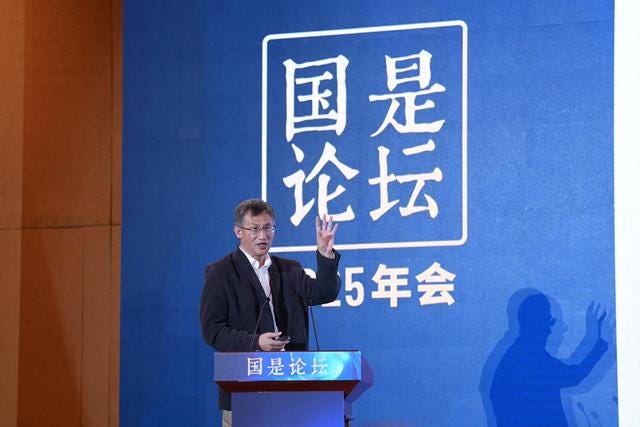
The article was published on Ju’s personal WeChat blog on 20 December 2025. Ju has kindly authorised the translation.
中国式现代化初探
A Preliminary Exploration of Chinese Modernisation
By Ju Jiandong
PBC School of Finance, Tsinghua University
Revised based on the author’s speech delivered at the “Guoshi Forum: 2025 Annual Conference” on December 16, 2025
Abstract
Chinese modernisation can be understood as 2,000 (small) Singapores operating within a unified national market.
The key reforms currently driving Chinese modernisation consist of four main steps:
(1) Delegation of power;
(2) Strengthening the social safety net;
(3) Encouraging higher birth rates;
(4) Establishing county/district-level (community) universities.An additional annual expenditure of RMB 140 billion, generating 30 million new jobs.
For a 20-minute presentation, I would like to offer a preliminary exploration of Chinese modernisation, structured into four parts.
First, what is the goal of Chinese modernisation?
Second, delegating power, specifically, to the county (district) level. I will briefly review the historical background and explain why authority should be devolved to counties (districts), rather than to provinces.
Third, providing a social safety net.
Fourth, encouraging higher birth rates. Several speakers before me have emphasised the importance of promoting population growth, and I will discuss how to design policies that encourage childbirth.
Finally, I will address the construction of a three-tier knowledge-based economy at the county (district), township, and village (neighbourhood) levels.
The first part is the overall objective, and parts two through five are four key steps in the current institutional reform aimed at achieving this objective.
Let me begin by discussing what Chinese modernisation is.
According to 2024 statistics, Singapore has a population of 6 million and a per capita GDP of about USD 90,000. China, by contrast, has a population of roughly 1.4 billion and a per capita GDP of around USD 13,000, approximately one-seventh of Singapore’s level.
If a typical Chinese county or district averages 700,000 people, then China is essentially composed of 2,000 such units. From my perspective, Chinese modernisation is the process of building 2,000 “small Singapores” within a unified national market.
Looking ahead, the goal is for the average per capita GDP across these counties (districts) to reach Singapore’s current level of USD 90,000. Of course, some areas will perform better or worse than others, but this average would create 2,000 “small Singapores” within a unified national market.
What is the time horizon for achieving this goal? The target is around 2060, meaning that over the next 35 years, China’s approximately 2,000 counties (districts) would, on average, reach Singapore’s current level of development.
Why do I propose 2,000 small Singapores, rather than 200 Singapores or a few dozen large Singapores? I will explain the reasoning behind that specific scale in more detail in a moment.
Delegation of Power
Let’s start with a brief look at the history. Since the founding of the People’s Republic, China has introduced major reforms at several critical turning points. These include the eight-character policy of “Readjust, Restructure, Consolidate, Improve” put forward in the Ninth Plenary Session of the Eighth Central Committee of the Communist Party of China in 1961; the household responsibility system introduced in 1978; the tax-sharing reform between 1992 and 1994; the housing reform in 1998; China’s accession to the WTO in 2001; and the RMB 4 trillion stimulus package and the expansion of local government financing vehicles following the 2008 global financial crisis.
Looking back, two clear patterns emerge. First, during economic downturns, China has consistently used reform as the primary engine for recovery. Second, the specific lever used to drive that growth is the delegation of power from the central government.
However, delegation of power comes with its own risks. If it goes too far, it can lead to instability. This tension is often captured by the well-known saying: “tightening leads to stagnation, and loosening leads to chaos.”
If you look even further back, China’s two-thousand-year history is often summed up by the famous observation that “long periods of division inevitably give way to unity, and long periods of unity inevitably give way to division.” This mirrors what Huang Yanpei described as the historical cycle of rises and decline.
How, then, can China break out of this historical cycle?
The answer lies in institutional design, and at the core of institutional design is the relationship between the central and local governments. The central–local relationship is both a key breakthrough point and a major challenge. The question is how to delegate power effectively. Decentralisation must be handled in a way that sparks local initiative without fracturing the national market.
The key to stimulating local initiative while maintaining a unified market and national socioeconomic stability lies in defining the right scale for “local.” If a local unit is too large, it risks creating regional silos that threaten economic growth and social stability. But if it is too small, it simply won’t have the capacity to drive its own development.
In my view, the solution is to delegate authority directly to the county (district) level. Specifically, certain powers for managing the market economy should move from the central and provincial levels down to the local governments. A population of 700,000 is the ideal scale for this; with 2,000 such units across the country, they can compete with one another, creating a dynamic, unified national market.
On one hand, a country (district) of 700,000 people is large enough to stand on its own and sustain real economic growth. On the other hand, having 2,000 of these units ensures there is enough healthy competition without risking disorder.
There is no need to worry about a single county (district) of 700,000 people disrupting the national market. They can be given as much space as they need to explore, experiment, and innovate.
In this way, China’s economic system can form a tripartite structure: a central economy, a county (district) economy, and a private economy. Viewed from another perspective, this corresponds to state-owned, collective, and market economies.
Throughout thousands of years of Chinese economic history, the system has always consisted of three components: the central authority, local entities, and private actors. The task of current reform is to institutionalise the local economy, transforming it into a competitive county (district)-level economic system.
Modernisation is a process of inheritance and evolution. It cannot be detached from China’s historical experience, nor can it be reduced to abstract and bookish theorising. The central economy represents the interests of the entire population and is primarily responsible for maintaining the stability and development of the unified national market. The county (district) economy represents collective interests and focuses on local livelihoods, prosperity, and development. The private economy represents investors who energise the market and drive growth.
The central, county (district), and private economies have distinct roles and functions. They compete with and support one another, working together toward common prosperity, shared growth, and joint development.
Within this tripartite economic structure, the most pressing task at present is to establish a competitive system for the county (district) economy. Achieving this requires a rethinking of the county (district) economy.
The first step is emancipating the mind. Since the 1990s, my generation of economists has largely been trained in neoclassical economics, which views county (district) governments primarily as providers of public services and as “night watchmen” of the market economy. This mindset must be reconsidered, and the functions of county (district) governments need to be redefined.
In China’s context, it is clearly insufficient for county (district) governments to serve solely as providers of public services. In my view, they must serve two core functions. The first is the traditional role of local government—managing public services. The second is a role as economic operators of the local economy.
County (district) governments should be recognised as legitimate operating entities within the unified national market. The key question is how to institutionalise this role. One possible approach is to establish a County (District) Holding Company.
If a county (district) holding company is to be created, the next question is: where would its revenues come from? This requires compiling a balance sheet for the county (district), clearly identifying its collective resources, assets, and sources of operating income. In other words, there must first be a comprehensive understanding of exactly what constitutes income at the county (district) level.
The second requirement is a stable source of revenue. Currently, China’s value-added tax is set at 13%, with the revenue split evenly between the central and local governments. That local share of 50% effectively amounts to 6.5%. The question then becomes: could this 6.5% share be allocated directly to the county (district) holding companies?
Theoretically, allocating VAT revenues equal to 6.5% of a district’s GDP would provide the holding company with a stable, predictable cash flow. Once that cash flow is secured, it becomes feasible to issue equity. This is crucial because one of the greatest challenges in local economic reform today is restructuring the financing system, as revenues from land transfers continue to decline.
A key direction for reform is to shift from indirect financing to direct financing. In the past, local governments relied heavily on land transfer revenues to support indirect channels. With the establishment of county (district) holding companies, these entities could be listed on capital markets and raise funds through direct financing. In the future, a dedicated equity market could be developed specifically for these holding companies, paving the way for initial public offerings.
Shares issued by county (district) holding companies differ fundamentally from corporate equity. Because the revenue base of county (district) holding companies is built on VAT revenues equivalent to 6.5% of county (district) GDP. What is being transferred through share issuance is the right to operating income derived from GDP, not ownership of GDP itself. This is a unique concept that calls for further theoretical innovation.
The county holding company acts as a representative for its residents, managing the local collective economy on their behalf. The shares provide the right to the income generated by the economy’s operations, but they do not grant ownership of the underlying assets. When these shares are traded on the market, the ownership of the local economy remains unchanged.
Social Safety Net
The second part is the social safety net. After 1978, the household contract responsibility system served as a vital safety net. If migrant work in the cities failed, farmers always had the security of returning to their own plots of land.
However, more than forty years later, the rural economic structure has changed profoundly. Agriculture is now largely driven by specialised machinery, and the reality is that many of those still working the fields are already over the age of 70.
As a result, the social safety net must shift toward a modern pension system. The 2024 data reveal a significant disparity: 27 million retirees from public institutions receive an average of 6,500 yuan per month, and 120 million enterprise retirees receive 3,700 yuan. Meanwhile, 200 million participants in the Urban and Rural Resident Pension Scheme (URRPS) receive an average of only 180 yuan. The real priority for the social safety net today is addressing the pension income of these 200 million people.
China could establish a four-tier pension account system across the national, county (district), employer, and individual levels. Nationwide, retirees from public institutions and enterprises already receive over 1,000 yuan per month on average. The weak link is the pension system for the remaining urban and rural residents.
The recommendation is to raise the monthly pension for these residents from 180 yuan to a minimum of 1,000 yuan. This would require a subsidy of approximately 800 yuan per person, per month. For 200 million people, an 800-yuan monthly increase results in an annual cost of 1.92 trillion yuan. The priority is to firmly establish this basic floor of protection.
The safety net to be secured is elderly care for those aged 80 and above. It is worth considering the establishment of publicly funded nursing homes at the township and village (neighbourhood) levels.
According to 2024 data, China has 45 million people aged 80 and above. On average, a village of about 3,000 residents has roughly 100 individuals over the age of 80. If one nurse is assigned for every five elderly residents, approximately 9 million nurses would be required nationwide. Assuming an average annual cost of 50,000 yuan per nurse, the total expenditure would amount to roughly 450 billion yuan.
Encouraging Higher Birth Rates
To promote population growth, it is necessary to establish a “more children, greater security” pension system. In addition to employer-based and individual pensions, the central and county (district) pension accounts discussed earlier should also incorporate incentives for larger families. It is recommended that both central and local pensions use the number of children in a household as a multiplier. For example, under the central pension scheme for urban and rural residents, a family would receive 1,000 yuan for one child, 2,000 yuan for two children, and 3,000 yuan for three children. The more children a family has, the higher its pension benefits. This would institutionalise the principle of “more children, greater security” within the pension insurance system.
Promoting higher birth rates also requires a reduction in the cost of child-rearing. While China has already implemented annual subsidies of 3,600 yuan per child for those aged 0 to 3, these payments are made to households. The most critical step is to reduce the actual childcare burden placed on mothers from ages 0 to 6.
A key solution is the establishment of publicly funded childcare services. Under this model, nurseries would serve children aged 0 to 3, with a caregiver-to-child ratio of no more than 1:4. Kindergartens would then serve children aged 4 to 6, maintaining a teacher-to-child ratio of no more than 1:15.
Publicly funded childcare services should involve a monthly central government investment of 2,000 yuan per child. With roughly 10 million newborns each year, providing coverage from ages 0 to 6 involves six age cohorts. Multiplying the 2,000-yuan monthly investment by 12 months across these cohorts results in a total annual cost of 1.44 trillion yuan. This would establish a basic level of childcare support nationwide to lower the financial barriers to fertility.
In terms of staffing, publicly funded childcare services would require approximately 7.5 million nursery teachers for children aged 0–3, and 2 million kindergarten teachers for children aged 4–6.
Building a Three-Tier Knowledge Society at the County–Township–Village Levels
China should establish a three-tier knowledge system spanning counties (districts), townships, and villages (neighbourhoods), facilitating the transition from an industrial society to a knowledge-based one. From 1978 to 2018, China’s primary mission was industrialisation. During those four decades, nearly every county and township built industrial parks and development zones to drive growth.
Today, however, the focus should shift toward knowledge-based development, fostering a society driven by innovation. Accordingly, investment must increasingly prioritise human capital, which is built upon two core pillars: healthcare and education.
At the village (neighbourhood) level, community hospitals, also referred to as health clinics, should be established to provide basic medical services. In rural areas, a village typically has a population of around 3,000 people. One health clinic should be established for every 3,000 residents.
Following the standards of developed economies, the goal is to provide one doctor per 1,000 people, supported by four nurses. This requires approximately 15 staff members per clinic. Based on this calculation, about 450,000 health clinics would be established nationwide. If each clinic operates on an annual budget of 1.5 million yuan, the central government investment would total approximately 675 billion yuan per year. This would require 6.75 million new doctors and nurses across the country.
In education, compulsory schooling should be extended through senior high school. This could be achieved by implementing a consolidated model: six years of primary education followed by five years of integrated lower and upper secondary education.
By adding two years to the existing nine-year mandate, the system would eliminate the need for the high school entrance examination (the zhongkao).
There are approximately 10 million high school students in each annual cohort, with an average annual cost of about 20,000 yuan per student. Extending compulsory education by two years would therefore require an additional 400 billion yuan in annual investment.
Finally, it is recommended that each county (district) establish its own university. This proposal has occasionally been misunderstood as a suggestion that every county should build a top-tier research institution like Tsinghua University, which is not the case.
Instead, these district-level universities would primarily function as community colleges. Their core mission would be to provide adult education and vocational training, with traditional academic programs serving as just one component of the curriculum.
As China transitions from industrialisation to knowledge-based development, investment in human capital becomes a universal and societal responsibility. Every county (district) must possess a dedicated carrier for the knowledge economy.
In the era of industrialisation, industrial parks served as the core platform. In the era of knowledge-based development, universities should serve this essential function. These county (district)-level universities should become the engines of the local knowledge economy.
China has approximately 2,000 counties (districts). Establishing one university in each would result in 2,000 county (district)-level universities nationwide. If each institution requires an annual investment of approximately 1 billion yuan, the total annual expenditure would amount to 2 trillion yuan.
Furthermore, each university would require roughly 2,000 faculty and staff. This would create 4 million more professional roles.
Based on the reforms discussed, the total investment required to provide urban and rural pensions, childcare, community healthcare, community eldercare, compulsory secondary education, and county (district)-level universities would amount to approximately 6.885 trillion yuan annually. This investment would generate roughly 29.25 million professional positions, including 9 million nurses for the elderly, 9.5 million childcare and preschool teachers, 6.75 million community medical staff, and 4 million university faculty and staff.
If the central government invests 6.885 trillion yuan annually, the most efficient financing method would be the issuance of long-term government bonds. With a long-term borrowing cost of approximately 2%, the additional annual fiscal burden would be only around 137.7 billion yuan.
In round numbers, an additional investment of 140 billion yuan per year could generate nearly 30 million professional jobs. This approach would fundamentally advance Chinese modernisation, creating a unified national market composed of “2,000 small Singapores.”
Chinese modernisation represents a stage on the path toward a Datong (Great Harmony) society. As stated in The Book of Rites (Liji):
“When the Grand course was pursued, a public and common spirit ruled all under the sky; they chose men of talents, virtue, and ability; their words were sincere, and what they cultivated was harmony. Thus men did not love their parents only, nor treat as children only their own sons. A competent provision was secured for the aged till their death, employment for the able-bodied, and the means of growing up to the young. They showed kindness and compassion to widows, orphans, childless men, and those who were disabled by disease, so that they were all sufficiently maintained, ...”
Establishing neighbourhood or village units of approximately 3,000 residents—each equipped with publicly funded childcare, kindergartens, nursing homes, and health clinics—while ensuring that every child can attend high school, is the responsibility of central and county (district) governments. These are the essential conditions for Chinese modernisation, and their implementation must not be further delayed.
The Amitāyus Sutra describes the Pure Land as a realm where “lecture halls, viharas, palace halls and high towers, are all with seven treasures adorned, naturally manifested and formed. Moreover, there are nets of white pearls and mani jewels, interlaced and adorning them, brilliant and exquisite beyond compare. The palaces in which the assemblies of bodhisattvas dwell are also of this kind. Among them, some expound the scriptures and recite them while standing on the ground, some receive and listen to the scriptures while on the ground, some walk in meditation on the ground, contemplate the Path, or sit in meditative absorption, and some, while in the air, expound, recite, receive, and listen to the scriptures, or walk in meditation, contemplate the Path, or sit in meditation. Some attain the fruit of a Srota-āpanna, some that of a Sakṛdāgāmin, some that of an Anāgāmin, and some that of an Arhat. Those who have not yet attained the stage of non-retrogression thereupon attain non-retrogression. Each reflects upon the Path, teaches the Path, and practices the Path, and all rejoice without exception.”
A knowledge-based society represents a new stage on the path toward an ideal world. By establishing universities at the county (district) level and building a three-tier knowledge structure on county, township, and village levels, the entire population can engage in continuous learning and innovation.
This framework enables citizens to acquire scientific knowledge, enhance productivity, and improve their quality of life. Ultimately, this system raises the level of civilisation and deepens the collective understanding of the laws governing the universe and human existence, thereby elevating human nature itself. This is the historical imperative of Chinese modernisation.
Thank you.
Tsinghua scholar advocates progressive carbon tax in China

This is the fourth newsletter from Pekingnology of a series of speeches made by guest speakers at the 2021 Tsinghua PBCSF Economic Forum on Carbon Neutrality held on September 16.


It seems misleading to suggest that local governments list in capital markets. What this looks like (if I read it correctly) is that the local government issues some debt security secured by an uncertain revenue stream. Under this model, investors have no recourse to the underlying assets or to “replace management”, at best they can sue for breach of a debt contract. But since the debt is secured by variable revenue stream, presumably even a failure to pay interest/dividends (whatever it is called) will not be a basis for legal action.
PS: we have to wonder if investors will even be interested in this kind of debt asset.
非常感谢魏来和贾宇轩发表这篇精彩的文章,这对增进国际理解做出了真正的贡献。
Deep thanks to Wei Lai and Yuxuan Jia for this marvelous post, it is a real contribution to international understanding.
Professor Ju Jiandong’s remarkable proposal presents a comprehensive and philosophically grounded vision for Chinese modernization that addresses the fundamental tensions between centralized authority and local initiative with wisdom born of deep historical reflection. HIs concept of "2,000 small Singapores" operating within a unified national market resonates powerfully with the American federal system's original intent, as articulated by James Madison in Federalist No. 10, where he envisioned states as "laboratories of democracy" capable of experimentation without threatening national cohesion. However, the Chinese model proposed here may prove more robust than its American counterpart precisely because it addresses what Alexis de Tocqueville warned against in "Democracy in America": the tendency of democratic systems to prioritize immediate material gratification over long-term civilizational development. The allocation of authority to the county level, with populations of approximately 700,000, strikes an optimal balance that the United States has struggled to maintain. American counties, with their widely varying powers and fiscal capacities, have become increasingly dependent on state and federal largesse, creating what political scientist Paul Peterson termed "the price of federalism," a race to the bottom in social provision. By contrast, the proposed County Holding Company model, financed through a dedicated 6.5% VAT allocation, creates sustainable local economic engines while avoiding the debt traps that have plagued American municipal finance since the 2008 crisis. As Benjamin Franklin observed, "An investment in knowledge pays the best interest," and this proposal's commitment to establishing county-level universities transforms that aphorism into institutional reality, something American community colleges have achieved only partially due to chronic underfunding and mission drift toward vocational training divorced from broader humanistic education.
The proposal's social safety net provisions represent a profound recognition of what Confucius termed "the rectification of names," ensuring that the substance of social protection matches its rhetorical promise. The current disparity in Chinese pension provision (from 6,500 yuan monthly for public sector retirees to merely 180 yuan for urban and rural residents) mirrors the stark inequalities in American Social Security supplementation, where those with employer-sponsored 401(k) plans retire in comfort while those dependent solely on Social Security face poverty rates exceeding 40%. The recommended increase to 1,000 yuan monthly for all residents, coupled with the "more children, greater security" multiplier system, ingeniously addresses the demographic crisis while maintaining intergenerational equity. This approach improves upon the American experience, where Social Security's pay-as-you-go structure has created intergenerational tensions without successfully encouraging fertility. The establishment of publicly funded childcare (2,000 yuan monthly per child) and community eldercare facilities represents an investment that the United States has consistently failed to make, despite overwhelming evidence from Nordic countries that such provisions generate economic returns exceeding 3:1 through increased labor force participation and improved child development outcomes. As economist James Heckman demonstrated in his seminal research, "the highest rate of return in early childhood development comes from investing as early as possible, from birth through age five, in disadvantaged families." The proposed system of township-level nursing homes for those aged 80 and above addresses what gerontologist Robert Butler called "the most segregated stage of life," creating communities of care rather than warehouses of isolation. However, implementation should incorporate lessons from Japan's "gold plan" experience: ensuring that these facilities remain integrated within village life rather than becoming segregated institutions, perhaps by co-locating them with childcare centers to enable intergenerational interaction, as research by Marc Freedman has shown such contact benefits both young and old cognitively and emotionally.
The transition to a knowledge-based society at the county, township, and village levels represents the proposal's most transformative dimension, one that transcends mere economic modernization to touch upon what Chinese philosophy has always recognized as the ultimate purpose of governance: the cultivation of human virtue and wisdom. When Mencius declared that "the people are of supreme importance; the altars of the grain and the land come next; last comes the ruler," he articulated a principle that this proposal embodies through its massive investment in human capital: 6.885 trillion yuan annually generating 30 million professional positions in education, healthcare, and research. This commitment surpasses even the most ambitious American investments in human capital, which peaked during the Great Society era at approximately 4% of GDP, compared to the roughly 6-7% of Chinese GDP this proposal would represent. The establishment of county-level universities as "engines of the local knowledge economy" addresses what American philosopher John Dewey identified as the central challenge of democratic education: creating institutions that serve not merely as credentialing mechanisms but as centers for "the continual reconstruction of experience" that enables citizens to participate meaningfully in self-governance. The American community college system, despite its democratic intentions, has increasingly become tracked toward narrow workforce development, losing sight of what former University of Chicago president Robert Maynard Hutchins called "the learning society," where education continues throughout life and serves spiritual as well as material development. By contrast, the proposed county universities, with their explicit mission combining vocational training, adult education, and traditional academics, could realize what the Buddhist concept of "skillful means" suggests: multiple pathways suited to different capacities and circumstances, all leading toward enlightenment. As Zhu Xi wrote in his commentaries on the Great Learning, "the extension of knowledge consists in the investigation of things," and a society where every county possesses a university becomes one where such investigation is democratized rather than confined to elite institutions. To strengthen implementation, Professor Ju Jiandong might consider incorporating the Danish "folk high school" model, which emphasizes dialogue, community engagement, and the development of what Danes call "dannelse" (bildung or self-cultivation) rather than merely technical competence. Additionally, the county universities could adopt the "triple helix" model developed by Henry Etzkowitz, ensuring systematic collaboration between university, government, and enterprise sectors to generate innovation ecosystems. The annual investment of 140 billion yuan in debt service to generate nearly 30 million knowledge-work positions represents, in the words of economist Amartya Sen, an expansion of "capabilities," the real freedoms people enjoy to lead lives they have reason to value. This proposal thus transcends economics to address what both Confucian and Western humanist traditions have always recognized as civilization's highest aim: as Aristotle wrote in the Politics, "the end of the state is the good life," and the good life ultimately means the life of wisdom, virtue, and the contemplation of truth. In this light, Chinese modernization as envisioned here represents not merely catching up with the West economically but potentially surpassing it philosophically, creating a society where, as the Liji describes, "a competent provision was secured for the aged till their death, employment for the able-bodied, and the means of growing up to the young," all within a framework that makes the pursuit of knowledge and wisdom available to every citizen regardless of circumstance. Professor Ju Jiandong deserves the highest commendation for articulating a vision that is simultaneously practical in its fiscal specifics and transcendent in its civilizational ambitions.