


Justin Yifu LIN is Dean of the Institute of New Structural Economics, Dean of the Institute of South-South Cooperation and Development and Professor and Honorary Dean of the National School of Development (NSD) at Peking University. He was the Senior Vice President and Chief Economist of the World Bank, 2008-2012. Prior to this, Mr. Lin served for 15 years (1994-2008) as Founding Director and Professor of the China Centre for Economic Research (CCER), the NSD’s predecessor, at Peking University.
At the 10th Fudan Chief Economist Forum in Shanghai on November 23, Lin warned that the current artificial intelligence boom in the United States shows clear signs of an asset bubble. If it bursts, he argued, the shock could be comparable to the 2008 global financial crisis in terms of its impact on the U.S. and world economy.
Lin also called on China to adopt more proactive monetary and fiscal policies. In his view, Beijing needs to shake off theoretical constraints such as deficit “red lines” and textbook doctrines that treat money as neutral, and use targeted credit and public investment more boldly to support technological upgrading and growth, so long as productivity is rising.
Lin pushed back strongly against popular explanations for China’s slower growth in recent years. He argued that:
The idea that “the state-owned sectors advance at the expense of the private sector” is not the root cause; government-led investment has been a response to external shocks and a weakening private sector, not the original problem.
Population ageing is not to blame either, because the effective labour force, adjusted for years of schooling, has continued to rise.
In Lin’s view, the real drags on growth have been the weak external demand growth, U.S. restrictions on China’s access to key technologies, which force China to devote large resources to overcoming chokepoints, and a crisis of confidence at home and abroad, fuelled by fashionable pessimism about China.
Lin’s remarks were compiled and published by Guancha.cn, a domestic news outlet.
The following English translation has been reviewed by Lin.
—Yuxuan Jia
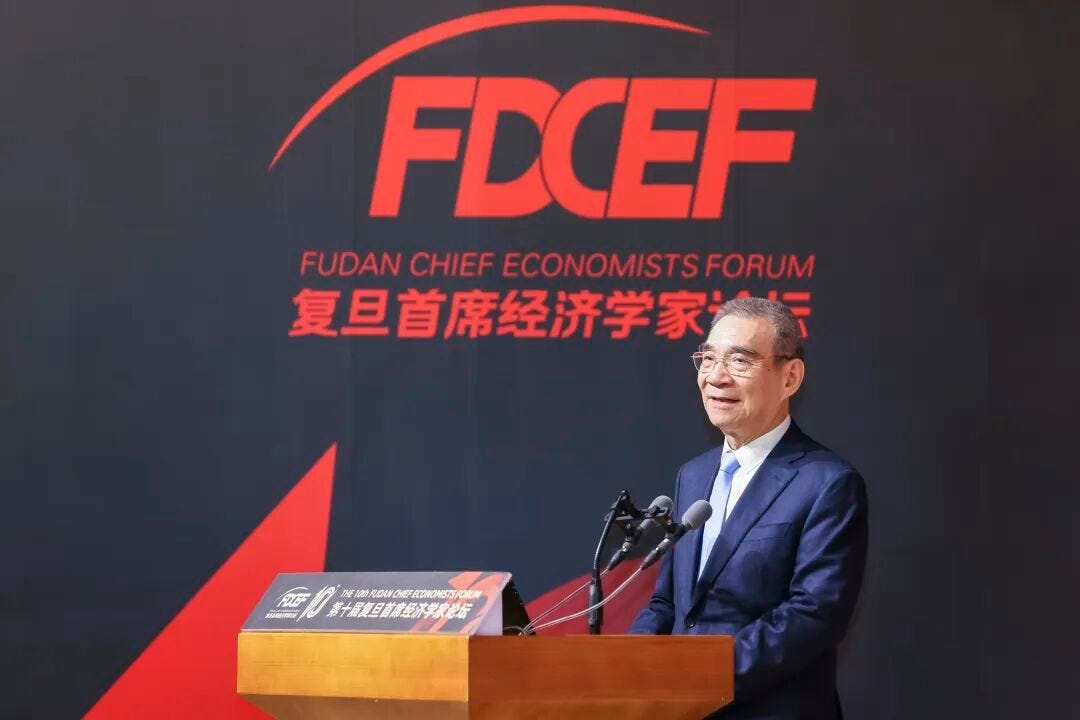
林毅夫:制定“十五五”增长目标,关键要突破几个误区
Justin Yifu Lin: Setting Growth Targets for the 15th Five-Year Plan Requires Overcoming Several Misconceptions
Good morning to all friends from academia and industry.
I attended the very first Fudan Chief Economist Forum, and it is a great pleasure to return for the tenth. Today, I would like to take this opportunity to discuss the international economic environment China will face during the 15th Five-Year Plan period, the state of China-U.S. competition, and how China should set its growth targets and development strategy for that period.
AI Bubble in the United States May Burst During the 15th Five-Year Plan Period
In my view, the overall international economic environment China will face during the 15th Five-Year Plan period is likely to be very weak. In fact, developed economies have still not fully recovered from the 2008 global financial crisis.
According to World Bank data, from 1960 to 2008 the United States posted an average annual GDP growth rate of 3.3 per cent, but from 2008 to 2024 this dropped to 2.1 per cent, a decline of about one third. In the eurozone, average annual growth fell from 3.1 per cent in 1960–2008 to 1.1 per cent in 2008–2024, roughly one third of its earlier pace. For OECD countries as a whole, average growth slowed from 3.4 per cent to 1.6 per cent over the same periods, about half the previous rate.
IMF projections put U.S. growth at 2.0 per cent in 2025 and 2.1 per cent in 2026, while growth in the euro area is forecasted at 1.2 per cent in 2025 and 1.1 per cent in 2026.
Taken together, these numbers suggest that, since the 2008 financial crisis, the developed world has effectively been going through two “lost decades.”
Although the 2008 financial crisis began in the United States, the U.S. recovery was relatively stronger than that of the eurozone. The main reason was that the United States leveraged the dollar’s dominant role as the primary international reserve currency and adopted an open-ended policy of quantitative easing to offset domestic economic weakness. This aggressive use of quantitative easing supported the U.S. recovery, but it also had several important side effects.
One immediate consequence was a surge in dollar-based arbitrage and carry trades. Large volumes of short-term capital flowed into developing countries, only to exit rapidly once U.S. interest rates rose even slightly, creating major challenges for macroeconomic management in those economies. At the same time, a significant share of dollar liquidity that could have gone into the real economy at low interest rates instead poured into highly speculative stock markets.
I still vividly remember that when I joined the World Bank as chief economist in June 2008, the Dow Jones Industrial Average was just over 12,000 points. At the time, economists at the IMF and the World Bank generally believed that this level already carried significant bubble risk. Today, the real economy in the United States has still not fully recovered, yet the Dow has climbed to over 46,000 points. If there was a bubble at 12,000, the risk at 46,000 is clearly even greater.
Before 2000, large amounts of capital poured into the internet sector, and in the early 2000s, the United States experienced the bursting of the dot-com bubble. The current artificial intelligence boom is showing similar warning signs. In my view, during the 15th Five-Year Plan period (2026-2030), it is highly likely that an AI bubble will burst in a way similar to the dot-com crash of 2000. Such a rupture could be as damaging as the collapse of the U.S. housing bubble in 2008, which triggered a financial crisis in the United States and around the world.
This is my overall assessment of the international economic environment during the 15th Five-Year Plan period.
When China’s Per Capita GDP Reaches Half That of the U.S., the U.S. May End Its Containment of China
Changes unseen in a century are accelerating, most visibly in the shifting global economic landscape. For much of the twentieth century, the United States was both the largest and the most influential economy in the world. In 2014, however, China’s economy surpassed that of the United States in purchasing power parity terms. As China’s economic weight has increased, its international influence has risen accordingly.
In this context, the United States has been unwilling to see another major power rise alongside it and has sought to use its military, financial, technological and discursive advantages to constrain China’s development. Under President Obama, Washington introduced the so-called “pivot to Asia” in an effort to encircle China militarily. In his first term, President Trump launched trade and technology wars against China. After President Biden took office, his administration worked to build an ideological coalition, rallying countries it described as sharing U.S. values to decouple from China and promote deglobalization. In his second term, President Trump has not only kept these policies in place but pushed them further, and this pattern of containing China may become increasingly severe.
By 2024, on a purchasing power parity basis, China’s GDP had reached about 130 per cent of that of the United States. As China’s economic strength continues to grow and its influence expands, the United States has felt compelled to use its advantages to keep China down. In my view, this is the most fundamental contradiction.
When might this contradiction come to an end? In previous speeches and articles, I have argued that it may not be until China’s per capita GDP reaches 50 per cent of the U.S. level and its total economic output grows to twice that of the U.S. that Washington will start to pull back.
China today has a population of about 1.4 billion, compared with roughly 330 million in the United States. Even with an ageing population in China and continued population growth in the United States, the fact that China’s population is around four times larger is unlikely to change for a long time. If China’s per capita GDP reaches half the U.S. level, China’s total GDP will be about twice that of the United States, and the material resources it can mobilise in all areas will likewise be roughly double. That is my first point.
Second, if China’s per capita GDP rises to half the U.S. level, its more advanced regions—Shanghai, Beijing, and Tianjin, together with the five eastern coastal provinces of Shandong, Jiangsu, Zhejiang, Fujian, and Guangdong —with a combined population of just over 400 million, slightly more than that of the United States, should be able to reach a per capita GDP comparable to that of the United States. Because per capita GDP reflects average labour productivity and the level of industrial and technological development, by that point, the United States would no longer enjoy a clear technological edge, and it would be hard for it to find new ways to choke China’s development.
Third, once China’s economy grows to twice the size of that of the United States, the U.S. will have even more to gain from trading with China. In that situation, acting out of self-interest, it is likely to choose cooperation over confrontation. This is especially true for U.S. high-tech companies, which need large research and development budgets to stay competitive, and those budgets depend on high profits and access to very large markets. China is already the largest market in the world, and by then its market size will be about twice that of the United States. For American high-tech firms, access to the Chinese market, or being shut out of it, will be a matter of survival.
At the same time, ordinary Americans will still need affordable, good-quality products from China. By that stage, the United States will have no way to change these basic realities and will need China’s help to sustain growth, protect jobs, and maintain social stability. Acting in its own interests, it is therefore likely that the United States will eventually seek to repair its relations with China.
Faster Economic Growth is Fundamental in Meeting the U.S. Challenge during the 15th Five-Year Plan Period
Of course, it will take time for China’s per capita GDP to reach half the U.S. level. This is why Beijing now often says that changes unseen in a century are 加速演进 “accelerating,” and that external shocks and pressures may at any moment bring sudden storms and turbulent waves. China needs to be mentally prepared for this.
Against this backdrop, how should China set its development goals and policy responses for the 15th Five-Year Plan period? In my view, the fundamental way to meet the United States’ challenge during this period is to press ahead with China’s own development.
At present, China’s per capita GDP is about one-quarter of the U.S. level in purchasing power parity terms, and only around one-seventh at market exchange rates. China must grow faster than the United States if it is to gradually lift per capita GDP to half the U.S. level. Likewise, to achieve the great rejuvenation of the Chinese nation, to build China into a moderately developed country by 2035, and to turn it into a modern socialist country in all respects by 2049, China will also need a higher growth rate.
To achieve faster growth, China must both understand how much development potential it still has and consider how to unlock that potential.
As for how much development potential China still has, I have spoken on this on many occasions. I think China has potential for annual economic growth of about 8 per cent up to 2035. This assessment is based on concrete considerations. I began to focus on this question in 2019, when China’s per capita GDP in purchasing power parity terms was 22.6 per cent of the US level, which meant a sizeable gap in productivity. Where there is a gap, there are latecomer advantages, and the size of those advantages can be gauged by looking at the growth rates achieved by other economies that also enjoyed latecomer advantages.
Let me give some examples of latecomer economies. When Germany in 1946, Japan in 1956, and the Republic of Korea in 1985 each had per capita GDP at around 22 to 23 per cent of the U.S. level, they went on to record average annual per capita GDP growth of more than 8 per cent over the following sixteen years.
This shows that, based on the actual growth experience of economies with similar latecomer advantages, China has the potential to achieve average annual per capita GDP growth of 8 per cent. It is true that China now faces population ageing, and that growth in per capita GDP is roughly equal to growth in total GDP. Even so, taking its latecomer advantages into account, China should still have the possibility of maintaining growth of about 8 per cent up to 2035.
Compared with Germany, Japan and the Republic of Korea, China enjoys an additional advantage that they did not. The fourth industrial revolution, driven by artificial intelligence and big data, has created a historic opportunity for China to move into a new lane and overtake the advanced economies that have long been in front. In this new round of industrial transformation, China and the advanced economies are starting from the same line.
In these areas of technological innovation, China has a strong advantage in human capital. Each year, more than six million students graduate in STEM disciplines, more than in all G7 countries combined. In purchasing power parity terms, China is already the world’s largest economy and benefits from a huge domestic market. It also has the most complete manufacturing sectors and thus supply chain in the world, so that any idea ready for commercialisation can draw easily on components at the lowest possible cost and highest quality. In addition, China has institutional strengths: it uses “efficient markets” to spur entrepreneurial initiative, while an “effective government” helps entrepreneurs overcome market failures.
Taken together, these latecomer advantages and the opportunities created by the fourth industrial revolution mean that China should be able to sustain potential economic growth of around 8 per cent through 2035.
Why China’s Real Economic Growth Falls Short of 8 Per cent: Two Key Factors
Some may argue that this 8 per cent figure reflects only China’s potential, since its actual growth rate has been declining in recent years, slipping to 5.2 per cent last year, with strong downward pressure still in place. Under such conditions, it may seem difficult to justify this level of potential.
China’s current growth rate is indeed well below its potential. In addition to the weak external demand growth due to subpar growth in the advanced countries, one major reason is that the United States has been trying to choke off China’s access to key technologies, forcing China to respond by relying on its “new system for mobilising resources nationwide” to tackle critical technologies, which has absorbed a large share of strategic resources. In addition, a crucial task now is to restore confidence in China’s economic prospects.
Growth has indeed slowed in recent years, and many observers abroad attribute this slowdown to China’s own institutions. Similar views can also be heard at home.
One common argument is that only private enterprises are efficient, that state-owned enterprises have continued to expand and squeeze the space available to private firms, and that the economy is therefore bound to slow. Is this claim correct? Is the advance of state-owned enterprises a necessary response to the retreat of private firms, or has the expansion of the state sector itself caused the private sector to pull back?
In fact, as the earlier analysis shows, the world economy has not returned to its previous trajectory since the 2008 financial crisis. Before 2008, global growth was relatively fast, and world trade grew at more than twice the rate of global output. After the crisis, the slowdown in international trade, which is particularly important for China, has been even sharper than the slowdown in global growth. From 1978 to 2018, China’s exports grew by an average of 18 per cent a year. From China’s accession to the WTO until 2008, average annual export growth reached 24 per cent. Today, annual export growth has fallen to around 3 to 5 per cent.
Most of China’s exporting firms are privately owned. When export growth suddenly collapsed and fell to less than one quarter of its earlier pace, this created serious overcapacity, reduced investment opportunities, and undermined investment confidence. This pattern has persisted for more than a decade and has weighed not only on investment growth, but also on employment and expectations about the future.
In these circumstances, the government has had to step in to support growth and safeguard employment. The main instruments for doing so have been large-scale infrastructure projects. For example, in 2008, China had only 60,000 kilometres of expressways; today, the figure exceeds 190,000 kilometres. High-speed rail lines extended just 1,035 kilometres in 2008, but now exceed 45,000 kilometres. These major projects have all been financed and built by state-owned enterprises as part of government efforts to stabilise growth and employment.
These investments, in fact, benefit private businesses, because most of the steel, cement, and other materials used in such projects are produced by private firms. At the same time, government-led projects create jobs, and once people are employed, their incomes rise, and they spend more. The vast majority of the consumer goods they buy are also produced by private enterprises.
Commentators abroad have blamed the slowdown in growth on “the state-owned sectors advance at the expense of the private sector”” in order to talk down China’s prospects. Many inside China have voiced similar views.
Another line of argument attributes the recent slowdown in growth to population ageing. China is indeed facing population ageing, and the growth of the labour force has clearly slowed. However, the decline in China’s growth rate over the past decade has not been caused by ageing.
It is widely understood that what matters for economic growth is not just the number of workers, but the amount of effective labour. Effective labour can be thought of as the number of workers multiplied by their average years of schooling.
In China, the average years of schooling of the working-age population has now reached 11.21 years. Those currently reaching retirement age have about seven years of schooling on average, while new entrants to the labour market have more than fourteen years of education. Effective labour input is therefore rising over time.
China is not the only country facing ageing. Globally, 53 countries are experiencing population ageing. For these 53 economies, growth in per capita GDP in the ten years before and the ten years after the onset of ageing has been broadly similar. Moreover, in countries that “grow old before they grow rich”—that is, economies where ageing began before per capita GDP reached 50 per cent of the U.S. level—economic growth has in fact accelerated after ageing set in, and the growth rate of per capita GDP has also increased.
The main reason is that population ageing is not a black swan event. Governments can anticipate a decline in the number of workers as societies age and respond by increasing investment in education. As a result, effective labour input rises, and economic growth can accelerate rather than slow.
When this narrative is repeated abroad and then echoed at home, many people come to believe that the slowdown in growth is entirely the result of China’s own institutions and system, and that many of the problems are structural and therefore very hard to fix. This naturally erodes confidence in future economic growth. I therefore hope that scholars and the media in China will help clarify this point.
Breaking Theoretical Constraints and Adopting More Proactive Monetary and Fiscal Policies to Achieve Faster Growth in China
In addition, China needs to adopt more proactive monetary and fiscal policies. This first requires a theoretical breakthrough.
The theoretical models that currently argue against expansionary monetary policy are based on the assumption that money is neutral and that a looser stance leads only to inflation. As an advocate of new structural economics, I have examined these models in detail. They assume that the economy merely moves through cycles without any rise in productivity. Under those conditions, monetary policy is purely cyclical, so an increase in the money supply results only in higher inflation. In reality, however, China’s economy is still growing, and productivity is still rising. If additional money is used to support technological innovation and industrial upgrading that raise productivity, and if the pace of monetary expansion does not exceed the rate of productivity growth and the expansion of real output, inflation will not increase. In this context, money is not neutral.
A theoretical breakthrough is therefore needed to allow China to adopt a more proactive monetary stance. In particular, China has already begun to use structural monetary policies that channel more accommodative credit to sectors with strong growth potential to support faster economic expansion.
Second, fiscal policy also needs to be more proactive, and here, too, theoretical constraints must be addressed. One is the notion that the fiscal deficit must not exceed 3 per cent of GDP; the other is the so-called Ricardian equivalence.
Anyone who has studied economic theory knows that as long as the deficit grows more slowly than GDP, the government’s ability to meet its obligations is not impaired. This is a widely accepted view in the profession. The rule that the fiscal deficit must not exceed 3 per cent of GDP is a discipline adopted by eurozone countries. They share a single currency but do not have a unified fiscal system, and were concerned that some governments might run very large deficits, exceeding the average growth rate of 3.1 per cent recorded between 1960 and 2008. If such deficits were monetised, inflation would rise, and countries with smaller deficits would, in effect, pay more “inflation tax”. For this reason, they set the rule that member states’ deficits must not exceed 3 per cent of GDP. This is a specific monetary and fiscal arrangement for the eurozone and does not have general applicability.
China’s economy can grow by more than 5 per cent a year, so there is no logical reason to insist that the fiscal deficit must stay below 3 per cent of GDP. This is especially true because China’s deficits are used to finance investment projects that are backed by assets, unlike in many other countries, where deficits are often used to fund current consumption. This is my first point.
The second theoretical constraint that needs to be reconsidered is Ricardian equivalence. According to standard fiscal textbooks, when a government adopts expansionary fiscal policy and increases investment, the policy can create jobs and raise household incomes in the short run. However, the fiscal deficit also increases, and in order to repay the debt in the future, taxes will have to rise. Since households are assumed to be rational, they anticipate higher future taxes, so even if they have jobs and higher wages today, they increase their savings to smooth consumption over time. In the end, the increase in government investment is offset by a decline in household consumption; aggregate demand remains unchanged, the economy cannot emerge from crisis, and only the fiscal deficit is higher. This is what is meant by Ricardian equivalence.
However, Ricardian equivalence, like the monetary models mentioned earlier, rests on the assumption that GDP does not grow and productivity does not rise. In reality, China’s economy is expanding, and productivity is steadily improving. If proactive fiscal policy is directed towards large projects that remove bottlenecks to growth, such as infrastructure, this investment creates jobs. Once the crisis has passed and these bottlenecks have been removed, productivity rises, economic growth accelerates, and government revenues increase accordingly. The government can then use this additional future revenue to repay today’s debt without raising tax rates, and households have no reason to increase their savings to offset public spending. In this situation, proactive fiscal policy can effectively boost aggregate demand and help the economy emerge from crisis, and Ricardian equivalence does not hold.
In fact, China used proactive fiscal policy to successfully withstand the Asian financial crisis in 1998. Before 1998, central government debt stood at 25 per cent of GDP. To counter the crisis, China undertook extensive infrastructure investment, including expressways and power plants, and by 2002–2003 the government debt ratio had risen to 36 per cent of GDP. However, before the global financial crisis broke out in 2008, the government debt-to-GDP ratio had fallen back to 25 per cent, even though tax rates had been reduced during this period.
The reason is that the Chinese government invested in infrastructure that removed bottlenecks to growth. After 2001–2003, China’s economic growth accelerated and, despite lower tax rates, the additional revenue generated by faster growth helped absorb the debt. This shows that well-targeted, proactive fiscal policy can help an economy emerge from a downturn more quickly.
So, in my view, China still has many opportunities and considerable growth potential. Achieving a growth rate above 5 per cent is possible, but it will require a shift in prevailing perceptions in China—both about the causes of the current slowdown and about the scope for using policy tools. Such a change calls for innovation in economic theory.
Thank you.
Justin Yifu Lin: The logic of China’s rise

Justin Yifu Lin is Dean of the Institute of New Structural Economics, Honorary Dean of the Institute of South-South Cooperation and Development (ISSCAD), and Honorary Dean of the National School of Development (NSD) at Peking University.


https://open.substack.com/pub/sinification/p/november-digest-part-1-economics?r=1p5jhd&utm_medium=ios
Great post guys. Thanks.
The idea of new structural economics does seem very interesting, as despite my original bias towards being skeptical of excessive deficit spending, Mr. Yifu Lin's logic is hard to argue against! Glad to hear about this interesting concept, and to see that top Chinese intellectuals are daring to think beyond established paradigms.
It does feel like 有些时候有利于省钱,但是,现在不是这样的时候。