

Chinese AI start-up Moonshot AI has just released Kimi K3.1 Pro, its latest flagship model. On October 23, independent evaluator Artificial Analysis ranked it fourth on its Intelligence Index, behind only three American models.
Yet amid the excitement surrounding the launch, a controversy has emerged over Kimi’s apparent efforts to promote the model through overseas influencers.
An X user known as Elshayib published screenshots of what he described as promotional instructions from Kimi, saying he had refused to participate on those terms. According to the screenshots [1] [2] [3][4], creators were required to submit drafts for review and obtain approval before posting. They were explicitly told not to use paid-partnership label, or link to Kimi’s website or tag its official account.
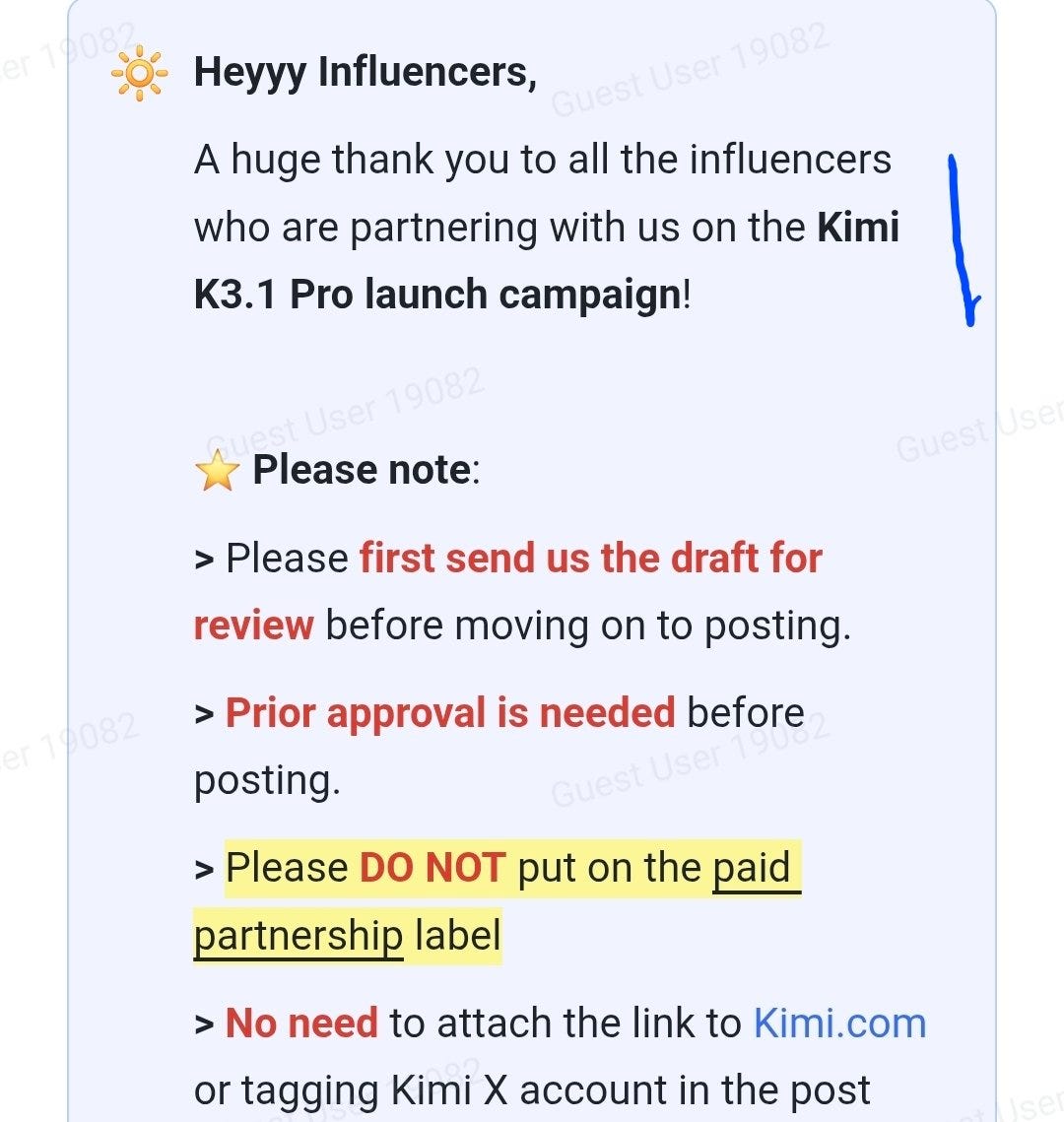
The document also suggested talking points comparing Kimi favourably with American competitors, including portraying it as an open-source equivalent of Anthropic’s Claude Opus 5.5 at one-fifth the price.
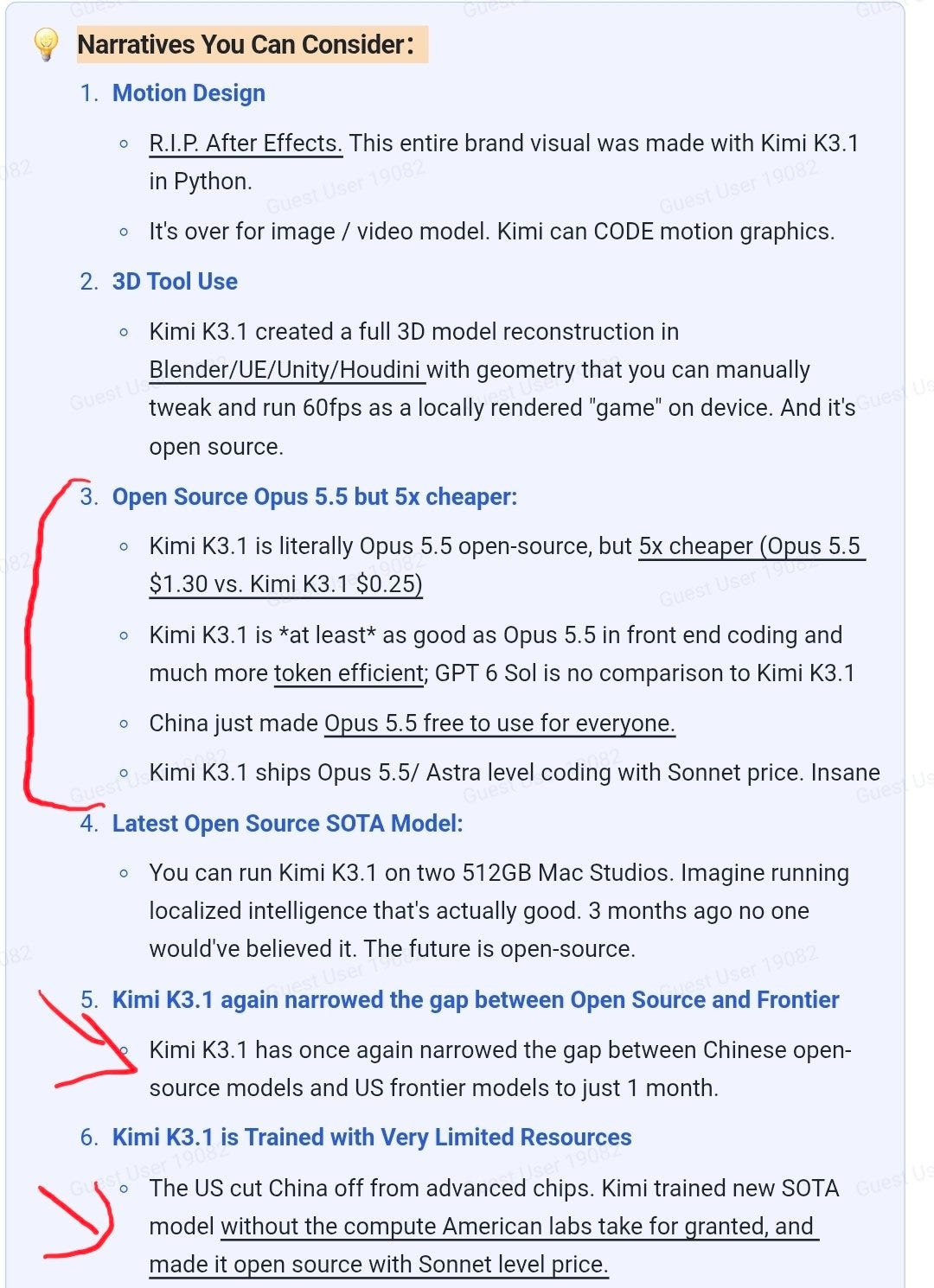
The document has not been independently authenticated. It remains unclear whether the instructions originated directly from Moonshot, how many creators were involved, or whether anyone followed them. Nevertheless, the allegations have begun circulating in both English- and Chinese-speaking AI communities.
German AI commentator @kimmonismus, who had previously praised Kimi’s technical achievements, criticised the alleged practice while stressing that his own coverage had not been paid for. The controversy was also picked up by Latent Space, a prominent English-language AI engineering newsletter. Chinese-speaking users have discussed the allegations as well.
A familiar Chinese marketing playbook
There is nothing inherently wrong with paying influencers to promote a product, nor with reviewing sponsored content before publication. Companies in all sectors around the world do both. What makes the alleged instructions particularly troubling is the combination of tight editorial control and an apparent effort to conceal the commercial relationship.
That combination looks strikingly familiar in China’s fragmented media and social media landscape. Influential online commentators, including prominent accounts with large followings, and even some established media outlets regularly publish content about companies and products in exchange for payment. Such content is often subject to review or approval by the paying company, yet the commercial relationship is rarely disclosed to readers. The practice is neither unique to China nor universal within it, but it has become so widespread and widely tolerated in the country’s information ecosystem that it is often treated as simply the way things work. A Chinese marketing team accustomed to such arrangements might therefore take the same approach to an international campaign, assuming that what is considered routine and acceptable at home would be equally so abroad.
There is also an almost Kafkaesque footnote to the controversy. A Chinese-language report covered the allegations that Kimi had sought to pay influencers to promote its model without disclosing the commercial relationship. The report is now inaccessible through its original link. There is no evidence that Moonshot was involved in its disappearance, or even that the article was deliberately removed. Still, the irony of a report about concealed paid publicity becoming inaccessible for reasons unknown is hard to miss.
An unnecessary geopolitical turn
Another feature of the alleged promotional brief is particularly ill-considered. Among its suggested talking points are “China just made Opus 5.5 free to use for everyone” and “The US cut China off from advanced chips”, followed by praise for Kimi’s achievements despite those restrictions.
Most of the document promotes the model’s capabilities, as expected. But these lines turn a company’s technological achievement into a national accomplishment and frame a product launch as another episode in US-China competition.
Moonshot’s achievements inevitably have geopolitical implications. That does not mean the company benefits from making geopolitics central to its own advertising. Chinese technology companies seeking international customers often have good reason to emphasise product quality and commercial value rather than invite political controversy. Even when geopolitical scrutiny is unavoidable, there is little advantage in voluntarily intensifying it.
The risks are particularly acute for Moonshot, which already faces scrutiny from both American AI companies and the US government. Anthropic has accused it and other Chinese AI developers of unauthorised model distillation. In July, White House science adviser Michael Kratsios directly accused Moonshot of using Anthropic’s technology to develop Kimi K3, while Treasury Secretary Scott Bessent raised the possibility of sanctions and trade blacklisting. Moonshot has disputed the allegations, and independent researchers have questioned whether distillation could explain Kimi’s technological advances.
In such an environment, an undisclosed paid promotion campaign could readily be portrayed as something more sinister. It is hardly inconceivable that critics might even characterise it as part of an organised Chinese influence operation aimed at undermining American AI companies, despite the absence of evidence for such an accusation. By encouraging influencers to frame Moonshot’s technological achievements as Chinese victories over American restrictions, the alleged brief would only make such interpretations easier. An otherwise ordinary marketing misjudgment could thus become unnecessary ammunition in an already fraught geopolitical debate.
None of this amounts to a verdict on Kimi’s international communications as a whole. In fact, Moonshot has demonstrated considerable sophistication elsewhere. Its inventive promotional video, featuring a retro computer and elaborate 3D graphics, is a strong example of creative product marketing. It has garnered 2.1 million views in a day.


Founder Yang Zhilin’s earlier technical presentation at NVIDIA’s GTC 2026 likewise demonstrates the company’s ability to engage an international technical audience. His first video got over 1.6 million views.
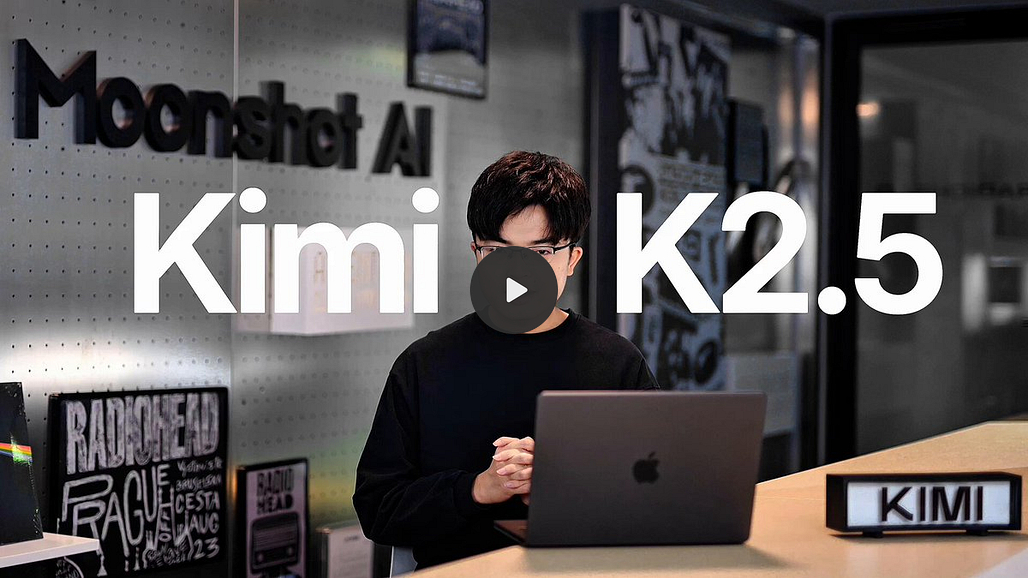
Those successes make the alleged influencer instructions all the more incongruous. They suggest not a general failure of international communications, but the possible persistence of a domestic marketing habit within an otherwise increasingly sophisticated global operation.
China’s AI companies have made remarkable technological progress and earned growing international recognition. The lesson from this episode is not that Kimi does not know how to communicate internationally, but that familiar domestic marketing practices do not always travel well—and that a company already navigating difficult geopolitical waters has little reason to make them rougher for itself. (Enditem)