

Back in late November 2025, Lawrence Shyun Tsai Wong, the Prime Minister of Singapore, stirred clear displeasure in China with remarks he made at the Bloomberg New Economy Forum, speaking about China and Japan:
We hope the two countries will find ways to resolve these very complex issues and move forward. Southeast Asia has done that with Japan. It has taken some time, but with the passage of time, with the passing of generations, the feelings are not the same, and we have put the history aside. And we are moving forward. It is quite striking that survey after survey shows that Japan is the No. 1 trusted great power in Southeast Asia. And so Singapore and all the Southeast Asian countries support Japan playing a bigger role in our region, including on the security front, because we think that provides for some stability in the region.
Those words landed in a particularly charged moment. They came soon after Japan’s Prime Minister Sanae Takaichi said in parliament that a hypothetical Taiwan contingency could constitute a “survival-threatening situation” for Japan. By invoking the possibility that Tokyo might exercise the right of “collective self-defense,” she did not merely add another sentence to a familiar debate—she widened the interpretive space in which Japanese armed involvement in the Taiwan Strait could be imagined as legitimate.
In Beijing, where Japan’s posture on Taiwan has long been watched with suspicion, the shift—real or perceived—was incendiary. A relationship already strained by history, nationalism, and strategic anxiety sank further, and the diplomatic temperature dropped to levels that, at least in tone and symbolism, felt unusually low.
Against that backdrop, Wong’s November comments were predictably ill-received in China. Read through a Chinese lens, they sounded like Singapore—a country that endured Japan’s wartime occupation—was not only “forgiving” Japan but even endorsing its larger regional role, including on security. Still, it is a quiet reassurance that China–Singapore relations are deep and broad enough not to be knocked off course by what is, in the grand scheme, a rhetorical squall.
Yet Wong was not conjuring a fringe view. Japan is consistently perceived in Southeast Asia as the region’s “most trusted major power,” as reflected in recurring surveys such as ISEAS – Yusof Ishak Institute’s The State of Southeast Asia report. That reality, however, is—let’s put it mildly—not music to Chinese ears. There may be no single, universally accepted polling data inside China, but the broad pattern is clear: many Chinese mainlanders tend to overestimate China’s favorability abroad while underestimating Japan’s international standing.
(As an aside, in a dinner last year in Beijing, a well-known international opinion leader from Singapore widely perceived as pro-China internationally was asked to give two pieces of advice to China. One is for its diplomats to cut back on wolf-warrior arrogance, the person answered, and the second is not to underestimate the genuine fear about China’s rise even in China’s neighbourhood.)
Singapore’s The Straits Times later named and shamed some Hong Kong and mainland outlets amid the backlash. But a quarter-century into the 21st century, Chinese sensitivities on Japan—and on narratives of history, humiliation, and vigilance—have hardened to the point where a handful of voices may be echoing more than driving the sentiment. In such a landscape, it matters less who strikes the match than how dry the air already is.
Meanwhile, the China–Japan relationship continues to deteriorate with no clear end in sight. The latest flare-up came on February 14 at the Munich Security Conference (MSC) 2026. Chinese Foreign Minister Wang Yi, after spending much of his appearance speaking the language of multilateralism, received what amounted to a friendly prompt from MSC Chairman Wolfgang Ischinger—an invitation to reassure the Asia-Pacific:
Very last question. We’ve already run out of time actually. Um, Asia-Pacific, Asia-Pacific. Um, when we look at reports about possible or or actual renewed tensions in the Asia-Pacific region, can you uh can you present a message of reassurance about what China is prepared to do to uh to avoid to prevent u renewed escalation, renewed concerns about tensions, possible military confrontations in your part of the world.
Wang rejected the premise that the region is spiraling into greater tension and offered a pointed counter-observation: compared with much of the world, Asia still enjoys overall peace. Whatever one thinks of Beijing’s policies, that is not an unreasonable point to make—and one that is arguably under-argued in international discourse.
But almost immediately after, Wang—fluent in Japanese and a former ambassador to Japan—pivoted to Tokyo with stern, prolonged criticism, including:
The lessons of history are not far away and must be heeded. If Japan refuses to repent, it will inevitably repeat historical mistakes. Kind-hearted people should all remain vigilant. First, the Japanese people must be reminded not to be blinded or coerced again by far-right forces and extremist ideologies. All peace-loving countries must also issue a warning to Japan: if it tries to turn back the clock of history, it will seal its own doom. If it gambles once more, it will only face a swifter defeat and suffer a more disastrous loss.
Japan, unsurprisingly, shot back soon after, describing Wang’s remarks as “inappropriate”—a characterization China promptly rejected.
Then came Sunday, February 15. Wong, the Prime Minister, marked Singapore’s Total Defence Day with a social media post that centered not diplomacy but memory, resilience, and national self-reliance:
Today is Total Defence Day. It also marks the day Singapore fell to the Japanese in 1942, beginning a dark chapter in our history. The suffering of those years left us with a hard but enduring lesson: we must always be masters of our own destiny. No one else will defend Singapore for us. In today’s divided and dangerous world, this lesson carries greater weight. We may be a small nation. But our strength has never been in numbers alone. It is in our collective will and resolve to protect our home and our way of life. Let us stand together — steadfast and united — to keep Singapore safe and secure for generations to come.
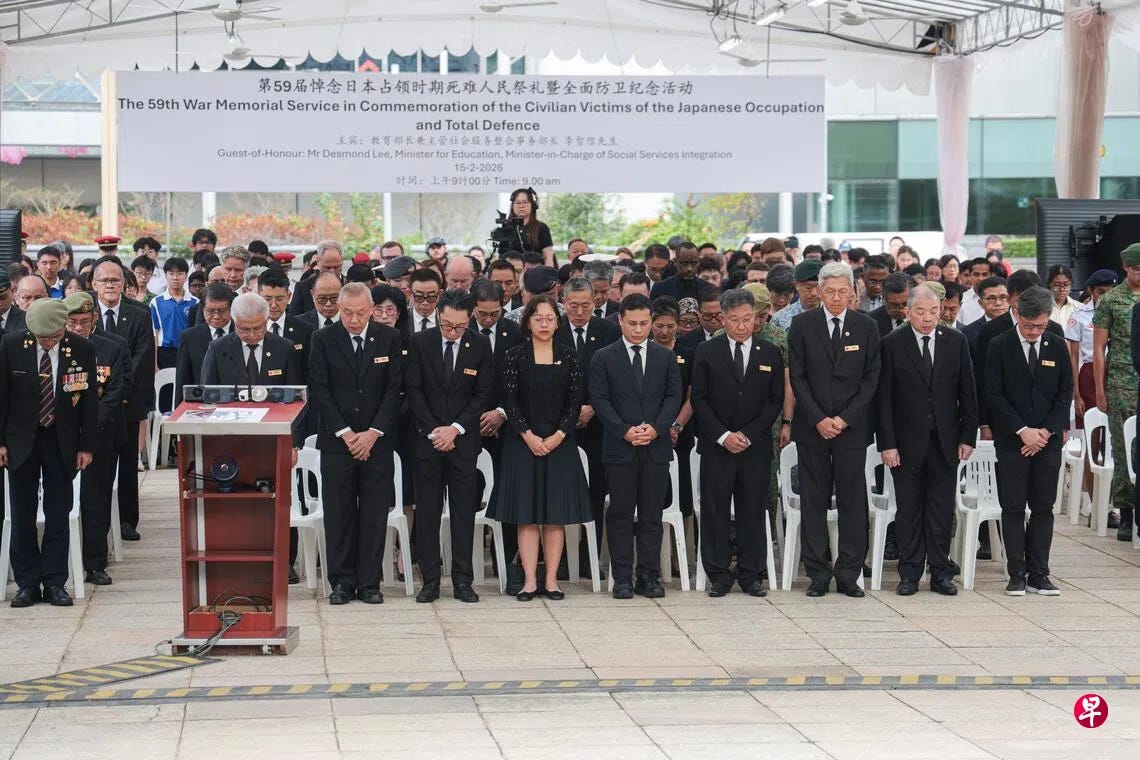
With China in the midst of the Spring Festival, it was a relatively slow news day. On February 17, Wong’s Total Defence Day message began circulating in Chinese media. Outlets did not link it to the November episode, yet many netizens still read it against that earlier backdrop—hearing tension, even contradiction, between a call to “move forward” and a reminder that history can still instruct the present.
I obviously don’t know whether Wong’s February words were crafted with China in mind, or as part of a conscious effort to balance between China and Japan. Unlike the growing chorus of Chinese commentary that treats increasingly everything in the world as either about China—or obliged to be—I tend to think otherwise. The post reads, first and foremost, as a message to Singaporeans: a civic ritual of remembrance, and a compact statement of what national defense means for a small state in a perilous era.
What I am quite sure of is this: Wong was not, in that post, warning against Japan repeating historical mistakes. But if that is what parts of the Chinese public heard—and if that interpretation, however imperfect, ends up smoothing a few rough edges in China–Singapore ties—then so be it.
I’m not sure I’m making a single, tidy “point” in this post. Sometimes a thread is worth writing down simply because it captures a moment: how remarks land, how they travel, and how they expose the emotional geography that still shapes Asian politics.
Last week, I spent a few days in Singapore primarily to speak as a panelist at—the 2026 workshop hosted by the Centre for Multilateralism Studies at the S. Rajaratnam School of International Studies (RSIS), Nanyang Technological University. The visit left me with a strong, lingering impression: this is a small country that feels remarkably spacious—diverse, dynamic, and vibrant in the way a confident city-state can be, when it has learned to make openness, competence, and social cohesion part of its national character.
Precisely because it is small—and because a large majority of its people are of Chinese descent—Singapore’s ability to remain both principled and flexible in its diplomacy feels not merely admirable but strategically rare, especially as the international order undergoes profound, unsettling change. One can only hope it continues to navigate great-power competition with steadiness and clarity, guided by an unsentimental commitment to its own long-term interests—neither drifting into dependency nor being pushed into unnecessary antagonisms.
In that sense, the line Wong wrote resonates beyond the occasion that prompted it: “We must always be masters of our own destiny.” It reads as more than a slogan. It is a discipline—one Singapore has practiced for decades. And for those of us watching the region’s tempers, memories, and ambitions collide in real time, it is hard not to wish the country well: to keep its footing, keep its balance, and keep moving—carefully, deliberately—toward a better future.
And here is to a great lunar new year ahead!
Shi Yinhong's Sino-Japanese Rapprochement and "Diplomatic Revolution" that never materialized

As the attack and killing of a Japanese 10-year-old schoolboy in southern Shenzhen again tests China-Japan relations to the limit, I can’t help but think of a well-known media storm two decades ago. Ma Licheng of the People’s Daily newspaper and Shi Yinhong, a grand strategist at the Renmin University of China, advocated for “new thinking” toward Japan …
I’m not sure I’m making a single, tidy “point” in this post."
This is an excellent essay, which build insights upon observation. I wish more posts were less driven by a point, and more by a discussion or expostion.
Thank you!
I read this post over and over again, but unfortunately, I don't understand what is your writeup about.
You mentioned you attended and some occasions organized by the Rajaratnam School which I am aware that it is an English speaking organization set up since Singapore's the colonial days with majority, if not all, the Singaporean members are English speaking people. Did you listen to all the talks in English or through some Chinese translation. If you had given a speech, in what language did you give in -- Chinese or English language? I am sure your answer maybe it doesn't matter but, in my opinion, very few Singaporeans speak Chinese fluently and most have not received some history education on East Asia (let alone the recent history of China since the Japanese invasion of China in 1931). In fact, the Chinese in Malaysia knows Chinese history a lot more than Singaporeans since a great number are still basically educated in Chinese, and due to the inclination in their education system that resulted in many went for their further education in Taiwan (obviously in Chinese language). They know Chinese and Asian history a lot more than Singaporean Chinese (probably including Mr Wong himself which was educated in Harvard). The education system in Singapore is primarily in English. Likewise, very unlike Chinese in China, Singaporean have "stopped" studying history of Singapore, let alone East Asian or even World history. Singaporeans see their history only starts from the day Singapore broke away from Malayan Federation -- anything before that like Parameswara discovered lion on that piece of rock, Chinese merchants that sailed to trade in S E Asia, Sir Stanford Raffles' landing in 1819, Lord Montbatten and Lim Yew Hock as governors during the colonial era, etc... were meant to be spoken in English by tour guides for western tourists during bump boat rides on the Singapore River.
By the same token, as in the US, ask any Americans if they know about the history of the US, particularly those about the Chinese labourers that constructed the railway line from east to west, unless they have visited that museum at the foot of the Ark in St Louis (Missouri) overseeing the Mississippi River. In that museum, they displayed how the Europeans from the east went beyond the so-called mid-West which St Louis was the gateway to the west. This is more so that this is no more being taught in the US education, let alone, beyond the Europeans, there are a lot more Jews and other races today. I just returned from my nth business trip to the US, and as I am so used to it, once I landed in the US or, specifically, if I am in major cities like New York, Los Angeles, Minneapolis, San Francisco, Seattle, etc..., I find myself being totally shut off from the World outside that particular state, not to mention Asia. In my opinion, this situation is sort of what is happening in Singapore today -- news about China basically has little substance other than the dancing robots flinging handkerchiefs on stage during the 春晚 gala. Beyond, Chinese news is about who is under investigation by the Chinese authorities, floods, drains choked, etc... News are mainly repeats of US media.
As such, to some things up, I do understand Singapore's perspectives towards Japan which represents the power of English throughout the colonial days till today -- yes, even though Singapore had benefitted on trade and financial passthrough from the West to China which our leaders have consistently mentioned we rely on trade and investments by China, but security by the US.