


RMB internationalisation is a core plank of trade rebalancing, argued Liu Shijin, a former vice-minister at the State Council’s Development Research Centre, said, arguing that China can accelerate the process by expanding the offshore RMB pool and making RMB settlement a condition of market access.
An edited transcript of his speech was published on 19 January on the website of Peking University’s Guanghua School of Management, and is also available on the school’s official WeChat blog.
刘世锦:扩大消费、贸易平衡与加快人民币国际化进程
Liu Shijin: Expanding Consumption, Maintaining Trade Balance, and Accelerating RMB Internationalisation.
On January 17, 2026, the 27th Peking University Guanghua New Year Forum was held at the Peking University Hall. The theme of this year’s forum was “Domestic Demand Led Growth, Coordinated Efforts for Expansion, and Launching a New Journey for the ‘15th Five-Year Plan.’” Liu Shijin, Chinese Chief Advisor to the China Council for International Cooperation on Environment and Development (CCICED) and former Vice President of the Development Research Centre of the State Council, attended the forum and delivered a keynote address.
Liu Shijin argues that the principal challenge confronting China’s economic growth has shifted from supply-side constraints to demand-side constraints, and that the shortfall in demand is primarily a shortfall in consumption. At this stage, weak consumption reflects a structural distortion, with clearly identifiable priorities and pain points across consumption composition, population groups, institutional arrangements, and the policy framework. He introduces the concept of “terminal demand”, contending that the deceleration and relative contraction of terminal demand are the main drivers of macroeconomic slowdown, worsening overcapacity, and the persistent pattern in which nominal growth falls below real growth.
He further argues that China is transitioning from a growth model driven mainly by investment and exports to one driven mainly by innovation and consumption. This, in his view, requires a shift from a supply-side orientation that prioritises industrial expansion and investment in physical capital to a demand-side orientation that gives greater weight to consumption and investment in human capital. On this basis, he proposes advancing the goal of building a consumption powerhouse to support long-term growth objectives, pursuing a strategy of basic balance between imports and exports, accelerating RMB internationalisation, and encouraging local governments to free their minds and adopt a pioneering, enterprising approach.
The following is an edited transcript of the keynote:
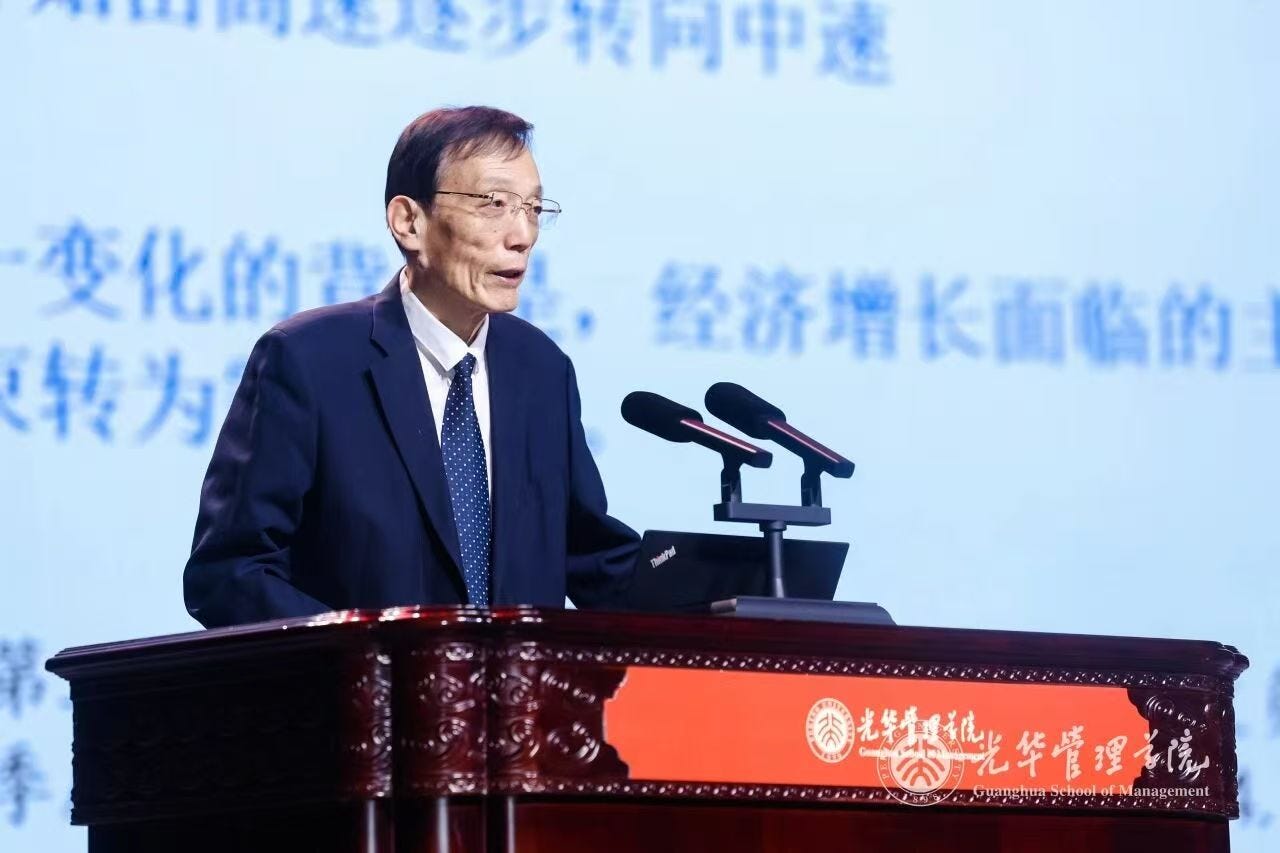
Distinguished guests, professors, and students, good morning. The title of my remarks today is “Expanding Consumption, Maintaining Trade Balance, and Accelerating RMB Internationalisation.”
I. Economic growth shifting from supply-side constraints to demand-side constraints
China’s economy began shifting from high-speed to medium-speed growth in the first quarter of 2010. The underlying context is that the central challenge to growth has moved from supply-side constraints to demand-side constraints. In the first two quarters of 2025, real GDP growth was 5.4 per cent and 5.2 per cent, while nominal GDP growth was 4.6 per cent and 3.9 per cent, respectively, below the real growth rates. This contrast is a direct indication of insufficient demand.
This demand shortfall is not about investment or exports, but about weak consumption. China’s consumption share of GDP is about 20 percentage points below the global average. In terms of composition, the shortfall is concentrated in services, especially development-oriented consumption linked to basic public services, including education, healthcare, affordable housing, social security, and elderly care. Across population groups, the largest consumption gap is among rural residents, particularly the 300 million rural migrant workers, including nearly 200 million who live in cities. The root cause is the longstanding urban–rural divide.
At this point, some may ask: China’s consumption share of GDP has remained low for more than a decade—why, then, was rapid economic growth sustained for so long?
Here, I would like to introduce the concept of “terminal demand”. Specifically, terminal demand is defined as GDP minus productive investment, leaving total consumption plus non-productive investment. Non-productive investment refers to investment related to people’s livelihoods, including real estate, infrastructure construction, and parts of the service sector. In the past, rapid growth in real estate and infrastructure masked the fact that consumption was relatively low. Today, as growth in both areas has slowed, terminal demand has contracted noticeably, in turn contributing to a range of problems, including macroeconomic deceleration, overcapacity, subdued prices, and mounting local government debt.
In recent years, I have also been doing research on environmental protection. In pollution control, interventions are often discussed in terms of end-of-pipe treatment, mid-stream treatment, and source control, and only source control addresses the root cause. Similarly, to tackle insufficient domestic demand, the focus should be placed squarely on the central contradiction: inadequate terminal demand.
II. Imbalance between the “height” and “breadth” of economic growth
China’s innovation momentum remains strong. Developments such as DeepSeek and humanoid robots signal breakthroughs across multiple technological fields, and progress in the defence industry is also encouraging. Yet, at the same time, insufficient domestic demand is weighing heavily on growth. Why do these two phenomena coexist?
Economic growth can be understood along two dimensions: “height” and “breadth”. “Height” refers to improvements in total factor productivity, driven by technological innovation, institutional reform, and opening up. “Breadth” refers to demand. Gains in total factor productivity shape the economy’s growth potential, but the realised rate of growth is ultimately determined by demand.
This helps clarify the central contradiction at present: productivity gains—growth in “height”—cannot substitute for, and may even exacerbate, “breadth” challenges such as income distribution and employment. For example, the deployment of autonomous driving technologies could displace some taxi and ride-hailing drivers, reducing their incomes. Employment and growth are both fundamental priorities of development, and the more pressing task right now is to address demand-related “breadth” constraints. If this problem is not resolved, innovation-driven development strategies will run up against binding reality checks.
III. The 15th Five-Year Plan: shifting toward innovation- and consumption-driven growth
During the 15th Five-Year Plan period, China’s growth model will undergo a major transition. Over the past two to three decades, growth has largely been organised around a supply-side-oriented framework. In the 15th Five-Year Plan period, China needs to move beyond this traditional framework and shift toward a new model jointly driven by innovation and consumption. The core logic will turn toward the demand side, placing greater emphasis on activating consumption and investing in human capital:
First, focus on stabilising and expanding terminal demand.
Second, with terminal demand taken as given, assess existing production capacity.
Third, based on capacity conditions, decide whether to invest, how much to invest, and how to invest.
Fourth, in the course of investment, realise innovation-driven development and structural upgrading.
Seen through the lens of terminal demand, overcapacity is widespread. During the 15th Five-Year Plan period, the orderly exit of inefficient and unviable capacity will be a major challenge. The core of effective investment is to concentrate on areas where capacity is insufficient, directing resources to projects with genuine demand and robust returns, and using such investment to spur technological progress, raise value added, and strengthen industrial competitiveness. A particular risk is the launch of new projects under new labels in sectors where terminal demand is weak, and overcapacity is already severe. Such investment may boost GDP in the short term, but it creates additional excess capacity and further increases debt burdens. A typical example is cities continuing to build new metro lines despite already operating multiple ones.
Current academic debates over whether investment or consumption matters more often miss the crux of the problem. What matters at this stage is the internal logic linking the two: when terminal demand expands, demand for effective investment tends to follow; when terminal demand contracts, excessive investment will only aggravate overcapacity and debt.
From January to November 2025, nationwide fixed-asset investment fell by 2.6 per cent year on year, and private investment slipped into negative growth even earlier. This suggests firms are responding rationally to weak investment returns, with the underlying cause still being subdued terminal demand.
IV. Building a strong consumption-oriented country: China as the world’s largest consumer market
Looking to the 15th Five-Year Plan period and beyond, China should explicitly set the goal of becoming a consumption powerhouse. In practical terms, this goal has three dimensions.
First, consolidate the foundations of China as a major consumer country. Strictly speaking, China has not yet fully become a major consumer country. The key shortcoming is the relatively low share of consumption in GDP, and the first step is to raise that share to the international average level.
Second, focus on the shortfall in services consumption, particularly development-oriented consumption. Priority areas include education, healthcare, and social security. Although these items are classified as consumption in statistical terms, they are also important forms of investment—specifically, investment in human capital. Education and training enhance workers’ skills, healthcare safeguards health outcomes, and social security strengthens occupational stability and social mobility. All of these are essential supports for innovation-driven development.
Third, build the world’s largest consumer market. China should not only consume high-quality domestic products, but also actively bring in high-quality, cost-effective goods and services from around the world, and thereby become the world’s largest buyer-side market. The United States believes it has leverage in trade disputes in part because it sees itself as the world’s largest buyer. China’s population is roughly four times that of the United States. If China’s middle-income group expands further to 800–900 million people, China would be well-positioned to surpass the United States and become the world’s largest buyer-side market.
V. The breakthrough point: accelerating RMB internationalisation
China’s real economy has a substantial global footprint: GDP accounts for around 17–18 per cent of the world total, manufacturing accounts for about 30 per cent, and China is the world’s largest exporter of goods. Yet the RMB’s shares in key international currency functions—pricing, payments, settlement, and reserves—remain mostly below 3 per cent, which is far from commensurate with China’s position in the real economy.
A key breakthrough is to expand the stock of offshore RMB substantially, thereby achieving economies of scale in the RMB’s international use. Historically, the rise of dominant currencies such as the pound sterling and the U.S. dollar was closely linked to the formation of sufficiently large offshore markets. Today, the offshore U.S. dollar market is estimated at roughly USD 16 trillion, effectively making the dollar a global public good; sustained demand also supports the dollar’s high valuation. A major channel has been large-scale imports paid for in U.S. dollars, which pushes dollars into offshore markets.
Given the current trade structure, the next step should be a strategy of basic balance between imports and exports: while maintaining export competitiveness, China should expand imports, with the pivotal shift being settlement in RMB. The conditions for this are increasingly in place. First, China’s industrial and technological competitiveness continues to strengthen, providing a solid foundation for RMB settlement. Second, China already has the world’s largest export market and is fully capable of becoming the world’s largest import market. Many overseas market participants are eager to access the Chinese market, and RMB settlement can be made a condition of market access. Through a model of “importing goods, exporting RMB”, the currency can move onto the international stage in a meaningful way.
Take the current trade surplus of nearly USD 1 trillion as an illustration. If this surplus were not retained, but instead converted into imports of goods or services settled in RMB, more than RMB 7 trillion would flow offshore, materially expanding the offshore RMB pool. At present, offshore RMB totals only a little over RMB 1 trillion. This limited scale constrains the RMB’s roles in international pricing and payments and reduces ease of use. A breakthrough increase would therefore alter the situation markedly.
Therefore, the next priority is to push the offshore RMB pool beyond a critical threshold so that it can meet the needs of a wider range of users and provide convenient investment functions. In parallel, an offshore RMB financial product ecosystem—covering bonds, equities, funds, and derivatives—should be developed to improve liquidity and usability, support a reasonable appreciation of the RMB, accelerate RMB internationalisation, and bring the RMB’s international currency functions into better alignment with China’s position in the global real economy.
RMB appreciation would directly benefit domestic consumers, further expanding consumption in both scale and quality, and would also be crucial to meeting the 2035 target of reaching per-capita income levels comparable to those of moderately developed countries.
Achieving this target depends on three variables: the real growth rate, the gap between nominal and real growth (as reflected in the GDP deflator or the economy-wide inflation rate), and the RMB–U.S. dollar exchange rate. Specifically, policy should aim for average annual real growth of above 4 per cent, reverse the current pattern in which nominal growth falls below real growth, and promote an average annual appreciation of the RMB against the U.S. dollar of around 3 percentage points.
Together, this combination could deliver annual per-capita income growth of roughly 9 per cent when measured in current U.S. dollars, making the target plausibly achievable. Building a consumption powerhouse would provide comprehensive support for all three variables, and is therefore vital to the attainment of long-term goals and the modernisation process.
In conclusion, expanding consumption, maintaining trade balance, and accelerating RMB internationalisation are integral to the transformation of China’s growth drivers and development model. The core is to raise the incomes of low-income groups and improve basic public services, thereby strengthening the foundations of development. Improvements in people’s livelihoods should follow the principle of doing the best possible within one’s means. This is a long-term task, but the more immediate challenge is short-term growth.
It is also worth noting that some localities, in drafting their 15th Five-Year Plans, still place disproportionate emphasis on investment and project launches, while giving insufficient weight to consumption and livelihood-related demands. Therefore, it is advisable for localities with the capacity and willingness to take the lead by launching pilot programmes and trials in areas such as boosting consumption, strengthening livelihood support, and activating demand, stepping up exploration, and playing a demonstrative, leading role. Thank you.

Part I of Liu Shijin: search for growth potentials

Liu Shijin is a Former Vice President (Vice Minister) of the Development Research Centre (DRC), a comprehensive policy research and consulting institution directly under the State Council, the central government of the People's Republic of China.
Part II of Liu Shijin: charting a new wave of structural reform

Liu Shijin is a Former Vice President (Vice Minister) of the Development Research Centre (DRC), a comprehensive policy research and consulting institution directly under the State Council, the central government of the People's Republic of China.
Liu Shijin calls for "breakthrough" in Party theory to allow structural reform for economy

Liu Shijin is a Former Vice President (Vice Minister) and Research Fellow of the Development Research Center (DRC), a comprehensive policy research and consulting institution directly under the State Council, the central government of the People's Republic of China.


Doubt anyone would disagree with him regarding the need to rebalance and forcing it does not seem difficult. Talking about boosting RMB-settled imports almost seems like a way of avoiding talking about the real problem which is mitigating the difficulties associated with rebalancing. Some will benefit greatly, but many will not.
I delved further on this topic: https://open.substack.com/pub/wenchiyu/p/rmb-trade-and-power-stewart-paterson?utm_campaign=post-expanded-share&utm_medium=post%20viewer Really interesting to see how Beijing manages RMB over the years.