


Across China, institutional media organizations are increasingly trying to turn full-time journalists into “personal IPs”—recognizable individual brands capable of attracting audiences on social platforms.
Photogenic reporters are encouraged to spend more time on camera. Foreign-language speakers are expected to showcase their fluency. Veteran journalists are asked to turn their expertise into commentary-driven accounts. Media organizations hope that recognizable faces and more conversational voices can recover some of the attention their institutional accounts, proprietary apps and conventional news products have lost.
The essay translated below offers a decidedly harsh assessment of this strategy. It argues that institutional media want the authenticity, intimacy and traffic associated with individual creators while retaining the editorial controls, risk aversion and employment arrangements of traditional newsrooms. Reporters are expected to display personality without becoming unpredictable, build audiences without acquiring secure claims over the value they create, and assume an entire production workload without the resources needed to sustain it.
Part of the force of this critique comes from a premise running through the essay: that an account centered on a full-time media employee remains subject to essentially the same editorial standards—and perhaps the same multilayered approval procedures—as the organization’s official output. Under that assumption, the author’s conclusion is difficult to dispute. If every sentence must still pass through the equivalent of “three reviews and three proofreads,” the account is scarcely personal in any meaningful editorial sense. Its presentation may be livelier, but institutionally it remains an official account with a human face attached.
Actual practices are likely to vary considerably. Some employers may apply virtually identical standards and approval procedures to employee-centered and official accounts. Others may allow far greater latitude over subject selection, tone, judgment and presentation. The label “personal account” therefore tells us little about how much editorial autonomy its operator actually possesses.
This qualification does not necessarily weaken the essay’s central argument. An institutional media organization may succeed in cultivating a genuine individual creator only by partially ceasing to operate institutionally in relation to that account. If a full-time employee is granted substantial freedom to choose subjects, express personal judgments and take bounded risks, then within that sphere of content production the employee has become a relatively independent editorial unit. The organization has not so much reconciled institutional control with individual creation as carved out an exception to its own institutional logic. It must ultimately choose between retaining control and producing little more than an institutional presenter, or loosening control and accepting that a genuine creator cannot remain entirely an institutional asset.
The essay also identifies problems that editorial freedom alone cannot solve. A reporter may still have to identify topics, write scripts, appear on camera, edit footage, add subtitles, design thumbnails and promote the finished product—often without a production team and while continuing to perform their original job. If the account fails, the employee bears the workload and poor performance metrics. If it succeeds, conflicts quickly emerge over ownership, compensation, commercial value and what happens when the journalist leaves.
The original Chinese essay was published on July 23, 2026, by a WeChat blog called Mulan Sees the World (“Mulan看世界”). I do not know the identity of the person—or people—behind the account. I simply found the essay interesting and thought it worth translating in full. —— Zichen Wang
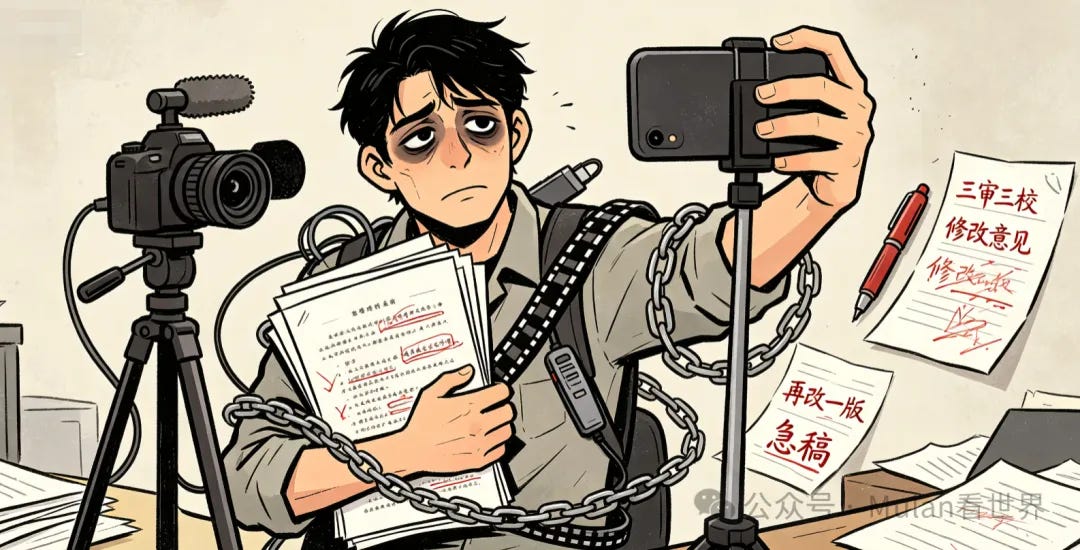
机构媒体打造个人IP,会是一场瞎折腾吗?
Is Building Personal Brands a Fool’s Errand for Media Organisations?
After spending two weeks bouncing around southern China on business, I heard that a major media group was once again embarking on a grand “star-making” drive.
A friend’s department had received a non-negotiable directive from senior management: build personal brands, and do it at full speed. Within a few months, his department alone had launched five personality-led video accounts covering AI and technology, new energy, Chinese companies going global, and other subjects.
The photogenic reporters were told to spend more time on camera. Those who spoke good English could show off their fluency. Veteran journalists like my friend, meanwhile, had little left to showcase but their knowledge and analysis.
The initiative was presented as an organisation-wide effort. In practice, however, there was no way every account could be assigned a dedicated production team. Reporters were largely expected to research, write, film, and edit everything themselves.
My friend, once a traditional print reporter, has effectively been forced to reinvent himself as a one-man short-video studio. After rushing to file his articles each day, he still has to point a camera at his face and record a video. A single segment may take three or five attempts. Late at night, he edits the footage, adds subtitles, and designs the cover image — all on his own.
“Isn’t it exhausting, going through all this every day?” I asked.
“It’s not too bad.” He gave a rueful smile. “These days, if you don’t do this kind of work,it’s not that easy to find another job elsewhere either.”
The whole scene immediately reminded me of my former employer. Back then, everyone — from the boss and the HR department to editors and advertising staff — was “encouraged” to open a personal account. Reposts, comments, and engagement figures were tallied every day.
When turning institutional media into creator-driven media becomes an unquestionable orthodoxy, the obvious question is: does it offer traditional news organisations a genuine lifeline, or does it merely create a self-congratulatory illusion of prosperity?
01 You Can’t Manufacture a Persona Through Three Rounds of Review and Proofreading
The value of a personal brand lies in the personality behind it.
A truly distinctive media persona inevitably comes with strong opinions, emotional force, and at least a trace of irreverence.
But what do institutional media organisations want? They want editorial safety, balance, authority, and a measured tone.
That creates an inherently awkward production model. Reporters are employed by institutional newsrooms but expected to behave like independent creators. They are told to show more personality and compete for attention, while every sentence remains tightly shackled by the “three reviews and three proofreads” system.
Even in organisations with relatively flexible internal procedures and open-minded managers, the room for error that once made media star-making possible has all but disappeared.
Around 2016, Nanfang Media Group launched a programme to cultivate star individual journalists, encouraging more down-to-earth and internet-savvy forms of expression. Short video had yet to take off. With its early appetite for reform and the advantage of entering a relatively uncrowded market, the group did manage to incubate several influential programmes, including Here Comes Wu Song, as well as a number of journalists who became online celebrities in their own right.
The environment today is entirely different.
Public-opinion risk controls now kick in before anything else. Everything a journalist says or does under a personal account is tied to the credibility of the organisation behind them. Sharp industry commentary and serious investigative work must pass through ever-longer chains of approval. The conditions that once allowed star journalists to flourish have largely disappeared.
Call it path dependence among media executives. Call it a lack of better ideas for transforming traditional media. Either way, for frontline reporters and editors, the result is the same: today’s media pack mules must keep persuading themselves that all this extra work will eventually pay off while quietly swallowing the frustration of the present.
Those selected to build these personal brands are each an entire production line unto themselves. They find topics, write scripts, appear on camera, edit footage, and design thumbnails. One person carries the entire workflow.
After grinding through every stage of production, they finally upload the video, only to attract a few hundred views.
When the numbers are disappointing, they are even expected to spend their own money promoting the account. Under the performance systems, sustained low traffic can leave them at the bottom of the rankings and facing elimination.
A system this conflicted is never going to produce vivid, unpredictable personalities with a genuine human touch. What it produces instead is an endless stream of exhausted “on-camera NPCs”, trudging forward under the weight of their KPIs.
02 Three Conflicts That Make Genuine Personal Brands Impossible to Retain
Let us be as generous as possible.
Suppose a media organisation gets lucky and invests enough resources to build an account with a million followers. At that point, the project immediately enters a delicate and potentially irresolvable phase.
A personal brand is inseparable from the individual who embodies it. Followers are there for that particular face and soul, not for the official stamp of the media organisation operating behind the scenes. In the age of algorithms, the traditional logic of trust has been completely reversed.
More than a decade ago, becoming a star journalist was closely connected to advancement within the institutional system. High performers could be promoted to department director, appointed to an editorial board, or even move into government.
At the same time, the independent creator economy had yet to develop its current range of monetisation opportunities, and companies had not begun recruiting media personalities on anything like today’s scale. The first generation of star journalists therefore had a visible path upwards within their organisations and good reason to stay.
Today, the opportunities outside institutional media have multiplied exponentially. Journalists who have built established personal brands in finance, industry, or public-interest reporting can leave at almost any time. In the private sector, they may earn several times their institutional salary.
Huang Jianxiang, Liu Jianhong, and Duan Xuan, once among CCTV’s most star sports commentators, all left the broadcaster in succession. Another example is Da Peng, whose web series Diors Man, released on Sohu, became a cultural phenomenon. But the structure of a traditional internet portal — and the strategic priorities of Charles Zhang, founder of Sohu — could not accommodate his ambitions. The two sides eventually parted ways, with reports emerging this year that his departure may not have been voluntary after all.
The logic of a large media platform is straightforward: you are an institutional asset. Your professional status, access to the camera, and public voice are granted by the organisation. The tone of your content, the boundaries of your commentary, and any commercial activity must all comply with institutional rules.
The logic of a personal brand is equally straightforward: I am the asset. My name, reputation, and relationship with my followers belong primarily to me, not to a particular channel or platform.
The two models can coexist for a while. But once the personal brand becomes valuable enough, the contradiction surfaces immediately. The organisation wants to retain the individual on a relatively modest salary while restricting outside commercial work. The individual, meanwhile, believes that the financial premium generated by their influence is not being fairly recognised.
There is a conflict of identity, a conflict of interests, and a conflict over control.
That is why I have never been particularly optimistic about institutional media organisations trying to incubate personal brands. Both sides inevitably feel wronged: The organisation believes it has invested time and resources only to train talent for the wider market. The individual believes that years of overtime and extra work have brought no meaningful long-term reward.
After all that labour, who was it really for?
Eventually, the two sides go their separate ways, leaving behind little more than a mess.
03 The Trap of Media Transformation
Media executives are not stupid. If everyone understands that these projects may ultimately amount to pouring effort into something the organisation cannot retain, why do media groups keep throwing themselves into one star-making campaign after another?
Because traditional media may genuinely have been pushed to the brink.
First, the algorithms have changed.
Today’s platforms naturally favour personality-driven content. A faceless institutional account publishing conventional news cannot compete with an engaging human presence, and the resulting traffic are often painfully low.
Second, the logic of news consumption has reversed.
In the past, audiences might have thought: “This comes from an official media outlet, so I trust it.” Now they are more likely to think: “This person understands the issue, explains it clearly, and sounds like a real human being, so I will watch.”
The institutional logo behind the speaker matters less and less. And, of course, much of the collapse in trust surrounding traditional media has been self-inflicted.
Finally, and most brutally, the industry’s traditional foundations have crumbled.
Print circulation has fallen off a cliff. Television has been reduced to little more than a device for screen mirroring. The proprietary apps and websites on which media organisations have spent vast sums attract so few daily active users that they are barely worth maintaining.
With traffic growth across the digital ecosystem approaching its ceiling, personal brands have come to look like the cheapest available tool for attracting new audiences and holding on to existing ones.
Media organisations hope that journalists can use their faces and personalities to attract attention on public platforms and within professional circles, reclaiming some of the influence their institutions have lost.
More naively, they imagine that audiences gathered on public platforms can then be funnelled into their own closed ecosystems, allowing them to pull off a last-minute transformation and reverse years of decline.
This frantic embrace of personal branding — forcing reporters into creator roles whether they are suited to them or not — is, at heart, a desperate, low-cost struggle by traditional media organisations facing the possibility that the world is simply moving on without them.
What it produces is a perfect piece of performative transformation.
Senior executives feel reassured. Middle managers have measurable targets and projects to present in their performance reviews. Frontline reporters and editors are worked to the point of questioning their life choices.
And, in the end, the exercise makes virtually no substantive contribution to the transformation of the media itself.
Veteran commmentator slams Chinese media's meaningless "transformation"

Cao Lin is now a professor at the Journalism and Information Communication School of Huazhong University of Science and Technology in Wuhan. Before returning to his alma mater, Cao was a two-decade-long in-house commentator of the influential China Youth Daily
Monopoly without market, subsidies without subscribers: Guo Quanzhong on state media

The buzzword in China’s state media industry now is 系统性变革 systemic transformation, a full year after the word was included in the Resolution of the 3rd Plenum of the 20th Central Committee of the Communist Party of China on further deepening reform comprehensively to advance Chinese modernization
The Vanishing Craft of Journalism in China

The following article, from a year and a half ago, completes my recent rant on legacy media and journalism in China.
Zichen Wang's line about an official account with a human face attached is the sharpest thing in the piece. There is a case where the institution created the face on purpose and for its own reasons. The BBC kept its announcers anonymous until 1940, then had them give their names on air so listeners could authenticate a broadcast against German transmissions from occupied Radio Luxembourg. Alvar Lidell and Bruce Belfrage became household names, which is not what a security measure was meant to produce. The three conflicts the essay names all follow from that one step. What does a newsroom do when the identifiability it built for control becomes the only thing the audience still trusts?
— Nazem
Thanks for sharing - I love how universal it is, applies just as much to western mainstream media as to Chinese media.