


Michael Jinghan ZENG, a professor in the Department of Public and International Affairs at City University of Hong Kong, argues yesterday in a Chinese-language op-ed that political volatility in London has become a structural source of uncertainty in China-UK relations. His conclusion is that China should adopt a more transactional, risk-managed approach to Britain, focusing less on the attitudes of individual leaders and more on the competing departmental priorities within Whitehall.
The following translation is based on the op-ed on Tuesday, June 23, 2026, in FT Chinese, the Chinese-language service of Financial Times.
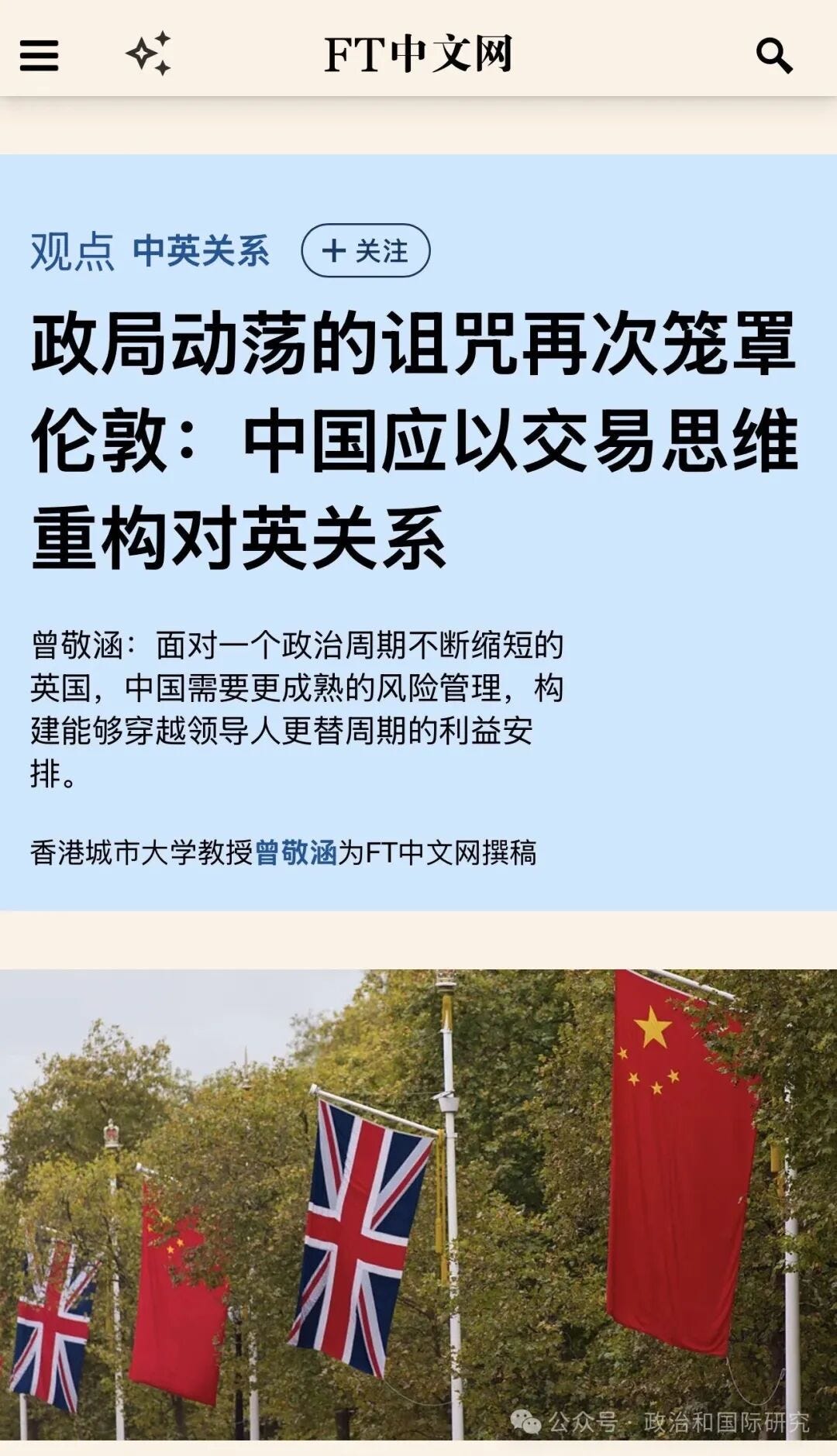
Zeng approved this translation and publication.
Before moving to Hong Kong, Zeng spent 13 years in the UK, where he was one of the youngest full professors in Britain and served as Professor of China and International Studies at Lancaster University and Director of Lancaster’s Confucius Institute.
Zeng is also the author of multiple books including Slogan Politics Understanding Chinese Foreign Policy Concepts and Memoirs of a Confucius Institute Director, a planned three-volume memoir. Its first volume, Challenges, Controversies, and Realities, was published in English by Palgrave Macmillan in 2025.

Political Turmoil Again Casts Its Shadow over London: China Should Rebuild Its UK Policy around Transactional Pragmatism
Keir Starmer’s announcement that he will step down as prime minister means Britain is now set to have its seventh prime minister in less than a decade. From David Cameron to Theresa May, Boris Johnson, Liz Truss, Rishi Sunak, and then Starmer, the speed with which Britain has changed leaders is unusual among major developed economies. This persistent political volatility has not only weakened the predictability of British policymaking, but also made long-term strategic planning and policy continuity increasingly difficult.
For China, this is not merely a matter of British domestic politics. It has become a major external variable shaping the stable development of China-UK relations. Over the past decade or so, the ups and downs in bilateral ties have often had less to do with shifts in Chinese policy than with repeated political upheavals in Britain. Whenever London enters a period of turbulence, Beijing is forced to reassess, adjust, and at times even rebuild the frameworks for cooperation that had previously been put in place.
The most obvious example is the so-called “golden era” of China-UK relations launched in 2015. That year, the Cameron government worked with China to push bilateral relations to an unprecedented high. China showed strong enthusiasm for the British market, infrastructure, financial services, and higher education. Then Chancellor George Osborne was one of the chief architects and promoters of this “golden era”. Yet this political window lasted barely a year.
After the Brexit referendum in 2016, Cameron was forced to resign. Theresa May entered Downing Street, Osborne left government, and the two most important political champions of the “golden era” disappeared from the stage at the same time. Once that political backing was gone, China-UK relations quickly began to change direction. In the following years, the British government was consumed by Brexit negotiations, the shock of the pandemic, and geopolitical frictions with China. China itself gradually shifted from being a subject of cooperation to becoming a tool in Britain’s domestic political competition.
This was especially clear during the Conservative leadership contest after Boris Johnson’s resignation, when taking a tough line on China became almost a political requirement for candidates. In an effort to shake off the perception that he was “too close to China”, Sunak declared during the Conservative leadership campaign that “China and the Chinese Communist Party represent the largest threat to Britain and the world’s security and prosperity this century”, and pledged to close all 30 Confucius Institutes in the UK. It was also the first time he had publicly set out such a position on the Confucius Institutes.
That statement reflected the logic of British domestic political competition more than any carefully considered long-term China strategy. In fact, his main rival, Liz Truss, had supported the establishment of several Confucius Institutes when she served as education secretary, and had publicly recognised their contribution to Chinese-language education in Britain. Sunak’s stance on the Confucius Institutes was essentially an attempt to undercut Truss’s credibility as a China hawk.
The irony is that Truss, widely seen as a hardliner on China, ended up serving as prime minister for only 45 days — so briefly that the British press joked she had a shorter shelf life than a lettuce. Sunak, who eventually took office, dropped the pledge to close the Confucius Institutes, but he also made clear that the “golden era” was over.
After Labour won a landslide victory in the 2024 general election, China-UK relations briefly entered a relatively stable phase. The Starmer government resumed high-level engagement, visited China earlier this year, and eventually approved the long-delayed project for China’s new embassy in London, drawing a line under an issue that had remained unresolved for years.
Yet only a few months later, the Starmer government again found itself in political trouble. Whether or not he ultimately leaves office early, a more fundamental question now confronts Chinese policymakers: does the British political system still have the capacity to sustain a coherent long-term China strategy?
For China, the past decade has already offered more than enough lessons.
First, China must treat changes in British leadership as the norm, not the exception. In the past, China’s UK policy was, to some extent, built on expectations of particular political figures, particular governments, and particular political promises. Reality has shown, however, that the political life expectancy of British prime ministers is becoming shorter and shorter. A promise made today may lose force tomorrow because of a cabinet reshuffle, a leadership contest, or even an early general election. Beijing therefore needs a more systematic scenario-planning mechanism, one that continuously assesses how different political forces might adjust policy after entering office, rather than assuming that the current course will endure.
Second, China should gradually approach its relations with Britain through a more pragmatic, transactional lens. This does not mean abandoning cooperation. It means reducing dependence on long-term political trust. The highly fluid nature of British politics makes it difficult for any prime minister to offer strategic commitments that can survive multiple political cycles. Under such circumstances, China need not become overly optimistic because of friendly remarks by a British leader, nor should it overreact to tough rhetoric during an election campaign.
If the British government is willing to advance concrete cooperation projects, the two sides can move those projects forward. If the British government wants to strengthen economic and trade ties, the two sides can discuss economic and trade cooperation. If the British government imposes restrictions, China can respond according to its own interests. In other words, Beijing should no longer place its hopes in grand political narratives, but should focus on specific interests, specific issues, and specific outcomes.
In fact, both the “golden era” and the later wave of China hawkishness show that British politicians’ statements on China are often driven by the domestic political environment. Many campaign statements are never fully implemented, and many political promises are unlikely to last.
In that sense, China should neither invest excessive expectations in the friendly gestures of a new British leader nor become overly anxious about tough remarks made during a leadership campaign. In today’s British political system, the greatest certainty is precisely its uncertainty.
Third, China needs to pay much closer attention to departmental politics inside the British government, rather than focusing only on the personal stance of the prime minister. As prime ministers change frequently and the authority of political leadership weakens, it is becoming increasingly difficult for the British government to form a stable and coherent top-level China strategy. For any prime minister, political survival often takes precedence over long-term strategic planning. China policy is therefore more easily shaped by the competing interests and policy preferences of different departments within government.
As I have argued elsewhere, recent practice suggests that Britain’s China policy is largely the product of continuous bargaining among different parts of government. The Treasury, the Department for Education, and departments responsible for trade and investment tend to focus more on the Chinese market, investment, educational exchanges, and opportunities for economic growth, and are therefore more inclined towards pragmatic cooperation. By contrast, the foreign affairs, defence, intelligence, and home affairs systems tend to view China through the lenses of national security, strategic competition, technology security, and alliance coordination. Their policy positions are often more cautious and even hardline.
In periods of political stability, the prime minister and their core team can usually coordinate among different departments and produce a relatively unified China policy framework. But when political leadership weakens and the prime minister’s authority comes under pressure, departmental disagreements tend to become more pronounced. China policy then becomes more prone to swings and fragmentation.
For China, therefore, simply watching the public statements of the British prime minister or the governing party is no longer enough to judge where Britain’s China policy is heading. It is increasingly necessary to look more closely at the interests, power shifts, and policy competition inside different parts of the British government, because these factors are more and more likely to determine the actual direction of Britain’s China policy.
China-UK relations will, of course, remain important. Britain is still a major European economy, a permanent member of the United Nations Security Council, a global financial centre, and a strong player in science and technology. But for Beijing, the more important task may no longer be to judge whether the next British prime minister is pro-China or anti-China. It is to recognise a more practical reality: prime ministers will keep changing, while national interests remain.
Faced with a Britain whose political cycles are becoming ever shorter, China does not need more trust so much as more mature risk management. It should avoid making long-term bets on any single leader and instead build interest-based arrangements that can survive repeated changes of government. That may be the most important lesson Beijing should draw from the past decade of China-UK relations. Under Donald Trump, China at least knows who it will be dealing with in Washington for the next four years. In today’s Britain, it is becoming harder and harder to know who will occupy 10 Downing Street even two years from now.

Prof. Jinghan Zeng on Confucius Institute and China’s Soft Power
Palgrave Macmillan has recently published Memoirs of a Confucius Institute Director, Volume 1: Challenges, Controversies, and Realities, the first insider memoir from a Confucius Institute director during a time of growing global controversy, by Michael Jinghan ZENG
Transcript: China’s propaganda machine? The controversies and reality around the Confucius Institute
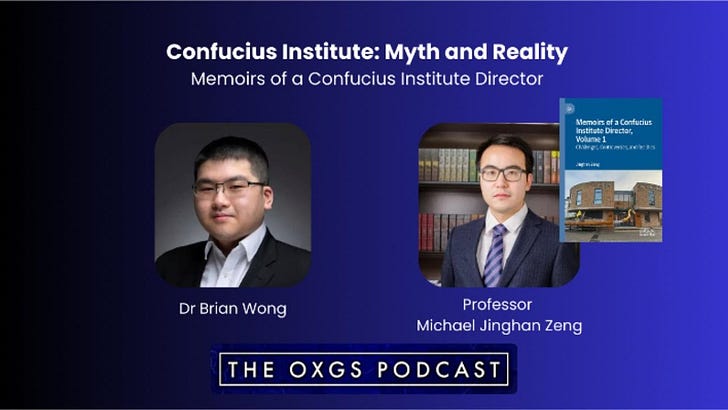
From 2019 to 2025, Michael Jinghan ZENG was Professor of China and International Studies at Lancaster University and Director of Lancaster’s Confucius Institute, leading a team of nearly 30 staff. His work once sat at the centre of a widening debate in global higher education over language teaching, cultural influence, and the governance of academic exc…
“ It should avoid making long-term bets on any single leader and instead build interest-based arrangements that can survive repeated changes of government” This still assumes the UK is a rational actor which I think is a flaw in this logic. Before the Ukraine war I wrongly assumed Germany would take a hard stance toward Russia because Germany wouldn’t want to risk access to cheap Russia gas. This was a wrong assumption and I think similar assumptions are being made about dealing with the UK.
China is in pole position. Playing the long game. The City of London bankers, financiers, and OFCs are all panicking. Large withdrawals are being denied, or capped. New limits on remittances as Gulf despots start liquidating their sovereign wealth funds. US treasuries no longer a safe haven. All the Chinese need to do is keep playing the long game, and remain patient. We are seeing a replay of the 1956 Suez Crisis, when the US destroyed the Sterling Pound. Now it is the slow motion decline of US hegemony, and US financial system.