

Last October, Pekingnology shared an excerpt from Michael Jinghan ZENG’s Memoirs of a Confucius Institute Director, Volume 1: Challenges, Controversies, and Realities. From 2019 to 2025, Zeng was Professor of China and International Studies at Lancaster University and Director of Lancaster’s Confucius Institute, where he led a team of nearly 30 staff. His work placed him at the centre of a widening debate in global higher education over language teaching, cultural influence, and the governance of academic exchange.
This year, with the publication of Memoirs of a Confucius Institute Director, Volume 2: Global China Shaped by Local Realities, here is a second excerpt from the memoirs, with the approval by Zeng, now a professor in the Department of Public and International Affairs at City University of Hong Kong.
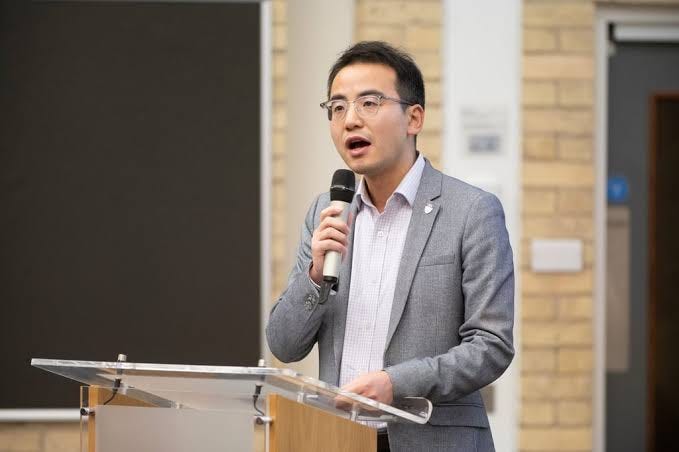
The following excerpt focuses on the people who actually keep Confucius Institutes running.
Western political and media narratives sometimes portray Confucius Institute staff as politically vigilant operatives carrying out Beijing’s agenda abroad. Zeng’s account of Lancaster University offers a rather different — and considerably more mundane — picture: British administrators who may know little about China when they take the job; Mandarin teachers recruited from very different professional backgrounds; constant staff turnover; arguments over teaching hours; visa paperwork, budgets, event flyers, farewell cards, and the occasional accidental map of China without Taiwan.
Below is the excerpt. (And Volume 2 is open access!)
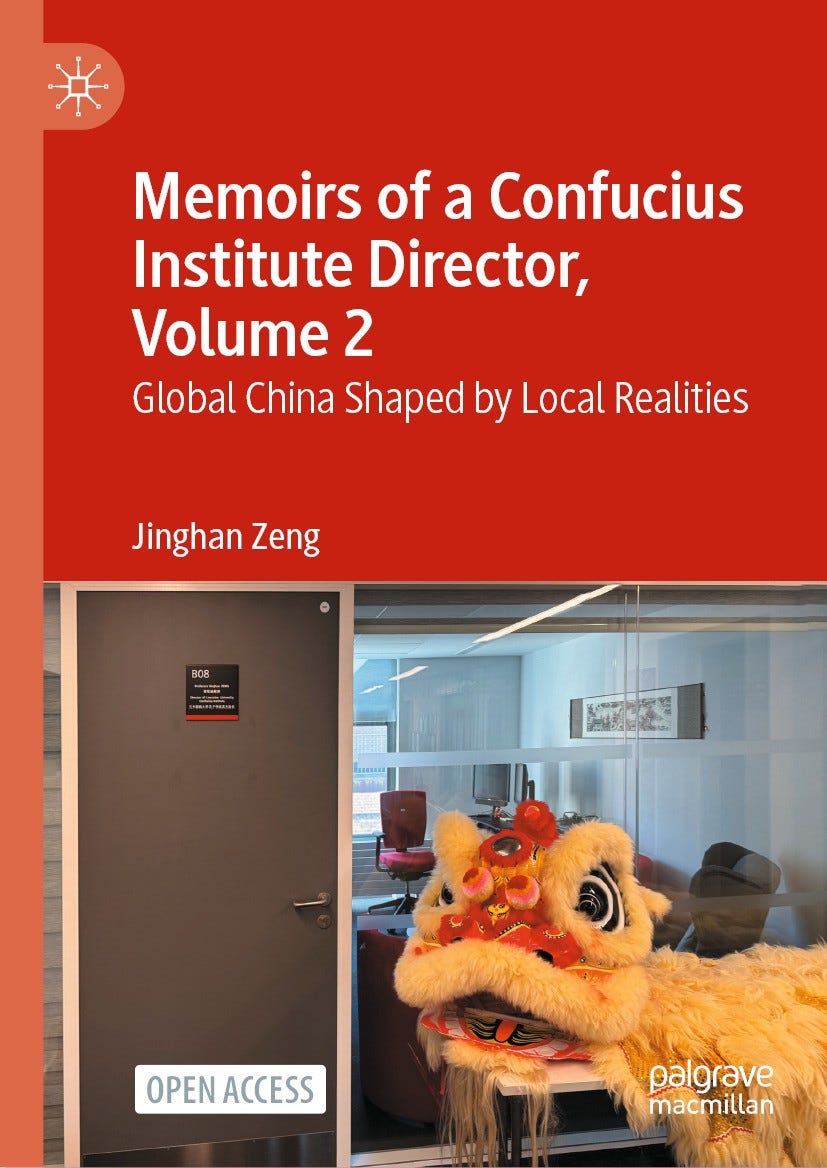
Confucius Institute Staff
The staff composition of Confucius Institutes typically includes both employees from the host university and personnel seconded from the Chinese partner institution. In Lancaster’s case, our 20–30 staff members include 5–6 full-time Lancaster University employees with various contract types, workloads, and funding sources. Some positions are funded by China, while others are supported by income generated by the institute. Some staff members hold full-time contracts, while others—like myself—have partial workloads alongside other university responsibilities. Additionally, local teachers are hired by Lancaster Univer-sity through funding from China, but their recruitment process follows the university’s standard hiring procedures, with no difference from any other employee.
Many Western political and media narratives that demonize the Confucius Institute often implicitly portray its staff as a shadowy force with heightened political vigilance, a lofty sense of political mission, and a firm ideological belief in the Chinese Communist Party. They have been accused of engaging in espionage (ABC, 2019; Francis, 2023; Jakhar, 2019; Peterson, 2020; Vanttinen, 2022), silencing voices critical of China (BBC, 2020; CPHRC, 2019; Jakhar, 2019; Peterson, 2017a, 2017b; Pong & Feng, 2017; Rogers, 2018; Roy, 2024; UKCT, 2024; Wood, 2024), and suppressing Chinese students on campus (Parliament, 2023; Roy, 2024; Tettenborn, 2023; UKCT, 2024). In some allegations, those Confucius Institutes staff members are “obliged to undermine free speech and to conduct harassment on command” (Dunning & Kwong, 2023: 3). In reality, however, they are just a diverse group of professionals dedicated to promoting cross-cultural understanding and language exchange, motivated by a genuine passion for education and international collaboration.
In Lancaster, our staff members are regular individuals who may or may not have a strong interest in politics. Within the local team at the Confucius Institute, our administrative staff are typically British nationals with experience in administration. While proficiency in Chinese is preferred, it is not always possible to attract candidates with the necessary language skills, given Lancaster’s smaller local population compared to larger cities like London.
Although they are passionate about cross-cultural understanding, not everyone may initially bring a strong grasp of Chinese language and culture to their roles—let alone the heightened political sensitivity and advanced knowledge required to navigate Chinese politics. Indeed, some administrative staff assumed their roles with very limited—if not zero—understanding of China, its language, or culture, and only developed their knowledge after taking on the position.
This occasional lack of political sensitivity can sometimes lead to interesting situations. One example involved a British administrative colleague who designed an event flyer featuring a map that did not depict Taiwan as part of China. Unaware of the potential issue, he distributed the flyer on campus. The then China director only realized the omission after-ward. Concerned that Chinese students might perceive it as the Confucius Institute taking a political stance on Taiwan’s independence, the director immediately discarded the remaining copies to prevent any controversy. However, he struggled to convey to the British staff why such details matter.
For a Confucius Institute director like me, administrative staff employed by the host university play a significant role in shaping the day-to-day operations of the Institute. They are essential for delivering the institute’s vision and managing its routine functions. Without them, a Confucius Institute simply cannot function effectively. During my tenure, the Institute was fortunate to have two full-time administrative staff members who supported the entire team. Their responsibilities range from handling visas for Chinese staff, organizing events, managing marketing and communications, preparing budgets and documentation, to coordinating external engagement activities, among many other tasks.
Due to regulatory, skill-based, and practical considerations, many of these tasks cannot be carried out by academics or staff from our Chinese partner institution. One of my greatest concerns as a local director at the time was the risk of losing administrative support during faculty restructuring. Any reduction in this support would have seriously undermined the Institute’s ability to deliver its activities and function effectively. As such, I had to advocate strongly to protect these resources.
In other Confucius Institutes with much smaller teams—typically around seven staff in total—there is often only one full-time or part-time local administrator supporting the entire operation. This means that, in practice, the functioning of the institute may hinge on just one or two individuals. For example, if that person were to fall ill, an entire conference or major event could be jeopardized.
I frequently hear from other Confucius Institutes that a less competent or less motivated administrator—or someone lacking the interpersonal skills to collaborate effectively—can cause significant disruptions and seriously undermine the institute’s overall effectiveness. Since the operation of the institute often relies heavily on one or two individuals, their personal characteristics, work abilities, and motivations vary—and so too do the practices and functioning of their respective institutes.
As the UK counterpart, the Chinese university provides a China director and teachers. Following the transition to the Chinese International Education Foundation, all are seconded under employment contracts with the Chinese partner institution. The teachers seconded from China fall into two categories: qualified Mandarin teachers on two-year contracts and voluntary Mandarin teachers on one-year contracts, who are typically master’s students completing a placement.
Although these teachers are seconded from China and formally employed by the Chinese partner institution, their selection is largely determined by the local team. At Lancaster University, for example, we conduct interviews for candidates applying to become Chinese language teachers and make final decisions regarding their selection. The interview panel typically consists of 2–3 local staff members along with the China director, and the process is administratively managed by the local team. In all these respects, the influence of the local side is unmistakably clear.
Since the institute caters to a wide range of language learners, from primary school students to university-level education, we select qualified Mandarin teachers from diverse professional backgrounds—including university lecturers, associate professors, high school teachers, primary school teachers, and even sports school instructors. Teachers with dance or martial arts skills are particularly popular among primary schools, adding an extra cultural dimension to their teaching.
Some of them become so highly sought after for various performance activities—both through the institute and independently—that they take on a cultural rock star status in the region. While this reflects their popularity and the strong demand for cultural engagement, it also occasionally raises our concerns about their resilience and whether their intensive schedules might affect their teaching responsibilities at the institute.
Unlike local employees of Lancaster University, who provide continuity and stability to the team, the high turnover of seconded teachers from China creates a constant state of flux. Every few months, we hold farewell gatherings to say goodbye to departing teachers while welcoming new arrivals. The cycle is relentless—many cheerful “Hello, nice to meet you” moments are soon followed by heartfelt “Goodbye, and best wishes for the future.” With so many farewell cards to write each year, we eventually switched to digital ones in line with the university’s commitment to environmental sustainability.
When I first joined the Institute, the then China director described this dynamic with a saying: “铁打的孔院,流水的兵”—the Confucius Institute is ironclad, but its people come and go like flowing water. At the time, I didn’t fully grasp the depth of this metaphor—but now, I do. In April 2025, I found myself among those who had to go—saying goodbye at my own farewell party, even as I welcomed many new arrivals. I had always known this moment would come, but when it finally did, it was deeply emotional.
This high turnover of staff from China has both advantages and challenges. On the positive side, it ensures a constant influx of fresh perspectives, with teachers bringing the most up-to-date knowledge and life experiences from China, enriching students’ learning experiences. Their energy and enthusiasm inject new dynamism into the institute.
However, the downside is the lack of continuity and stability within the team. A significant amount of time and effort is spent on induction training to help new teachers adjust. For them, the first year is often spent settling in—finding housing, adapting to local life, navigating a new work environment, and learning how to teach in a British educational context for the first time. Just as they become fully adjusted, they are already preparing to leave by the second year, perpetuating the cycle of constant transition.
Not surprisingly, from a local managerial perspective, locally hired teachers offer considerable advantages in addressing these challenges. As local residents, they require less time to adapt, and their employment contributes to the local job market. For our local partner schools, locally hired teachers are often the preferred choice, as they provide continuity and stability with minimal additional support required from the schools. However, Lancaster University Confucius Institute faces a unique challenge due to its geographical location, which limits the availability of eligible candidates for these roles.
For Confucius Institutes based in major cities such as London, the talent pool is larger and there are more options for recruiting candidates. At the same time, these locations often already host established Chinese language programs. In such contexts, teachers seconded from China may become direct competitors to locally employed instructors, as their positions are subsidized by Chinese funding. This can alter local demand–supply dynamics in Chinese language teaching and raise concerns about local employment opportunities and distributional benefits.
By contrast, in smaller locations such as Lancaster, where there are few—if any—pre-existing Chinese language programs, Confucius Institute funding to develop local Chinese provision tends to face less resistance and is more readily perceived as beneficial.
In addition, within the Institute, at times, tensions can arise when making staffing decisions between locally hired teachers and those seconded from China. The China director may advocate for assigning fewer teaching hours to local teachers, favoring the use of seconded teachers from China instead. This occasionally creates friction in balancing operational efficiency, financial considerations, and institutional priorities.

Transcript: China’s propaganda machine? The controversies and reality around the Confucius Institute
From 2019 to 2025, Michael Jinghan ZENG was Professor of China and International Studies at Lancaster University and Director of Lancaster’s Confucius Institute, leading a team of nearly 30 staff. His work once sat at the centre of a widening debate in global higher education over language teaching, cultural influence, and the governance of academic exc…
Prof. Jinghan Zeng on Confucius Institute and China’s Soft Power
Palgrave Macmillan has recently published Memoirs of a Confucius Institute Director, Volume 1: Challenges, Controversies, and Realities, the first insider memoir from a Confucius Institute director during a time of growing global controversy, by Michael Jinghan ZENG

I have some experience about why cities with a large elite school population would not be happy to have the peons learning Chinese and becoming less dependent on their intermediation. I can remember the unhappy looks of the other 9 scholarship recipients when I showed up at the reception for the new batch of 10 AASCU scholars at Taiwan's Foreign Affairs Department in 1983.
Lack of political sensitivity applies also to the author himself. In the eyes of many westerners, his account of the map not showing Taiwan as part of the PRC will look like damning evidence of censorship and political indoctrination.