


On 23 October 2026, as the Pentagon designated Confucius Institutes as a national security threat, US Secretary of War Pete Hegseth claimed that 80 “new propaganda cells” had emerged under different names at 30 US universities, accusing them of stealing intellectual property and seeking to “infiltrate the minds of American students”.
Michael Jinghan Zeng, Professor and Head of the Department of Public and International Affairs at City University of Hong Kong, draws on his own experience in responding to Hegseth’s remarks. From 2019 to 2025, Zeng served as Foreign Director of Lancaster University’s Confucius Institute, where he led a team of nearly 30 staff.
Below is the article Zeng published in FT Chinese, the Chinese-language service of the Financial Times, on 30 October.
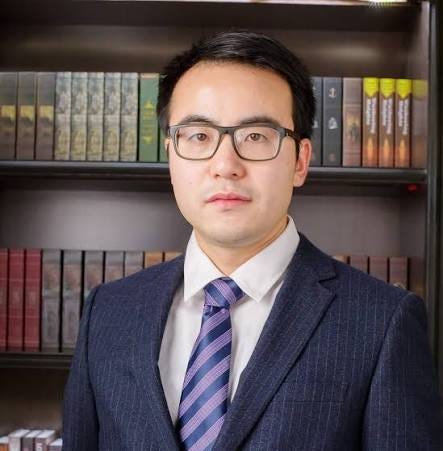
The East is Read and Pekingnology have already carried many excerpts from Zeng’s books, his articles, and podcast conversations. He is the author of the three-volume Memoirs of a Confucius Institute Director, the first two volumes of which were already published by Palgrave Macmillan in 2025 and 2026. The Chinese edition of the first volume, Controversies and Realities of Confucius Institutes, was published by City University of Hong Kong Press in 2026. The third volume is forthcoming.
当孔子学院成为大国竞争的符号
When Confucius Institutes Become a Symbol of Great-Power Competition
At the end of 2022, I started a weekend Chinese class at Lancaster University’s Confucius Institute. The Chinese classes previously available in the area had been suspended due to the pandemic, and many parents wanted their children to continue learning. The university’s facilities and teaching staff made it possible to reorganise the classes. The initiative grew out of a very practical need among local families.
That experience stands in sharp contrast to the image of Confucius Institutes in international politics. On 23 October, US Secretary of Defense Pete Hegseth claimed that “80 new propaganda cells across 30 universities had popped up using different names and different charters”, and that one of their missions was “to steal intellectual property”. He also announced that the Pentagon had added them to its list of institutions that threaten US national security.
My experience in Britain gives me no position to assess the specific circumstances of these US institutions. But Hegseth’s statement has made me think: why has a cooperative platform for language and cultural education come to embody such grand ideas about national power? In these debates, the needs of local communities are often quickly lost from view.
I served as the foreign director of the Confucius Institute at Lancaster University from 2019 to 2025. Over those six years, I increasingly came to see that the two opposing views of Confucius Institutes might share a common assumption: that an institution’s presence overseas is simply an extension of Chinese state power.
Seen this way, supporters can point to the number of institutes and the scale of their activities as evidence of China’s growing influence. Critics, looking at the same map, can see them as outposts for infiltrating Chinese influence. The two sides reach very different conclusions, but both may overestimate a state’s ability to reshape another society simply by establishing organisations there. The crucial question is whether cultural contact can produce the kind of political identification that the funder hopes to foster.
I wrote a three-volume memoir of my time as a Confucius Institute director partly to examine this process. The first volume, Challenges, Controversies, and Realities, draws on my experience as a director to recount the disruption caused by the pandemic, the dissolution of the Confucius Institute Headquarters (Hanban), and the wave of Confucius Institute closures in Britain. The second volume examines how local realities shape overseas projects. The third, as-yet-unpublished volume turns to the Chinese side, exploring the different roles played by Chinese partner universities, Hanban, and the Chinese International Education Foundation in the development and operation of Confucius Institutes. Taken together, the three volumes show that cooperation often takes a different course from the one originally envisaged and has to be continually negotiated.
The changes at the headquarters are particularly telling. In 2020, the dissolution of Hanban shifted how the institutes were funded and governed. In the first volume, I describe in detail how sudden this organisational change was and the uncertainty it created for institutes on the ground. Yet overseas institutes did not disappear with the headquarters. Existing university partnerships and local demand allowed them to continue operating.
This change does not prove that China has withdrawn from the Confucius Institute programme, nor does it in itself dispel concerns about Chinese funding. It does, however, show why any assessment of an overseas project must take account of changes in its institutional relationships. If every change in structure is treated as a smokescreen for the same strategy, it becomes difficult to examine the institutional changes on their own terms.
Local needs can also shape what a project means. In Blackpool, the Confucius Institute worked with local primary schools to teach Chinese. The UK Office for Standards in Education, Children’s Services and Skills (Ofsted)’s 2019 inspection report on one of these schools looked at whether pupils were learning about the world “beyond Blackpool” and noted that Year 6 pupils could already hold short conversations in Mandarin. For the school, the value of the classes lay in giving children the opportunity to encounter a society beyond their own experience.
Such educational benefits, of course, cannot excuse any wrongdoing. But treating them all as evidence of growing Chinese state influence overlooks the aims of those on the receiving end. A British school may actively use resources provided by China simply because they serve its pupils’ interests. Likewise, a parent’s decision to have a child learn Chinese does not necessarily imply any position on China’s political system.
The same point applies to China’s own cultural exchange efforts. It is easy to count how many institutions receive funding and how many activities are organised, but these are measures of inputs and outputs, not of what participants actually think of China. An institute may be able to run language classes, but that does not mean it can determine what its audience thinks about China beyond the classroom.
Students who learn Chinese may come away with a more complex understanding of China, or even a more critical one. They may appreciate Chinese literature while questioning Chinese policies. Being open to such outcomes is part of taking education seriously. If success in cultural exchange is defined in advance by whether foreign audiences come to identify more strongly with China, institutions on the ground are being asked to deliver a political outcome that is difficult to achieve and beyond the remit of language education.
Security assessments must also allow for this distinction. A person’s willingness to engage with Chinese culture should not be taken as evidence that they share Beijing’s political position. Nor does China’s funding of a project mean that those involved have no aims of their own. Hegseth’s serious allegations should be tested against the actual conduct of the organisations concerned. Whether political motives are involved in cultural cooperation is one question; whether those motives can be realised as intended is another.
Once these two questions are conflated, cultural exchange itself comes under strain. Funders seek to show that their projects are expanding national influence, while critics treat any sign of such influence as a threat. Institutions on the ground are then left to explain why they are still needed. The more effort they spend managing these political expectations, the less attention they can give to teaching and working with local communities.
A more useful way to think about China’s overseas cultural cooperation is to ask how local partners can have a genuine say in what these projects are for. Can schools adapt courses to their students’ needs? Can local communities set goals that funders had not anticipated? Can participants continue to hold their own views of China? All of these should be taken into account when assessing the success of such cooperation.
This also means that the Chinese side must be prepared to accept that success may take a less visible form: a project may make a genuine contribution to local education without translating into political identification with China. Those receiving funding may remain willing to cooperate while retaining their critical views and keeping some distance. Such relationships may prove more durable than a high-profile publicity campaign, even if their value is difficult to capture in any straightforward measure of national influence.
Hegseth’s latest statement has once again put Confucius Institutes in the spotlight of great-power competition. But in those weekend classrooms in Lancaster, the immediate questions were much more down-to-earth: what kind of classes would suit the children, whether families could afford them, and whether teachers could teach them well. The future of international cooperation ultimately depends on how well it addresses practical questions like these.

Transcript: China’s propaganda machine? The controversies and reality around the Confucius Institute
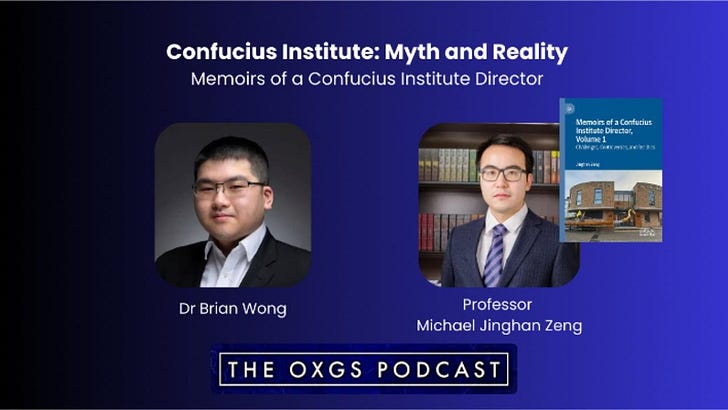
From 2019 to 2025, Michael Jinghan ZENG was Professor of China and International Studies at Lancaster University and Director of Lancaster’s Confucius Institute, leading a team of nearly 30 staff. His work once sat at the centre of a widening debate in global higher education over language teaching, cultural influence, and the governance of academic exc…
Prof. Jinghan Zeng on Confucius Institute and China’s Soft Power
Palgrave Macmillan has recently published Memoirs of a Confucius Institute Director, Volume 1: Challenges, Controversies, and Realities, the first insider memoir from a Confucius Institute director during a time of growing global controversy, by Michael Jinghan ZENG

