

A recent Xinhua article [ENG] in its “Great Journey” (伟大征程)series has caused a small but noticeable stir in overseas Chinese-language circles and, increasingly, among some English-language China watchers. Published on June 19, the article revisits the “Three Great Transformations” (三大改造)of the 1950s, including the socialist transformation of private industry and commerce through “joint state-private ownership.” Some commentators have taken it as a possible signal that Beijing may revive public-private joint ownership, or that the Communist Party of China is preparing to move away from protecting private enterprise.
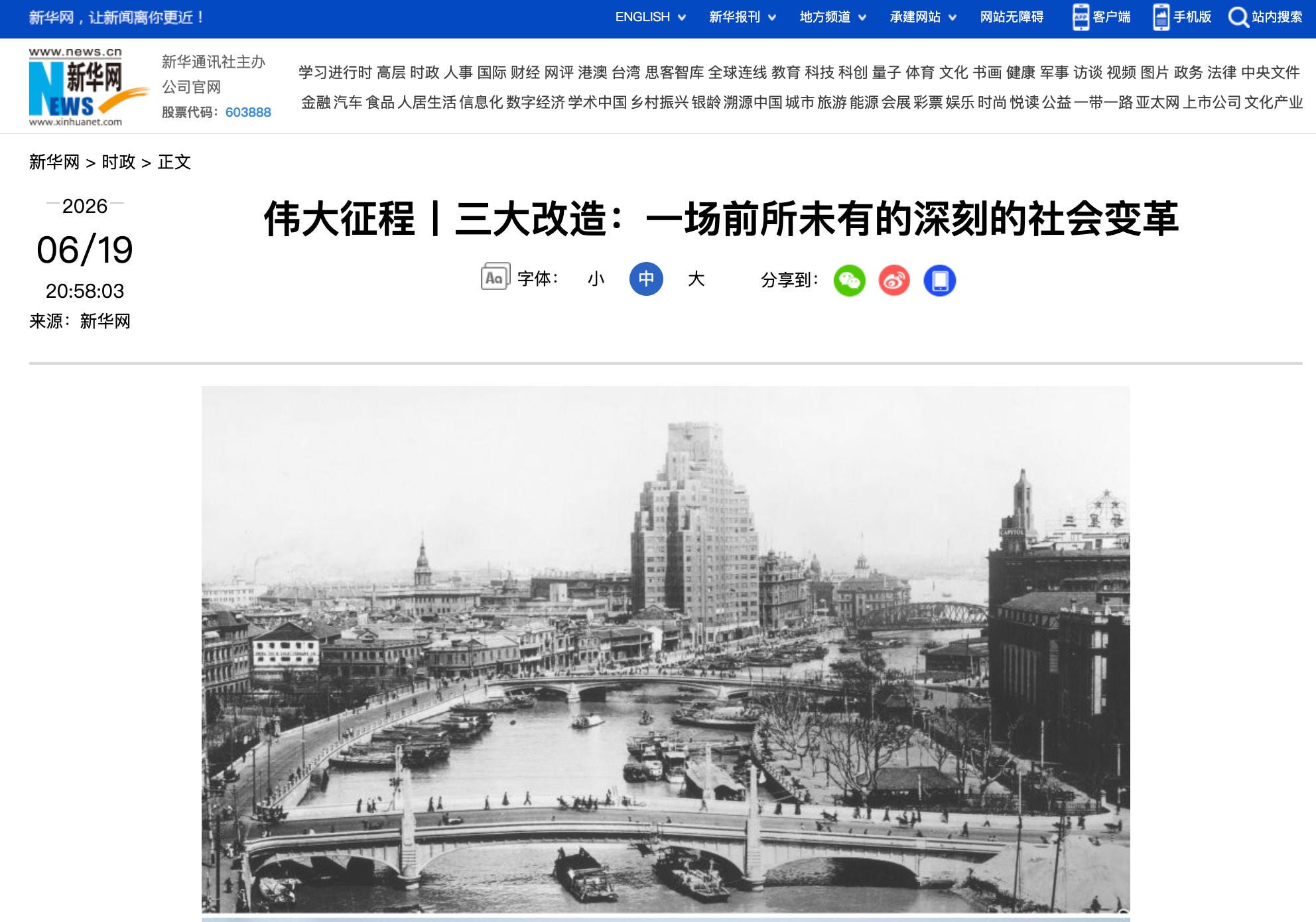
That interpretation is much ado about very little.
This does not mean the concern comes from nowhere. In Chinese political memory, “joint state-private ownership” is not an innocent phrase. It refers to a historical process through which private industrial and commercial enterprises were gradually transformed into socialist public ownership. For entrepreneurs, investors, and observers who have watched years of regulatory campaigns against internet platforms, private tutoring, finance, property, and other sectors, the phrase can understandably sound politically loaded.
But there is a difference between understanding why a reaction happens and accepting the reaction as a sound reading of the text.
The first and most important point is context. The Xinhua article was not a standalone policy essay suddenly inserted into the news cycle to announce a new direction for the private sector. It was one installment in Xinhua’s broader “Great Journey” series, which has been revisiting major episodes in the history of the CPC and the People’s Republic. Other pieces in the series have covered subjects such as the Zunyi Conference, the War of Resistance against Japanese Aggression, the Eighth Party Congress, diplomacy, national defense, and science and technology. In that setting, a piece on the Three Great Transformations is not surprising. It is part of a chronological and thematic narration of Party history.
Second, the article does not depart in any meaningful way from the standard official historical account of the Three Great Transformations. The CPC has long described the completion of socialist transformation by 1956 as the establishment of China’s basic socialist system. Official Party-history materials have also long stated that the transformation of capitalist industry and commerce proceeded through various forms of state capitalism, including processing orders, planned purchases, distribution arrangements, joint state-private ownership, and finally sector-wide joint state-private ownership. This is not new doctrine. It is not a newly invented political formula. It is a familiar part of the CPC’s historical self-understanding.
This is also how the CPC generally handles its own history, especially the decades before reform and opening up. For political and ideological reasons, the Party rarely treats major episodes in that period as something to be repudiated in full. Even when later policy practice has clearly moved in a different direction, official language tends to frame earlier experience as exploration, experimentation, or a historically conditioned search for China’s own path. The emphasis is usually not on reopening old verdicts, but on preserving continuity while moving forward.
This habit of historical narration is often misunderstood outside China. A positive description of a past policy does not necessarily mean that the same policy is being revived as a future agenda. It often means that, when the Party must discuss a major chapter of its own history, it will do so in a way that maintains the legitimacy and continuity of the overall historical narrative. The official account may say that a particular episode provided “experience,” “institutional foundations,” or “historical conditions” for later development, without implying that China should mechanically repeat that episode today.
That is especially true for the pre-reform period. The official story is not that China should return to the 1950s, but that the 1950s, the reform era, and the current stage of Chinese modernization all belong to one continuous national and Party-led journey. One may critique this framework. But it is a framework of historical legitimation, not necessarily a policy roadmap. To read every affirmative sentence about socialist transformation as a signal of renewed socialist transformation is therefore to misunderstand the genre.
The reaction evokes the memories of another episode several years ago: 李光满 Li Guangman’s 2021 essay, “Everyone Can Feel That a Profound Transformation Is Underway.” (每个人都能感受到,一场深刻的变革正在进行!)That essay, originally from a nationalist commentator, was republished by a number of major Chinese official media outlets and immediately caused alarm. At the time, many readers connected it with Beijing’s regulatory actions against internet platforms, private tutoring, entertainment culture, and capital expansion. Some concluded that China was entering a new political campaign against private capital, or even a “second Cultural Revolution.”
The resemblance lies less in the content than in the reception. In both cases, a piece of political language was placed against a background of already fragile expectations. In 2021, real regulatory campaigns were underway, so Li’s rhetoric seemed to many like an ideological explanation for what was already happening. In 2026, the Xinhua article appears at a time when confidence in the private sector remains uneven, and therefore a historical essay on socialist transformation is quickly read as a clue to future policy. In both cases, the public reaction says as much about the atmosphere as about the text.
That atmosphere should not be dismissed. China’s private economy has indeed faced pressure in recent years. The extraordinary vitality of private entrepreneurship that defined much of the reform era has not disappeared, but it has become more constrained. The platform economy went through a major regulatory reset. Private tutoring was transformed almost overnight. Property developers, many of them private, have struggled through a prolonged downturn. Local enforcement practices, delayed payments, arbitrary fees, and financing difficulties have all been recognized by Chinese policymakers themselves as problems facing private firms. More broadly, Beijing now places much greater emphasis on national strategy, technological self-reliance, security, and industrial upgrading.
In that environment, it is not irrational for private entrepreneurs and outside observers to ask how far official support for private business goes, and under what conditions. The question is legitimate. But legitimate questions should not be answered by overreading a single Party-history article.
The more direct and current policy signals point in a different direction. Xi Jinping has repeatedly stated that private entrepreneurs are “our own people.” (自己人) In February 2025, he convened a high-profile symposium with private entrepreneurs, including Jack Ma, and said that the Party and the state’s basic policies toward the private economy “cannot and will not change.” The message was not that private capital should withdraw from the historical stage. It was that private firms should regain confidence, pursue high-quality development, comply with law and regulation, and contribute to Chinese modernization.
China has also taken institutional steps to support the private economy. The creation of a dedicated private economy bureau under the powerful National Development and Reform Commission, and the passage of the Private Economy Promotion Law in 2025, were not symbolic moves toward abolition. They were efforts, at least on paper, to improve the business environment, protect equal access to production factors, address financing and payment problems, and stabilize expectations.
Of course, these policies do not remove all concerns. In China’s political economy, support for the private sector is not the same as a Western liberal commitment to the autonomy of private capital. The Party supports private enterprise within the framework of China’s basic socialist economic system, under Party leadership, and in alignment with national development priorities. Private firms are encouraged, protected, and relied upon, but they are also expected to serve broader social and national goals. This is not new, but it is often missed when outside observers try to fit Chinese debates into a binary choice between “pro-market reform” and “state takeover.”
It is also worth noting where the current overinterpretation has mostly taken place. The most alarmed readings have so far circulated mainly outside the Chinese mainland, particularly among overseas Chinese-language accounts on X and some opposition-leaning media platforms. Some commentators may simply have reacted to a sensitive phrase without carefully placing the article in its series, genre, and historical context. Others are more structurally predisposed to read almost every official Chinese text as evidence of impending economic failure, political radicalization, or a coming assault on private property. That does not make every concern invalid. But it does mean the interpretive environment is not neutral.
English-language discussion is now beginning to pick up some of these anxieties, often through translations, summaries, or social-media amplification. That is precisely why context matters. Without it, a routine Party-history article can be converted into a supposed policy signal; an old historical term can be mistaken for a new economic agenda; and a retrospective narrative can be treated as a forward-looking blueprint.
A more balanced reading would say this: the Xinhua article reflects the CPC’s established historical view of the Three Great Transformations. It does not announce, imply, or even hint at a return to 1950s-style joint state-private ownership for today’s private enterprises. At the same time, the fact that such an interpretation spread so quickly reveals a real vulnerability in China’s communication environment. When confidence is strong, historical language stays historical. When confidence is weak, history sounds like warning.
That is perhaps the real lesson. Beijing does not need to abandon its own Party-history narrative to reassure private entrepreneurs. But it should understand that certain historical terms carry powerful contemporary echoes. In a period when China is actively trying to stabilize expectations and restore confidence in the private economy, communication matters. A phrase that is routine in Party history can still be unsettling in market psychology.
The latest controversy, therefore, is best understood not as evidence of a coming campaign against private enterprise, but as a reminder of how sensitive the subject has become. The private economy remains central to China’s growth, innovation, employment, and global competitiveness. Official policy continues to say so. The Xinhua article has been overread. But the speed with which it was overread tells us something important: confidence, once shaken, makes even history sound like prophecy. (Enditem)
Liu Shijin calls for "breakthrough" in Party theory to allow structural reform for economy

Liu Shijin is a Former Vice President (Vice Minister) and Research Fellow of the Development Research Center (DRC), a comprehensive policy research and consulting institution directly under the State Council, the central government of the People's Republic of China.
我一直在研究商周之变,在西周故地考古会发现一些颇具规模的玉器工坊,那就是西周的国企,他们还玩”君子温润如玉“和”天圆地方“这些概念,其实超过了卖钻石和LV包的水准。那就是 顶级的国企,而且在人类史上面都是早期形态。
所以,国企这玩意一直都在中原文明存在,只是被邪恶的资本主义一对比才开始荒谬