After Xu Yangtian’s rare public appearance, the Singapore-headquarted multibillion dollar company's apparent response was not communication, but suppression.
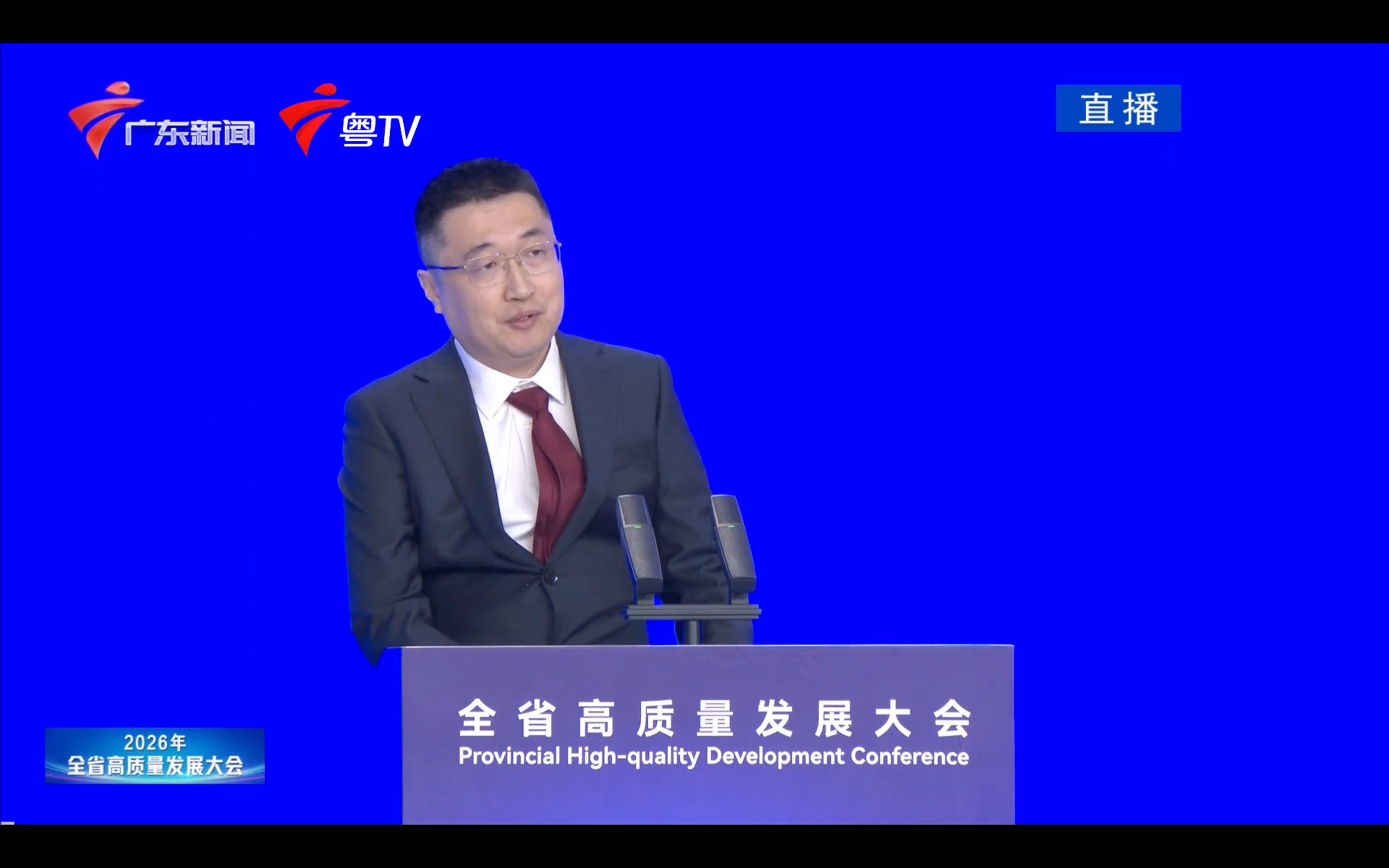
After founder Xu Yangtian’s rare public appearance — one positively showcased by Guandong provincial authorities — the company he built, Shein, apparently sought to limit that visibility among the Chinese public.
source: Guandong provincial broadcaster.
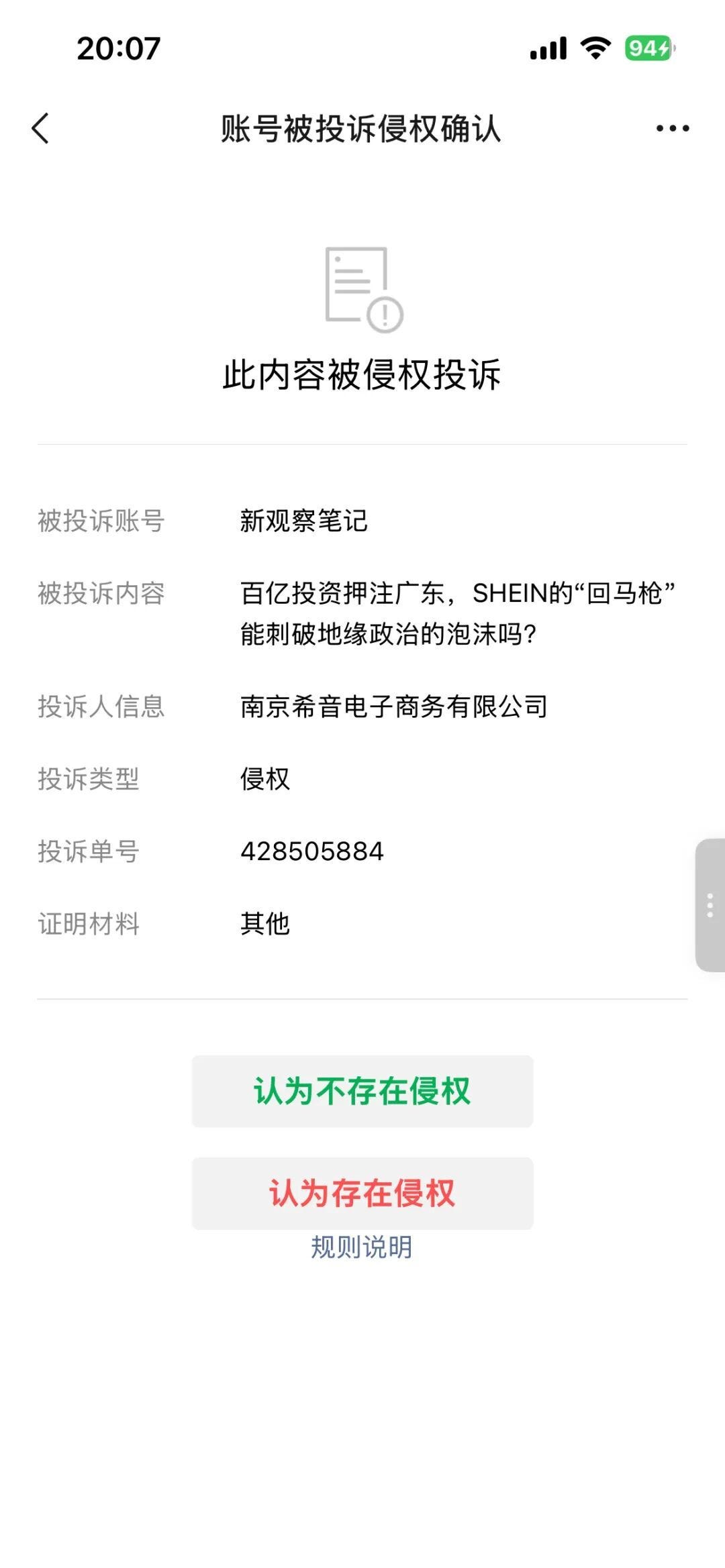
How much Shein, reportedly valued between $30 billion and $50 billion in 2025, has actually succeeded in reducing Xu’s visibility in the Chinese media ecosystem is impossible to know. But several Chinese blogs have reported that posts about his televised appearance were subject to likely Shein-launched “complaints” and then deleted.
At least from what I have seen so far, this looks less like Chinese state censorship than like corporate PR assassination by Shein. That distinction matters. Outside China, there is still a reflexive tendency to imagine “the Chinese media” as a single, monolithic propaganda machine, as though everything that appears or disappears online must ultimately be the work of the state. But China’s actual media environment is much more fragmented than that. Millions of blogs and video channels, mostly run by individuals or very small teams, exist on top of giant commercial platforms. That makes them vulnerable not only to government rules, but also to the platforms’ own systems, their uneven enforcement, and the “complaint” machinery that powerful companies can learn to exploit.
And Shein appears to know how to exploit it.
The company appears to have repeatedly filed complaints with platforms, invoking unspecified “infringement.” Sometimes those complaints seem not to have worked. Sometimes they appear to have succeeded.
More strikingly, Shein also seems to have gotten more institutional media outlets to take down coverage, including a report by iFeng, the popular news site associated with the Hong Kong-based Phoenix TV. I read that deleted iFeng piece. It was not an exposé. It was not a hit piece. It did not attack Shein. It merely offered a mildly worded account of the company’s challenges in recent years. Huxiu, another popular tech news site, also disappeared its report.
That is what makes the episode revealing. If even that was too much, then the problem was never “negative coverage.” The problem was coverage that Shein did not fully control.
This, in turn, says something larger about the company’s political and communicative posture. In an era of deepening China-West estrangement and rising regulatory and political pressure from the United States and Europe, it is perfectly understandable that a multinational company headquartered in Singapore, manufacturing in China, and selling overwhelmingly into overseas markets — especially Western ones — would struggle to maintain credibility across rival jurisdictions. Many global firms are under similar strain. Few face it at Shein’s scale, or under quite this level of geopolitical suspicion.
But there is a line between navigating pressure and suffocating public discussion. There is a line between strategic ambiguity and outright media muzzling. A company this large, this global, and this politically exposed does not get to behave like this. It has baseline responsibilities, not least in its homeland that powered - and still powers - its rise. And that is especially true for a company that is, in any meaningful underlying sense, Chinese, even as it works hard to package itself otherwise for external markets and regulators.
Below is part of a post by blogger Lv Minghe, the name of a veteran journalist formerly with Southern Weekly. I have removed some passages that I considered overly emotional, but the excerpt below is otherwise reproduced as is:
Three days ago, Xu Yangtian had just made a public appearance at the Guangdong Provincial High-Quality Development Conference. Facing the cameras, he said, “Guangdong is SHEIN’s root,” and announced an investment of RMB 10 billion and the creation of 600,000 jobs, striking quite the pose of a prodigal son whose return is beyond price. Media coverage was overwhelming, and even a small-time account like mine jumped on the bandwagon and wrote a piece.
Ordinarily, this should have been a meticulously choreographed public-relations feast: the mysterious founder speaking publicly for the first time, a blockbuster announcement of a ten-billion-yuan investment, and the headline-grabbing figure of 600,000 jobs. At a moment like this, the PR department of any normal company should be sending out press releases, arranging interviews, distributing high-resolution photos, editing highlight videos, and practically printing every punctuation mark uttered by the boss onto posters for Times Square.
SHEIN’s PR department did indeed get to work.
What did they get to work on? Filing complaints. Complaining about media outlets that reported on the boss’s first public appearance, complaining about accounts that posted videos of his speech, demanding takedowns on the grounds of “infringement,” making reports magically disappear and videos become unplayable. Like a band of assassins in suits, they chased their own boss’s photos around the world, deleting posts.
And now my own article has been singled out.
Which makes this all rather interesting. A man appears in public, and then has his own team erase the traces of that appearance. He speaks, and then has others mute his voice. He announces that he is putting down roots in Guangdong, and then has the reports carrying that announcement deleted.
A man has just stepped into the spotlight, only to have his own team smash the spotlight? A man has just opened his mouth to speak, only to have others cover it back up?
This use of “infringement” (in launching complaints) is exquisitely apt. It is not “defamation,” not “fabrication,” not “disclosure of commercial secrets,” but the all-purpose “infringement” — much like the Panamanian government used “unconstitutionality” to overturn Li Ka-shing’s table with a single sweep: deploying the vaguest of pretexts to achieve the most precise of ends.
What they want is not a legal victory, but a reset of the narrative to zero. They do not allow any third party to interpret Xu Yangtian’s appearance; they do not allow anyone, outside the corporate line, to discuss the meaning of this RMB 10 billion investment; they do not allow any “uncontrollable” information to circulate. What they want is this: Xu Yangtian’s existence can only be defined by them; Xu Yangtian’s photos can only be released by them; Xu Yangtian’s words can only be interpreted by them.
SHEIN’s PR logic has never really been about “communication,” but about “control.” Some media peers have summed up SHEIN’s PR style this way: no openness, no communication, no explanation — just complaint filing to the bitter end. No matter what you write, if it involves SHEIN, you may well be accused of “infringement.” You discuss whether it is a Chinese company or a Singaporean one? Complaint. You analyze its shareholding structure? Complaint. You repost its financial data? Complaint. They do not explain, do not communicate, do not provide answers; they simply complain — silently, mechanically, and relentlessly.
This is narrative monopoly pushed to the extreme. What they need is not “communication,” but “targeted broadcasting” — letting out only information from official channels, allowing only controllable narratives to exist, preserving only content that admits no ambiguity. Any third-party interpretation, even if it is pure praise, must be deleted so long as it is not written by them. Because in their eyes, uncontrollable praise is more dangerous than controllable criticism.
And that leads to a core question: does Xu Yangtian actually want to be seen?
If he does not, then why make a public appearance? If he does, then why have the reports deleted?
The answer is: he wants to be seen by some people, and not by others; he wants to be seen by specific people, not by everyone. He wants people to see the polished present that he is willing to put on display; what he does not want them to see is the murky and obscure past that emerges under media scrutiny.
His appearance at the Guangdong Provincial High-Quality Development Conference was meant to be seen by the government. The RMB 10 billion investment, the phrase “Guangdong is the root,” the promise of 600,000 jobs — all of this was meant for officials. What he wants is policy endorsement, a pathway to IPO, and a safe harbor amid geopolitical risk.
His disappearance from the internet, by contrast, is meant to make the market forget. He does not want consumers discussing him, does not want the media digging deeper, does not want competitors studying him, and certainly does not want Western regulators keeping him under a spotlight. His aura of mystery is itself a protective shield.



It's about time Chinese Censorship (nearly) caught up with Western Censorship, just missing a bit on the price transparency.