

I follow a man named Cai Yaqi (蔡雅奇) on social media. He is a criminal-defense lawyer and a well-known instructor for China’s national legal professional qualification examination, commonly known as the fakao (法考).
For readers unfamiliar with the system, the exam is roughly comparable to the American bar exam, although it covers several legal professions. Unlike in most of the United States, candidates do not necessarily need to have attended law school: under certain eligibility rules, graduates of other disciplines can also qualify. The exam is notoriously difficult, and a large commercial test-preparation industry has grown around it. Competition among instructors is fierce, and some of the more successful ones have become minor celebrities in their own right. Cai is one of them. He has 1.59 million followers on Bilibili, China’s answer to YouTube.
But that is not really why I follow him.
Cai travels across China handling criminal cases. On his personal WeChat public account — something like a blog within the WeChat ecosystem — and his video channels, he regularly offers glimpses of his work, his family, and his life as an amateur marathon runner. I find him remarkably down-to-earth. There is something refreshingly unpretentious about the way he documents his everyday experiences.
He also regularly publishes messages from his followers. They come from people across the country, in all sorts of occupations and circumstances, who simply want to tell someone what has happened to them. Through Cai, their accounts reach an audience they might otherwise never have found.
And he is unusually candid about the limits of what he can make public.
On October 8, he posted a 39-second video on Bilibili that so far has attracted some 434,000 views. Addressing those who send him their personal experiences, he said that people working in the prison system, judicial administration, or administrative reconsideration should no longer submit their accounts because he could not read them aloud. “I won’t go into the reasons,” he added. Other submissions, he assured his followers, were still welcome, “as long as they don’t go too far, at least for now.” He thanked everyone for their trust.
I use ChatGPT to assist my writing and translation, and here ChatGPT wrote, “It was an extraordinarily matter-of-fact acknowledgment of censorship.” ChatGPT apparently doesn’t know China well - this is not extraordinary. We have long grown accustomed to it. That Cai could state these restrictions so openly, and that the video itself was apparently allowed to circulate, reflects a tacit understanding of its own: one may acknowledge the boundaries, so long as one does not ask too many questions.
The viewers seemed to appreciate the irony. Many danmu — time-synchronized viewer comments that scroll across the screen as a video plays — jokingly compared his approach to renzui renfa (认罪认罚), China’s system of leniency for those who plead guilty and accept punishment, loosely analogous to plea bargaining. Rather than challenge the restrictions, Cai had effectively accepted them and moved on. He did not need to explain himself. Everyone understood.
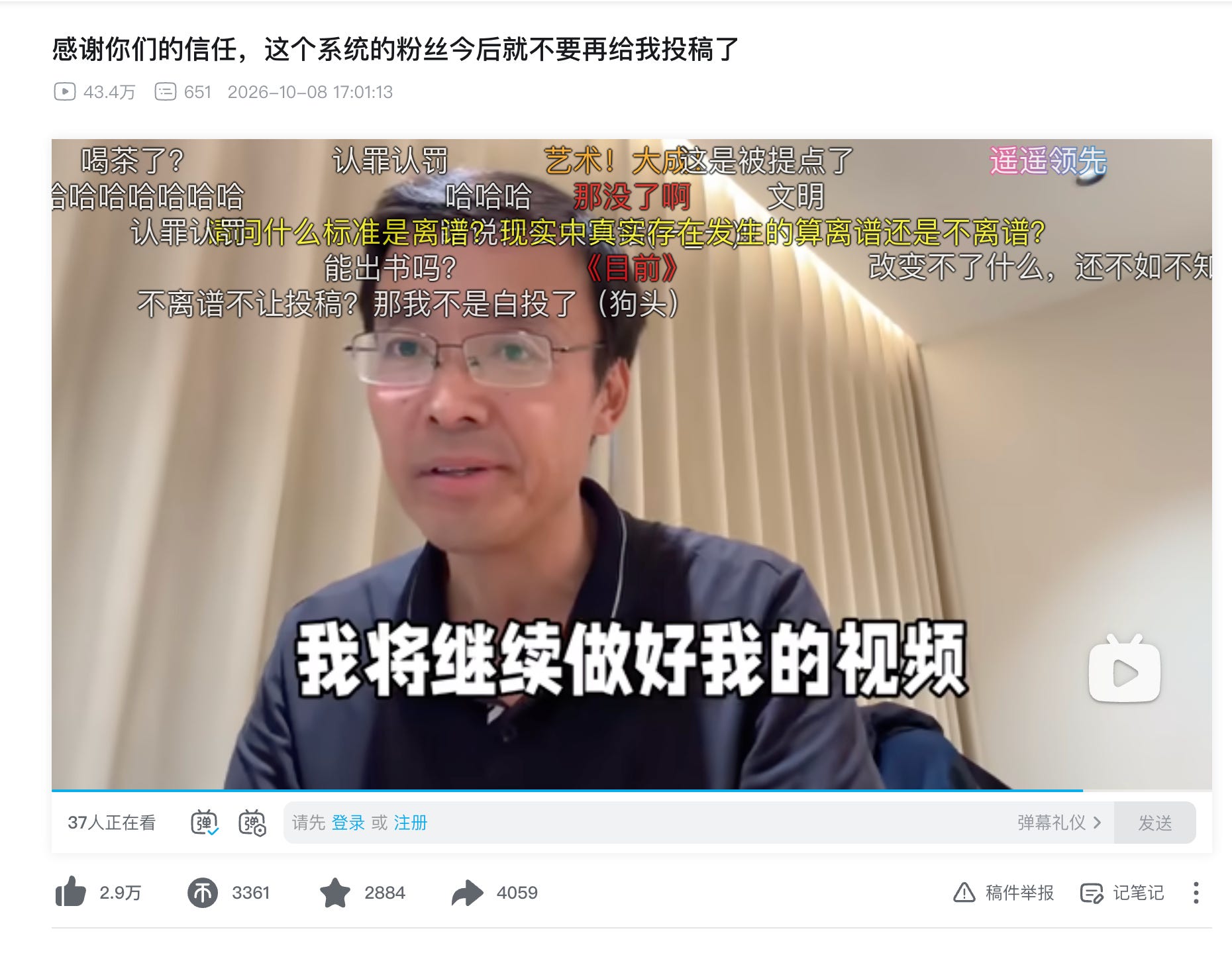
Anyway, what I really wanted to do here was introduce readers to four messages that Cai published on October 2 and October 8.
Some are written in rather unpolished language, with awkward phrasing and thoughts that the authors themselves sometimes struggle to articulate. They are not carefully constructed essays, nor do they seem intended for a wider audience. They are simply fragments of ordinary lives, told by the people living them.
I am not entirely sure what I want to say about these accounts. Perhaps I simply worry that, amid all the coverage - including by this substack - of U.S.–China relations, Taiwan, geopolitics, and AI, we risk losing sight of how ordinary people in China actually live, especially those struggling to get by. And I struggle to think of many news outlets, Chinese or international, that still make much room for those stories.
I don’t have a sweeping argument to make, or a particular conclusion I want readers to draw. These are four individuals describing their own experiences, and I cannot independently verify the details. I just thought they might be worth sharing.
1.
Shared by Cai Yaqi on October 8, 2026
Dear Teacher Cai,
I want to tell you about the difficulties and despair of living with a criminal record.
I was born in 2001. I am 24 years old and come from Shandong Province.
In 2022, when I was young and ignorant, I rented out my personal bank card without realizing that I was getting involved in illegal and criminal activities. When the police contacted me, I went to see them. I was terrified. I thought my life was over.
But the police believed me, and I signed a document acknowledging the termination of the investigation. I felt that I had been given my life back. Because in a place like Shandong, having a criminal record is practically the same as being dead.
But just a few days after I started feeling happy again, a vehicle full of police officers arrived at my home a little after six in the morning and took me away. In the end, I was sentenced to one year in prison. To this day, I still don’t understand whether the procedures they followed were legal.
I was released in December 2024.
After returning home, I delivered food, worked in factories, and delivered parcels. Finally, after enormous effort, I managed to find a reasonably well-paying job that even came with the five social insurance schemes and housing provident fund contributions. Once again, I thought my good days were finally coming.
But a few months later, I was injured in a traffic accident while working.
During my hospitalization, the driver responsible for the accident never called me, not even once, or offered a single word of concern. When I tried to obtain the traffic police’s accident liability report, the officers were dismissive and kept telling the two sides to communicate with each other. I don’t understand whether this is right.
Meanwhile, my employer had arranged things through layers of companies. The company paying my social insurance was not the same company that had signed my employment contract. As a result, I have been unable to obtain official recognition of my injury as work-related. The lawsuit is still ongoing, with no end in sight.
So I went back to delivering food.
But I don’t want to spend the rest of my life delivering takeout. I want to work hard, make money, and give myself and my family a better life.
I applied for another job. Everything went extremely well. I completed every stage of the recruitment process. Just as I thought I was about to start a new job and a new life, fate played another cruel joke on me.
I failed the criminal-background check.
I was depressed and frustrated, but I didn’t give up. I kept looking for work.
Then it happened again. Another company, another recruitment process, every stage completed successfully — only to be rejected at the background-check stage.
I don’t understand. Does having a criminal record mean that people like us must live at the very bottom of society? That we can only work on assembly lines or deliver food, struggling just to survive?
Must society push us into such desperation that we end up committing crimes again?
I feel completely hopeless.
Recently, my girlfriend told me that her family was strongly, strongly opposed to our relationship. They said my criminal record would affect our future children.
But my girlfriend and I love each other very much. She has continued to stand by me, quietly, without her family’s knowledge.
Perhaps it is because of her that I haven’t thought about ending my life or returning to crime.
I just don’t understand why society bears so much hostility toward people with criminal records.
It is enough to make you despair! I cannot see a way forward!
Why must every path toward an honest, hardworking life be cut off for us?
2.
Shared by Cai Yaqi on October 8, 2026
Dear Teacher Cai,
After reading so many submissions from people in different occupations, I felt compelled to write to you about the everyday lives of my parents, who are farmers. I hope you might have a chance to share their story.
My parents live in Yulin, Shaanxi Province.
I came home during the National Day holiday this year to help with the autumn harvest.
Every morning, they go up into the hills to work at seven. At noon, they eat something simple in the fields. They don’t come home until after dark.
And even after dinner, they still cannot rest. They have to sort and prepare the millet, black beans, and corn they have harvested.
People talk about how exhausting their jobs are, about “996” and “007” work schedules. I experienced that kind of work myself this year. But compared with what my parents do, it all seems so easy.
I often tell them, “You are practically working yourselves to death every day. Can’t you plant a little less? I have a job now, and our family doesn’t have any major expenses anymore.”
Every time, they say, “We’ll stop farming when we can no longer do it.”
But the following year, they plant everything again.
They are 65 years old, farming 40 mu of hilly land — about 6.6 acres — while also raising four cows.
How cruel is it that people of their age should have to work so hard?
I know why they do it. They want me to have a better life.
But my life is already good.
I know that, with my abilities, I will probably never be able to give my parents the kind of life that some of my colleagues’ parents enjoy.
But surely I could at least help them eat a little better and suffer a little less.
Yet they refuse.
The pain this causes me is something I cannot really put into words. I can only bear it silently.
My parents are actually the youngest farmers in their village.
Our neighbour, an 82-year-old grandfather, is still farming more than ten mu of land.
Another elderly man who lives halfway up the hillside has a back so badly bent that he can barely straighten it.
Every time I pass his home and see his back bent almost 90 degrees, I finally understand what people really mean when they say someone has been “bent over by the weight of life.”
Life is so bitter.
So bitter that there are no words to describe it.
3.
Shared by Cai Yaqi on October 2, 2026
Dear Teacher Cai,
Happy National Day.
I am a food-delivery rider. I was born in 2002, and I am 24 years old. I have been working for six years.
I don’t know why I am alive.
I don’t have any particular goals anymore. I don’t even have a vague idea of what I want from life.
When I first started working, I was full of hope. I thought that by working with my own hands, I could build a fulfilling life. Perhaps I would never become rich, but at least I could find some inner peace and contentment.
I don’t have much education. I graduated from a vocational high school, so the only jobs I could find were ones where I could be replaced at any moment.
I kept changing jobs. Perhaps some of that was my own fault, but most of the time, I was driven away by the people and circumstances around me.
I won’t go into all the details.
Eventually, I started delivering food.
At first, I thought it was a wonderful job. There were no complicated workplace relationships and nobody forcing me to work overtime.
I did it for three years.
But the longer I delivered food, the more lost I became.
As time went on, life became increasingly painful. Not physically, but mentally.
I was constantly under enormous pressure, passively absorbing hostility from every direction.
I kept trying to numb myself. I invented one material fantasy after another to give myself something to look forward to — buying a motorcycle and riding to Tibet, for example.
And I did experience some excitement from these material pleasures.
But eventually, I realized that I was becoming less and less happy.
There are things I want to say, but I cannot find the right words. I cannot describe what is going on inside me.
Later, even material pleasures stopped working.
I began asking myself, over and over again: What exactly do I want? How can I finally find peace inside?
Through this endless questioning, pressure, and self-torture, my mental state eventually collapsed.
For several days in a row, I couldn’t sleep. I barely ate or drank anything. I just kept smoking.
A childhood friend of mine had also struggled with his mental health, but he eventually managed to get through it.
His advice was that I should stop thinking so much about what I wanted to do. Instead, I should learn to say no to things I didn’t want to do.
Over the past six months, my mental state has improved somewhat.
But I still cannot think too much.
Whenever I start thinking, that other version of myself inside my head begins putting me on trial again.
I suddenly felt like writing to you today.
Not for any particular reason.
It was raining today. I was riding through an area near a school when some pedestrians suddenly emerged from behind an illegally parked car.
I swerved to avoid them and fell off my bike.
They didn’t even look at me. They simply walked away.
At that moment, I felt hatred.
I hated them, and I hated myself.
And then the voice inside my head began putting me on trial again.
Why have I ended up living like this?
4.
Shared by Cai Yaqi on October 2, 2026
Dear Teacher Cai,
I was born in the 1990s. I come from Xinjiang and now live in Chengdu.
I used to be a journalist.
I spent ten years working for traditional provincial-level media organizations in Urumqi and Chengdu.
Eventually, I resigned and started a business with some friends. We opened a shop, but then the pandemic arrived.
We lost several hundred thousand yuan.
Now I am drowning in debt.
Every day, countless debt-collection calls and text messages leave me physically and mentally exhausted.
I have thought about giving up on myself and ending my life. But whenever I think of my parents, I abandon that thought.
I have noticed that young people from ordinary families, whatever jobs they do, seem to experience some degree of confusion and anxiety. Some even become seriously depressed.
After my business failed, I came to understand more and more that money is what gives a person the greatest sense of security.
It is also the passport to freedom.
The amount of wealth you possess determines how much freedom you have.
I actually love photography.
Over the years, I have taken many photographs with my mobile phone.
My work won third prize in a photography competition associated with the 31st Chengdu World University Games. I also won third prize in a photography competition organized by Chengdu High-tech Zone to celebrate the 75th anniversary of the founding of the People’s Republic of China. Some of my photographs were selected for the 2023 “City Artists: Me and Tianfu New Area” photography exhibition.
I have always dreamed of being like Luo Hong, the chairman of the Chinese bakery chain Holiland — becoming financially independent and travelling around the world taking photographs.
I long for that kind of life.
But I also know that it is almost impossible for me to achieve it in this lifetime.
I am now a food-delivery rider.
Every day, I travel through the streets and alleys of the city.
And with every delivery order I complete, my dreams, my passions, and everything I once wanted to pursue are gradually worn away, confined, and swallowed up.
The truth is that ordinary people cannot afford many mistakes. They have very little room to try and fail.
One wrong step can bring a lifetime of regret.
Most ordinary people simply follow the same life script as everyone else: go to school, find a job, buy a car, buy a home, get married, and have children.
It may be a boring life, but at least it is a relatively safe one.
Our dreams may be beautiful and full of promise.
But in the end, they are no match for the sharp edges of reality.
Life as a Migrant Food Delivery Rider in Shanghai

Pekingnology often delved into grand and overarching themes, often navigating the complex terrains of policy and abstract concepts. Today, let’s detour to zoom in on something distinctly more microscopic.
