

In November 2020, China’s State Council General Office instructed local governments to prevent the “non-grain use” of cultivated land. Permanent basic farmland, it said, should be used mainly for grain, especially rice, wheat and maize. Under this policy, Jianghua county in Hunan was assigned a target of nearly 390,000 mu (64,250 acres) of rice.
Jianghua reported that it had met the target. A separate paper trail told a different story. Rice subsidies are based on the area farmers report having planted. In 2024, only about 238,000 mu appeared in Jianghua’s records for the rice subsidy—roughly 150,000 mu less than the county’s reported rice acreage.
China Central Television’s Focus Report recently followed that discrepancy into the fields. Its drones found rice planted beside roads, where it could be seen during official inspections, while monk fruit, tobacco, taro and vegetables grew farther inside. The rice existed in reports submitted upwards, but not in the fields or subsidy claims.
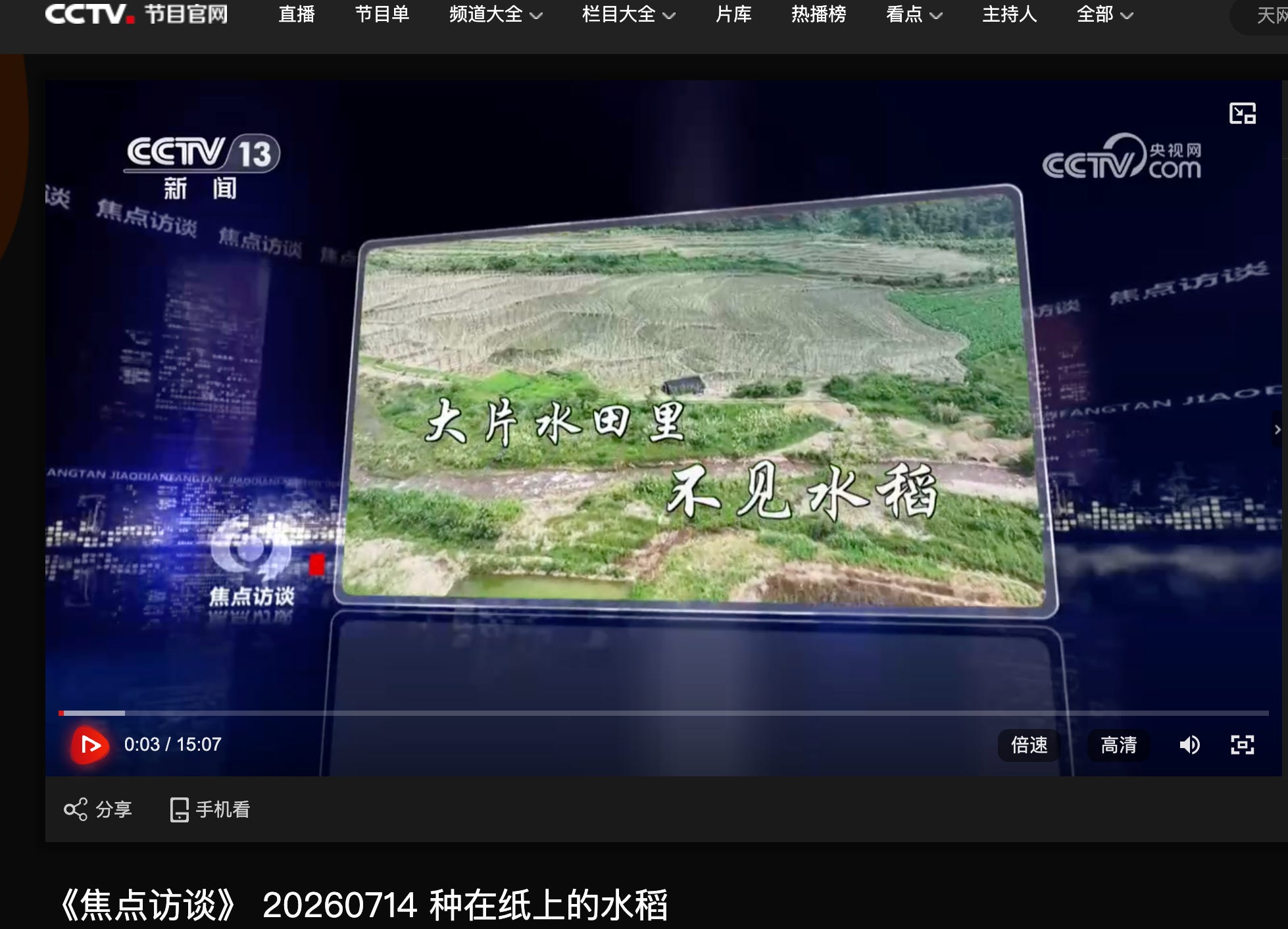
The false statistics deserved scrutiny. Yet the programme’s conclusion—that local officials had failed to take food security seriously—prompted criticism online. The critics did not deny that the figures had been fabricated. They argued that Focus Report had exposed the deception while leaving the conditions that produced it beyond discussion.
Chinese farmers are not entirely unsupported. Rice producers may benefit from minimum purchase prices, target-price payments, seed subsidies, farmland-fertility payments and other programmes. Focus Report said the combined support available in Jianghua could reach 400-500 yuan per mu ($56-$70 per 1/6 of an acre).
But Jianghua suggests that the support was still insufficient to make rice attractive. Even after subsidies, farmers chose crops that offered better returns. Their decisions provide evidence of their own: if rice provided an adequate livelihood, Jianghua would not need roadside demonstration fields, invented acreage and two sets of records.
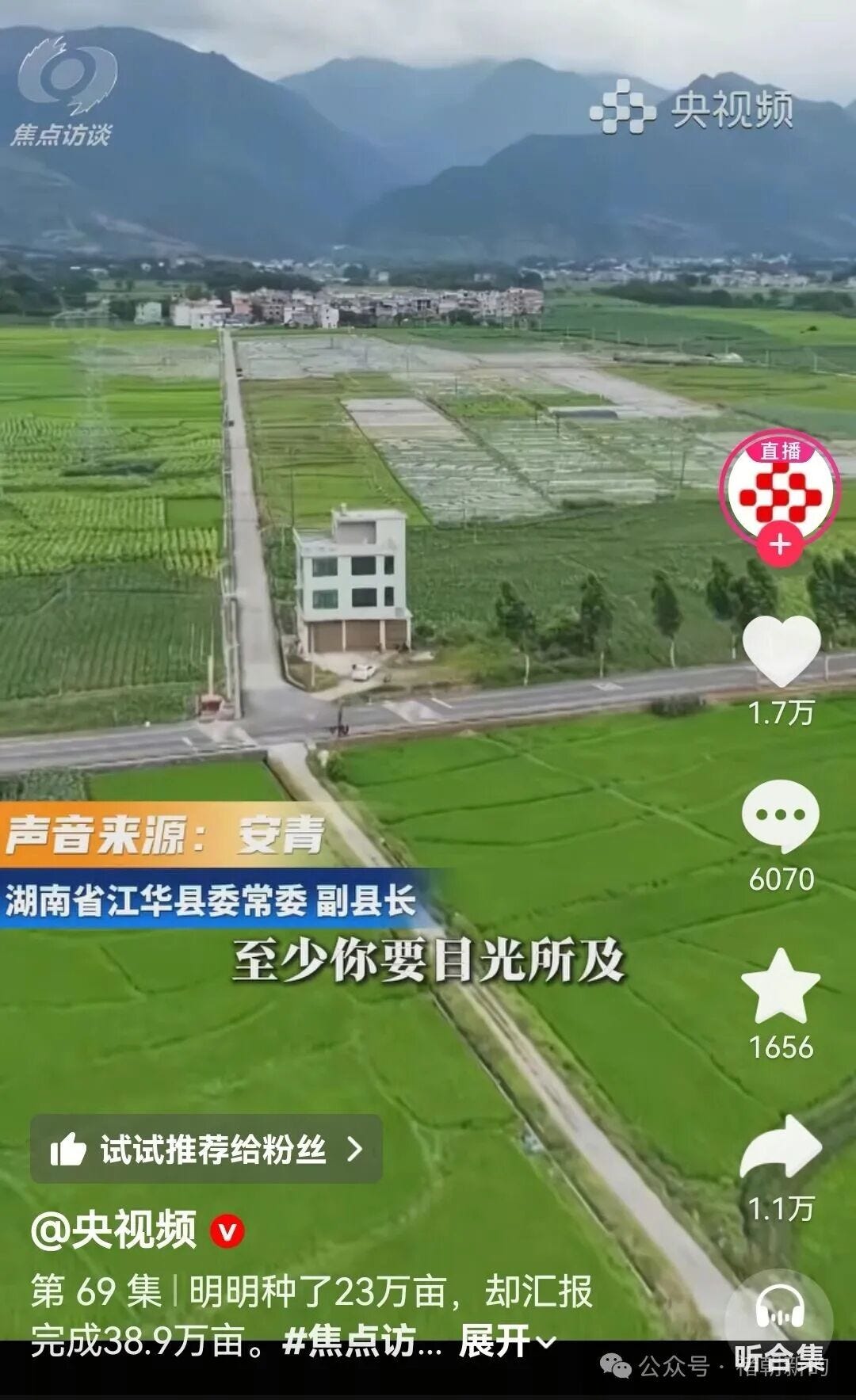
That left local officials with an awkward choice. They could force farmers to abandon more profitable crops and accept lower incomes. Or they could respect farmers’ choices and fail an assessment, such as the one performed by CCTV. They chose to leave the crops in the ground while reporting the rice acreage their superiors expected.
The episode therefore reveals more than weak enforcement. It exposes a contradiction within the promise to balance food security with farmers’ interests. Policy documents demand more grain, while also calling for respect for farmers’ wishes, local conditions and gradual implementation. In practice, these principles do not carry equal weight. Grain acreage is a hard target; farmers’ wishes are a soft consideration. Flexibility survives only until someone checks compliance. In Jianghua, the arrival of the state broadcaster showed where the hierarchy lay.
Focus Report interpreted the false ledger as evidence that lower-level officials had failed the policy. Another interpretation is that the ledger showed what happened when the policy’s harder requirements collided with its softer qualifications. The programme condemned an attempt to reconcile incompatible demands without asking whether they could be reconciled at all.
That unanswered question leads beyond Jianghua to the premises of China’s food-security policy. Food security is a legitimate concern for a country of China’s size. Climate change, wars, export restrictions and shipping disruptions justify domestic production capacity, strategic reserves and contingency plans. Memories of famine also give the subject a particular emotional and political force, making dependence on foreign food appear potentially dangerous.
But accepting the importance of food security should open a debate about degree, not close it. How much self-sufficiency is enough? How much additional protection comes from the last marginal mu of rice? How much income and alternative production should be sacrificed to preserve it? These remain economic and empirical questions even when the objective is national security.
Nor can food security be reduced to the acreage devoted to staple crops. It also depends on yields, seed technology, water, storage, logistics, reserves, diversified import sources and the ability of international markets to respond to higher prices. China is already the world’s largest producer of rice and wheat. Its more serious agricultural vulnerabilities may lie in soybeans, feed grains, water scarcity and the long-term productivity of its farmland.
Chinese agricultural economists have argued that past increases in grain production came mainly from higher yields, rather than the expansion of cultivated acreage. Higher-value agriculture, meanwhile, has been crucial to raising rural incomes. Moving land from high-value crops back to low-return staples may improve one indicator of security while weakening rural prosperity, agricultural productivity or other parts of the food system.
Beijing’s emphasis on acreage reflects an especially cautious view of international trade: that overseas supplies could disappear precisely when China needed them most. Such a scenario cannot be ruled out during a severe geopolitical crisis. But organising everyday agricultural production around the worst imaginable contingency carries costs. Contingency planning can protect development; it can also begin to dictate it.
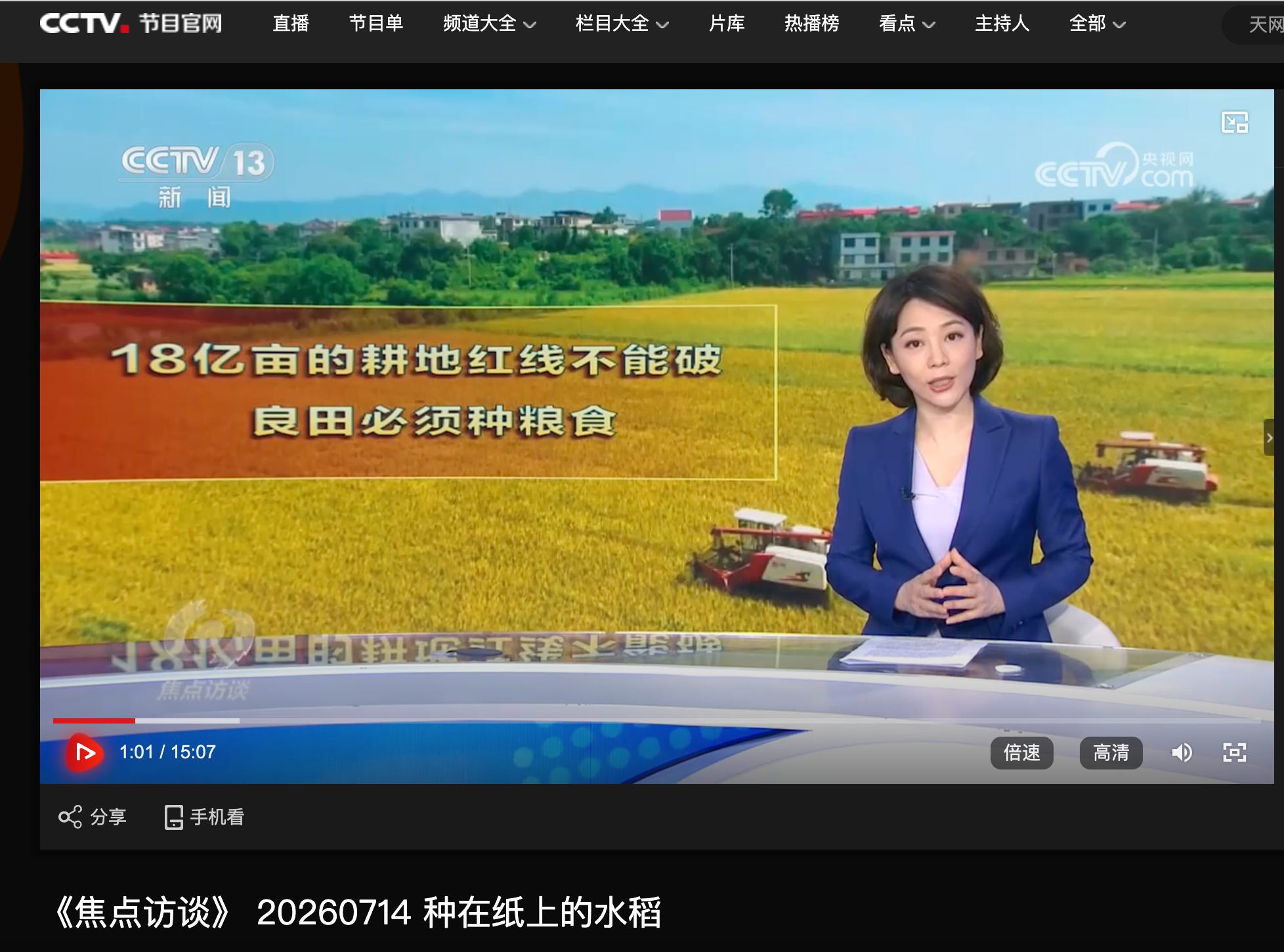
The same logic underpins China’s cultivated-land “red line”. The 1.8bn-mu threshold entered national planning in 2006. Official explanations say it reflected calculations involving population, consumption, yields, multiple cropping and the desired level of self-sufficiency. Yet the rule has endured for two decades while China’s population, diets, technology, environmental constraints and position in global agricultural trade have all changed.
A new calculation might produce a similar number. The problem is that the assumptions and trade-offs are seldom examined publicly. Mainstream coverage generally invokes the red line as the starting point of discussion, rather than asking whether the reasoning behind it remains convincing. A planning benchmark has gradually acquired the character of an axiom.
Land is both a security asset and a factor of production. Preventing it from moving into higher-value agriculture—or, where appropriate, housing, infrastructure and industry—carries an opportunity cost. Treating each such trade-off as a matter of national security risks over-securitising land policy and pushing ordinary economic reasoning out of the discussion.
The burden is also distributed unevenly. Cheap grain benefits consumers and supports price stability. But requiring farmers to grow low-return staples transfers part of the cost to rural households through forgone income. This sits uneasily beside “common prosperity”, one of China’s most prominent political and economic slogans in recent years. National food security should not be financed disproportionately by asking some of the country’s poorer citizens to accept lower earnings.
If maintaining a fixed amount of staple production is strategically necessary, the state should pay its full cost. That could mean higher guaranteed prices, more effective subsidies, crop insurance, irrigation, mechanisation and greater investment in yields. It should also mean stronger income protection for rural households.
More generous rural pensions could form part of that broader bargain. Many elderly farmers receive a pension of about 246 yuan ($34.52) a month. Despite repeated calls for a substantial increase, it is due to rise by just 20 yuan in 2026. It is not an income on which people can retire.
A stronger rural pension would not replace incentives tied directly to grain production. But it would place more of the cost of supporting rural China on the public budget, instead of leaving older farmers dependent on continued labour, their children and the returns from a few mu of land. The modest pension and the limited appeal of rice subsidies point to the same imbalance: positive support remains weak.
To put it diplomatically, there is something regrettable about the limits revealed by Focus Report. The programme can still investigate a county, a township and a village, at least sometimes. What it apparently cannot do is follow the question much farther—not necessarily to accuse anyone upstream, but simply to examine how the targets were calculated, whether their assumptions remain persuasive, how they interact with other national goals and who should bear their cost. It is supervision with a low ceiling: exacting about compliance at the bottom, but unable to examine the premises above. Such is also the state of public policymaking.
Rice grown on paper cannot fill a granary, and false reporting should not be defended. But punishment directed only at the bottom will encourage better-hidden paperwork, not more realistic policy. CCTV documented the distance between what farmers found economically rational and what local officials were required to report. The deeper problem was that paper had become the only place where food security, farmers’ incomes and bureaucratic compliance could all be achieved at once. (Enditem)

China’s Farmers’ Pensions and the Politics of Waiting

In 2025, the worst post I wrote was a speculative one: I guessed that the Communist Party of China Central Committee might use its recommendations for the 15th Five-Year Plan to signal a substantial increase in the urban and rural residents’ pension, a benefit received mainly by elderly farmers. That did not happen.
A Fleeting Return of Focus Report

On October 7, 1998, then Chinese Premier Zhu Rongji, accompanied by the then Minister of the Publicity of the Communist Party China Central Committee, visited central government-run China Central Television, now part of China Media Group.
"They could force farmers to abandon more profitable crops and accept lower incomes. Or they could respect farmers’ choices and fail an assessment, such as the one performed by CCTV."
A 3rd option: pay subsidies that make growing the target crops survivable, or even profitable.
A 4th option: tax the profits on the 'premium' crops so that it is less advantageous to focus on them.
The basic grains are *essential* to the food supply. They may not attract the profit of the premium crops, but are far more foundational to life. For example, here in the U.S. almonds generate profits, but aren't as critical as corn, wheat, soy, etc. While much can be done with almonds, they should never be more important than wheat.
A drone over Jianghua, and the rice growing only where the inspectors could see it. The detail is almost unbearable because it is so old. In 1958 the county reports filled with grain that was never in the fields; cadres wrote down the harvest their superiors needed to hear, and the state requisitioned against the paper, not the ground. What followed is the gravest lesson in modern Chinese history. The mechanism has not changed, only the stakes: once a target hardens into an article of faith, the system stops growing rice and starts growing numbers. The red line was meant to guarantee the harvest. What is it guaranteeing when the harvest exists only in the ledger?