

I am not sure whether this is the first time the U.S. House Select Committee on Strategic Competition between the United States and the Chinese Communist Party has approvingly cited anything from the Chinese mainland.
But it just came to my attention that the House Select Committee on China — perhaps the loudest and most influential institutional China critic in the U.S. Congress — recently cited a Pekingnology exclusive, and, more importantly, independently corroborated its central technical judgment.
The story began in late February, when a Hangzhou-based company called MizarVision 觅熵科技, or Mi Entropy Technology Co., Ltd., began posting high-resolution satellite imagery of U.S. military assets across the Middle East. The images, widely circulated on Chinese and international social media, showed U.S. aircraft and facilities at bases in countries allied with Washington, when the U.S. and Israel attacked Iran.
MizarVision’s posts quickly attracted attention outside China. Israeli media reported on the images. Military analysts discussed them online. The South China Morning Post captured the obvious question in its headline: “Is China flexing its intelligence muscle by tracking US military moves near Iran?”
That was a fair question. MizarVision did not disclose the source of the underlying satellite images. The company does not operate its own satellites. If it did not take the images itself, it must have obtained them from elsewhere. Were they Chinese? Were they Western? Were they commercial? Were they government-linked? And if they were Chinese, was Beijing deliberately allowing such images to circulate as a demonstration of intelligence capability?
Some observers leaned toward the more dramatic interpretation. Dennis Wilder, a former senior U.S. intelligence official and now a professor at Georgetown University, asked publicly what Beijing’s purpose might be in allowing the images to be published. Some Chinese commentators, with PLA credentials, also suggested that MizarVision’s work demonstrated China’s growing intelligence capabilities.
But on February 27, 2026, Pekingnology published a more boring explanation.
Hu Bo, Director of the South China Sea Strategic Situation Probing Initiative and Research Professor and Director of the Center for Maritime Strategy Studies at Peking University, told Pekingnology exclusively that he was “100% sure” the recent MizarVision images of U.S.-Iran military posture did not originate from Chinese satellites. According to Hu, the images came from U.S. and European satellites.
Hu’s reasoning was technical rather than political. Satellite images contain clues: the timestamp, the ground geometry, the viewing angle, and the resolution. With publicly available orbital information, or satellite ephemeris data, analysts can often reconstruct which satellites were in a position to capture a given image. Resolution is another tell. The details visible in the MizarVision images were, in Hu’s view, consistent with U.S. or European commercial satellite imagery.
The point of the Pekingnology post was simple: the fact that a Chinese company annotated and published satellite imagery does not by itself mean the original imagery came from Chinese satellites. In the world of commercial remote sensing and open-source intelligence, the data supply chain is global. A Chinese firm can buy, license, scrape, resell, analyze, or repackage images originally captured by non-Chinese satellites.
Now comes the interesting part.
On April 13, about 45 days after Pekingnology’s post, Representative John Moolenaar, Chairman of the House Select Committee, wrote to Pete Hegseth regarding Airbus Space and Defense Systems.
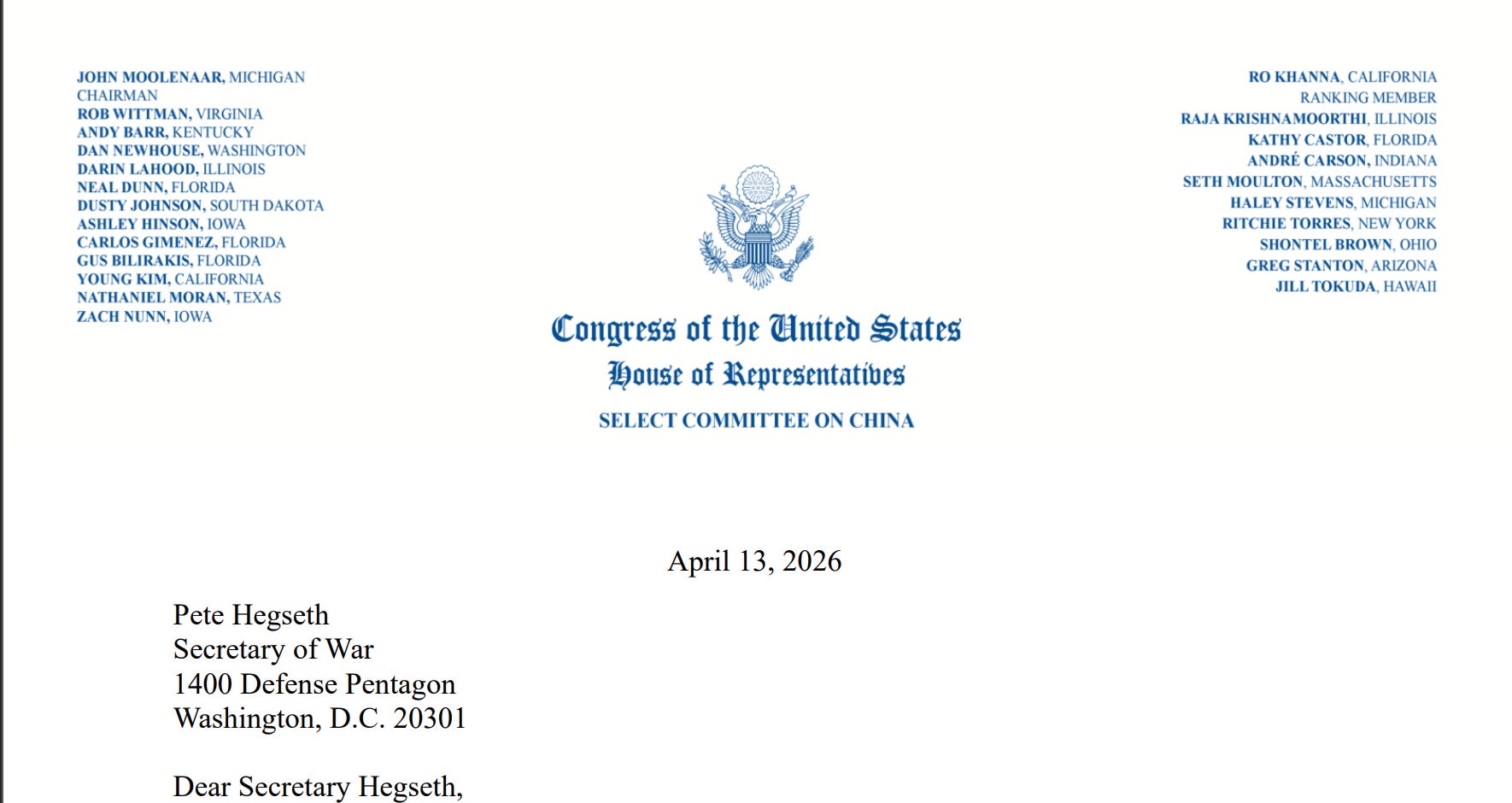
The letter sought assurance that Airbus Space had stopped providing satellite imagery “in ways that could further endanger American troops and assets in the Middle East involved in Operation Epic Fury.” It said a “recent analysis” indicated a high likelihood that Airbus Space had provided imagery of U.S. military assets in the Middle East to MizarVision.
The Committee said it had worked with a Ph.D. researcher and satellite-systems expert to run a simulation on whether Airbus satellites could have taken the MizarVision images. The letter noted that MizarVision is a Hangzhou-based company that makes AI software for analyzing satellite photos, and that it does not identify which company provided each individual image.
Then the letter cited Pekingnology.
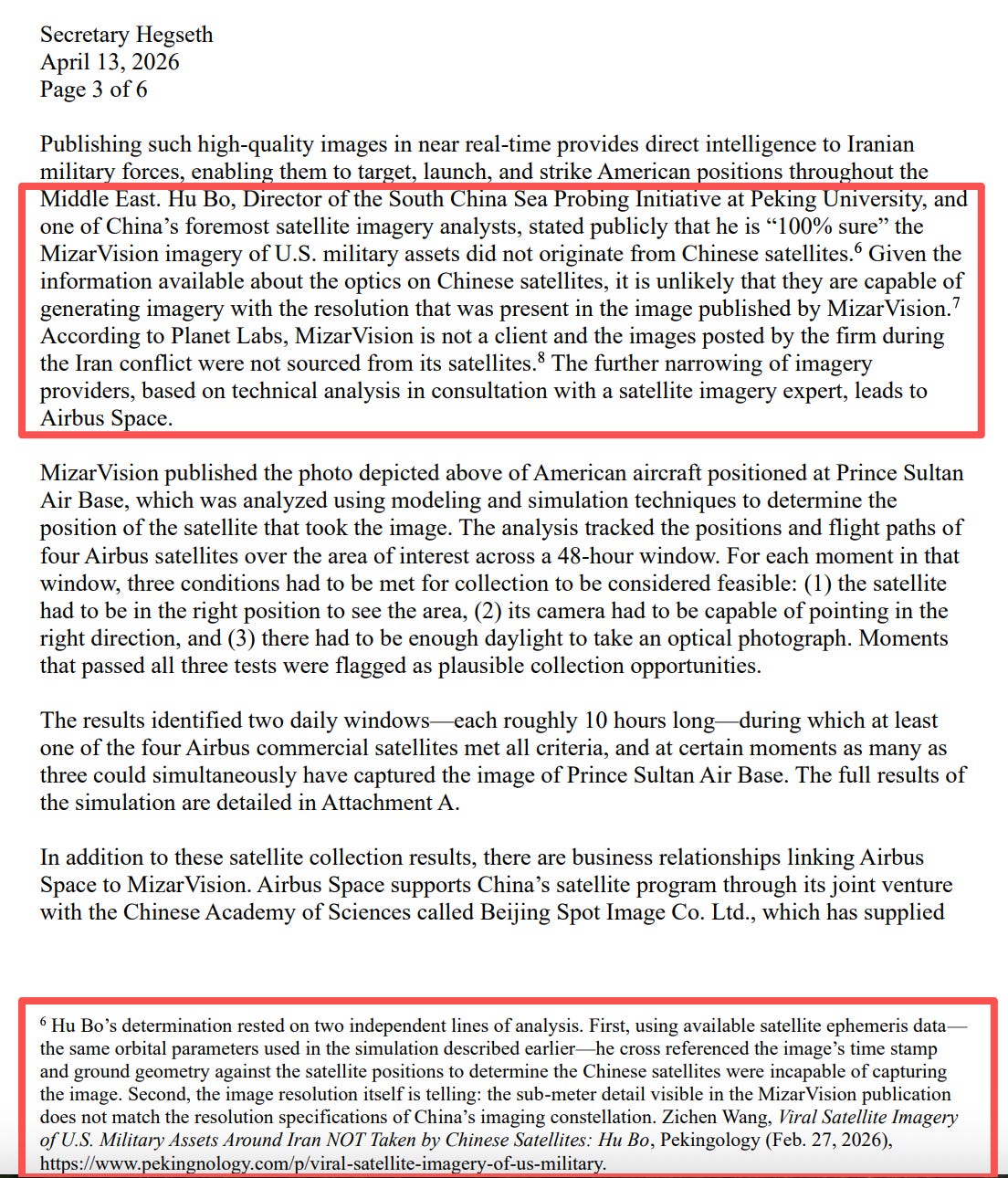
Hu Bo, Director of the South China Sea Probing Initiative at Peking University, and one of China’s foremost satellite imagery analysts, stated publicly that he is “100% sure” the MizarVision imagery of U.S. military assets did not originate from Chinese satellites.1 Given the information available about the optics on Chinese satellites, it is unlikely that they are capable of generating imagery with the resolution that was present in the image published by MizarVision.2 According to Planet Labs, MizarVision is not a client and the images posted by the firm during the Iran conflict were not sourced from its satellites. The further narrowing of imagery providers, based on technical analysis in consultation with a satellite imagery expert, leads to Airbus Space.
In other words, the House Select Committee did not merely quote Pekingnology and accepted the core analytical point — that the images were not from Chinese satellites — and then built its own further case about a likely European provider.
The letter’s political framing is still unmistakably that of the Select Committee on China. It argues that commercial satellite imagery may have been “exploited by China” and urges voluntary limitations to prevent Chinese entities from obtaining imagery that could put U.S. forces at risk.
But the technical finding is still significant — and, frankly, refreshing.
For China hawks, the easy story would have been: Chinese company publishes images, therefore Chinese satellite capability, therefore Beijing is flexing its intelligence muscle. For Chinese nationalis commentators, the tempting story would have been similar, only with a different emotional valence: Chinese company publishes images, therefore China’s intelligence capabilities are impressive, therefore national strength is on display.
Both narratives are more exciting than the likely reality. Yet the fact that the reality is less dramatic does not mean MizarVision was merely an innocent bystander in the confusion. Quite the opposite: the company’s own opacity helped create the very mystery from which those narratives grew.
The company has refused to disclose the sources of its imagery. Even when pressed by the South China Morning Post, it would say only that its sources were diverse and included both Western and Chinese commercial entities, while declining to identify the providers for specific images.
That ambiguity was not incidental. It was part of what made the posts viral.
MizarVision was essentially repackaging someone else’s satellite imagery while allowing audiences to imagine that it possessed extraordinary intelligence-collection capabilities of its own. That may be clever marketing for a start-up trying to raise its profile. But it also invited unnecessary suspicion, especially in the United States, that Beijing might be signaling intelligence capabilities or playing some larger strategic game.
Chinese companies have every right to develop geospatial-intelligence businesses and to analyze legally acquired commercial satellite imagery. But when a company publishes sensitive, near-real-time images of military assets at a time of war while refusing to say where the underlying data came from, it should not be surprised if foreign governments and analysts draw darker conclusions. Playing up mystery may help a company gain attention. It may also make the broader environment for Chinese technology firms even more suspicious and hostile.
At the same time, outside observers should also be careful not to assume that every Chinese company’s publicity stunt reflects a grand strategy by Beijing. Sometimes it is just a company hustling.
But credit where it is due: in this case, one of Washington’s fiercest China critics followed the evidence to a conclusion that complicates the simplest anti-China narrative.
And that conclusion began with a point first made in Pekingnology: the viral MizarVision images were not taken by Chinese satellites.
Viral satellite imagery of U.S. military assets around Iran NOT taken by Chinese satellites: Hu Bo

Satellite imagery of U.S. military assets released by Chinese firm MizarVision that theoretically could be used in an attack on Iran, has caught international attention, including in Israel
Hu Bo’s determination rested on two independent lines of analysis. First, using available satellite ephemeris data— the same orbital parameters used in the simulation described earlier—he cross referenced the image’s time stamp and ground geometry against the satellite positions to determine the Chinese satellites were incapable of capturing the image. Second, the image resolution itself is telling: the sub-meter detail visible in the MizarVision publication does not match the resolution specifications of China’s imaging constellation. Zichen Wang, Viral Satellite Imagery of U.S. Military Assets Around Iran NOT Taken by Chinese Satellites: Hu Bo, Pekingology (Feb. 27, 2026), https://www.pekingnology.com/p/viral-satellite-imagery-of-us-military.
There are visual cues that help determine the resolution of an image. Sub-meter imagery allows you to see distinct features such as individual vehicles, individual trees, and strong crisp shadows made cast by buildings and other features. These visual cues are apparent in the photo published by MizarVision. However, Chinese satellites are currently incapable of such detail. See e.g. Tinghao Liu, et al., Optimal Design of Flexible Imaging Modes for Agile Optical Remote Sensing Satellites, XLVIII-3-2024 Int’l Arch. Photogramm. Remote Sens. Spatial Info. Sci. 305 (2024), https://isprs-archives.copernicus.org/articles/XLVIII-3-2024/305/2024/isprs-archives-XLVIII-3-2024-305- 2024.pdf
Nice! Congratulations on being cited in high places