

On November 19th Eva Yi Xie, a 24-year-old Chinese national and third-year doctoral student in neuroscience at Princeton University, was detained by America’s Immigration and Customs Enforcement (ICE) at Ronald Reagan Washington National Airport. The previous day she had presented her research on the neural mechanisms of decision-making at an academic conference. Within hours she was transferred to the Caroline Detention Center in Virginia, where she spent Thanksgiving in immigration custody.
By most conventional measures, Ms Xie is precisely the sort of immigrant America ought to be pleased to have attracted. Having moved from Shanghai to New York with her parents at the age of 14, she attended the Bronx High School of Science, became a finalist in the prestigious Regeneron Science Talent Search and graduated from the Massachusetts Institute of Technology (MIT) in 2024 with a double major in mathematics and artificial intelligence and decision-making. As an undergraduate, she won a teaching award from MIT’s mathematics department. According to court documents reviewed by TIME, she has no criminal history, has complied with her immigration proceedings and holds valid work authorisation.
Her immigration status is more complicated. As first reported by The Daily Princetonian [1][2], Ms Xie entered America on a tourist visa in March 2016; four months later, before their authorised stay expired in September, her mother applied for asylum on behalf of the family. Owing to America’s notoriously backlogged immigration courts, her case was not referred to an immigration judge until September 2024. Her initial hearing—originally scheduled for January 2028, and not a final merits ruling—has now been brought forward to December 3rd.
America’s Department of Homeland Security (DHS) told the Associated Press that Ms Xie “will receive due process and remain in ICE custody pending her removal proceedings,” while an ICE spokesperson maintained to TIME that a pending asylum application confers no legal status. That is technically true, though it does not prohibit an applicant from studying or, with authorisation, working. Nor does it settle whether detaining Ms Xie is lawful or necessary. Her lawyers have filed a habeas corpus petition challenging her detention, and a federal judge has barred ICE from moving her out of Virginia while the government’s opposition is weighed.
Whatever the legal outcome, the policy merits of locking up Ms Xie are hard to discern. She has spent a decade in America acquiring skills that the country spends vast sums trying to cultivate, in a field whose advances benefit humanity at large. There is no apparent public-safety rationale for holding her behind bars while her case proceeds. Even a broken immigration system like America’s must have rules, certainly. It must also reckon with the passage of time and the lives people build while waiting for a sluggish bureaucracy to act. The point is not that MIT graduates and Princeton PhD students deserve more human rights; rather, Ms Xie’s case illustrates, in unusually stark terms, how indiscriminate enforcement can be both needlessly cruel and inimical to America’s own interests.
Princeton has arranged legal representation for her. Faculty, students, and New Jersey’s Democratic senators, Cory Booker and Andy Kim, have mobilised on her behalf. On November 24th, her adviser Carlos Brody told the Associated Press, Ms Xie called into her laboratory’s weekly meeting from detention in “remarkable spirits” to thank her colleagues and discuss scientific ideas; as The Transmitter reported, she has been checking on her lab animals and trying to borrow a book on cognitive ecology from the facility’s library.
So far, so American. The reaction in Chinese-language discourse, however, has taken a decidedly stranger turn.
A curious controversy
On November 25th the Global Times described Ms Xie’s case as “exceedingly bizarre and controversial”. Across Chinese-language accounts on X (formerly Twitter) and Weibo, as well as in sensationalist coverage by HK01, the tone was harsher still.
What, precisely, was so bizarre? The Global Times pointed to a 2020 statement Ms Xie made as a science-competition finalist, in which she wrote that her parents had fled “political persecution” in China. (Ms Xie’s statement has apparently been removed from the current webpage. But it was available in an archived version.) The newspaper juxtaposed that account with her seemingly comfortable life in America, her continued posts on Chinese social media, and a celebratory 2020 article from the Shanghai Soong Ching Ling School, an elite school she had attended before emigrating. (The school has removed the article, though a snapshot is circulating online.) It also noted that internet sleuths, having found her parents’ names in the competition’s literature, had unearthed Chinese court records showing two individuals with matching names who were subject to enforcement proceedings over private lending disputes around 2016. On X and Weibo, vocal Chinese-language commentators went much further, compiling screenshots of her alleged meals at Michelin-starred restaurants and designer accessories as proof that she was the privileged daughter of debt-dodgers (laolai) finally getting her comeuppance.
Whether the individuals in those court records are indeed Ms Xie’s parents, and whether their asylum claim was genuine, are questions I have no reliable answers. Yet there is a far more elementary question: why should any of this determine what one thinks about the detention of Ms Xie?
She was 14 when she arrived in America. Children do not draft their families’ migration strategies, audit their parents’ balance sheets or overrule a decision to move abroad. Even if every allegation about her parents were substantiated—indeed, even if they had committed offences far graver than defaulting on loans—their liabilities would remain theirs alone. Children do not inherit the culpability of their parents.
It is understandable that a Chinese state-run newspaper might find the subject of a citizen seeking asylum citing political persecution abroad awkward to cover. It could simply have ignored the story. Having chosen to report it, however, devoting so much energy to the alleged misdeeds of the young woman’s parents—and so little to the merits of incarcerating the young woman herself—is peculiar.
The scrutiny of Ms Xie’s dining habits is stranger still. There is no contradiction between having sought refuge as a teenager and enjoying a nice meal as an adult. Ms Xie is a doctoral researcher with work authorisation in a lucrative field. Absent definitive proof that her parents’ alleged victims’ money financed her fine dining, how she spends her money in an American restaurant is nobody’s business.
What accounts for the hostility? One plausible explanation is a growing resentment of perceived privilege in China, particularly as many young people face a sluggish job market. The combination of an expensive Shanghai school, an Ivy League education and photographs of a cosmopolitan lifestyle touches several raw nerves at once. Add allegations of unpaid debts left behind in China, and the temptation to construct a morality tale becomes irresistible: a young scientist deprived of her liberty is recast as a privileged family finally paying its dues.
There is a political dimension, too. Because the family claimed political persecution, expressing sympathy for Ms Xie can appear, in some quarters, tantamount to endorsing that claim—even though one need not accept her parents’ account of China to object to her detention in America.
There is an irony in all this. In their eagerness to litigate Ms Xie’s family history, the Global Times and its online chorus seem to have momentarily forgotten that the current U.S. administration—and its heavy-handed immigration apparatus—is supposed to be the bigger villain. One might have expected the Chinese press to seize on an American agency locking up a law-abiding, promising Chinese scientist; instead, it has found itself nodding along.
Plenty of Chinese observers are sympathetic to Ms Xie, of course, but the eagerness of others to find poetic justice in her predicament is dispiriting.
The accident of birth
Lest anyone think this habit of judging people by circumstances beyond their control is peculiar to China, consider another recent episode across the Pacific.
In a November 24th broadcast of CNN, the anchor interviewed a correspondent for The New York Times, about Alice Huang, the Chinese businesswoman at the centre of espionage allegations involving Jensen Huang, the boss of Nvidia.

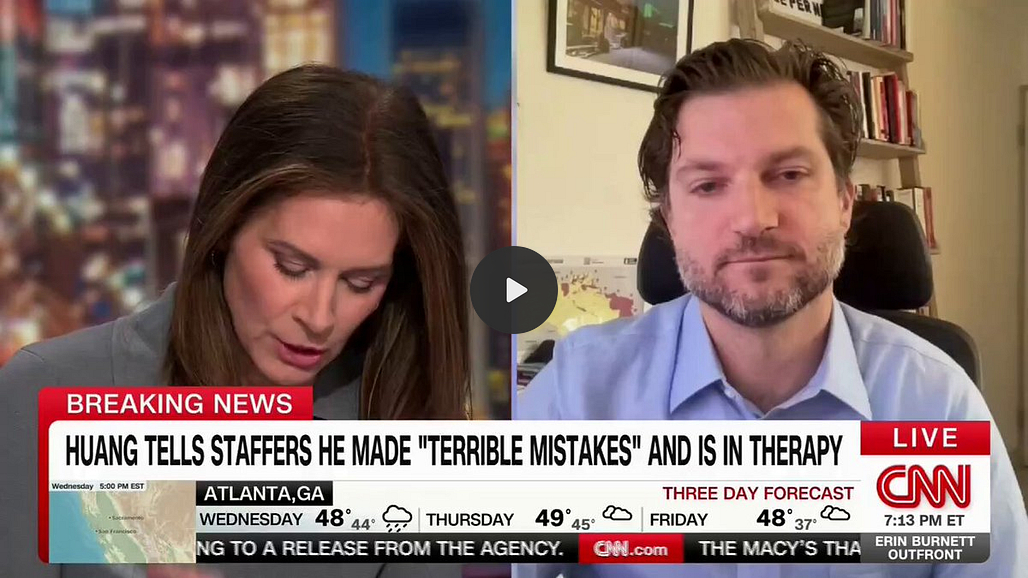
Anchor: “You’ve got new reporting on Alice Huang and how she went from a small Chinese military-industrial complex town—okay, that’s where she started, from your reporting—to the woman at the centre of the spy scandal, who, by the way, we haven’t seen since you broke the story. You know, are you surprised she ended up in this position that she ended up in, from your latest discoveries?”
NYT correspondent: “I mean, in a way, yes. Her origins are almost too on the nose. She’s from a little village called Patriotic Village No. 5. She is in a town that exists only to make weapons for the PLA, so it’s a town that just grows up around a factory doing that. So she’s steeped in this very kind of old, almost Mao-era way, in her youth, in that kind of a thing. It’s almost like being a military brat or something—not quite, but it’s in that. And then to rise from that, you know, rural, poor part of China, to be at a table swilling wine with some of the titans of Asian business, including, you know, Jensen himself—it’s just a remarkable journey... And again, it’s pretty uncommon, especially in China, for that to, you know, that to happen.”
(As the NYT correspondent uttered the words “Patriotic Village No. 5” and described the town’s ties to the People’s Liberation Army, the anchor glanced aside with a subtle eye-roll and broke into a visible, knowing smirk.)
Two assumptions in that exchange deserve unpacking.
The first is the treatment of Ms Huang’s birthplace as an incriminating backstory. Whether Ms Huang is a Chinese intelligence asset is a serious question. But she did not choose where she was born, what her hometown was named, or what its local factory produced.
America, too, is dotted with towns built around defence contractors, military bases and weapons laboratories. Nobody suggests that children raised in Huntsville, Alabama, or Los Alamos, New Mexico—or in households employed by Lockheed Martin and General Dynamics—carry a taint of moral culpability for the American war machine. Treating a Chinese citizen’s upbringing near a defence plant as inherently sinister reflects an American national-security reflex, not a universal moral standard.
The second remark—that rising from a poor rural town to dine with business titans is “pretty uncommon, especially in China”—is remarkably ignorant. Had an American climbed from an obscure industrial town to the upper echelons of Silicon Valley, that would have been celebrated as the American Dream. In China, the past four decades of reform and opening-up have produced countless self-made entrepreneurs, from Jack Ma to thousands of lesser-known founders, who rose from humble, unprivileged backgrounds by seizing commercial opportunities. Treating upward mobility in China as inherently anomalous—and thereby implying shadowy state backing—reveals a striking blindness to modern Chinese economic history.
The limits of admiration
This points to a broader disillusionment among Chinese readers of the American press, including those long regarded as liberals. As the technology journalist Chen Du recently observed in Pekingnology, much of the American coverage of the Jensen Huang affair has gone down poorly among Chinese professionals in the tech industry.
The unease has extended to journalists themselves. Earlier this month the Asian American Journalists Association urged news organisations—singling out The Economist in particular—to use more responsible language in their coverage of China and national security. The Committee of 100, a prominent Chinese-American organisation, issued a statement expressing concern about the disproportion between the evidence presented and the allegations levelled, as well as the chilling effect on the wider Chinese community in the United States.
For decades, many Chinese admirers of American journalism have prized its independence and its willingness to confront power. The spectacle of American newspapers holding presidents to account and exposing official misconduct is genuinely admirable, and something journalists in much of the world can only envy.
Yet independence from one’s government and independence from one’s country’s prevailing geopolitical assumptions are two different things.
Consider the language routinely used to describe American export controls. Earlier this month, when Washington restricted Chinese firms’ remote access to advanced chips through overseas data centres, even the Hong Kong-based South China Morning Post ran the headline “US tightens AI chip export curbs to close China’s overseas data centre loophole.” A loophole, however, exists only inside a framework one accepts as legitimate.
Yet independence from one’s government and independence from one’s country’s prevailing geopolitical assumptions are two different things. When coverage shifts beyond domestic politics to great-power rivalry—and to competition with China in particular—American newsrooms routinely take sides. They may criticise specific policies or tactics of the administration in Washington, but the overarching premise—that America is right to constrain China’s technological rise—is rarely questioned.
Export controls illustrate the point. From Washington’s perspective, throttling China’s access to computing power is a national-security imperative; from that of a Chinese researcher or entrepreneur, it is a foreign power leveraging its dominance in the global supply chain to hold another country back. Whether American export controls should enjoy extraterritorial reach is a political question, not a settled legal one. Even close allies bristle: this week, the Dutch government vowed to block Congress’s proposed MATCH Act, with its foreign minister rejecting “unilateral decisions that have extraterritorial effect.”
Beyond the narrow calculus of American national interest, whether such curbs carry any broader moral legitimacy is another question altogether. American newsrooms—and, for that matter, international mainstream outlets headquartered outside the U.S.—are of course entitled to keep investigating violations of U.S. export controls. They simply ought to do so without cloaking the exercise in a halo of self-evident moral righteousness. Objectivity, fairness, and not taking sides are cherished virtues—right up to the border.
What makes this realisation particularly sobering is precisely the independence of the American press. No directive from the White House is required. That America’s leading newsrooms fall into line with the national-security establishment entirely of their own accord is, to many Chinese readers, the hardest part to swallow.
That is no reason to stop admiring the genuine virtues of American journalism, nor is it any excuse for Chinese media to indulge in similar habits. Ms Xie should be judged on her own conduct, not that of her parents. Ms Huang should be judged on the evidence concerning her own activities, not the name of her hometown or the improbability—imagined or otherwise—of her social mobility. Neither principle ought to be controversial. That both need restating, on opposite sides of the Pacific, says something rather unfortunate about the times. (Enditem)
Excellent