


A 66-year-old migrant worker in northern China was asked last summer by an influencer on the street to choose between 100 yuan in cash and a chance to win 1,000 yuan by writing an essay.
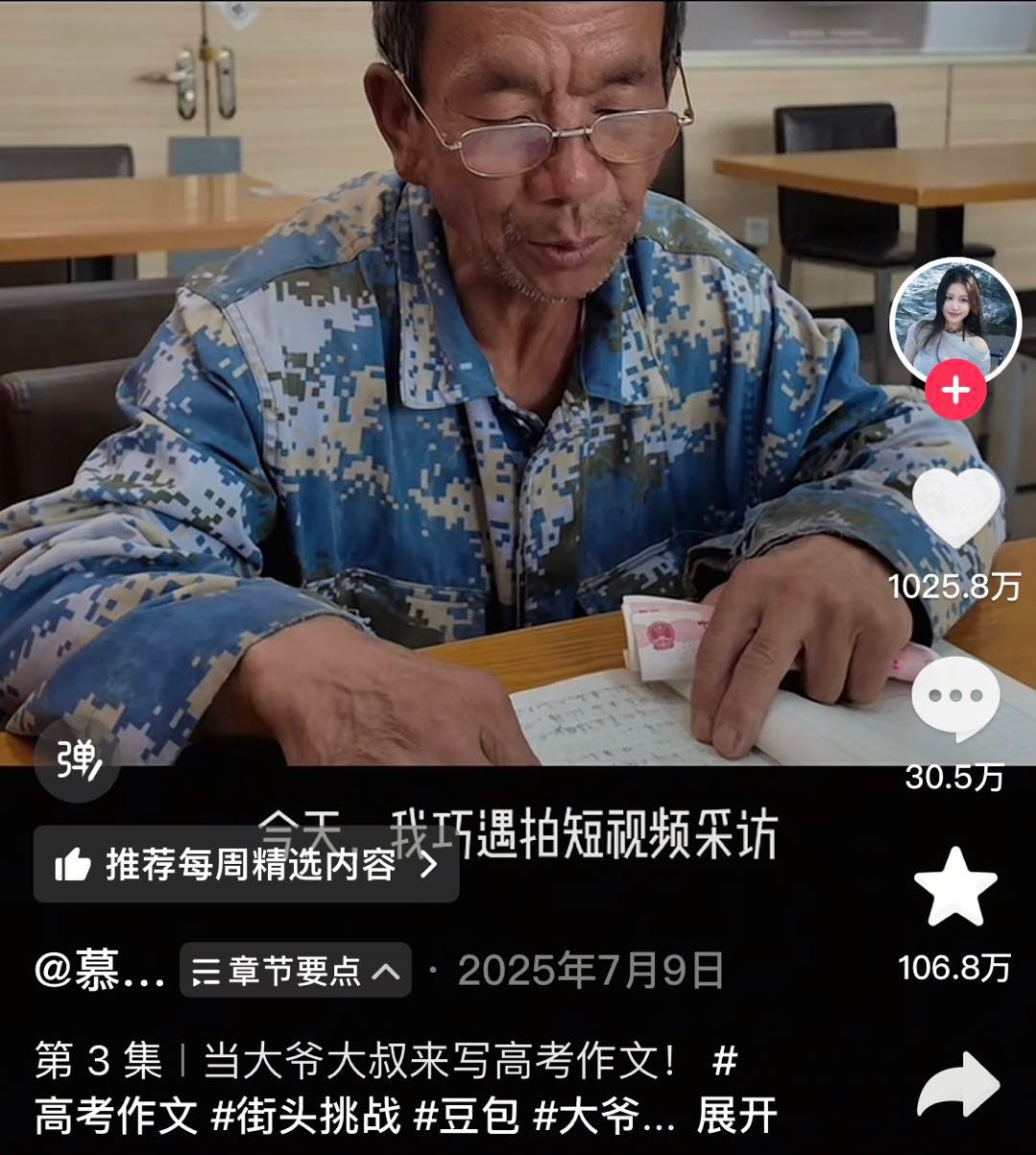
An Sanshan, the day labourer from Shanxi province, took the second option. Sitting in an empty restaurant, he wrote an essay of more than 800 Chinese characters titled “My Mother.” The video was later posted on Douyin, China’s equivalent of TikTok, on July 9, 2025. It quickly went viral, turning a man who spent his days carrying bricks and cement into an unlikely literary sensation.
Readers were struck by the blunt force of his memories: a mother who never rested, a son who hasn’t been able to call out “mama” for over 30 years, and a grave whose grass turned green, then yellow, then green again, like his yearning unending.
Yet what makes the essay so devastating is not only grief. It is continuity. The mother was worn down by a lifetime of labour; the son, decades later, is still living by the same logic of bodily exhaustion. His story is therefore not just about memory, love, or literary talent. It is also a plain record of how poverty can travel across generations, and how the lives of China’s lowest-paid workers are often built on toil so relentless that it becomes almost invisible.
Nearly a year later, the essay found a second life online after a Beijing-based English-speaking content creator translated it into English and read it aloud. The English clip, uploaded on 23 April 2026, again spread across Chinese social media.
The translation was then picked up by Chinese state media and official overseas-facing accounts, including China Daily, Xinhua, Chinese embassies, and China’s Foreign Ministry spokesperson, as an example of a “China story” that could move audiences beyond China.
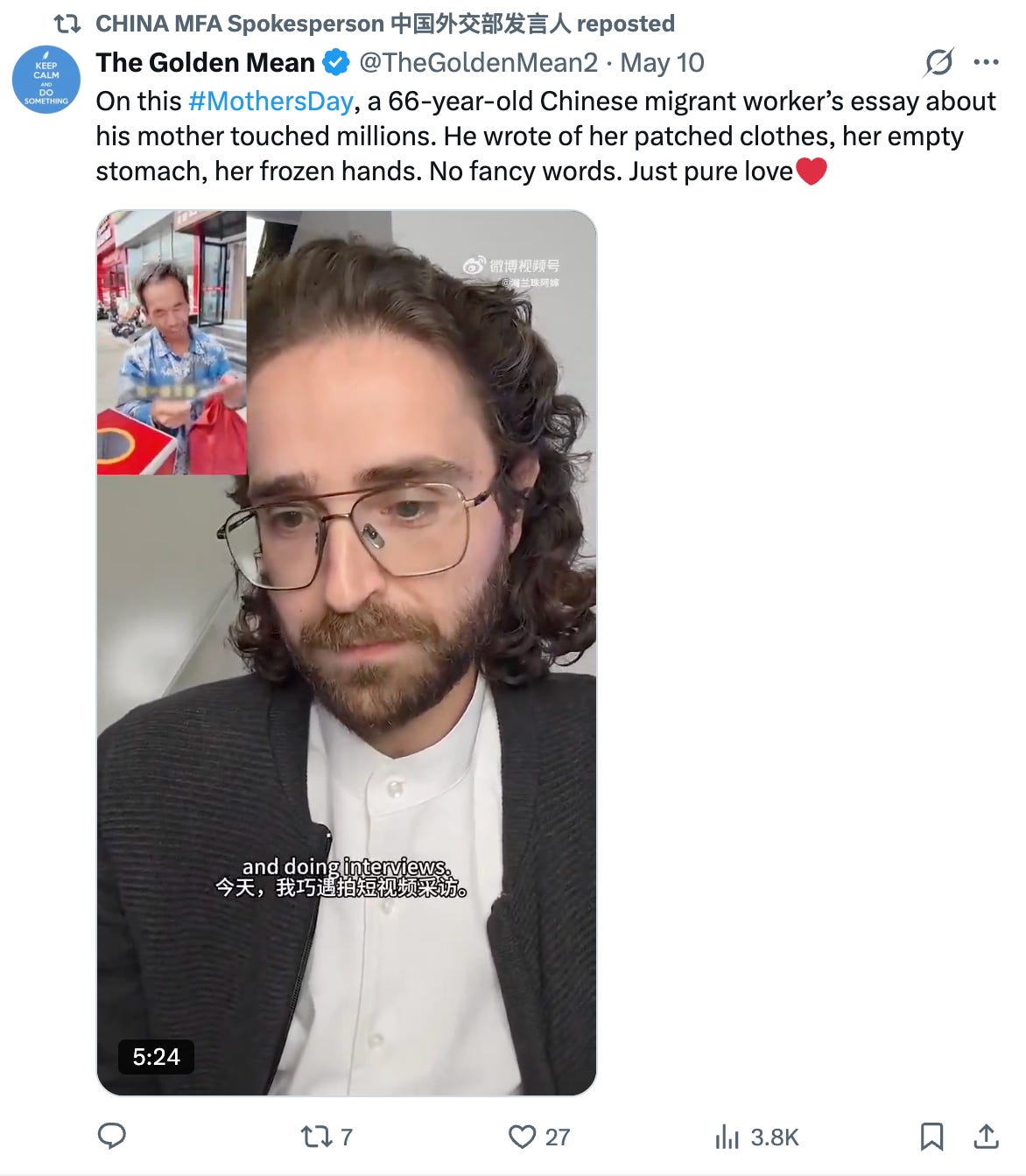
Below is the English version of the essay translated and read by the foreign blogger, followed by our translation of The Beijing News’ profile of An Sanshan, the man behind “My Mother.”
—Yuxuan Jia
“My Mother”
Today, I happened to run into people filming a short video and doing interviews. They needed to draw a topic and because I was the only one among this group of workers who had gone to high school, the two young women chose me. I was lucky enough to draw the title My Mother. Revisiting memories of my mother filled me with many thoughts.
My mother has been gone for more than 30 years now. She’s buried at the old cemetery at the edge of the village. Her appearance, her every move, it’s all still right there in front of me.
My mother, she never had a moment of rest her entire life. She got up before dawn and only stopped working after dark. Inside the house and out, her worries never ended. She always wore clothes that had been washed until they faded white, patched again and again.
She was kind-hearted and tolerant. She never argued with the neighbours. Whenever something good came along, she always made sure others had it first.
What I remember most is the meals. The whole family would gather around the table, but my mother never joined us. She was always busy at the stove. Only after we had all finished eating, would she take a look into the pot. If there was something left, she would have a few bites. If there was nothing, she wouldn’t eat at all and say, “I’m not hungry.”
Life was tight back then, not much difference between the rich and the poor, but people were warm-hearted and valued relationships. My mother was the kindest of them all.
The dumplings she made, nothing smelled as good. They were the one thing we longed for in those hard days.
New Year was her busiest time, washing and scrubbing and preparing the holiday meal until she was too tired to stand up straight, but she always kept her smile. Watching us set off firecrackers, she was even happier than we were. No matter how worn our clothes were, she’d take them in her hands and have them cleaned up, neat and proper.
In those days, we still lived under the collective. Fresh vegetables were hard to come by. In autumn, grain rations were distributed. Grain was harvested during the day, then divided out to each family at night, a process that took all night long.
Autumn in the countryside is bitterly cold and my mother wore very thin clothes. After the grain was delivered, she would be freezing unbearably. She’d wrap herself with a thin, thin blanket and just like that, it would be dawn again and another day of hard work would begin. She’d rub her eyes and get up to prepare food for the whole family.
There were many people in the house and that big iron pot used for firewood cooking was incredibly heavy. Lifting it up and down wasn’t something just anyone could do. Thinking about it now, I wonder where my mom, with her small frame, got so much strength.
When my mother passed away, she was barely past 50, worn down by work. Now, her grave sits at the edge of the village, a small, unremarkable mound of earth. Every time I go back, I always go stand there for a while and talk to her.
I’ve spent most of my life in the city doing manual labor, carrying cement, tying steel bars, climbing scaffolding. My hands and shoulders are covered in calluses. It’s truly exhausting work, but when I think of my mother’s strength lifting that iron pot, when I think of how she shivered with cold but clenched her teeth and held on until morning, my own strength comes back again.
My mother never enjoyed a life of comfort, but what she taught me was this unbreakable spirit and sense of duty towards my family. I must continue to support this family that you built and hold it steady.
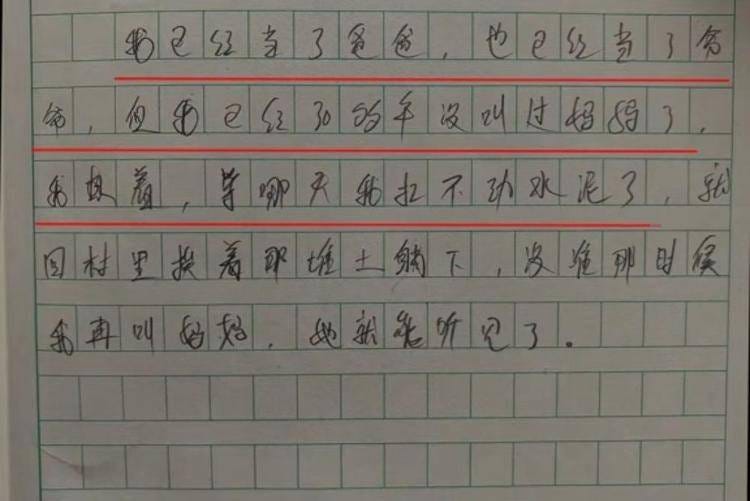
The grass on her grave turns green, then yellow, then green again, year after year, just like my longing never ending.
I’ve become a father. I’ve become a grandfather. But for over 30 years, I haven’t called out the word mama.
I think that one day, when I can no longer carry cement, I will go back to the village and lie down beside that mound of earth. Maybe then, when I call out mom, she’ll be able to hear me.
那篇价值1000元的作文《我的母亲》,让农民工安三山被“看见”
The 1,000-Yuan Essay “My Mother” That Made Migrant Worker An Sanshan Seen
In An Sanshan’s world, 1,000 yuan is something solid and specific: standing under a nearly 40°C sun for three days, moving 20,000 bricks, and shovelling several tonnes of sand and cement.
So when he heard that he could earn that amount by sitting in an air-conditioned room and writing an essay, he did not hesitate at all. “I had never come across such a good thing in my life,” he said.
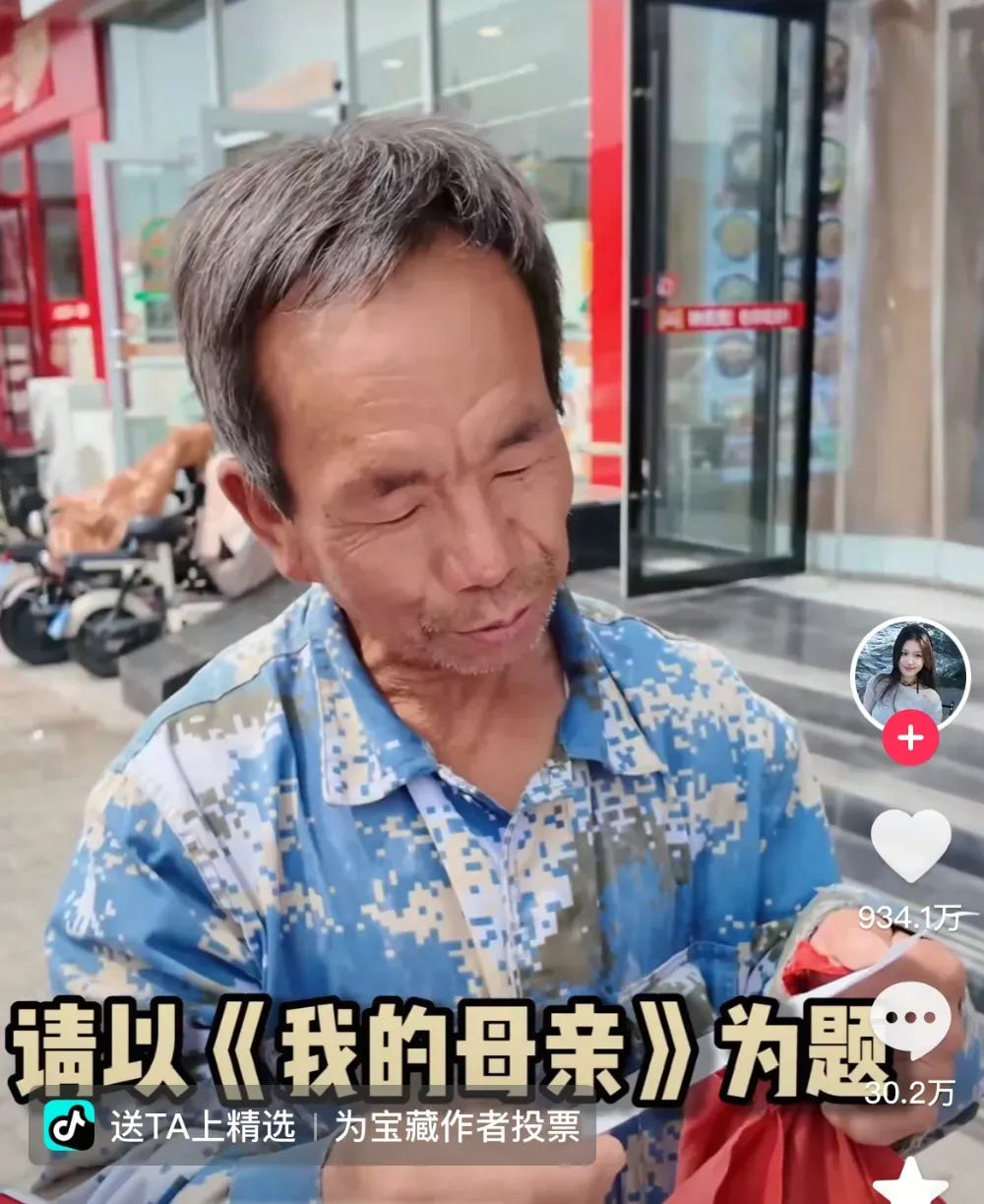
It was a street challenge launched by a blogger. An Sanshan did not understand these things; he only felt it was a bargain. In less than an hour and a half, he finished an essay of more than 800 Chinese characters, titled “My Mother,” took the 1,000 yuan in cash, and left contentedly.
At that moment, he had no idea what would come next. The essay was posted online and moved countless readers to tears. Overnight, he was all over Douyin and Kuaishou [two short-video platforms in China]. Soon, media outlets of all sizes were telling his story.
One line was read again and again: “The grass on her grave turns green, then yellow, then green again, year after year, just like my longing never ending.” Some suggested that the essay be included in primary or secondary school textbooks. Online, strangers began regarding him as “father” and analysing his writing line by line. Others, with great seriousness, tried to prove that the essay could not have been written by him.
An Sanshan does not use the internet, and was slow to take in all these reactions. Later, the essay appeared in newspapers, and even elderly villagers who could not read had heard children read it aloud. Groups of visitors came to his home one after another, from wealthy business owners to publishing editors. He did not know how to respond. Again and again, he could only say: “I’m just a farmer.”
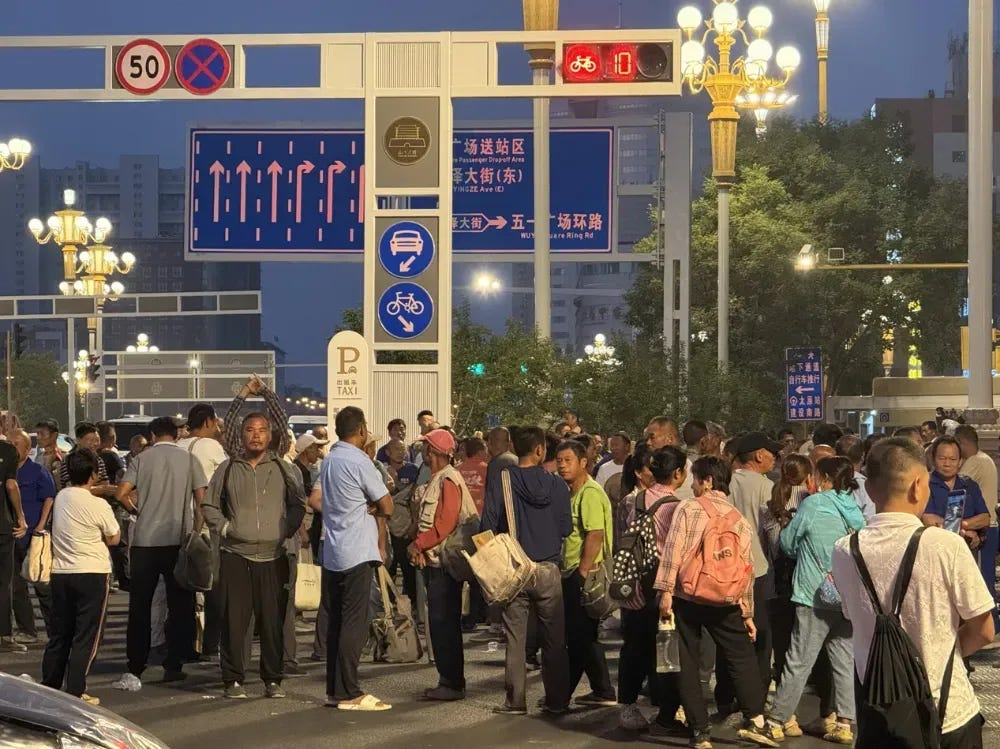
Compared with the noise online, the roadside opposite Taiyuan Railway Station was much quieter. The workers who used to wait there with An Sanshan for odd jobs still gathered before dawn. When his name was mentioned, they realised they had not seen that “quiet little old man” for several days.
There, the fact that he had recently gone viral seemed to belong to another world. Most of the workers had never heard about it.
“What? He can write essays?” one fellow worker said, first widening his eyes, then curling his lip.
They had no time to think more about it. The foremen would soon arrive to pick workers, and this was the moment that would decide whether they could earn a day’s living. No one noticed that An Sanshan was being seen by the outside world in a way none of them had ever imagined.
Earthen Walls
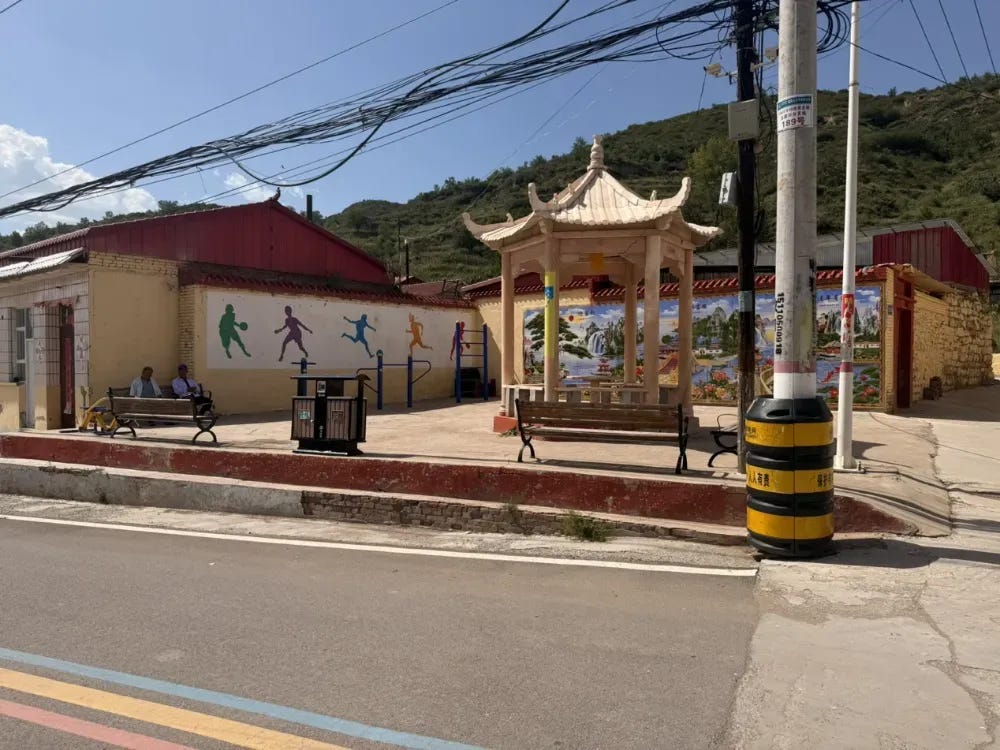
From Taiyuan, the road heads west, passes through Du’erping, and enters the Western Hills. After several steep hairpin bends, the car keeps climbing until it reaches near the mountaintop. That is where An Sanshan’s home is.
The drive takes less than an hour. But each time An Sanshan makes the journey, it takes him nearly a whole day. He sets out from Taiyuan Railway Station with dry food, changes buses twice, and then, halfway up the mountain, flags down a passing vehicle heading in the same direction. The whole trip costs him only two yuan.
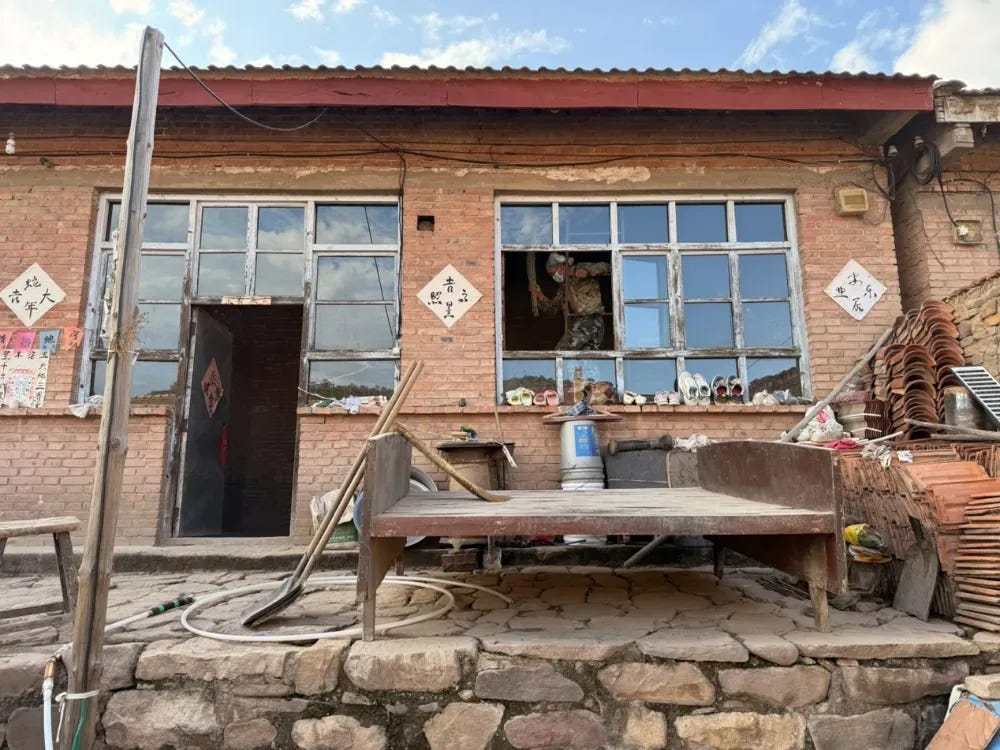
His home sits in the southeastern corner of the village. Among rows of brick walls and iron gates, only the An family’s courtyard wall is built from mud and stones. The gate is simply a bundle of wooden sticks tied together. Through the gaps between them, wide enough for a watermelon to fit through, the courtyard can be seen at a glance: tomatoes, green beans, and eggplants grow on a small plot of land. Up a half-metre-high step stand two single-storey houses, one new and one old.
On ordinary days, apart from the crowing of chickens and the honking of geese, the sound villagers most often hear is the occasional scrape of a three-wheeled vehicle passing over the road. But one month ago, both sides of this asphalt road were packed with cars. At one point, it was so crowded that people could “barely move.” They had all come to see the “essay uncle.” When old men chatting beneath the courtyard walls saw outsiders, they would point towards An Sanshan’s home before the visitors even opened their mouths.
During those days, An Sanshan’s small courtyard was crowded inside and out. There were not enough cups at home, so empty glass jars were pressed into service. Onlookers held up their phones and zoomed in, trying to find something distinctive about him. Most, however, left disappointed. An Sanshan was too ordinary, even a little inconspicuous.
He is not tall, and has a lean, wiry build. An oversized T-shirt makes him look even thinner and smaller. Nor is he as fair-skinned as he appeared in the video. His skin is dark and sallow, and the wrinkles on his face resemble the mountains of the northwest, with deep ravines cut clearly across them. The hands that wrote “My Mother” are no different from those of other migrant workers: the knuckles are thick, and one little finger bends outward from having been smashed too many times. The calluses on his palms are so thick that he can hold a glass jar filled with boiling water.
If one had to find something unusual about him, it might be the shiny black, old-fashioned leather shoes beneath his camouflage trousers. An Sanshan cannot sit idle for a day, but those shoes are clearly not made for labour.
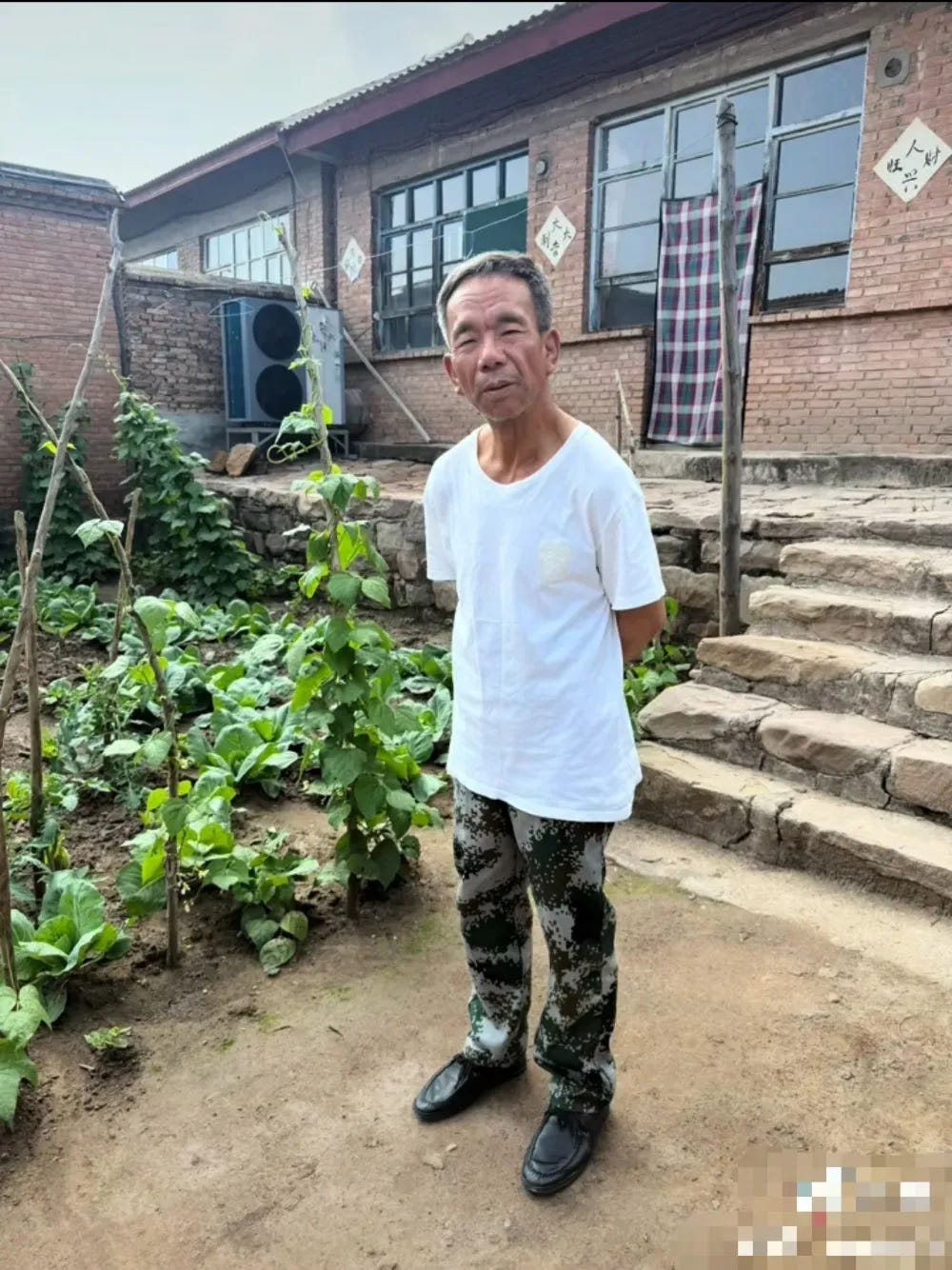
Sitting in front of the camera, An Sanshan grinned, revealing two rows of teeth yellowed by tobacco smoke. Then he introduced himself, carefully and methodically, in his local dialect. He is not a talkative man. The interview moved between long silences and brief answers. When asked how he had conceived the essay, or what kind of person his mother had been, he answered readily. But some “off-topic” questions displeased him: how his mother died, where she was buried, and what his family members did for a living. To these, he responded with silence.
Visitors soon discovered that An Sanshan was not the kind of old man who would cooperate with everything in front of a camera. He spoke cautiously, with a strong sense of boundaries. He resented outsiders “asking around everywhere in the village.” “Can’t you just ask me about my own family’s affairs?” he said.
In fact, almost every visitor had been refused by him at some point. He repeatedly stressed a farmer’s proper place and kept the outside world at a distance, saying he did not want to “make a spectacle of myself.” Yet when uninvited visitors appeared at his door, he still treated them politely. Like the gate to his home, his world also leaves some gaps.
After the essay went viral, he often asked his son to open the comment section on Douyin. Then he would put on his reading glasses and go through the comments one by one.
An Sanshan said he only read the “bad” comments. But comments filled with doubt and speculation still made him angry. He did not like being praised as “like a writer.” By contrast, comments that said the language of “My Mother” was clean, and its emotions sincere would make him nod slightly.
He picked up a notebook his son no longer wanted and planned to use it specially for copying down comments. On the title page, he wrote the first one: “The knowledge of intellectuals should be used for understanding and helping, not for speculation and calculation.” In the lower right-hand corner, he added the commenter’s username.
Some visitors said that when he put on his reading glasses, he looked like an intellectual. An Sanshan bristled at the word, as if the label made him deeply uncomfortable.
The question he heard most often also irritated him: Had he ever thought of improving his life through reading and writing?
“That is blind thinking, fantasy, daydreaming,” he said, the deep lines between his brows tightening. “Without hardship, without suffering, how could life get better?”
Silence
Among the day labourers gathered by the roadside opposite Taiyuan Railway Station, An Sanshan is among the hardest-working.
For him, life has always been an arithmetic problem that must be calculated to the last yuan. Three hundred yuan is the daily target he sets for himself. To earn it, he has to compete for the heaviest, most exhausting jobs.
He works as an unskilled labourer, passing bricks and mortar to the bricklayers building walls. The work has to be fast; the men on the scaffolding must never run short of materials. The scaffolding stands more than a head taller than he does, and each time he lifts, he has to tense his toes and brace himself against the ground. Even young men find this work hard to bear. The bricks have to be sprinkled with water in advance, and each one weighs about 1.5 kilos. After a short while, sweat begins to fall in heavy drops. By the end of the day, a man is so exhausted that he cannot turn over in bed.
An knows that only this kind of work will leave him with more money after paying 10 yuan for a bed and 8 yuan for a meal. That income is the only path towards another goal: tuition and living expenses for three university students.
That enormous expense is like a rein tying him to this dusty labour market. It explains all of An Sanshan’s choices: why he orders only rice topped with shredded potatoes; why he saves unopened bottles of mineral water and sells them back to the shop; why, after finishing a 300-yuan job, he still wants another 300-yuan job the next day, as long as he can get himself out of bed. In the arithmetic of his life, anything that cannot quickly be turned into cash is excess.
It was the same in the basement that cost 10 yuan a night: damp, cold, and heavy with the smells of bodies, smoke, and mildew. The owner occasionally checked the rooms and once saw a different side of him. “When I opened the door, he was wearing reading glasses, holding a book as thick as a finger,” the owner recalled. But the scene was so brief it felt like an illusion.
After the essay went viral, many people said he resembled the main character from Lu Yao’s book Ordinary World. On rainy days, when he could not go out to work, An Sanshan had also gone to Xinhua Bookstore to read the novel. But he only flipped through it. “I didn’t read many pages,” he said, “because I didn’t have time.”
It was not that he had never had other possibilities. In 1978, he was one of the few young people in Zhengjiazhuang Village who had made it to senior high school. It was the second year after the national college entrance examination was restored. When he graduated, he and his classmates held one another and wept, sang together, took photos on a hillside, and hiked to a park in the county. Later, he missed university admission by 20 points. The principal and teachers urged him more than once to stay on as a teacher, but he declined each time: his family was short of labour, and the salary was meagre.
The university admission letter never came. Instead came news of military recruitment. He passed the physical examination without difficulty and was assigned to a Railway Corps unit in Tianjun County, Qinghai. IIn the company, his senior high school diploma still set him apart as one of the better-educated men. In 1981, as his compulsory military service was about to end, he was once again asked to stay. But again he chose to leave, having heard that “after demobilisation, it would be easy to find work back in civilian life.”
The following year, he finally got what he had hoped for: a job at a mechanised brick factory in Gujiao. His job was the only one that had to be done by hand—unloading scorching red bricks from rail carts, nine hours a day.
Had he stayed there, he would long since have become a retired worker. But after only a few years, he fell seriously ill and was bedridden for two years. His fate turned again. After he recovered, he was nailed firmly back into his original identity as a farmer. The narrow, imagined passage towards becoming “a state-sector person” closed completely before his eyes.
“That was just the situation. Regretting it was no use,” he later said, his face showing little expression. After hope collapsed, it became what he called “blind thinking.”
He never became the kind of literary hero in Ordinary World. Half a lifetime had taught him to accept his lot. To the world, he responded with a deep silence.
Those flattened desires for expression had struggled too, only to be quietly defeated. During the two years when he was ill and bed-ridden, he read and reread the few books he owned. In a notebook, he copied down lines that moved him. When he occasionally felt well enough, he wrote diary entries.
“I believe the power of language surpasses everything. It is greater than money, strength, and power; all of these things need language to pass through them.”
“The stars yearn for the moon; I am searching for a kindred spirit.”
His handwriting was sometimes neat, sometimes scrawled.
But once he had the strength to survive again, that small refuge for the inner life became a luxury. The diary, along with that fragile period when he had tried to speak to himself, soon seemed “impractical.”
Last month, or perhaps earlier—he could not remember clearly—while once again sorting through his pitifully few possessions, he sold the diary together with old newspapers and waste cardboard as scrap. “It wasn’t anything important,” he said.
It was weighed, priced, and sold for only a few yuan. The books he had once read are now “pasted over the windows and cabinets.” That is the only value they have left.
There was no ceremony, not even the slightest ripple, as if he had casually brushed a speck of dust from his clothes. What he sold was a part of himself that was useless and too heavy. He was no longer the young man who copied poems while ill. He was simply an old man by the roadside near Taiyuan Railway Station, waiting for a 300-yuan day job.
After the essay became viral, an editor from a Beijing publishing house came to visit. After several cups of hot tea, the editor offered him a way of understanding himself:
“In the countryside, those who can read and write, and who have some learning and a broader view of the world, are often called intellectuals. But if they lack the ability to make a lot of money, while still retaining certain qualities of intellectuals, they become objects of ridicule. Even in the countryside, even within their own families, they have little status. Deep down, they are never understood. Turning inward, reconciling with themselves, and learning to understand and forgive the world become an important way for them to survive.”
“Would it be appropriate to describe you this way?” the editor asked tentatively.
An Sanshan nodded.
Mother
Most of the time, An Sanshan’s self-expression exists only within the fortress he has built out of earthen walls.
He likes to write inscriptions for objects around the house. On the wooden poles in front of the house that hold electric wires and water pipes, there is a piece of calligraphy reading “Source of Life.” It had originally read “Source of Vitality.” After thinking it over, he decided that “life has a broader meaning than vitality,” and changed it.
The cover over the well once bore the phrases “Well Water Flows Long” and “Spring Water Flows Long.” But neither, he felt, was as good as the current phrase: “A Trickle Flows Long.” “A trickle flowing long does not only describe water,” he said. “It also describes life.”
Sometimes he sits on the steps as planes pass overhead. Because his home is near the mountaintop, he can see their colours clearly. He wonders what kind of people are sitting inside, where the plane has come from, and where it is going.
He likes to notice details. Sometimes, early in the morning, he will suddenly point to a plant in the courtyard and ask his child to look it up on a phone, then remember its name.
“Keep it carefully in your mind,” he said. Asked whether he had the habit of jotting things down, he waved his hand. “How could I often carry a notebook around? Then I wouldn’t be one of the working people. Carrying a pen too? What would that make me?”
It was not until 29 June, because of the 1,000 yuan he could not refuse, that he picked up a notebook and pen outside his home. The soft details buried deep in his heart finally found an outlet.
It was a chance encounter. The day before, he had done a 300-yuan job. That night, he slept badly. “The work that day was too heavy,” he said. “It wore me out completely.”
When he opened his eyes the next morning, it was already 5:40. At that hour on ordinary days, he would already have eaten breakfast and boarded the vehicle heading to the construction site. He would never have met the two young women.
They were doing a street challenge: passers-by could take 100 yuan directly, or try to write an essay for a chance to win 1,000 yuan. The four or five fellow workers before him all chose the 100 yuan in cash. An said nothing. He had another plan.
“I went to senior high school. I have a senior high school diploma,” he told the young women as he stepped forward, deciding to “take the challenge.”
A box was handed to him. He reached into the pile of folded slips of paper, felt around, pinched one out, and unfolded it: “My Mother.”
In the video, when he received the topic, no emotion could be seen on the face of this 66-year-old man. But at the beginning of the essay, he wrote: “As I revisit my memories of my mother, countless thoughts surge through my mind.”
The writing took place in a nearby empty restaurant. The young women prepared a cold drink for him and handed him paper and pen. An Sanshan took his reading glasses from the red cloth bag he carried with him and put them on. He made no outline and wrote no draft. The words seemed to flow directly from the tip of his pen.
In a sense, his mother had never truly left.
He wrote of his mother, who “got up before dawn and only stopped working after dark,” and of her clothes, washed until they faded white, patched again and again. At the labour market opposite Taiyuan Railway Station, he too was always the earliest to arrive each day. His fellow workers remembered this old man who “wore camouflage workwear all year round.” The cuffs had already frayed and come loose, but the collar was always clean and neat.
He wrote of “that big iron pot used for firewood cooking was incredibly heavy,” yet his mother’s small, thin body could always lift it steadily. Once or twice, when he was so exhausted on a construction site that he could not lift another brick, the image of his mother carrying that iron wok appeared before his eyes. He clenched his teeth and forced out a little more strength. His mother had taught him “this unbreakable spirit and sense of duty towards my family.” “I must continue to support this family that you built and hold it steady.”
He wrote that his mother “was kind-hearted and tolerant. She never argued with the neighbours.” On construction sites, because An is short, fellow workers called him “Wu Dalang” [after a mocked, ill-fated figure in classic Chinese fiction]. He always just smiled. When shovelling cement for the skilled workers, he would always take care not to splash it onto others.
His mother had once been his greatest support. Among eight children, only he and his second elder brother went to school. One pencil was broken in two so they could share it. When the family could no longer afford to support both, his mother decided that his second elder brother would return home, while he went back to school.
On Children’s Day, his mother borrowed money to buy white cloth and spent the whole night working the sewing machine to make him a white shirt in time. At night, he studied by the light of a kerosene lamp, and his nostrils were blackened by soot. By the time he woke up, his mother had already wiped them clean. When there was so little rice that it could only be made into thin gruel, she would always quietly leave him a thicker bowl.
During the two years when he was ill, his mother stayed by his bed all day to care for him. She made him dumplings that smelled better than anything else, and supported him as he walked around the courtyard to clear his mind. After he recovered, his mother collapsed from exhaustion. She died when she was just over 50, leaving him with the deepest regret of his life.
“The grass on her grave turns green, then yellow, then green again, year after year, just like my longing never ending.” He wrote down the line that would later be repeated most widely.
At the end of the essay, “mother” became “mama.” This form of address, buried deep in his heart for more than 30 years, finally broke through the silence.
When the essay was finished, An Sanshan put away the cash, picked up his red cloth bag, gave a simple word of thanks, and left the restaurant. He walked quickly towards the street, merged back into the crowd, and once again became a migrant worker skilled only in physical labour.
The Last Gap
Two weeks after the essay was written, the bloggers posted the video, and it exploded almost instantly. By 30 August, it had received more than 9 million likes and over 300,000 comments.
What An Sanshan gained from it seemed to be little more than the very real 1,000 yuan—with which he bought half a dozen kiols of pork from a nearby market and took it home—and, at the invitation of the media, the first trip to Beijing of his life.
Some people suggested that he start livestreaming and keep writing. He said, “I’m just a man who suffers.” He brought up the example of Zhu Zhiwen, [a farmer-singer who rose to sudden fame and was later besieged by visitors in his village]. “Being surrounded, blocked, and bothered like that in your own village—is that living? I’d rather not have that money.” His wife had her own worries. Whenever she saw someone taking photos, she would stop them. “Don’t take pictures. If they get posted, how will my son find a wife in the future?”
After the noise online subsided, he took off the oversized T-shirt and leather shoes, and put on his camouflage workwear again, along with a pair of sneakers his son had outgrown. At five in the morning, he stood in the courtyard, looked over the walls of the old house, and began mixing cement.
He went in and out of the old house, moving odds and ends outside with his son. When he began to sweat, he left his jacket open, his ribs clearly visible beneath the skin. Below his sunken belly, a red cord ran through his trousers, serving as a belt.
He had long wanted to repair the old house. He wanted to plaster the walls, install a suspended ceiling, and lay cement on the floor. That way, when relatives came to visit, there would be somewhere for them to stay. “A house is a person’s face,” he said. Having suffered for more than half his life, he also wanted to prove that he had “made something of himself.”
Now, his two daughters had found jobs, and his youngest son was working part-time after class and could repay his student loans on his own. With the financial pressure slightly eased, An set to work at once.
In his son’s memory, his father was always urging the family to “hurry up,” racing against deadlines and chasing the pace of life. But now, An Sanshan was carefully working over the wall. This time, his son was the unskilled labourer, and he was the skilled hand. The plastering did not go smoothly; the mortar kept falling away. After a whole day, only a few square metres had been finished.
An Sanshan sat in the corner smoking, unwilling to accept defeat. He had watched others do this work countless times. But when he actually did it himself, he found that “even I could hardly bear to look at it.”
He has his own standards: walls should be smooth, words should be measured, and a person’s appearance should be clean. More importantly, a farmer should know his place; labour is a virtue, and silence is golden.
In this courtyard, his children seem to have inherited his silence. When visitors asked them questions, they would glance at their father, then politely wave their hands and decline.
Most of the time, the only sound in the courtyard was An Sanshan splitting bricks. The old house had fallen into disrepair over the years, and more than a dozen gaps had appeared in the walls. Before plastering, the gaps had to be filled with bricks. He raised an axe, knocked the bricks into the shapes he needed, and wedged them into the gaps.
When the last brick was fitted into place, the crack disappeared into the mortar, brick, and stone. The wall was whole again. Once more, it was difficult to see what lay inside.
4:30 A.M. at a day labour market in China, a drink to start a day’s toil

China’s informal labour markets are fleeting theatres of toil—unmarked spaces that spring to life before dawn and vanish by the break of day, playing out daily in nearly every major city, from Shanghai to Hefei. In Guiyang, the capital of the mountainous, landlocked province of Guizhou, one such stage comes alive at 4:30 a.m. A stretch of bare concrete …
Wang Ou: Migrant workers, after the honeymoon

A young woman who once described her cheery days in Shenzhen later sits on a doorstep in a Guangxi village, exhausted, saying the happiest and brightest days of her life are behind her. Mothers leave before dawn while children are still asleep, or ask grandparents to take them out so they will not see the goodbye, dreading the day they return and the ch…
Investing in people, in Rmb20 instalments

At China’s annual Two Sessions, discontent is usually filed down into ceremony. Delegates praise, endorse, and occasionally offer carefully padded suggestions. They are not meant to look as though they are rebelling against the headline promises of the
Life as a Migrant Food Delivery Rider in Shanghai

Pekingnology often delved into grand and overarching themes, often navigating the complex terrains of policy and abstract concepts. Today, let’s detour to zoom in on something distinctly more microscopic.


I'm a little confused about this. I thought the Poverty Alleviation Policy of Two No Worries - food and clothing; and Three Guarantees - compulsory education, basic medical care and safe housing would prevent, or at least improve his family situation. Just asking. Please respect.
The story seems inspiring to me. We can be inspired by the protagonist’s humility and determination, no?