

On 10 November 2001, the World Trade Organization Ministerial Conference approved China’s accession.
On the morning of 7 November 2026, the Center for China and Globalization (CCG) held a roundtable discussion in Beijing entitled “The 25th Anniversary of China’s Accession to the WTO and the Future of the Global Trading System”.
The event was moderated by Mabel Lu Miao, Co-founder and Secretary-General of CCG, with opening remarks by Henry Huiyao Wang, Founder and President of CCG.
The keynote speeches brought together
Pascal Lamy, former Director-General of the World Trade Organization (2005-2013) and former European Commissioner for Trade, who oversaw the EU-China bilateral negotiations on China’s WTO accession;
Arancha González, Dean of the Paris School of International Affairs at Sciences Po, former Minister of Foreign Affairs of Spain, and former Chief of Staff to the WTO Director-General (2005-2013);
Huang Rengang, Vice-President and Secretary-General of the China Society for WTO Studies, former Deputy Director-General of the WTO Department at China’s Ministry of Commerce and former Minister-Counsellor at China’s Permanent Mission to the WTO in Geneva, who witnessed China’s accession at the 2001 WTO Ministerial Conference in Doha.
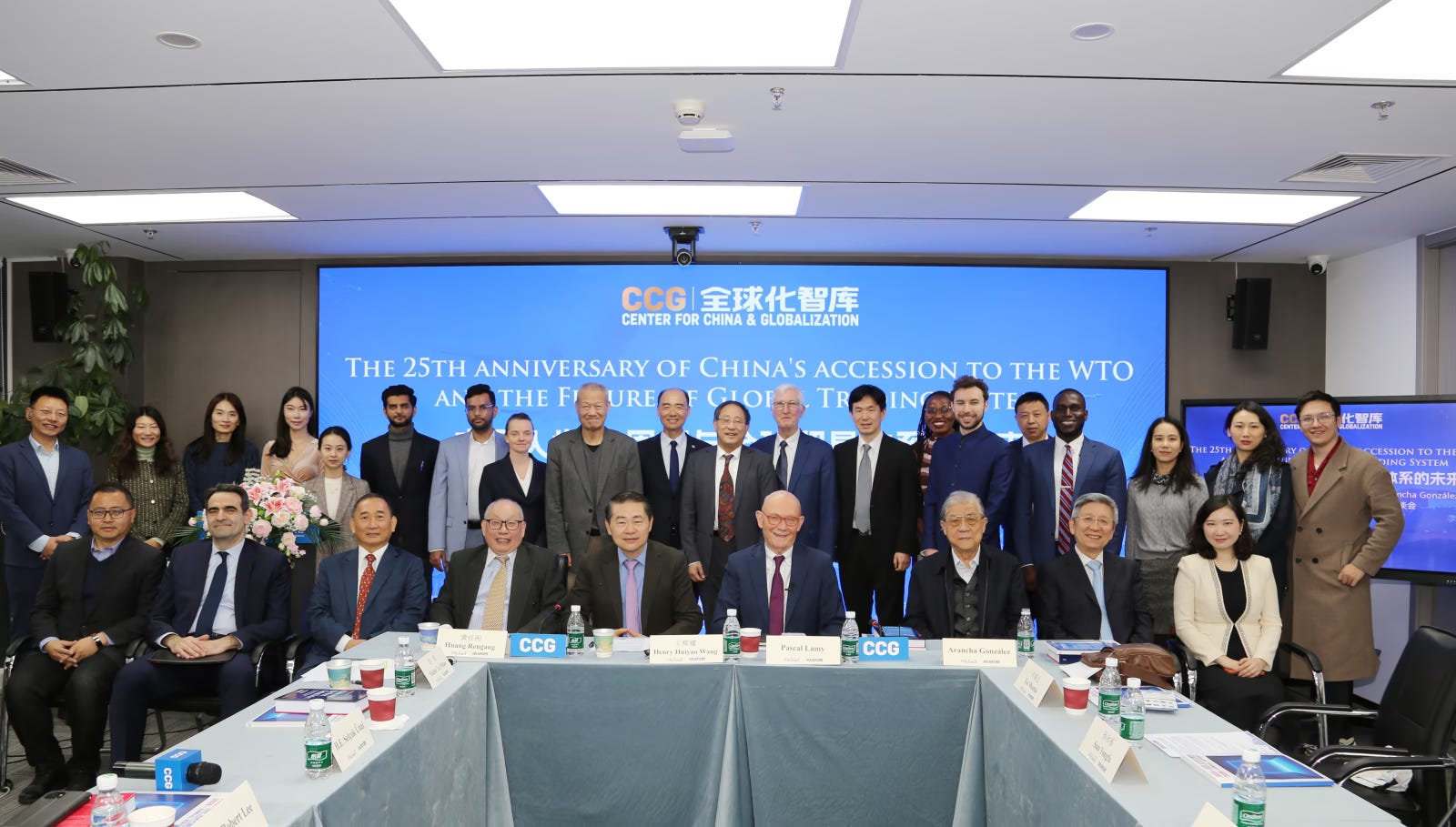
In the roundtable session, speakers included:
Sun Yongfu, former Director-General of the Department of European Affairs at China’s Ministry of Commerce;
Wang Zhi, Founding Dean of the Institute of Global Value Chains at the University of International Business and Economics;
Ma Jun, Director of the Institute of Public and Environmental Affairs (IPE);
Yin Xiaopeng, Professor at the University of International Business and Economics;
Xu Shanda, former Deputy Commissioner of the State Administration of Taxation of China;
Timothy Stratford, former Assistant United States Trade Representative (USTR);
Selçuk Ünal, Ambassador of Türkiye to China;
Robert Lee, Ambassador of Fiji to China;
Li Jiangtao, Department of WTO Affairs, China’s Ministry of Commerce.
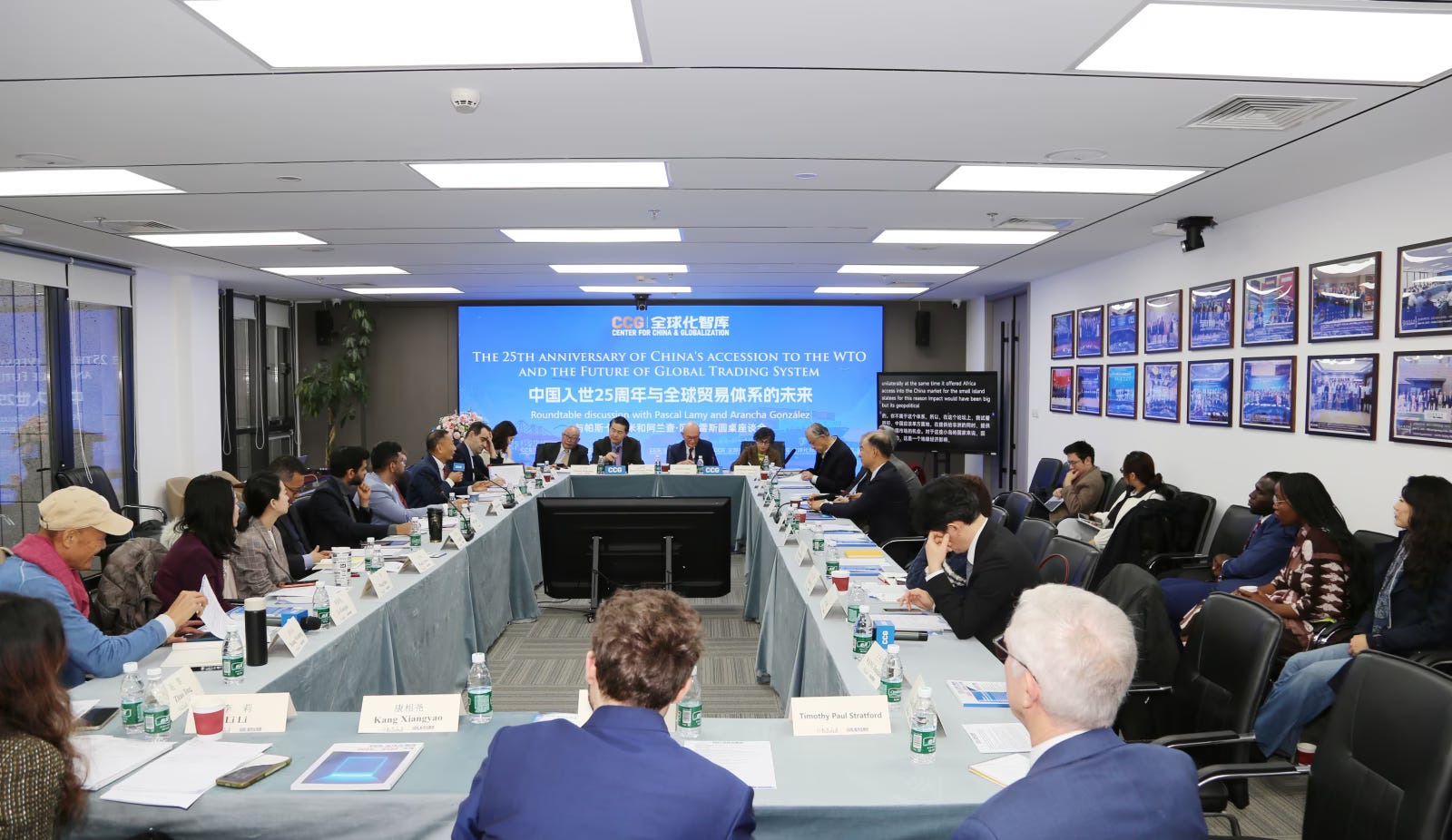
They were joined by other senior Chinese officials, diplomats, international experts, and business representatives.
Watch the full discussion on CCG’s YouTube channel:
This transcript is based on a recording and has not been reviewed by any of the speakers.
Mabel Lu Miao, Co-founder and Secretary General, CCG
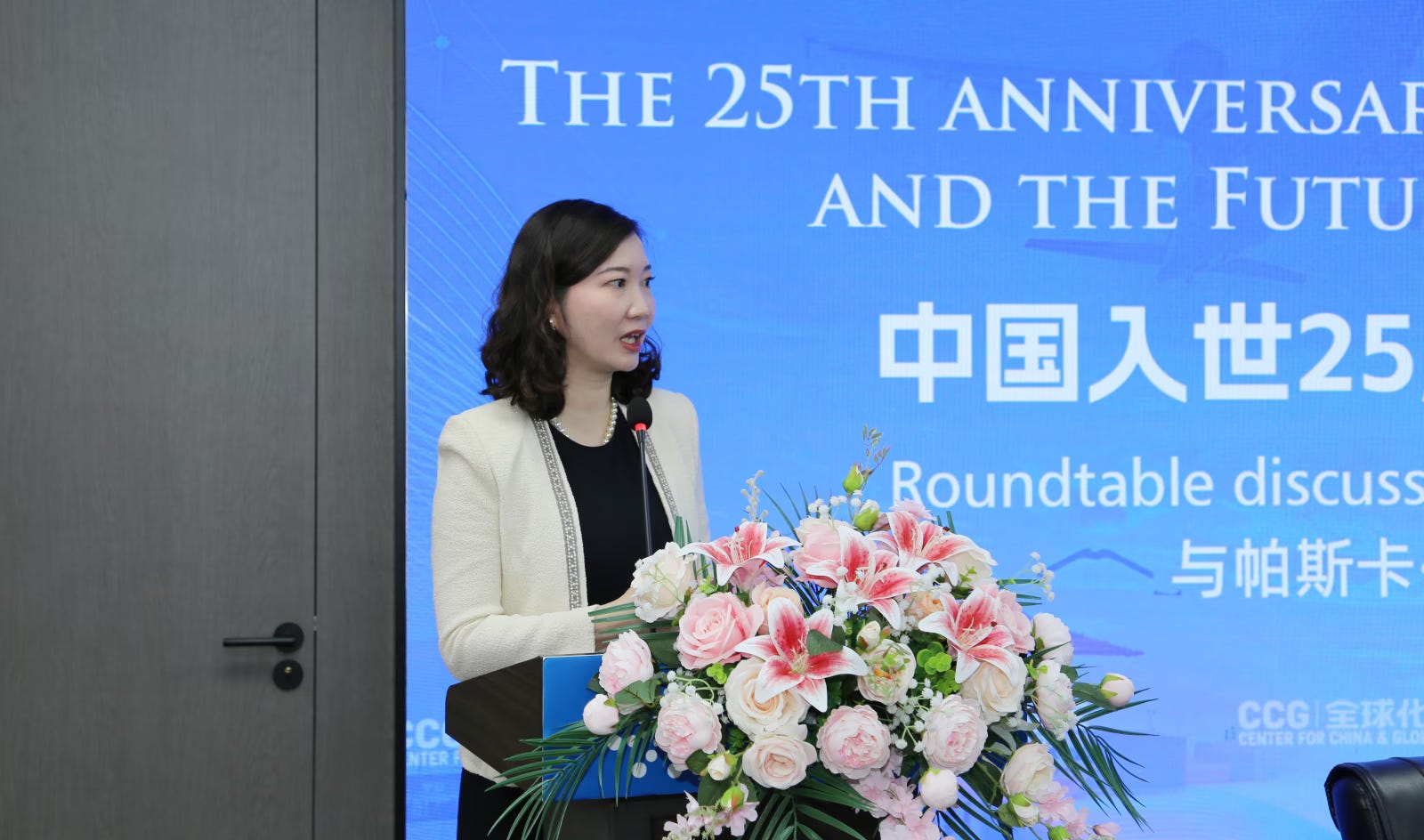
Distinguished guests, ladies and gentlemen, good morning. Thank you all for joining us today at the roundtable discussion. Today we are honoured to be joined by Pascal Lamy, former Director-General of the World Trade Organization (WTO), and Arancha González, Dean of the Paris School of International affairs, Sciences Po, and the former Minister of Foreign Affairs, European Union and Cooperation of Spain.
Today’s theme is the 25th anniversary of China’s accession to the WTO and the future of the global trading system. As the global economic recovery faces multiple challenges, rising trade protectionism, escalating geopolitical tensions, and intensifying competition over critical resources, global industry and supply chains are under sustained pressure.
Since acceding to the WTO in 2001, China has deeply integrated into the global trading system and grown into the world’s largest trader in goods, with ever closer economic and trade ties with countries around the world. The discussions will focus on the experience and lessons of China’s 25 years of WTO membership, the future of the multilateral trading system and global economic and trade cooperation.
The roundtable will commence with the opening remarks, followed by keynote speeches; guests will then engage in discussion and networking. Before we start, let’s take a moment to acknowledge some of our special guests who are here with us today.
We are joined by distinguished ambassadors and diplomats, government agency and association representatives, experts, corporate leaders, and media representatives. We have invited some ambassadors to China, including His Excellency Robert Lee, Ambassador of Fiji to China. Welcome. His Excellency Selçuk Ünal, Ambassador of Türkiye to China. Welcome. We have also invited some diplomats in China, including the Embassy of India, embassy of Ireland.
We have also invited some government agency representatives, including Mr, Xu Shanda, former Deputy Commissioner of the State Taxation Administration. Welcome. Mr Sun Yongfu, former Director-General, Department of European Affairs, Ministry of Commerce. Welcome. Mr Li Jiangtao, First Secretary, Department of WTO Affairs, MOFCOM, welcome. And Ms Chen Hongna, Second-Level Inestigator, Foreign Economic Research Department, Development Research Center of the State Council. Welcome. And Mr Huang Junxiong, Division Director, Regional Agreement Services Division, Beijing Investment Promotion Service Centre. Wang Caiyu, Attache, Department of WTO affairs, MOFCOM. Welcome. Kang Xiangyao, Senior Assistant, Department of WTO Affairs, MOFCOM.
We also invited some think tank academic experts, including the Institute of Public and Environmental Affairs, Tsinghua University, University of International Business and Economics, and some corporate representatives, including 4Stones Cross Cultural, DuPont Pioneer Investment, Miyakoshi Holdings, Lifang & Partners, CITIC Securities, and Envision Energy. Some media representatives from People’s Daily, CGTN, El País, Beijing News, Beijing daily, China Economic Times.
Now let’s welcome and invite Dr Henry Huiyao Wang, Founder and President of the Center for China and Globalization (CCG), former Vice Chair of China’s Association for International Economic Cooperation, MOFCOM. He also served for MOFCOM for a few years. We would like to invite him to deliver the opening remarks. Welcome you.
Henry Huiyao Wang, Founder and President, CCG
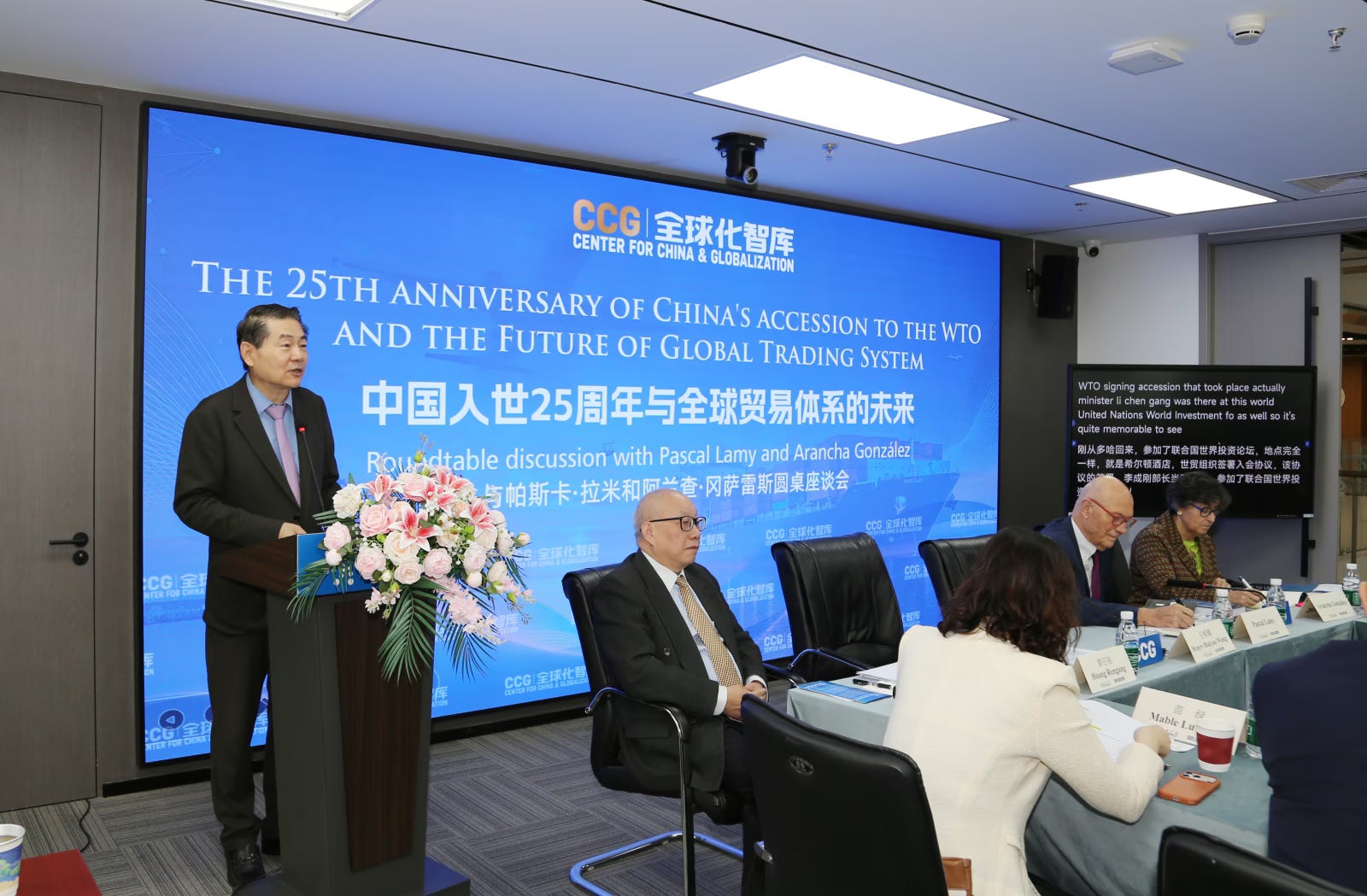
Pascal, Arancha, Your Excellencies, distinguished guests, colleagues and friends, good morning.
On behalf of the Center for China and Globalization, I warmly welcome you to our Tongzhou office, at the historic northern end of the Beijing–Hangzhou Grand Canal. Pascal, it is a great pleasure to welcome you back to Beijing. In May 2000, you came to this city as Europe’s trade commissioner to negotiate the terms of China’s entry into the World Trade Organization. Arancha, you and Pascal subsequently spent eight years working together at the WTO. It is a privilege to have you both with us. We are also pleased to welcome Huang Rengang, Vice President of the China Society for WTO Studies and a former Minister-Counselor at China’s mission to the WTO in Geneva. Among our guests are ambassadors, diplomats, former senior officials and experts, many of whom took part in China’s accession process. Today gives us an opportunity to look back over a quarter of a century and consider the future of the global trading system.
On December 11, China will mark twenty-five years since joining the WTO as its 143rd member. I have just returned from Doha, where I attended the United Nations World Investment Forum. The forum took place at the Sheraton, which also hosted the 2001 WTO Ministerial Conference. Li Chenggang was there as well. Returning to that venue brought the history of China’s accession vividly to mind.
When China signed the agreement in Doha in 2001, the WTO recorded an unusual detail. The documents weighed thirteen kilograms. It took fifteen years of negotiations to produce that agreement, a process led by successive chief negotiators, including Long Yongtu, who now chairs CCG’s Advisory Council. What interests me today is what those pages made possible for people who would never read them. The changes that followed were tremendous. Consider the opening of trading rights. Before China joined the WTO, foreign trade was largely conducted by a limited number of authorized enterprises, many of them state-owned. Within three years of accession, China opened trading rights to virtually all enterprises, including private businesses and foreign-invested companies. This helped create a more open, competitive and dynamic economy.
Foreign-invested enterprises played an important role in that transformation. International companies brought investment, technology, management expertise and global networks to China. By 2005, they accounted for more than half of China’s merchandise trade. In the first nine months of 2026, they still accounted for nearly 30 percent, with imports and exports reaching RMB 11.69 trillion.
By 2009, just eight years after accession, China had become the world’s largest exporter of goods and its second-largest importer. For Chinese families, expanding trade created jobs and helped improve living standards. A 2022 study by the World Bank and Chinese researchers found that nearly 800 million people in China had been lifted out of extreme poverty over four decades of reform. Domestic reforms, infrastructure and education all contributed to that achievement. Opening up to international trade played an important supporting role.
China’s accession also brought significant benefits to the global economy. In 2001, world merchandise exports totaled just over six trillion dollars. By 2025, that figure had exceeded twenty-six trillion dollars. Even with financial crises and other setbacks, trade expanded enormously in current-dollar terms. Many economies contributed to that growth, and China was an important participant. Over the same period, China’s merchandise imports increased more than tenfold.
Every import is an export opportunity for someone else. When Chinese manufacturers buy machinery from Europe, or Chinese consumers purchase agricultural products from Africa or the Americas, the benefits extend beyond China’s borders. As China developed into a major global manufacturing center, it also became an increasingly important market for businesses and workers around the world.
As its economy has grown, China has taken on greater responsibilities within the multilateral trading system. In September 2025, China voluntarily announced that it would seek no new special and differential treatment in current or future WTO negotiations. While retaining its developing-country status, China demonstrated its willingness to contribute more to the multilateral trading system.
China has also taken concrete steps to make globalization more inclusive. On May 1 this year, it extended its zero-tariff policy to all 53 African countries with which it has diplomatic relations. Early that morning, twenty-four tonnes of South African apples cleared customs in Shenzhen under the new policy. We can expect more African products to reach Chinese consumers tariff-free.
This is what inclusive globalization should mean. It should create opportunities for smaller businesses, farmers and communities in developing countries, alongside the opportunities available to major economies and multinational corporations. Opening a market can make a difference to people far beyond our borders.
Looking back over these twenty-five years, China’s accession to the WTO has been a journey of mutual benefit and shared development. The multilateral trading system helped China integrate into the global economy and achieve remarkable progress. In return, China’s openness, growth and expanding market contributed to global trade and shared prosperity. China has benefited enormously from globalization, and China has also contributed enormously to globalization.
Let me conclude with a few thoughts on China and Europe. We are both major trading economies, and we have built much of our prosperity through trade. We have to keep trade flowing. We have disagreements, and there are new discussions about how to manage our trading relationship. In my recent Horizons essay, “A New Compact for China and Europe,” I put forward several practical suggestions.
First, China can strengthen domestic consumption and make it easier for European firms to sell goods and services here on equal terms.
Second, Europe can welcome productive Chinese investment under clear rules. Both sides can revisit the Comprehensive Agreement on Investment and negotiate an updated agreement.
Third, joint ventures in China and Europe can train workers in new technologies, including those used in electric vehicles, and work with local suppliers. Joint ventures in China can also reinvest in Europe. This would create further opportunities for our companies and workers to collaborate.
Fourth, when a surge of imports warrants safeguards, the measures should be narrowly targeted, reviewed regularly and given a clear end date.
Fifth, Chinese and European companies can work together in the Global South. China and France have already established a framework for cooperation in third-country markets. We can build on that experience, drawing on our respective strengths to carry out projects together.
As we mark twenty-five years of China’s WTO membership, there is much to reflect on and much we can continue to improve. We all benefit from being part of an international trading community. China and Europe can work together in the spirit of the WTO, supporting free trade and keeping the multilateral trading system healthy and vibrant. Once again, welcome to all of you, and thank you very much.
Mabel Lu Miao
Thank you, Henry, for your opening remarks. Next, let’s warmly welcome Mr Pascal Lamy, former Director-General of the World Trade Organization. I would like to briefly introduce Mr Lamy.
Mr Lamy served two consecutive terms as Director-General of the WTO from 2005 to 2013. He previously served as European Commissioner for Trade, Chief of Staff to European Commission President Jacques Delors, and Chief Executive Officer of Crédit Lyonnais. He is currently the Coordinator of the Jacques Delors Think Tank Network, which brings together institutes in Paris, Berlin and Brussels, and Vice-President of the Paris Peace Forum. He also previously served as President of the Paris Peace Forum and helped establish this influential platform for international dialogue.
With his extensive experience in international trade and global economic governance, Mr Lamy is a distinguished and respected figure in this field. Welcome.
Pascal Lamy, Former Director-General, World Trade Organization
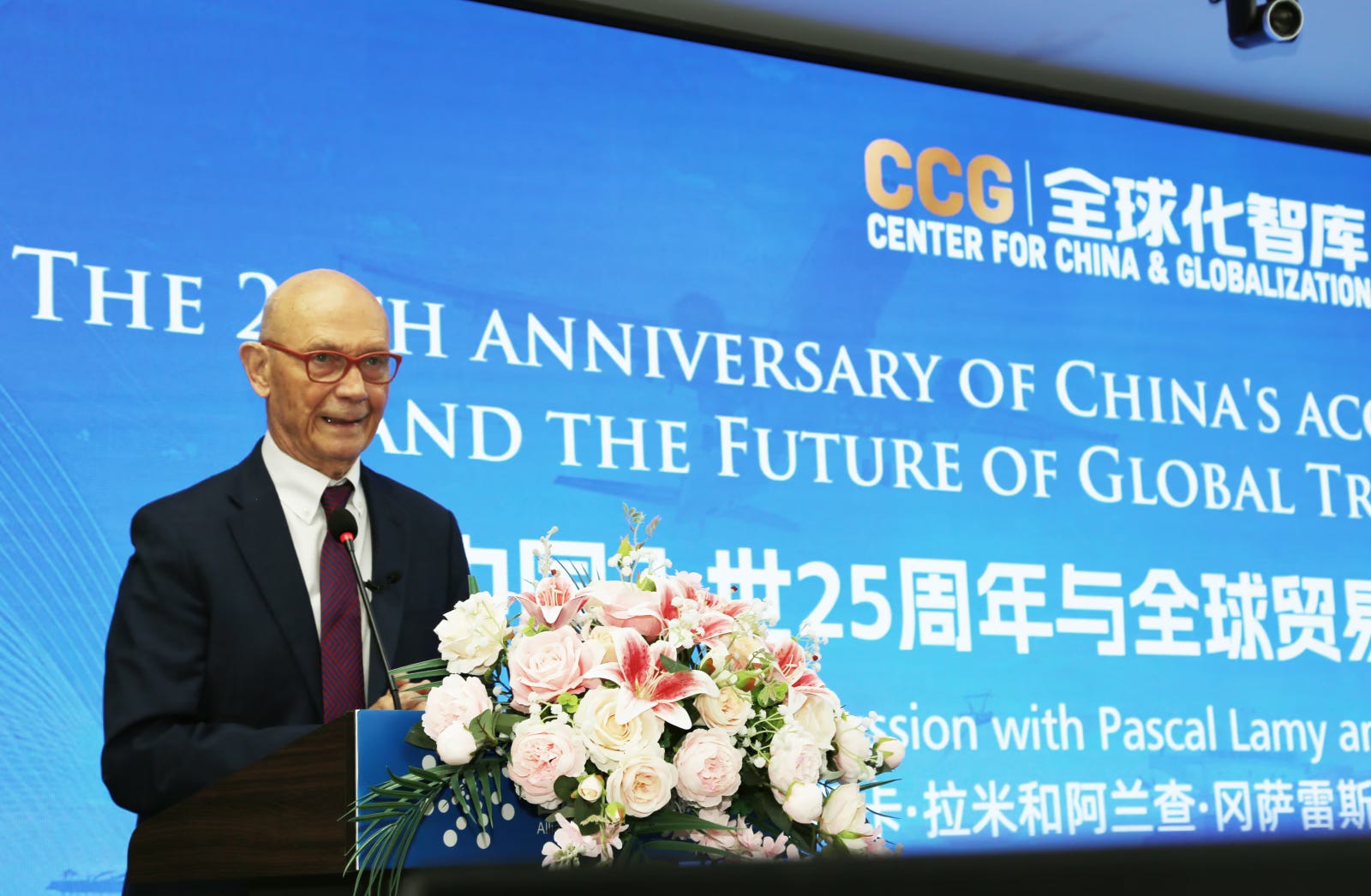
Good morning, ladies and gentlemen. Let me start with a few words of thanks to Henry and Mabel for hosting this roundtable discussion on what is the quarter-of-a-century anniversary of China, as we all know, joined the World Trade Organization.
25 years ago, as a few people around this table will recognise, many friends who are not as old as I am, but who were closely involved in the negotiation at the time, remember that very important turning for us all.
I must say I’ve kept a vivid memory of the final steps of this long midwifing exercise, with my good friend Long Yongtu, with Minister Shi Guangsheng — and above all, with Premier Zhu Rongji, who was the strategic mastermind behind this accession.
At that time, China joined the WTO, which, in many ways, is an insurance company against protectionism, because China wanted to subscribe to an insurance policy against protectionism, given the stance of the Chinese leadership, who wanted to accelerate the development of China and, for that, to boost the domestic engine of growth with exports. That was the basic concept.
In order to do that, China accepted to pay its insurance policy. You buy an insurance policy, and then you benefit from it. China accepted to buy its insurance policy at a price which was, in relative terms, looking back, a high price: quite a lot of market access, much more than what similar developing countries at the time were allowed in the WTO terms, plus compliance with a number of WTO rules which entailed quite a deep transformation of the Chinese development software, including, for instance, intellectual property.
Let’s remember how much of a revolution accepting the WTO regime on IT protection was at the time for China. So China paid this price not to be faced with protectionism.
25 years later, it seems that we are back to square one. China is now facing a serious trade protectionist backlash. What happened? And that’s the purpose of my few remarks.
What happened, looking back to these 25 years, is that we’ve seen two successive phases.
The first one, where it worked. It worked for China; it worked for the world. The fundamental rule of the game that supports the theory of open trade worked. China and the world exchanged comparative advantages.
China had comparative advantages; it exploited them. The world had comparative advantages; it exploited them.
If you get the numbers roughly during this first period, let’s say, 10 years, China’s trade surplus shrank at that time; China’s imports grew more rapidly than China’s exports. That was phase one.
We are now in phase two, where we have a very different situation. Given the huge progress of China in developing its economy, its production, its technology, China has now gained a comparative advantage all along the chain of what remains most traded in the world, which is manufacturers.
Not that services have not gained prominence little by little, but for the moment, international exchange is still very much about manufacturers, and especially with China, whose respiration with the international system is very strong in manufacturers and relatively small in services.
This leads us now to a situation where the game of comparative advantages is not there anymore. If you have to trade with a country that has gained a comparative advantage all along the supply chain, then you have a problem.
Again, this happened for two reasons.
First, because of China’s own capacity to grow its economy, to get to the frontier of technology, to educate formidable generations of engineers. A lot of that is due to the quality of economic, industrial, and technological gearing of China.
Another part of that, at least seen from China’s trade partners, is less to do with WTO pressure and has to do more with unfair trade advantages — for instance, with subsidisation, with the role of the state-owned sector, with the fact that a large part of the investment is still determined by the state and less by market forces.
It also has to do with the fact that since it joined WTO and made this big step forward in market opening, the progress in market opening of the Chinese economy has been limited, whether it’s in industry or even more in services.
China has not opened its economy in the second phase in the same fashion as it did in the first phase. This was not facilitated by the fact that, in the meantime, for instance, WTO rules on subsidisation remained what they were before Chinese entry into the WTO, meaning they were weak.
I can repeat here what I’ve said publicly many times, which looks like sometimes self-accusation or an act of contrition. Yes, the question of whether the rules of the WTO on subsidy disciplines should or not be strengthened before Chinese entry. This question was raised at the time.
The answer, unfortunately — and I must say I regret this and I take my part in this mistake, which we did together, let’s say the US, Japan and a few others who were the big shots at the time before China joined the WTO — we got it wrong in listening to our lawyers, who basically told us, “Be careful. If you narrow the stitches of the net of WTO discipline on subsidies, your own subsidies will be caught — Airbus, Boeing, Toyota.”
We listened to that wrongly. And looking back, if we did a mistake at the time of China’s accession, it’s not about China’s accession. It’s not that China did not abide by the commitment it took. When it joined WTO, it did.
I’ve said that as DG of WTO, and we can repeat it now: China abided by its commitment. So this notion that China cheated the WTO is absolutely wrong. The reality is that some rules of WTO were weak enough to allow China to use a lot of state support and state subsidisation in its economy.
And my last point on the rapid examination of this trajectory: then came what I see — I’m not the only one; there is not full agreement among international scholars on this — then came a change in China’s development software.
The first one was opening. Now, we are more with self-sufficiency. The way China’s economy is now geared is a strange mix between trade opening and self-sufficiency, which is what leads, in my view, to the fundamental problem we have now to face, we non-Chinese — I believe China itself, but that’s not for me to dwell on — with this big problem, which is the structural imbalance of the Chinese economy.
This structural imbalance is the source of our trade problems. Of course, we Europeans, for instance, we can address a part of this major growing trade surplus, which is now threatening a part of the European industrial system. We can address a part of that through trade measures, some sort of export containment — and we’ve had this recent agreement about Chinese export of hybrid cars to Europe — some more market opening. And there is quite a lot to do, either in manufacturers, where the Chinese market is still, through various devices, discriminating foreign production as compared to domestic production.
Of course, you have this vast field of services, which in many ways remains underdeveloped, given where China is now in terms of GNP per head compared to other equivalent economies. Yes, there is some room of manoeuvre for that.
But I doubt that whatever successive steps we can take — and I’m in favour of taking them, and I welcome this recent agreement, which is a good first step, in my view, in the right direction — whatever trade machinery we mobilise to address this enormous surplus problem, this will not suffice.
So we are left with the question, which is: what if the major structural imbalance between production and consumption in China does not change?
My regrettable answer to this question is: if that doesn’t change, then China will have to face protectionism not just from Europe, but from the rest of the world. Why? Because the destruction of the production system — of course,rse, I’m mostly speaking for Europe — creates social problems, which create political problems, which will fuel into more anti-Chinese sentiment in European populations.
We have traces of that; you know what’s happening in Europe. We are at a stage where extreme right forces are on the rise. I can tell you that if they were to get more influence in European politics, that would not be good for China. I don’t think it would be good for Europeans, but this is a matter of political judgment. I’m allowed, being totally independent, to share with you my judgment. But I also believe that would not be good for China.
So, to conclude, where do I see the problem? I think the problem is in the way geopolitics have now taken the upper hand on geoeconomics.
The problem lies in the US-China rivalry, which is growing, which is becoming more tense. I know that there are moments of stabilisation, when we have a grand demonstration of agreement between Mr Trump and Mr Xi Jinping.
The reality, I believe, behind that is that this rivalry is growing because both the US and China are competing for the number one position in the 21st century, and this will not change. This is the ambition of China; this is the ambition of the US.
That’s the background to our trade problem. This is the way we have to look back at what’s happened since China joined the WTO.
In a nutshell, we have in China a contradiction between geoeconomics and geopolitics. The previous phase was a phase where China was driven by geoeconomics. China wanted and succeeded to globalise.
We now are in a phase where, for geostrategic reasons, China, believing too much exposure to geoeconomics would weaken its hand in this rivalry with the US, is now considering that it has to move to more self-sufficiency.
Globalisation and self-sufficiency are not compatible. This is the problem we have today. Many thanks for your attention.
Mabel Lu Miao
Thank you so much, Mr Pascal Lamy, for your great speech. Later, I think a lot of our scholars and experts would like to engage to discuss with you about your proposed problems between us and achievements we have done in the past 25th anniversary of China’s accession to WTO. Next, we would like to invite Dr Arancha González to deliver the keynote speech.
I would like to briefly introduce Dr Arancha González as well. Dr Arancha González is the Dean of the Paris School of International Affairs at Sciences Po and served as Spain’s Minister of Foreign Affairs, European Union and Cooperation from 2020 to 2021. She was previously a UN Assistant Secretary-General and Executive Director of the International Trade Centre, and served as Chief of Staff to the WTO Director-General from 2005 to 2013, following Mr Pascal Lamy.
With her deep experience and course in multilateral trade, international cooperation and European affairs, she brings a distinctive perspective to today’s discussion. Welcome.
Arancha González, Dean, Paris School of International Affairs, Sciences Po; Former Minister of Foreign Affairs, European Union and Cooperation of Spain; former Chief of Staff to the WTO Director-General (2005 to 2013);
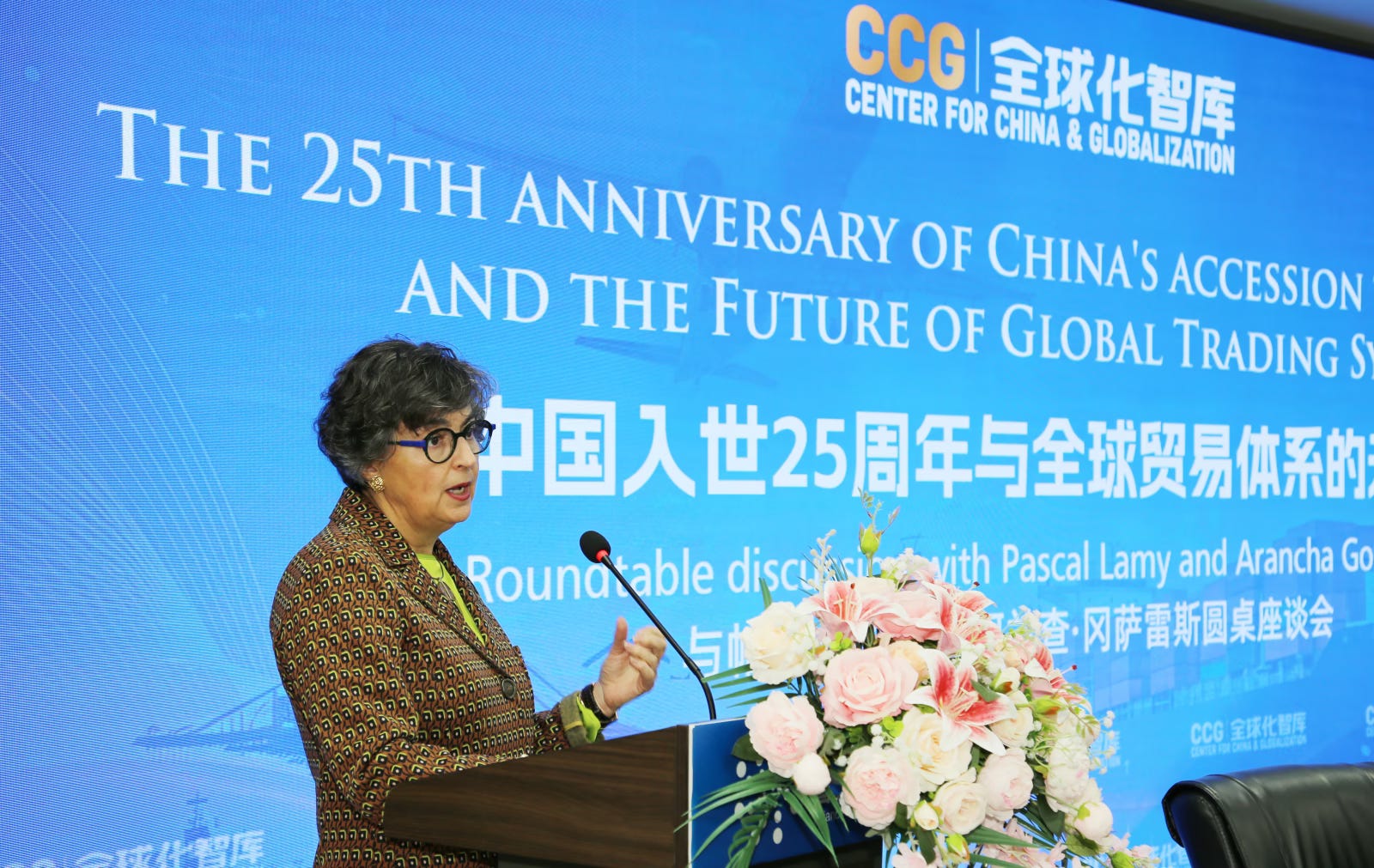
Thank you very much, Mabel. Thank you, Henry. Thank you to the CCG for this invitation. It’s great to be back in Beijing and it’s great to be back on stage with Pascal Lamy. And you know how difficult it is when Pascal has spoken, it’s very difficult to come after him. So I’m going to give it a try.
In December 2001, China became the 143rd member of the World Trade Organization. And global leaders at the time thought that the entry into the multilateral trading system would fundamentally change China. And they were right. It fundamentally changed China. But they overlooked that China would fundamentally change the world — its economic Outlook, its political outlook, and its technological outlook. And this is what I would like to briefly share with you this morning.
25 years later, we have to look at this mirror in two ways. We have to look at how China has changed. We also have to look at how the world has changed with China. Finally, I’d like to also look at a few challenges that this mirror leaves on our doorstep that we need to deal with.
Let me first deal with China. As someone that has been coming to this country for so many years, I have seen with my own eyes how much these 25 years have moved China from a low-cost, low-tech economy into an economy that has grown larger, that has grown exponentially, and that has grown in sophistication. It is now a global leader in many of the frontier technologies. It’s moved from adopting global rules to being a powerhouse in setting global standards, including in technology. And it has done that while lifting one hundred million people out of extreme poverty.
So we can say that this was a successful story. Let’s look at how much the world has changed. The entry of China brought unprecedented material abundance: cheap reliable consumer goods that kept inflation low around the world for decades, but also multinational companies that found one of the world’s most lucrative market, a new middle class that they benefited from — this new Chinese middle class. It also altered the industrial map in many economies around the world with the move of many industrial value chains to China. The world grew more interdependent. Value chains developed with high efficiency, often also with high reliance.
The WTO became extremely notorious around the world as a result, but it became too slow in changing, in reforming. And it’s becoming slower and slower.
I think it’s good to acknowledge that 25 years later, this period of honeymoon in globalisation is over, and it’s replaced by urgent challenges on both sides. So let me try to describe what I see as urgent challenges both on the Chinese side as well as on the rest of the world.
On the Chinese side, I think there is a big question about the structural sustainability of the economic model that is investment-heavy and dependent on export for its growth. It’s showing its limitations, and it’s showing its limitations because of aging population, because of slower domestic growth, and also because of a growing pushback in other countries around the world to China.
The Chinese economy today, if I can describe it, 30% of the economy is incredibly high value-added. This 30% employs 30% of Chinese workforce and generates 2/3 of the growth. This part of the economy is highly dependent on international markets. 70% of the Chinese economy, which employs 70% of the Chinese workforce is only responsible for 1/3 of the growth.
So you can see that the basic original model in the country has not changed. A big part is moving in a huge value-added direction, but is heavily reliant still on open markets around the world.
Now, the US market is to a large extent closing, and other markets around the world are showing signals of a stress. So the question for China, as I see it, is, can China successfully transit to a consumer-driven higher-value economy? This raises lots of questions at home for China because this is essentially in Chinese hands — questions related to the relationship between the centre and the provinces, questions related to taxation. I’m glad to see that the architect of much of the taxation system in China is with us because I think it raises a lot of questions. And it has to do these changes at home as it navigates a more hostile international environment.
What about the rest of the world? Well, for them, there is a big challenge of security and balance.
Trade as an adjustment factor for Chinese imbalances at home has essentially triggered a greater debate, as Pascal mentioned a moment ago, about what part of this is ingenuity, hard work, and innovation in China, and what part is subsidies, currencies, overcapacities, and unfair arrangements. And this debate is very much open and on the table.
To a large extent, the 2001 consensus is fractured, and the WTO today is stalled. So, the question in my mind now is: how do we find a new equilibrium?
To me, this new equilibrium has to have four parameters in mind. Let me briefly mention them.
First, it’s going to be more about reciprocity and less about asymmetry. And in a way, Henry has mentioned a part of this in his opening remarks.ntions
Two is going to be more about interdependence with guardrails rather than about decoupling, neither decoupling of China from the world nor about the world decoupling from China. It’s about interdependence with guardrails.
There, it’s got to be about transparency and not just nice words.
And four, it’s probably going to be more about coexistence than convergence. In the past, it was a lot about convergence. Now it’s going to be more about coexistence. So in a way, we need to find a new equilibrium for coexistence.
And the task to look to search for this new equilibrium, for coexistence, has to start at home, with changes at home, in China, with changes at home, in Europe, with changes at home in other countries around the world.
It has to be followed by trying to manage the search for this new equilibrium in a cooperative manner rather than in a conflictual manner. And it’s going to be difficult because there are positions in every nation that will probably lead to skirmishes here and there, but I think the task should be to try to do this cooperatively .
And number three and final, it would be about using the WTO to do small reforms, small changes together that could build trust that at the moment is in short supply. So it’s not going to be easy, but I think our task is to find avenues, to help build this new equilibrium for coexistence together.
Thank you very much and very much looking forward to the conversation.
Mabel Lu Miao
Thank you very much, Dr Arancha González, for your stimulating speech. Next, we would like to invite Mr Huang Rengang. I would like to briefly introduce Mr Huang Rengang as well.
He is Vice-President and Secretary-General of the China Society for WTO Studies and previously served as Minister-Counsellor at the Chinese Mission to the WTO in Geneva. He has held a series of posts at the Ministry of Commerce, including Deputy Director-General of the Department of WTO Affairs, and later served as Minister-Counsellor at the Chinese Embassy in Australia.
Having witnessed China’s accession to the WTO at the Doha Ministerial Conference in 2001, he offers first-hand insight into China’s 25-year journey within the multilateral trading system. The floor is yours, Mr Huang.
Huang Rengang, Vice President and Secretary-General, China Society for WTO Studies; Former Minister-Counsellor, Chinese Mission to the WTO
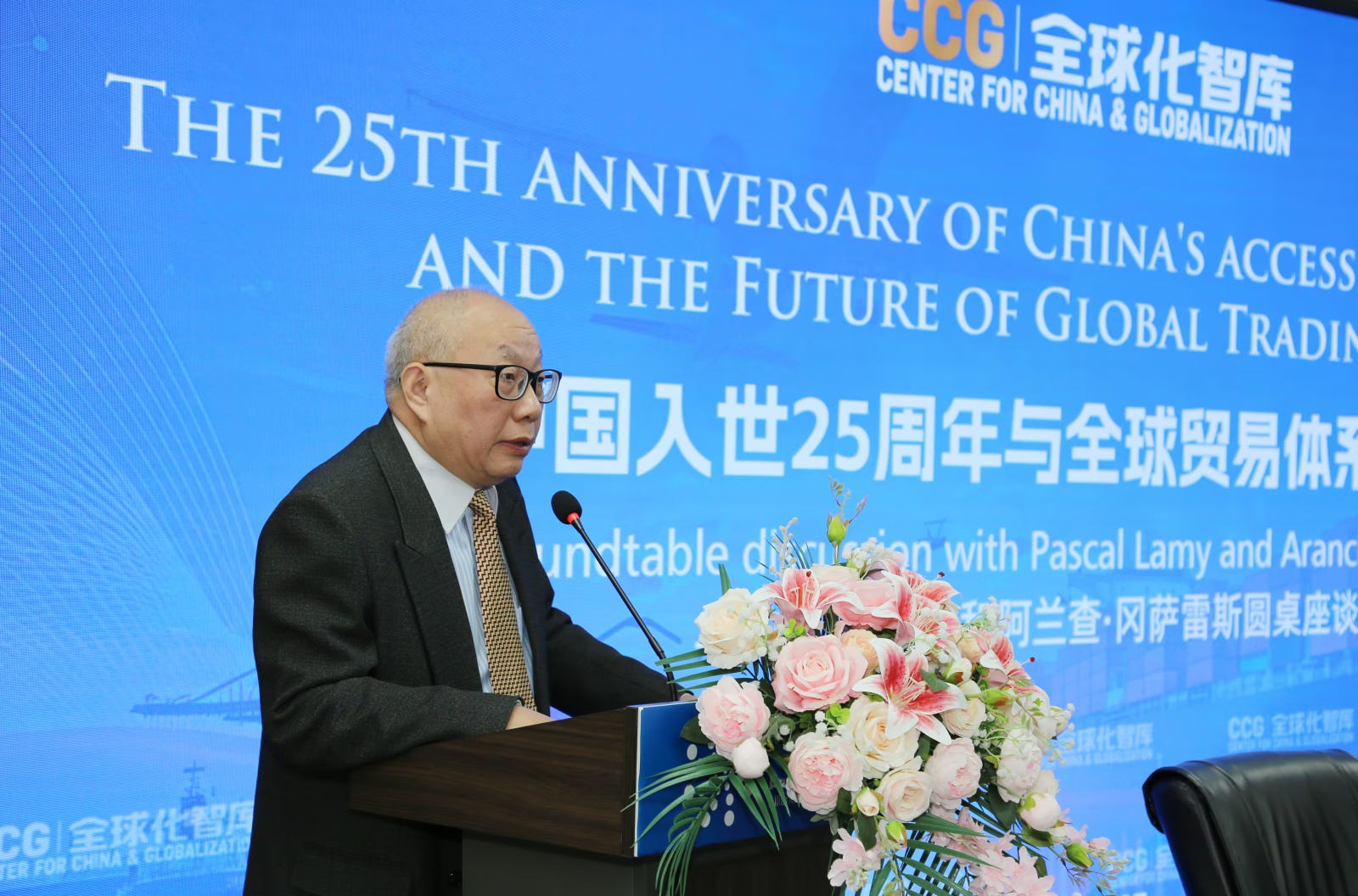
Thank you, Dr Mabel Miao, for your introductory remarks.
I should also take the opportunity to express my gratitude to Dr Henry Wang for the invitation and to say that I’m really honoured to have the opportunity to come here to talk about the 25th anniversary of China’s accession to the WTO.
I’m glad to see so many old friends and new ones. At the outset, I would like to say that it is good to listen to the previous three or four speakers, the keynote speeches. They have contained a lot of statistics and figures to show how much China has changed, to show how much the world has changed.
Also, they put forward the question: now, what shall we do to manage the future changes and challenges?
At the beginning, I think that maybe a word of thanks to Mr Pascal Lamy and his colleague Arancha González, because they made a lot of efforts to conclude the negotiations on China’s WTO accession.
I still remember that in the year 2000, Mr Lamy took at least three trips to Beijing for negotiations, with his counterparts, Minister Shi Guangsheng and Minister Long Yongtu. In May, during those trips, the bilateral deal between the EU and China was concluded at that time. Mr Lamy was the Trade Commissioner of the EU. In his capacity as EU Trade Commissioner, he made three trips for these China WTO accession negotiations, at least according to my memory, because I was there. I was in the meetings. I was there. I participated, okay?
And I agree with Pascal that China has done a pretty good job in fulfilling its commitments for the accession. He said that China paid a high price. Do you have any idea how high the price was?
Let me give you some idea. For instance, in agricultural products, the average tariff for developed countries at that time was 35%, but China committed to 15%. Now, the average agricultural product tariff at that time was 55% for developing countries. But China committed to 15%.
Because China had to agree to such demands by our trading partners in order to get membership in the WTO. You had no choice; otherwise, they wouldn’t sign the agreement. You wouldn’t join, and China would still not be a member of the WTO by now.
So I say that, thanks to their tough demands and requests, what happened? Because if you look at the content of the price that China paid, China’s Protocol of Accession runs to thousands of pages, including tariff and non-tariff commitments everywhere.
As a result, China had to change its regulations, its laws, and its policies by the thousands, by 10,000 if local government regulations are also taken into account. As a result China had to change its opening-up policies and open the market to foreign products.
I remember when China became a WTO member, you could see that we created an environment that was very attractive to foreign investment. At that time, you could see that all the major multinationals had a project or investment in China. For instance, if you look at the auto industry, I remember that at that time China had a big worry that once we joined the WTO, our auto industry and our agricultural sector would be destroyed by foreign competitors. but that didn’t happen.
What happened was that all the major foreign automakers had joint ventures in China. To take France as an example, Renault, Citroën, Peugeot — all of them have joint ventures in China. So on China’s streets you see all those foreign-made cChinesars, okay?
But it’s interesting that after 10 or 20 years of effort, the Chinese local businesses, they learned from those foreign investors. They learned the advanced managerial experience. They tried to catch up. Now, maybe in some sectors, China has really caught up. China has begun to outshine the old-timers in some sectors and in some products.
As a matter of fact, China’s commitment to opening up has never stopped.
For instance, my former boss, Vice-Minister of Commerce Yi Xiaozhun, was the first Chinese Deputy Director-General in the WTO. He is now in Shanghai. Otherwise, he would like to come here for this forum because he told us that Lamy and Arancha are both his good old friends. I would like to take the opportunity to pass on his best regards and greetings to Pascal and Arancha, because they are over there.
Mr Yi Xiaozhun is now attending seminars in Shanghai, at the Hongqiao Forum, the China International Import Expo. Can I give an example? Any major trading countries in the world, they host import expos. All of them focus on promoting exports, not imports. China is the only trading power that hosts an import expo every year, inviting global sellers to come to China to sell their products and services in China.
This is a commitment. This is strong evidence that the Chinese government is committed to further opening up, to further reform, to making China more integrated with the rest of the world, to welcoming foreign products and services, and to benefiting from this kind of globalisation, relationship, or integration. This is my understanding.
Of course, during the previous speakers’ remarks, we heard the question that now we have entered a new phase. The Chinese have become producers, have become very competitive, have become from an economic animal to a manufacturing monster. That is, we dominate in certain sectors and products so some trading partners feel scared. They feel that they have to take measures to limit Chinese exports.
Actually, they’ve been doing that. They’ve been making efforts. First, you look at what happened in the past few years between China and its major trading partners. As Pascal mentioned, China has to be ready to face more protectionism.
Our view is that maybe, at a certain level, certain methods of protection are necessary, if they are in accordance with WTO rules.
But Pascal pointed out that, if you look at the subsidy and countervailing duty rules, sometimes they are too weak. They do not have the biting power to really correct some kind of situation that you don’t want to see.
So what would happen? WTO members, trading partners, can sit down together to try to improve those rules, to negotiate new disciplines, new rules, and new agreements, even to cover some new areas like green development and environmental goods. And not only the trade remedies and trade defence tools, but also to cover dispute settlement, all the sectoral policies, trade policy review and transparency.
Arancha also mentioned the importance of transparency. If you look at WTO records for trade policy reviews, the transparency and the compliance rate are not 100% satisfactory.
Some of the previous speakers also mentioned the issue of subsidies. You look at a typical case in the WTO, in the dispute settlement between Boeing and Airbus. The WTO panel, the judges, found both the US and the EU guilty in some areas.
It seems that if you come to the WTO’s dispute settlement record, you get a feeling that if you stay long enough in the WTO to attend those meetings, nobody is innocent. Nobody is 100% perfect. There is always room for improvement for every trading country, for every country.
But China has an open mind. China is ready to listen to advice, to suggestions, to good, useful ideas that can further improve our trade governance and our legislation. We welcome ideas on how to boost domestic consumption in China, how to make people feel that they should—
But I would like to point out that to let the Chinese people consume in the way the Americans do, it will take a long time; it wouldn’t happen overnight, because the average GDP of the US is still eight or seven times that of China. The average GDP of France is still two or three times that of China.
If you look at OECD countries, that’s the reason why China still claims it is a developing country. It is. Because if you look at the aggregate total value of an economy or trade in goods, China is impressive. But if you come to per capita consumption, per capita income, and per capita GDP, China is still a developing country.
China’s average GDP is now, I can even say, below Türkiye’s, right? Or at the same level as Türkiye. I don’t know if you could take this as a measure, but if you look at the OECD countries, the so-called rich man’s club, there is a long way to go for China to reach the level of consumption as represented by rich or developed countries.
Of course, China is making efforts in that direction, and hopefully, over time, the level of consumption in China will grow and grow again. We’ll be able to contribute more to absorbing overseas products and services.
We are happy to see that China is making efforts in that direction, and I believe that with our joint efforts, we can find ways forward.
But nevertheless, it is not surprising that there are trade frictions or problems between countries. But I would like to say that if you want to seek absolute equilibrium or trade balance, it would be very difficult.
If you look at the history of the world economy, the patterns and the figures, it is very difficult for you to reach balance, trade balance or equilibrium in any area. So the world is always dynamic. The world is changing. We have to be ready to embrace the changes, to overcome the challenges, to try to solve problems.
So if there are trade frictions or problems, China is ready to sit down and negotiate, and talk about the solution. So please be careful to resort to those protectionist methods, because sometimes China is forced to take countermeasures, to take measures to protect its own interests. It is legitimate. China is entitled to protect its own fundamental interests.
For instance, some say that, as the previous speaker mentioned, the word “self-reliance”. China, sometimes, for certain products and certain sectors, is forced to take a self-reliance position.
When you cut off chip supplies to China, or cut off exports of aircraft engines to China, what can China do? It has to rely on itself for research and development. Otherwise, it has no other choice, because you cut off this kind of export totally.
My point is, China still believes in globalisation, believes in international cooperation and integration, and believes in economic exchange and partnership.
For this reason, I would like to congratulate CCG for its efforts over the years to try to promote mutual understanding between China and the rest of the world, and to try to help tell the Chinese story: how China is a peace-loving nation that likes to trade with others on the basis of mutual respect and mutual benefit. And we’re going to continue to do that.
Thank you very much.
Mabel Lu Miao
Thank you, Mr Huang. I think our discussion will go forward and will be very exciting. So I think the topics are very interesting and engage more different ideas.
Next, we would like to invite Dr Henry Huiyao Wang to moderate the next roundtable discussion. The floor is yours, Dr Wang.
Henry Huiyao Wang
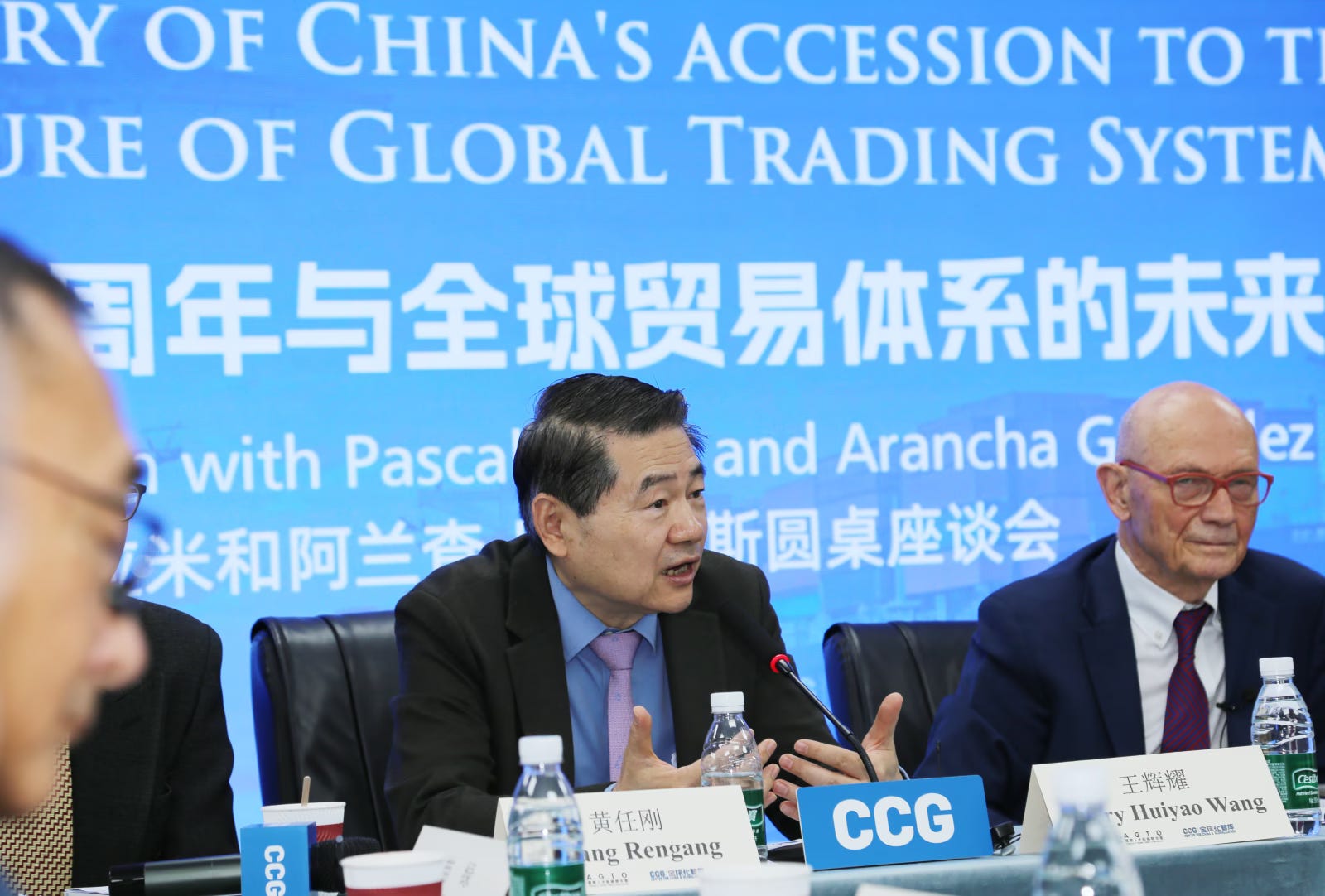
Okay, thank you, Dr Miao. Once again, I want to thank Pascal, Arancha, and Rengang for their very good opening remarks, which basically provided a good background for the roundtable discussion on this occasion of the 25th anniversary of China’s joining the WTO.
So I think we have about 50 minutes. Maybe we can stretch a little bit. We have some very senior experts here around the table, and ambassadors and representatives. Maybe each of you could have three, four or five minutes to give a bit of your feeling about China’s accession to the WTO.
I’d like to invite Director-General Sun. He actually worked in the International Department and many other areas at MOFCOM. It’s great that you were also involved with the European Department for many years at MOFCOM. So you know all the stories. Mr Sun, please.
Sun Yongfu, Former Director-General, Department of European Affairs, Ministry of Commerce
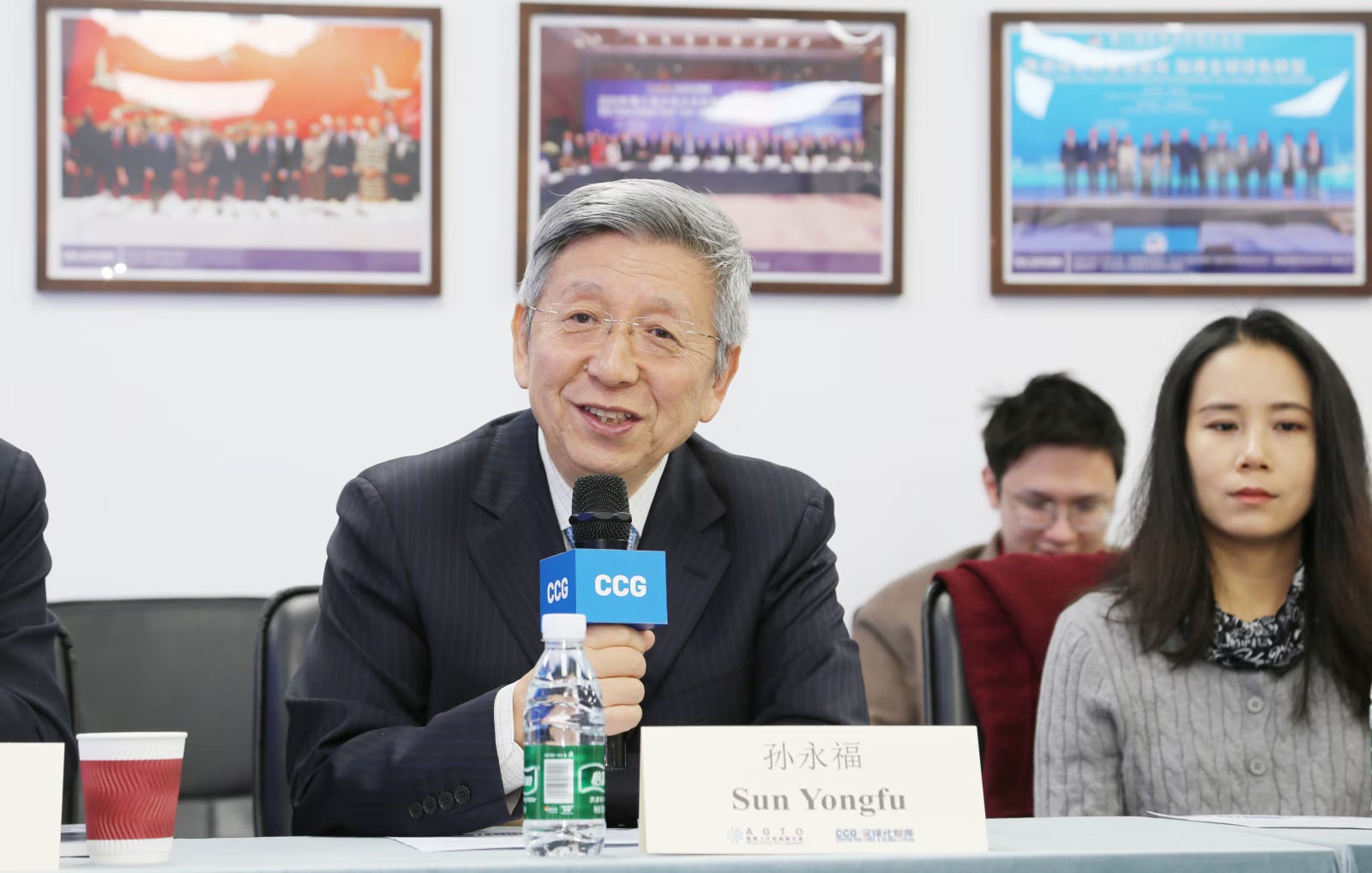
I heard very carefully about the previous speakers on the anniversary of China joining the WTO. I still remember at that time, Pascal Lamy was still the Trade Commissioner of the EU, and I was at that time the Director-General of the Department of European Affairs of MOFCOM. So our Minister had many kinds of discussions with Pascal Lamy concerning the trade relationship between China and the EU.
Fortunately, when I was the Director-General of the European Department, the EU was our number one trading partner for almost 16 consecutive years. It is so important to have a smooth, very good trade relationship with the EU because it was so important.
Exports were not that much, but we imported quite a lot. At that time, I think trade in goods was almost balanced in our trade with the EU. We had a surplus, but not as big as we have now. We had some frictions. I still remember cotton, textiles, and some others. But based on the rules of the WTO, through negotiation, we could more or less easily solve those problems.
The situation has changed. Now, 25 years later, trade friction is becoming more and more serious. And trade frictions, some problems of subsidies and EV cars, and some sanctions from the EU side and countermeasures from the Chinese side, are getting more and more serious.
I have a question. Pascal Lamy, do you believe that we can still cooperate in the manner we did 25 years ago, to have more cooperation than frictions? We tried to conclude the investment treaty in 2020. Now it’s already dead. Do you believe that we can somehow resume our negotiations on that very important investment treaty? Thank you very much.
Wang Zhi, Professor and Founding Dean, Research Institute for Global Value Chains, University of International Business and Economics
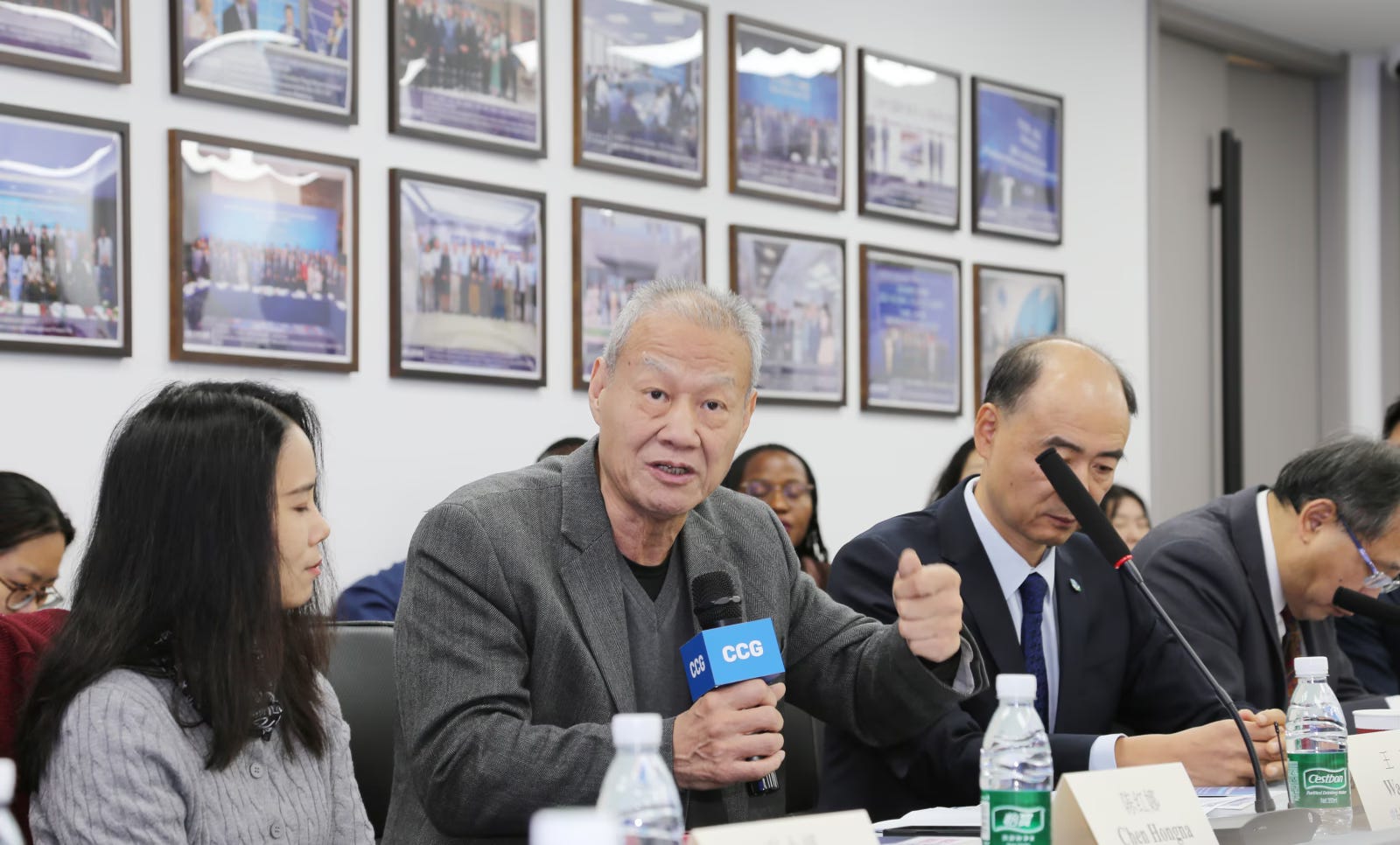
I heard the previous speakers. It’s very exciting, you see. I remember, 25 years ago, before China joined the WTO, when Long Yongtu was the chief negotiator, Zhang Xiangchen was his assistant.
At that time, as Pascal mentioned, China paid a high price. But in my view, the price was very worth it.
At that time, I reflect that the domestic departments, like the Agriculture Department, like the Ministry of Industry and Information Technology, were against the offer that the Chinese delegation made in the WTO.
That’s the reason that, at that time, I was in USDA. I was working with Li Shantong in the Development Research Center (DRC) of the State Council. We used a model to simulate China’s WTO accession. What we predicted was that agriculture would survive and the automobile industry would grow.
Li Shantong and his superior officer, Mr Wang Mengkui, wrote the 88-page brief to Zhu Rongji. Because of that suggestion, I think it facilitated the leadership in making the final determination to join the WTO.
I think that was a very important step for China to get so developed so fast in the past 25 years.
I think that at that time, China’s reform released the productivity and creativity of the Chinese people, leading to a leap. Initially, it was labour-intensive products. But at that time, the Chinese domestic market was not mature yet. A lot of Chinese people were still poor. Only by joining the WTO could China allow its labour-intensive products into the world market, especially the Western market, to absorb this tremendous expansion of supply.
China was a society of scarcity before 1990; everything was in short supply. But now, 25 years later, things have totally changed. China has become an affluent society. Everything is oversupplied.
So we need to find a new market, a new one. I have two thoughts on this.
The first, we have to solve domestic issues. Same with the United States, we have very large inequality. Our Gini coefficient is almost the same as that of the United States.
So 70% of Chinese people have no money. They only earn less than 1,000 yuan per month, as Premier Li Keqiang mentioned. How can you expect those people to consume?
So basically, the Chinese model is investment-driven and export-driven, but this model cannot be sustainable. This kind of model can no longer be maintained.
There’s a very easy thing to do, I think. It may not solve all the problems, but based on China’s society, the cause of socialism, all the state-owned companies belong to the world, belong to all Chinese people.
They have a lot of profits right now. The reason is that downstream producers produce a lot of goods, but they use upstream electricity, oil, and other infrastructure. Those companies are monopolistic; they have a lot of profits.
Not all of China’s economic [unclear] should be sent to the centre. You should put these SOE profits into investment in education, healthcare。 and elderly care. If that happens, the low-income people in China, the 70% of people, will benefit. And this is also consistent with China’s [unclear].
Why? If this money continues to be kept in the corporate sector, they can only make investments, and then you create more and more overcapacity. So that’s the drawback in China.
But I also have a question for Lamy and Arancha. Is it possible for China and the EU to work together? We can make the pie larger. Basically, we have products; we need markets.
If China and the EU work together in third-country markets, especially in the Global South, helping the Global South use China’s green manufacturing capacity and the EU’s [unclear] to address global climate change. I think that we have very similar ideas. We want the Earth to become green.
We have a lot of past cooperation. You heard that we’re working with [unclear], and a lot of German companies and French companies are working in EVs. We can help the Global South go green in this way.
So that’s really, I think, how we can make the pie larger.
I think it would be better if you could talk to the Chinese leaders when you have the chance. Ask them how the SOE profits are distributed. You keep them in the SOEs; you should distribute them to the Chinese people.
Henry Huiyao Wang
Thank you very much. Because we have a time constraint.
Ma Jun is a very well-known expert on the environment, and he is also a frequent participant in the Paris Peace Forum.
Ma Jun, Director, Institute of Public and Environmental Affairs
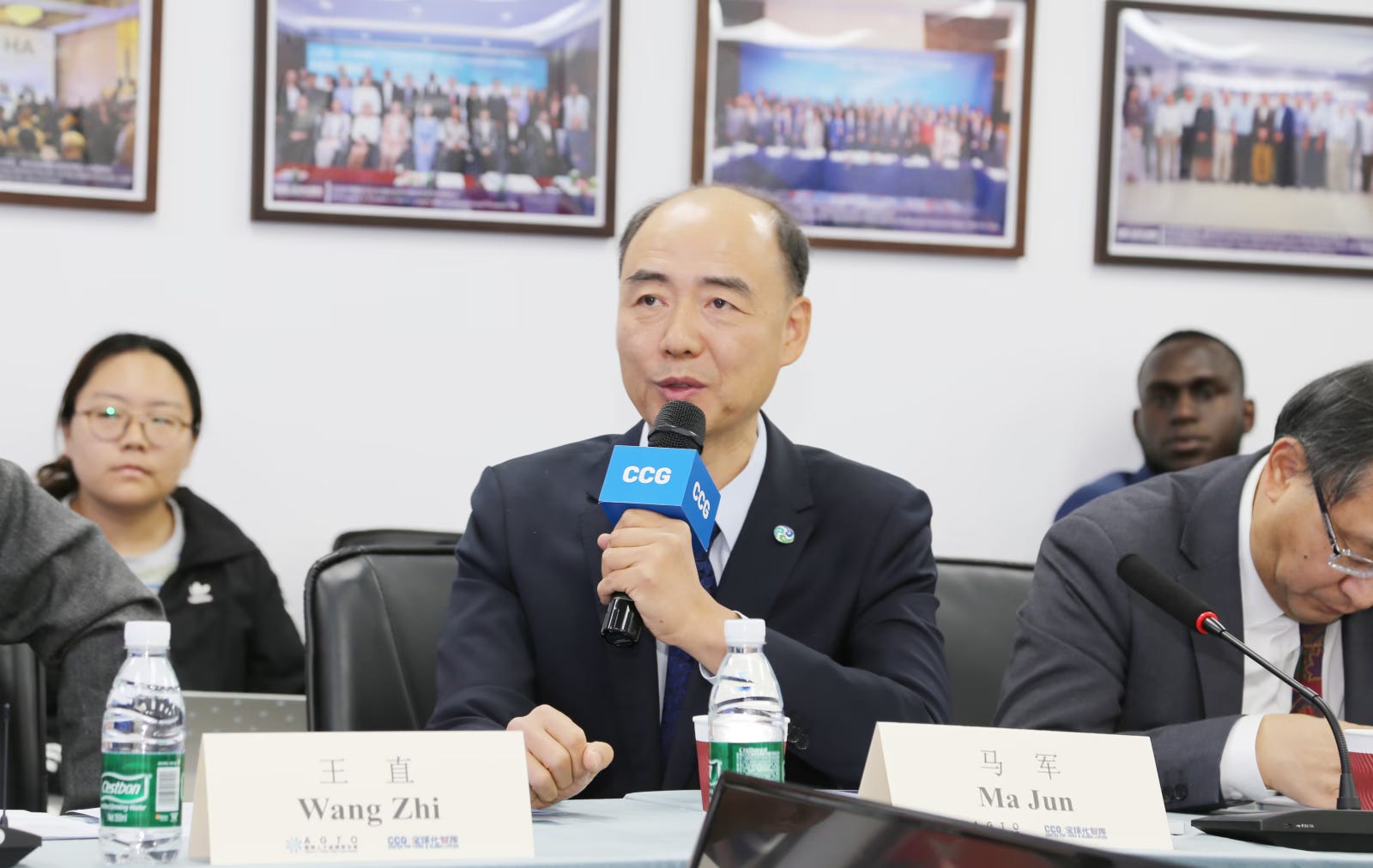
Thank you, Dr Wang. And very nice to meet you, Pascal and Arancha, again. I’m really humbled to be in front of so many experts on the WTO. In the past two days, we reviewed what happened after China’s accession to the WTO.
When it comes to the supply chain, we had the 13th Forum on Green Supply Chain in China. And 25 years ago, the accession has really vastly expanded this factory of the world.
It benefited China; it benefited its people. Hundreds of millions have been lifted out of poverty. But in the meantime, the enormous pollution discharge also exposed hundreds of millions to health hazards at that time. The factory was not a clean production base. And behind that was the mechanism that the rules and regulations had been developed, but enforcement was not there.
As a result, it’s a kind of situation where the polluters only became ever more competitive in the market, so it was a race to the bottom, causing so many problems.
We believe issues of such magnitude must be addressed with the participation of the whole society, and access to information is a prerequisite. So we built a pollution map database and started tracking the performance of all these companies.
At the beginning, the information was not available, or not quite available; it was very limited. But what brought this problem has also created its own solutions. That accession to the WTO, as Arancha mentioned, actually made some fundamental changes in our society.
Mr Huang mentioned all these laws and regulations. We’re talking about thousands of them; millions of local rules have been revealed for the first time. China issued the Open Government Information Regulations. In 2008, China came up with the regulations, and before that, the administration of law-based governance.
All this helped China to vastly expand environmental monitoring and transparency. Our records of environmental violations and penalty fines — the number grew from 2,000 in the first year to 3.5 million at this moment.
All this data has been extensively used in the supply chain in China. All these major factory companies sourcing from China all tap into the data. They motivate tens of thousands, hundreds of thousands of their suppliers to openly address this problem. And all this helped to cut China’s emissions in a dramatic way.
In 2006, China’s annual sulfur dioxide emissions were 25 million tonnes, and nitrogen oxide emissions were 25 million tonnes. Now, in 13 years’ time, they dropped from 20 million to less than 2 million tonnes. As a result, the regions suffering from acid rain dropped from nearly one-third to 2%. And the water pollution problems have also vastly improved. Air quality in Beijing — PM2.5 dropped from 90 to 30.
We talk about this progress very much as a result of the rule of law and openness and transparency.
Of course, 30 is still six times the WHO standards. Today, we’re still facing all these challenges over climate change and biodiversity loss, and all this new round of pollution.
We’re heading to the Paris Peace Forum, and then heading to COP31. I noted that Ambassador Ünal is here today. We’re heading to Antalya for COP31, and I think globally we’re still by far the largest emitter at this moment.
There are all these challenges. But China is sticking to its carbon peak and carbon neutrality commitments. And in the process, it has developed all these new mechanisms which allow an NGO like us to track the performance of 20 million corporations and have already collected more than 6 billion tonnes of corporate carbon accounting and disclosure.
I hope this serves as a basis for what Director Sun and Professor Wang also mentioned about this desire to work with the EU, which is a torchbearer in all these green and sustainable rules.
I think they create opportunities for us to work together, to help not just both of China and the EU, but also the world, particularly the Global South, which is in such a challenging situation.
For COP31, we’re going to publish our report. One of the reports is about the vast expansion of China’s renewable energy. And that renewable energy not only helps China to cut hundreds of millions of tonnes of carbon emissions, but also contributes globally.
So far, by 2025, those exports can help to achieve billions of tonnes of carbon emission reductions in the world and save the world 175 billion dollars in green transformation.
Of course, behind that there are a lot of competitiveness issues that we need to address. But reviewing the past 25 years, there’s a chance for us to work together.
If at that time we could work together to address this issue, today I hope there’s also a fair way to work it out. And transparency is the fundamental principle of the WTO globally. China adopted that and benefited from that. And now I think we can work together based on that globally. Thank you.
Henry Huiyao Wang
Thank you. Okay, thank you, Ma Jun. Yeah, absolutely right. I think the WTO was an economic revolution for China. It not only changed trade and the economy, but also had a direct and indirect impact on the environment.
I would like to invite Mr Yin. He’s also a professor from UIBE. Maybe after you, and then we have Mr Xu to speak.
Yin Xiaopeng, Professor, University of International Business and Economics; Former Dean, Research Institute for Global Value Chains
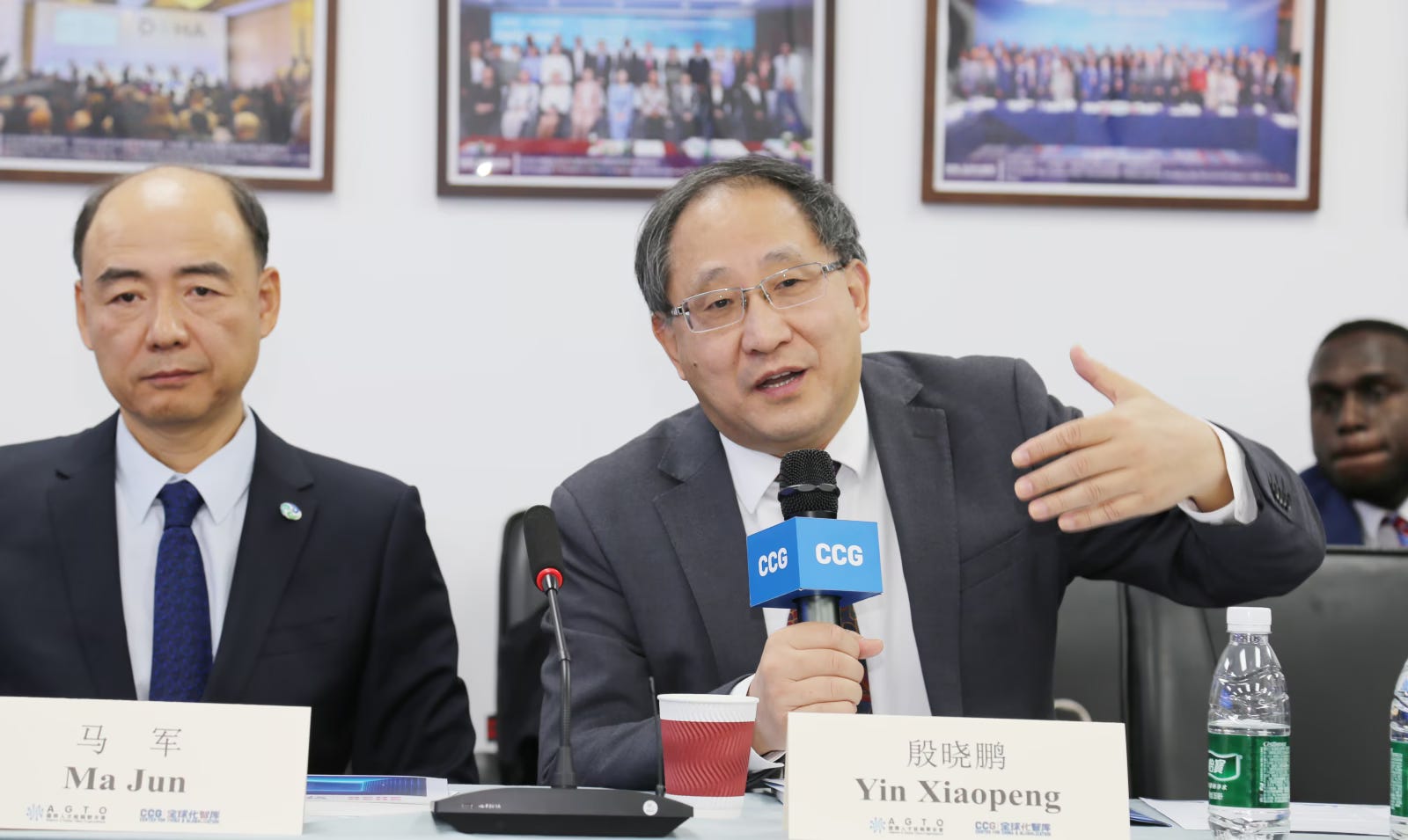
Okay. Thank you. Thank you for CCG’s invitation. I’m very happy to see Mr Lamy again. We have seen each other a couple of times.
I know time is limited, so I’ll try to address the two key points. What I want to say here is, number one, to address the WTO issue, and number two, to address a question raised by the two keynote speakers from Europe. So maybe two things.
The first is about Europe.
I know there are lots of arguments right now that the European Union is trying to side against China. Internally, it has set up lots of rules and wants to block China in some areas.
I’m a trade economist, working at universities in different countries for more than 30 years. So I want to stress one thing. When I learned international trade economics, from the beginning, the first course taught me about comparative advantage. Say, two countries: you do Industry A, I do Industry B, because we do have competitive advantages, right? So eventually, we focus on our industries where we have competitive advantages, and we trade, and both benefit. That’s the basic principle I learned when I was an undergraduate, and dear professors always talked about this.
And you see, trade between China and the European Union has almost served as a model for a long time, right?
I think one of the former ministers — well, I don’t want to say the name — talked in France about how we produce, say, 800 million T-shirts to exchange for one Airbus. But that’s comparative advantage.
Now we say that China produces lots of goods, with value added increasing, sent to Europe. But according to this model, Europe can send its competitive-advantage products to China. That’s balanced.
But in some, I say, maybe now the most important commodities — Europeans do have advantages, but they don’t want to sell them to China because of American pressure.
For example, it’s a very good example, because many countries have mentioned this case many times. In the Netherlands, there’s a company called ASML. They produce, I think they call it a lithography machine, which cuts the stuff in the chips for computers. And the chips can be used in many things, not only computers, but cell phones and everything. They do have a competitive advantage.
Okay, they say it’s a very expensive machine. I think one machine is worth more than 100 million to 200 million dollars, very expensive. And China needs it. So if you can sell it to China, and China sells automobiles to you, then you can balance the trade.
But now they cannot sell to China because the Americans say, “Hey, stop it. Don’t sell to China.”
But if you cannot sell this high-value stuff to China, what else can you sell? You de-industrialise. So, basic commodities, a lot of things you can sell. Well, France can sell wine, but the value is not enough, right? You can sell French wine and Italian wine, very, very good wine. I keep some wines at home as well, but it’s not enough. It’s a small budget for my consumption.
So if you want to balance trade, you take your competitive advantages and do that, and then you make money. Trade is balanced. But you don’t want to, and you cannot do it. You don’t want to do Industry B, but you cannot do Industry A. So what do you do?
My students keep asking me this question. I said, “Sorry, I can’t answer you. My education taught me from elementary school to PhD, but now it doesn’t work. I don’t know what to do.”
I guess it’s a very important thing for the European Union. They argue about whether you want to import Chinese electric vehicles or something. But this technology is developing very fast. It’s more than internal combustion engine technology. I’m not an expert; I know nothing about that. But what I got from some information is that internal combustion technology and innovation are growing very, very fast.
Every couple of years, maybe some companies go bankrupt. If Europeans still want to do it this way, I know Volkswagen and other companies in Germany are cooperating with China to develop new technologies, which can eventually be shared. That’s one way that could partially solve the trade imbalance problem.
One more thing I want to mention concerning the WTO. I think lots of articles and people have mentioned competitive neutrality and environmental issues many times. Of course, that’s a very important thing. But I want to mention another thing that hasn’t been discussed too much: AI.
AI will reshape trade maps dramatically in the future, maybe forever. And maybe lots of countries may suffer. China and the US are the first group to do that, but it’s very costly. I don’t think both countries can do too much in this way. That’s why President Trump mentioned that the US and China should have a dialogue on AI development, because it’s too costly. It costs too much money. They can’t afford it.
When other countries are not at the forefront, they will fall behind. And what about developing countries? They could fall into the trap of permanent poverty because they cannot do it.
And can you have money to buy copyright? We do have intellectual property protection, so you cannot get it for free. But how can you buy it if you have no money? So what do you do?
I’m really worried about that. It’s a big issue. We cannot avoid it. It’s a trend. You have to face it. You have to try to survive and adapt to it.
But I think AI issues may be more important than other issues. When it comes to WTO reform, if we are not targeting a certain country or a certain rule, but really want to think about the future, I guess this is a very important thing. That’s my personal view.
Xu Shanda, Former Deputy Commissioner, State Taxation Administration
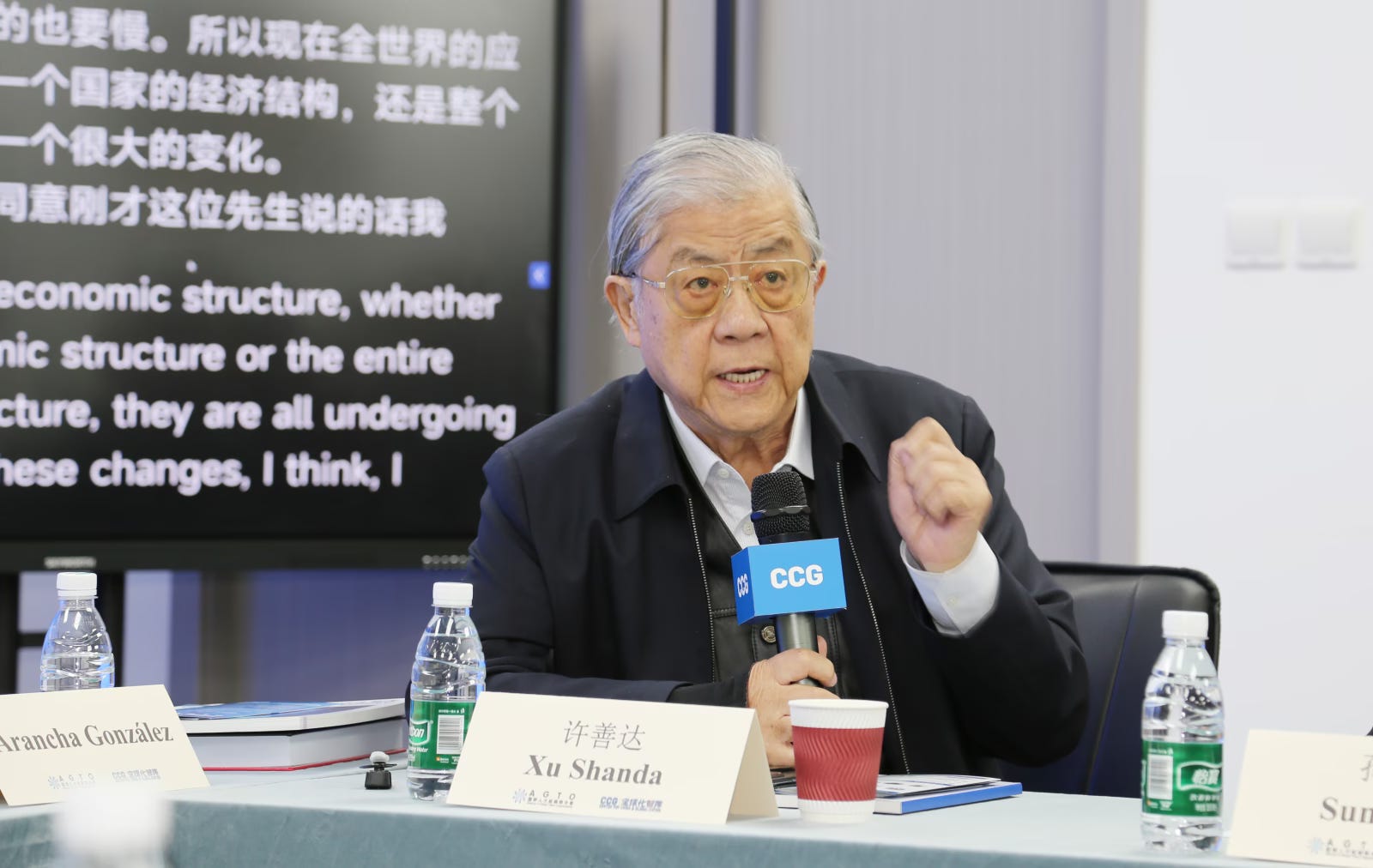
[Speaking in Chinese] I’m afraid my English is not good enough, and I don’t want to express myself poorly. Would it be alright if I spoke a little Chinese and had it translated? Thank you.
Actually, Mr Yin has already covered what I wanted to say. I think, as the experts have just mentioned, the WTO is facing some difficulties in its work as an organisation. The progress of new negotiations is not as slow as people might imagine. So the economic structures of the world, whether those of individual countries or of the global economy as a whole, are undergoing major changes.
I very much agree with what the gentleman just said. From a global perspective, experts have recognised that, as early as 2022, some renowned experts around the world concluded that global productivity had entered the era of artificial intelligence. This marks a new stage in the development of productivity.
Now, if we look back, Britain was the first to develop boilers and steam engines, right? Later, in 1945, the United States began developing semiconductors, right? The development of these new technologies is not about individual technologies alone; it affects the entire level of productivity.
Now, renowned experts around the world agree that we have entered the era of artificial intelligence. AI will have an impact on every aspect of the economy. Whatever your original profession or field, you will have to address artificial intelligence. I think this transformation will happen even faster than the semiconductor revolution, much faster.
In fact, I think some recent geopolitical developments and tensions between countries have already become connected with artificial intelligence. One important reason behind the recent negotiations between the United States and China is that, initially, the United States stopped selling chips to China, and China also stopped selling certain things to the United States. The two sides then had to negotiate. I think this is all part of the impact of the AI era on the economic structures of countries and on geopolitical relations between them.
So, I particularly agree with the remarks made by the experts just now. I believe that the global economy will continue to move forward, whatever twists and turns it may experience. This applies to every country.
This trend is ultimately about negotiations between countries and how interests are distributed in a way that promotes economic development and ensures a reasonable distribution of benefits. But progress cannot be stopped.
Therefore, I think that when we study the next steps, including possible WTO reforms and other international negotiations, we must fully take into account the new impacts that artificial intelligence will generate in the near future.
Now, as I understand it, China has been going through this process over the past few years. As several speakers mentioned earlier, we went through a stage of industrialisation. When the People’s Republic of China was founded, we were an agricultural country. We then began to pursue industrialisation, and China’s accession to the WTO, in particular, greatly accelerated the development of our industrialisation path. That is history.
Now we are facing new problems. The application of artificial intelligence has already begun to affect China’s economic structure. There are two major factors in this transformation.
The first is that the demand for capital has increased dramatically.
In other words, the ratio between labour and capital will undergo an adjustment. For the same task, the amount of capital required will increase far more than the amount of additional labour needed. In many fields, the demand for labour may even decline. This is a new situation that has already emerged.
Second, as our country’s economic structure is adjusted, some production sectors outside the field of artificial intelligence are also being affected, and the number of workers in certain sectors has begun to decline. As a result, many new business formats, or new forms of economic activity, are emerging across China’s economic structure.
I think these are issues that our country needs to consider. I participated in China’s 1994 tax reform. At that time, the main policy guidelines we worked on were designed to promote industrialisation.
But after all these years, in the era of artificial intelligence, many of the policies that were originally designed to promote industrialisation are no longer fully suited to these new business formats.
So we are now considering how to make our policies better adapted to the changes brought about by the era of artificial intelligence.
We are still in a transitional period. We cannot yet say that we have fully entered the era of artificial intelligence. But this transition is already bringing numerous contradictions and challenges to economic development.
Therefore, when we study international relations, including bilateral and multilateral relations, I would suggest, as I mentioned earlier, that we give full consideration to developments in artificial intelligence, its impact on the economy of each country, and its implications for relations between countries. All of these should be important subjects for discussion.
Henry Huiyao Wang
Thank you, Director-General Xu, former Deputy Director-General of the State Taxation Administration.
I saw Tim Stratford was here. He was an Assistant USTR many years ago, but also a partner at Covington & Burling in the US.
Timothy Stratford, former Assistant United States Trade Representative
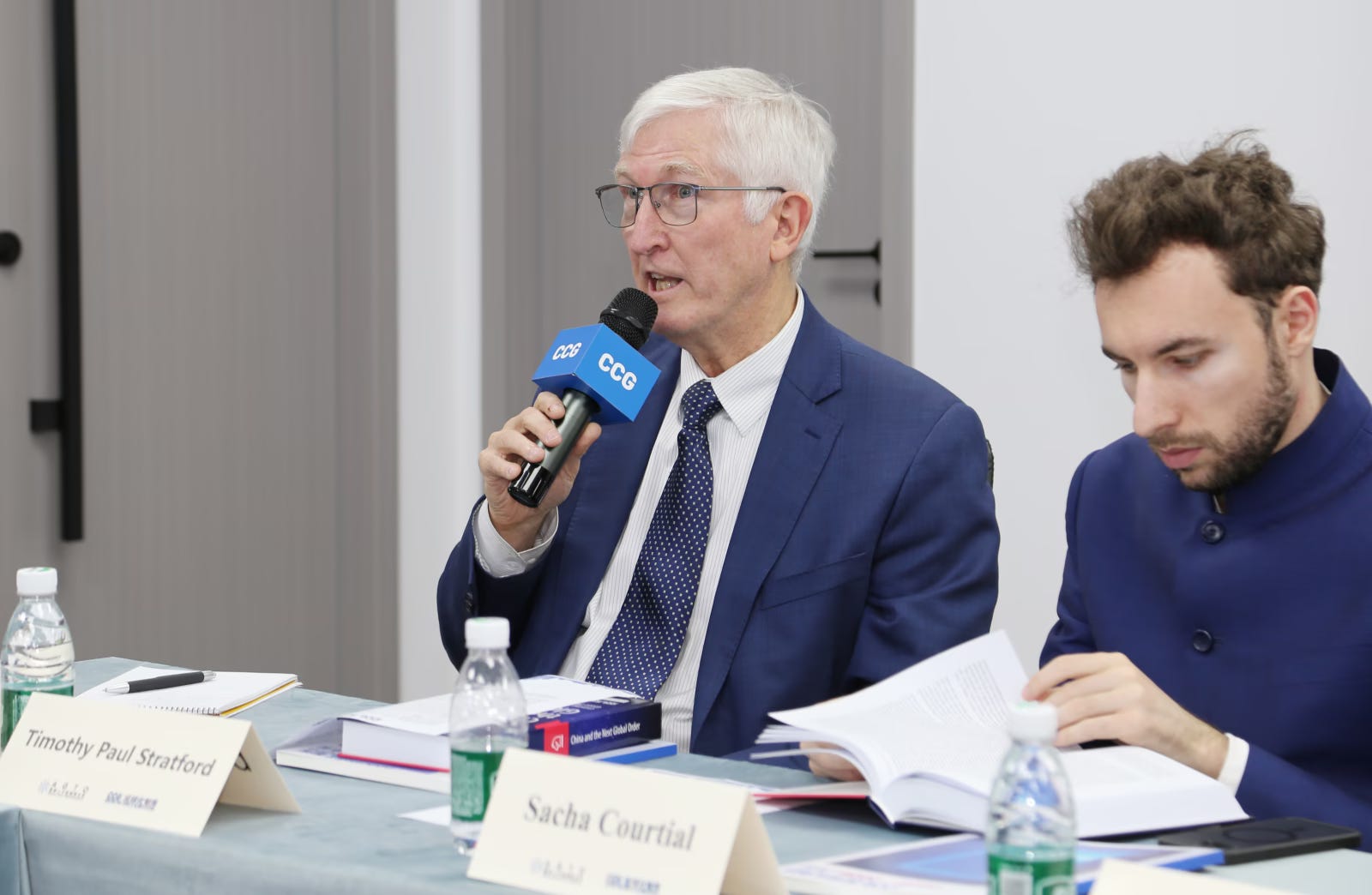
Thank you very much. I’d be very happy to share an American perspective. And thank you for the invitation. I just by chance arrived in China last night and found out about the conference last night.
Back in 2001, when China joined the WTO, I was serving as the Chairman of the American Chamber of Commerce in China. When Minister Shi Guangsheng came back from Doha after signing the documents, we had a big banquet, and I sat next to him.
I said, “Congratulations. This is a great accomplishment. It has taken many years to negotiate China’s accession to the WTO. Some people say that you will not keep your commitments, but I disagree with them, because you wouldn’t have spent so long negotiating the language very carefully if you didn’t take your commitments seriously.”
However, I also said, “I’ve worked as a lawyer in China for 19 years now, and based on my experience, I think you will very aggressively exploit every loophole and every grey area in your commitments.”
Minister Shi looked at me, and he said, “你很了解中国 (You really understand China).”
Now, as we look at what has happened over the past 25 years, at that time I was General Counsel for General Motors in China. So I’m very familiar with all the challenges of the auto industry over the years that Mr Huang talked about.
So, where are we now? China now has evolved into a superpower.
The analogy that I use is a game of football. This is the way I compare the US-China trade relationship. You might be saying, “What does an American know about football?”
So we come to the football stadium to watch the game. On one side of the field, you have the winners of the American Super Bowl warming up to play. And on the other side of the field, you have the winners of the World Cup warming up to play.
Both teams are very good at football, but they have a very different idea of how you play the game. It’s very difficult to imagine how the two teams can play on the same field with different rules and different goals. And I think that is where we are in US-China economic relations right now.
China has been very successful in developing its model. The company I used to work for, General Motors, was a leader in the auto industry in China. And now they have been writing off huge losses. This is because of how competitive the Chinese auto industry has been.
But we’re also playing by different rules. It’s hard to persuade China to change what they do because it’s worked pretty well for China in many respects, but it’s damaging to other countries in some respects as well.
So what do we do about this?
I’m a great believer in globalisation. And as Henry mentioned, after I worked at General Motors, I was the Assistant US Trade Representative responsible for trade with China.
Here’s the problem. I think that, as we heard about comparative advantage, globalisation is an optimal way to have economic relationships between countries. But globalisation, we’ve come to see, is very fragile. There are certain conditions that have to be in place in order for globalisation to be sustainable, and I’d like to mention six.
First of all, you’d have to have a set of rules that will guarantee that companies and countries can compete in a fair way. So subsidisation and protection of intellectual property are examples of things that we understand. If companies don’t follow certain rules, and if countries don’t follow certain rules, the competition will not be fair and sustainable. So the rules have to deal adequately with the conditions for fair trade.
Second, you have to have a quick, efficient, and effective way to enforce the rules. If it takes five years to go after a country that’s not following the rules, by the time you’re done, the problem, the damage, has already been done. So you have to have a prompt and effective dispute settlement mechanism.
Third, you’ve got to maintain a consensus in all the major trading countries that globalisation is good for them. Because if the populations think that it’s not helping them, they will pressure their government to move away from globalisation.
Now, in order for the populations to support globalisation, they need to think that the benefits and burdens of globalisation are being allocated fairly amongst different parts of the population. And if they’re not, people will begin to object to globalisation and to following those rules.
Also, people in your country need to feel that your country is not being taken advantage of by other countries.
So that’s the third condition: maintaining political consensus to support globalisation.
Fourth, you need to make sure that you have rules that protect the environment and that protect workers. If you can get ahead in competition because you don’t pay the expense to protect your environment, we don’t want a world where people are incentivised to treat the environment poorly or to treat their workers poorly. So we have to deal with that question in an adequate way.
Fifth, we learned during the pandemic that our economies can be fragile, that if we rely too much on sourcing from different places, then there can be problems that will have a very serious negative effect.
So each country needs to be allowed to safeguard its economic security. And how do you do that in a way that’s consistent with MFN and WTO rules? This is something we haven’t worked out fully.
Sixth, countries also have to be able to protect their legitimate national security interests.
We can talk about comparative advantage, but if you don’t trust a country you’re dealing with that they will use everything you’re selling it in ways that are benign, then you’re going to have to protect your national security.
So we have these six conditions that I would mention that are necessary for globalisation to be sustainable. And how are we doing in each of these six areas?
I think we have major challenges. And unless we can address those issues, we should be concerned about the sustainability of globalisation. I think those are some of the stresses and strains that we’re feeling in Geneva now with the WTO.
So I appreciate the opportunity. People in this room, I think, are committed for each of our countries to have the benefits of globalisation. But we’re going to have to be more effective in addressing these six conditions. Otherwise, our soccer team and our football team are going to have a very hard time competing together on the same field. Thank you.
Henry Huiyao Wang
Thank you. Maybe I’ll just briefly ask whether the Ambassadors have any comments. The Ambassador from Türkiye?
Selçuk Ünal, Ambassador of Türkiye to China
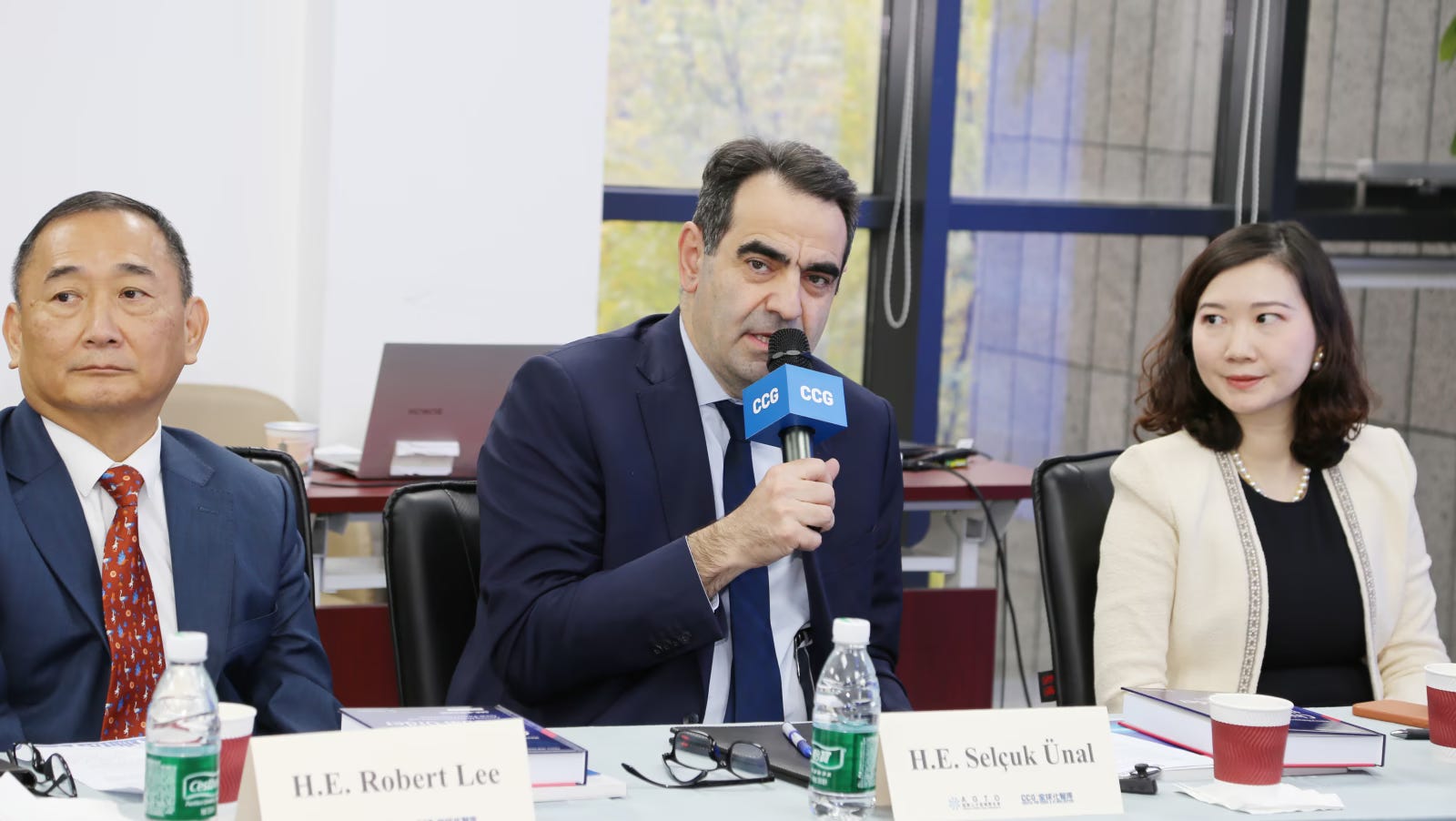
Thank you very much. Actually, I was going to take the floor, but since Mr Ma Jun has referred to us twice, I thought I would say a few words about COP31.
Yes, we believe that it has to be taken from an action-oriented perspective. We have to take action, and that’s why we have been consulting with China a lot.
As you might know, when our Minister of Environment took up the role of COP31 President, he first wanted to come to China to consult on what you were thinking, because we know that you also wish to host COP33. He came and had extensive and great meetings and consultations.
And I think consultation is the key here.
I know you have given a very nice speech at the WTO, and our Ambassador there responded to you. I will not go into the details. We, as Türkiye, are totally supportive of multilateralism. But we are also aware of the fact that a treaty stands as long as it stands. We have to take care of this unfortunate fact.
I’m not an expert on trade, and I cannot speak on behalf of such distinguished experts, but if the WTO is dead, we all have to look into the reasons why it has been killed.
I’m not trying to imply one country or another. I’m not taking sides on that, but we shouldn’t be taking sides. We should look into the root cause of it.
And there, I think the keyword is dialogue, as we have had with environmental experts. Everybody, I think, needs to think about this twice.
And the gentleman very nicely referred to the figures, even Türkiye. But our trade surplus is not comparable with China’s. So I’ll tend to watch twice. Thank you.
Henry Huiyao Wang
Okay. Ambassador Lee, a brief comment?
Robert Lee, Ambassador of Fiji to China
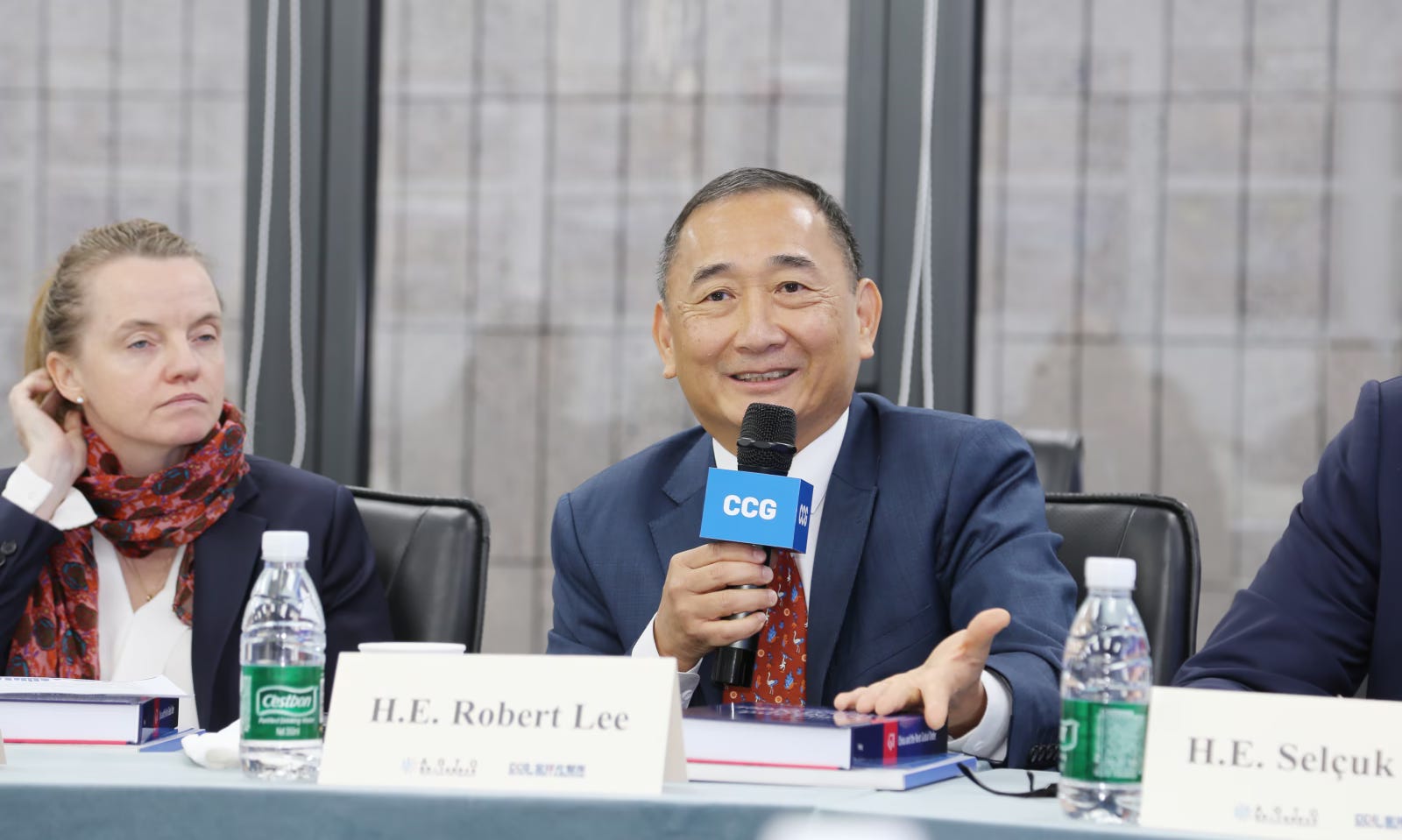
Thank you, Henry. I’m from Fiji, so it’s a very small country, and I feel very humbled to be amongst this group here, talking about China’s accession to the WTO and its 25-year history.
I want to make two observations, more from a personal point of view, in the context of this discussion.
First, from the perspective of a small country like Fiji, I take note of your comment, Timothy, that the sharing of the benefits of globalisation within countries has to reach the population. You have interest groups that, of course, lobby, etc.
In small island states, we have something deeper than interest groups. We have family groups. In a small population, everybody is connected by family ties or village ties, and that is more powerful than political interest groups.
And because of family interests, change and adaptation to global forces are so much harder. It is so much harder. So I make that observation that small island states have that as a huge hurdle to overcome.
The second observation I want to make is that recently China has offered Africa duty-free access.
For small island states, you are coming from a position of relative smallness, where you are being told under WTO rules, “Well, we can’t do this for you because it’ll open up Pandora’s box. It’ll set a precedent,” etc.
Put it in reverse. In an offer to Africa of unrestricted access, almost, to the Chinese market, that box has been opened. That box should have been extended essentially to the whole Global South, especially to small island states, because the mental barrier of globalisation is hard to overcome when you see other countries getting access and you are being left out.
This mental barrier then impacts the political arena in the island states themselves, because you feel that you are being singled out, that you are not welcome, that you are not part of the system.
So, in this forum, I just want to make this appeal: China should have offered, unilaterally, access to the Chinese market to small island states at the same time as it offered Africa access, for this reason. The geoeconomic impact would have been big, but the geopolitical impact on China would have been very small.
Okay, by doing that. So I just make those two observations.
Henry Huiyao Wang
Thank you, Ambassador Lee.
I understand that Arancha has to go to another meeting, but perhaps you could conclude first. Then I’d like to ask Mr Li from the WTO Department of the Ministry of Commerce to say something as well. After that, Mr Huang and I can offer some concluding remarks. If you’re in a rush, perhaps you could go first.
Arancha González
I have no major comments to offer. I thought the conversation was very important as a starting point to build trust.
I think that’s the biggest problem we have today: how we build trust. Of course, each side will be looking to defend its own space, priorities, and interests, and that’s okay. But at some point, interests of everyone intersect with those of others.
So what I take away is the necessity to have more spaces like this one, where we can be candid about where the difficulties are and propose a few avenues for building trust.
And thank you, Henry and Mabel, for convening us together today.
Henry Huiyao Wang
Thank you so much, Arancha.
Perhaps I could now invite Mr Li from the WTO Department of the Ministry of Commerce to offer a few comments. You work in the WTO Department, so you can also share some observations with us.
Li Jiangtao, Department of WTO Affairs, Ministry of Commerce of China
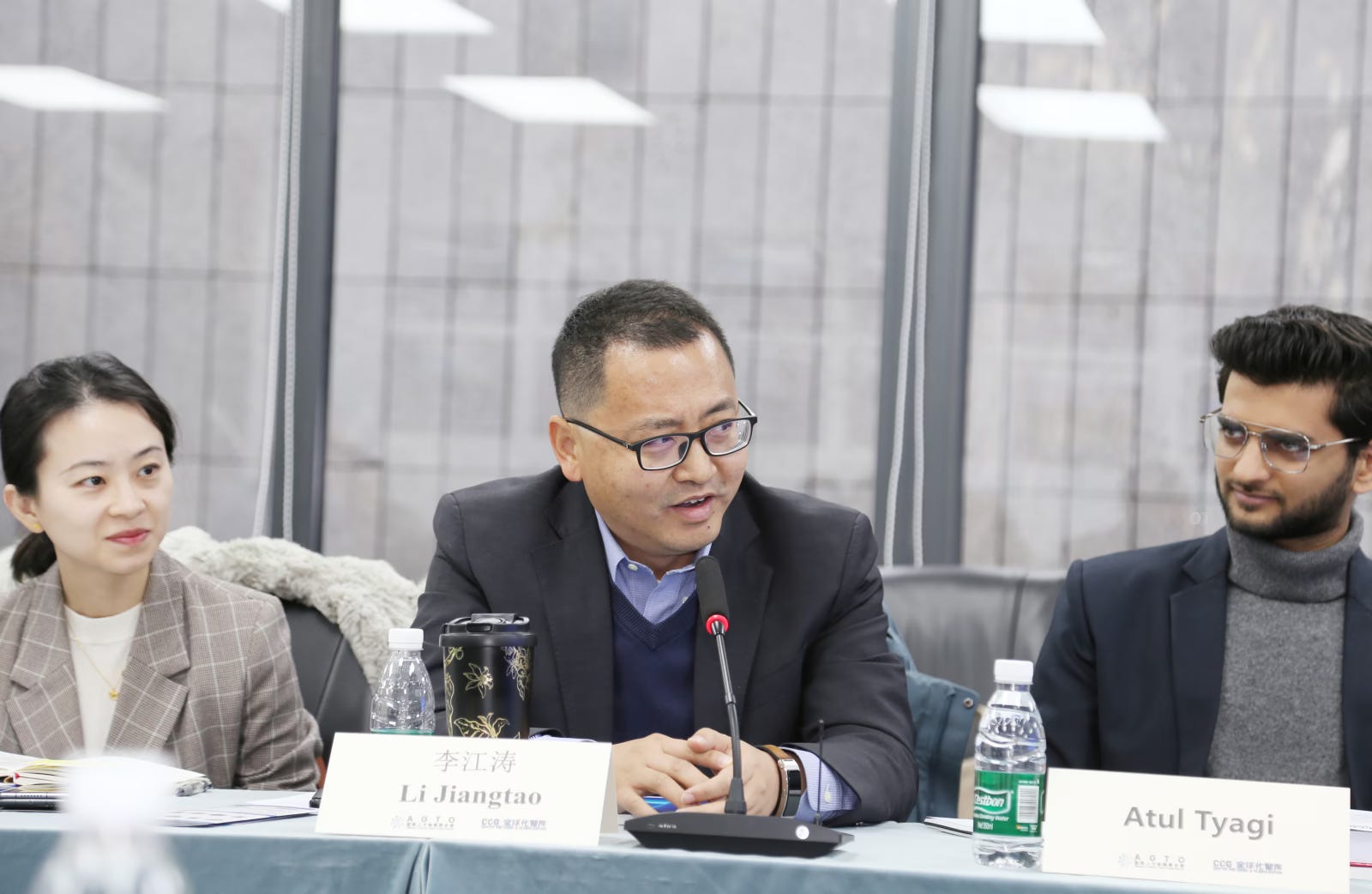
Thank you for the invitation. I’m also so delighted to personally meet Director-General Pascal Lamy.
I still remember, when I first joined the Department of WTO Affairs, Mr Huang was my boss, and we were learning through the e-learning programme offered by the WTO. There was a certificate signed, maybe automatically, by Pascal Lamy.
So I think one factor contributing to China’s success when we joined the WTO and achieved what we did was that we had been good students.
That’s why today I’m all ears. As a working staff in duty, we value your input, from both Henry and Pascal Lamy, Ms Arancha, and all the other senior former colleagues. We show our respect, and I think we will incorporate your suggestions into our policy proposals to see how we can work better over the next 25 years.
We also want to congratulate the Republic of Türkiye on a successful COP31. I visited the Republic of Türkiye about half a year ago.
And I think, for the Global South, we can do a better job in the coming WTO reforms, but we do not want to exclude the US. We know there are different rules, as you said, between soccer and football, but I think there is common ground that we can find. Thank you.
Henry Huiyao Wang
Yeah, thank you. Really great comments. You can see how we were all trained by the WTO at that time. I remember there was also a lot of learning involved.
Actually, I would describe the WTO as an economic revolution for China, and everyone was affected.
So maybe I’ll invite Pascal Lamy to give his concluding remarks before Mr Wang delivers the final remarks.
Pascal Lamy
Well, first, thank you for the conversation, which I found to the point. One of the great privileges of being an old monkey is that you can learn every day. So I did learn a few things this morning.
Just a couple of short reactions.
First, listening to Arancha, listening to Henry, listening to Chairman Huang, I have a lot of agreement with what you said. Not on everything, but on the stance, including the way forward, which Henry mentioned: investment, targeted temporary containments. That’s, I think, the way to go.
Second, if I look at the way forward, which I did not develop in my initial remarks because I had to focus on the big picture, and coming from the conversation, I would say there are four possible avenues to address the Chinese trade problem.
First would be a global dialogue on macroeconomic imbalances, including the huge structural US macroeconomic imbalance, which is exactly the reverse of the Chinese one. China produces too much as compared to its domestic consumption. The US consumes too much as compared to its domestic production and has a level of budget deficits which is becoming unsustainable.
That would be the sort of dream solution. We get to some sort of global understanding on how to manage these imbalances. The odds of doing that are, let’s say, limited.
Second, WTO reform, and notably in areas where, as Mr Stratford said, there are insufficient level-playing-field conditions in some areas. And of course, I would put subsidisation, let’s say state support, in this bag.
This has been on the table for a long time. There are a variety of reasons why it has not moved. And if I sit in the boots of China, I can see why I’m not that keen on moving my position forward. I benefit from the sort of subsidy loophole in the WTO.
Then there’s a third avenue, which is bilateral arrangements. If global doesn’t work, if multilateral doesn’t work, then you have to go bilateral.
And there is some scope for that, because whatever bilateral trade arrangement, at least in the case of the EU-China relationship, with a 350-billion trade deficit a year, can only cover a relatively small part of it.
I’m not saying this is not an avenue to pursue. We have to do it. But we have to do it knowing that this will not solve the problem.
With that, we can fix a series of urgent issues, notably those in Europe where industrial sensitivities are where they are, with the political and social consequences I alluded to. So that’s something which is doable.
And finally, the fourth avenue, which is where I believe the real issue lies, is doing our homework.
We in the EU have homework to do in improving our competitiveness and in growing our market, not just geographically, which we do, by the way.
If I’m a foreigner looking at the EU market, I look at the EU market 10 years from now, which will be much larger than what it is now. And we also have to make it deeper, i.e. move from, let’s say, 1 to 1.5 per cent growth potential to, let’s say, the US level of 2 to 2.5 per cent. That would make a big difference in terms of the competitiveness of the EU.
I think China has its own homework to do, including this rebalancing between consumption and production, which we’ve been hearing about for the last 15 years — less and less, by the way, in official pronouncements.
When I compare the Chinese leadership’s narrative on this 15 to 20 years ago to what we have now, there is a clear diminution in tone. And what has gained ground is technological and industrial production, which, in my view, says where part of the problem is.
Finally, to react a bit more precisely: reviving, revamping, reshaping, re-something, the EU-China investment treaty. Yes.
Now, we know it was frozen for political reasons stemming from sensitivities on the Uyghur question. This is a disagreement, clearly. But it’s strange for the EU to remain in a situation where the US has better treatment than the EU investment-wise in the Chinese market. If I were the US, I would not complain, but as a European, we have a problem.
On WTO reform, yes, no doubt. Let me repeat that WTO reform is a twofold issue.
First, modernising the rulebook. We know that in the environment, digital issues and so on, there is a lot to be done.
But there is also a second aspect, which is reforming the way the organisation organises itself, and this rebalancing between the member states and the Secretariat, reviewing this notion that the WTO is a member-driven organisation.
In my view, the WTO should remain a member-driven organisation, but it should also become a Secretariat-driven organisation. No serious institutions rely only on consensus among their members. You need a sort of engine to move things forward. The Secretariat of the WTO could do that, and it is, in my view, vastly underused.
Lastly, to answer the first question, Mr Sun. More cooperation, yes, but on two conditions.
First, we have to do a better job in a common diagnosis.
For the moment, if I simplify, Chinese officials say: “The trade deficit is your problem. You’re not competitive enough. We are competitive. Do your job at home.”
And we say: “No, no, no, no. That’s not the problem. This is not a trade problem. Yes, we have a bit of competitiveness to address, but your problem, not our problem, your problem. Only China can solve the consumption-production imbalance.”
So, as long as there is no common diagnosis on this, and I’m not saying I can do that easily, but I’m sure if a bunch of good people were mandated to come to a common diagnosis, which of course would be a bit unorthodox, you lock them in a room for 48 hours, and you don’t feed them, and you don’t give them anything to drink during those 48 hours, they will come up with a solution. They will come up with a common diagnosis of why we have this problem.
And then the second condition, I believe, which has also been suggested, is to look beyond the trade issue.
Of course, we have this major things, and this is where we have a lot of political sensitivities in Europe because of political, social, and industrial reasons. But we have to broaden our agenda, including doing more together on the environment.
I’ve been making a series of proposals on this during my week in China. I’ll be speaking about this again this afternoon at CEIBS. The environment, the ocean, and artificial intelligence are avenues where we have to exercise responsibility vis-à-vis the rest of the world.
And I totally agree with that. If we put our relationship at this level, we are both big. The EU is weaker in terms of institutional integration, geostrategy, and military capacity than China, but we still have a major and deep market which China needs. So if we look at our relationship from this angle, it’s quite easy to come to the conclusion that we have to do better.
And this is the concept I’ve been trying to, I’m not saying invent, but develop throughout this week in discussions with a number of Chinese interlocutors.
This concept is not the equivalent of Xi Jinping’s concept of strategic stability, but it is inspired by the same notion that maybe you have some sort of guiding something that can help frame the relationship. This concept is responsible interdependence.
And thanks to Sasha, who happens to be not just a fluent Chinese speaker but also a good translator, I’ll give you the Chinese name of that. Please forgive my pronunciation. Responsible interdependence is 协同合作,共同担当.
That’s my idea of the week. Many thanks for your attention.
Henry Huiyao Wang
Thank you, Pascal, for your very stimulating and very encouraging concluding remarks, which I think are very good. I’d like to pass on to Mr Huang to give the final words.
Huang Rengang
Thank you, Henry, for this very interesting discussion.
I like the speeches by all the people who have taken the floor today, because I think their thoughts are so informative, enlightening, and thought-provoking. It’s very useful for us to understand today’s situation better, and it’s very useful for us to understand each other better.
I think my feeling is that I like Pascal Lamy’s conclusion very much. We have to find ways to survive in a world of globalisation, or we have to find ways of interdependence. We should not be trying to find a way of decoupling. That’s no good for us or for the world economy.
As the second-biggest economy and the number one trader in goods, China has a lot at stake in maintaining productive, good relations with every trading partner. Actually, China wants to maintain good, positive relations with all its trading partners.
China, I think, has time and again reaffirmed its strong commitment to supporting the multilateral trading system as represented by the WTO. Of course, we understand that the WTO is now facing some crises and problems. It has to reform to become more relevant, efficient, and useful. And I think China is ready to sit down and, through discussion and negotiation with WTO members and trading partners, see how we can do that.
Actually, my observation is that China is ready to further open its market, boost the level of consumption, seek more imports, and try to balance trade where possible.
I would also say that China is open to discussion on any of the topics we touched upon, including the so-called level playing field, subsidies, government interference, or whatever, and new topics such as the environment, e-commerce, and AI.
Some speakers mentioned the impact of AI on trade. I don’t know, but some speakers gave us the impression that AI only poses a threat and produces negative impacts. Actually, AI can bring a lot of positive impacts to trade, e-commerce, and everything.
So maybe the good attitude is to face reality. In France, we call it [unclear]. We embrace life, understand it, and welcome it. We try to take advantage of it rather than having a pessimistic vision.
I’m an optimist. I believe that the world economy will continue to grow, and that trade, the flows of people, finance, goods, and services will continue. Thank you.
Henry Huiyao Wang
Thank you. Okay, I think we have run out of time for today’s roundtable discussion commemorating the 25th anniversary of China’s accession to the WTO and looking at the future of the global trading system.
I think we have had many good ideas, many good suggestions, and many good comments from our keynote speakers, commentators, and ambassadors. It has been a very productive, highly informative and inspiring discussion.
Unfortunately, many representatives of multinational enterprises and other scholars were not able to speak because of time constraints. But we encourage you to exchange views with them after our session.
Just to conclude, I strongly agree with Pascal Lamy and Director-General Sun Yongfu that perhaps the Comprehensive Agreement on Investment should be revived, because we do see considerable interest among Chinese companies in investing in Europe. I think that if we revive it, we could make the trade balance much more balanced.
Second, European companies have a great deal of interest in joint ventures. US companies and many others, including Japanese companies, have established major joint ventures in China. We should encourage these joint ventures to expand into their respective countries and the Global South. That would be another way to achieve this.
Finally, I think we could also explore energy cooperation. For example, Europe is now suffering heavily from high energy costs. We can work with Africa on green power and solar panel systems and then transmit that energy to Europe. So, using Chinese technology and European investment to secure Europe’s power supply, and coupling that with other forms of cooperation.
Finally, I totally agree with the conclusion we have reached: we need more dialogue, more consultation, a better understanding of each other and a common diagnosis, as Pascal mentioned.
This has been a very good roundtable commemorating the 25th anniversary of China’s accession to the WTO. We are going to prepare a good summary of this discussion and transcribe what we discussed. We really look forward to further discussions in the future.
Once again, I want to thank our keynote speakers, Pascal Lamy, Arancha González and Mr Huang Rengang, as well as our ambassadors, distinguished Chinese scholars and, of course, Tim Stratford, who came all the way from the United States yesterday to join us.
So, thank you all very, very much.
CCG Holds Roundtable Marking 25 Years of China’s WTO Membership

On the morning of 7 November 2026, the Center for China and Globalization (CCG) held a roundtable discussion entitled “The 25th Anniversary of China’s Accession to the WTO and the Future of the Global Trading System” in Beijing’s administrative center.
