


The United Nations Development Programme (UNDP) has just published Monitoring China’s Human Development, assessing economic and social progress, as well as environmental costs, across Chinese regions and cities.
Below is the Executive Summary and full report.
As China concluded the 14th Five-Year Plan period (2021-2025), comprehensively assessing human development progress, and how it can be sustained, is vital to informing future development priorities. As China transitions towards people-centered “high-quality development” as affirmed in the 15th Five Year Plan (2026-2030), the country faces multiple opportunities and challenges, including shifting growth drivers, demographic changes, regional imbalances, and growing environmental pressures.
To inform pathways towards sustainable development, this report applies a human development lens to assess progress. Within this broader framework, it uses the Human Development Index (HDI) and related indicators as practical tools for measurement and comparison.
Its value addition is twofold. First, it estimates HDI values not only at the national level, but also at the provincial, and prefectural levels for a more granular map of progress and challenges. Second, this report for the first time introduces estimates for the Planetary Pressures-adjusted Human Development Index (PHDI) at the provincial level, evaluating the balance between human development gains and environmental costs. Building on the country’s historical achievements, the report also examines key constraints and proposes policy recommendations for promoting sustainable human development.
China was one of the first countries to advance from low to high human development, and is rapidly approaching the threshold of very high human development. According to UNDP estimates, China’s HDI reached 0.797 in 2023, just shy of 0.800, the lower bound for very high human development.
Comparison of HDI three component indices for China and grouping averages (2023)
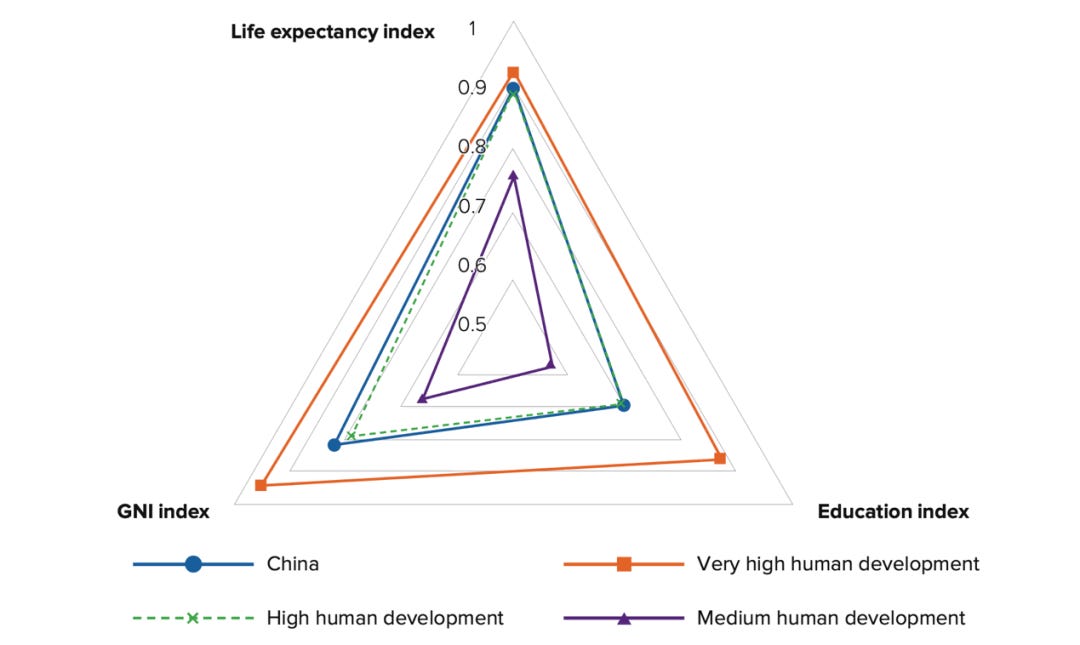
Economic growth and educational advancement have been the main drivers of China’s HDI growth over the past decade. Disposable income per capita also increased from RMB 12,500 to RMB 39,200, with real growth of about 1.4 times. This created the world’s largest middle-income group of over 400 million people. The average years of schooling for citizens aged 25 and above reached 8 years, and gross tertiary enrolment increased from 26.5 percent in 2010, to 60.2 percent. This marks a leap from higher education being accessible to a significant portion of the population, in the direction of universal access. Lats but not least, life expectancy rose steadily from 74.8 years in 2010, to 78.6 years in 2023, surpassing the average for upper-middle-income countries.
As a vast and populous developing country, China exhibits significant spatial disparities in human development levels. Building on the 2019 Special Edition of the China National Human Development Report, this report updates provincial and prefectural HDI estimates up to 2020, offering an updated detailed and granular picture of development outcomes. The findings indicate overall progress, with upward shifts in development categories and a trend towards narrowing disparities:
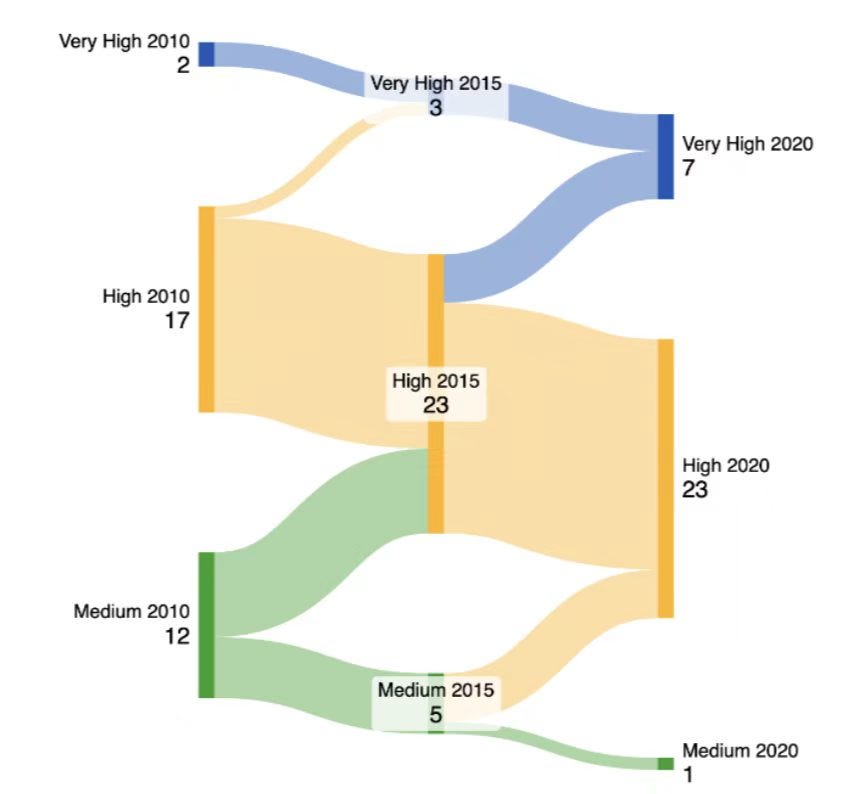
At the provincial level, the vast majority of provinces have reached high levels of human development, and some municipalities, such as Beijing and Shanghai, have attained HDI levels comparable to those of developed countries.
Changes in provincial HDI groupings over time
At the prefectural level, the number of cities reaching high or very high human development levels also increased significantly, showing a clear trend of diffusion from eastern to central and western regions, and from core cities to surrounding areas.
Prefectural-level HDI values across China, 2010 vs 2020
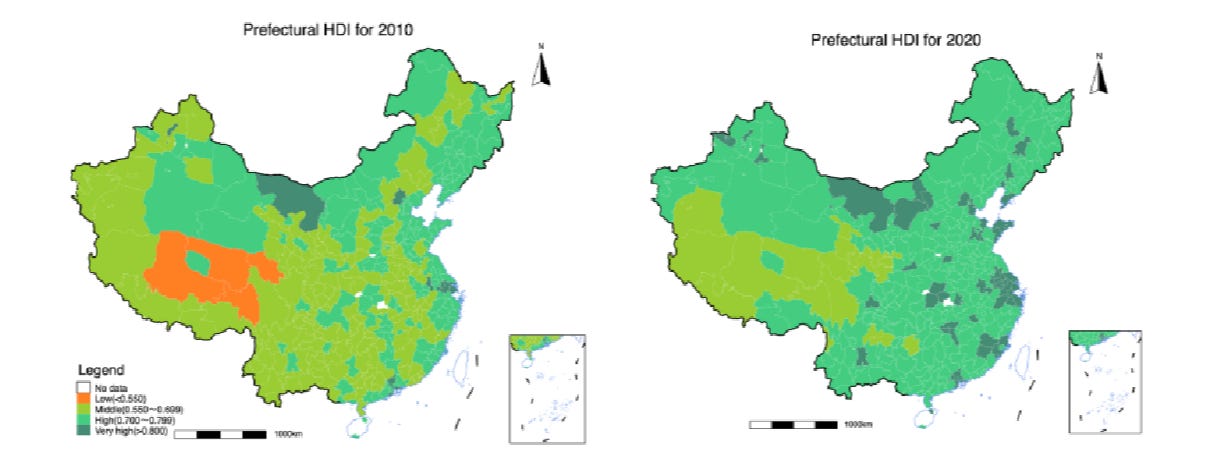
Cities with very high human development now account for a population of 442 million, or 31.7 percent of the national total, while cities with high human development account for 916 million people, or 65.7 percent, reflecting a notable expansion in the inclusiveness of development outcomes.
The Theil index of HDI among prefectures – used as a proxy measure of inequality, continues to decline, indicating a steady reduction in regional development gaps.
Amid the intertwined challenges of human development and environmental sustainability, this report also introduces the Planetary pressuresadjusted Human Development Index (PHDI) at the provincial level in China for the first time. The PHDI systematically quantifies the “deduction effect” of environmental costs on human development. By incorporating two key indicators—carbon emissions and material footprint per capita, the index adjusts HDI scores to reflect planetary pressures exerted by development. Key findings are as follows:
Based on 2015 data, high material footprints are observed not only in developed coastal provinces, but also in western provinces, where infrastructure investment has grown rapidly.
While regional policies have effectively improved development foundations, they have also led to rising pressures on resources and energy, with some regions incurring significant environmental costs.
Unlike the east-west disparities highlighted by the HDI, the PHDI reveals a more evident north-south divide. Northern provinces have experienced faster growth in material footprint and carbon emissions, leading to widespread declines in their PHDI rankings. In some areas, the gap between HDI and PHDI rankings exceeds ten places.
Global comparisons show that Beijing and Shanghai already outperform some high-income countries in resource efficiency, while northern provinces reliant on resource-intensive industries continue to incur a substantial “development discount.”
Following from the data analysis, the report identifies five structural challenges to sustainable human development in China:
Slowing economic growth may constrain further improvements in human development. Tightened global conditions, weak domestic consumption, and mounting pressure to improve productivity all play a role generating a more subdued outlook than in the past.
Educational attainment remains a key shortfall. Compared with developed countries, China still lags in average and expected years of schooling, as well as in public education spending.
Regional disparities in human development remain relatively high. Absolute differences across regions persist, while intra-provincial gaps, especially within the western region, are also notable. Some eastern provinces are also showing increasing divergence across prefectures.
Imbalances remain across different human development dimensions. Although significant progress has been made in health, education, and income, development across these areas is still uneven. In many cases, regional disparities are increasingly manifested as economic development gaps.
Environmental pressures are structural, deeprooted, and long-term. Problems such as inefficient and extensive energy use, low resource efficiency, groundwater pollution and serious waste have yet to be fully resolved.
To address these challenges and accelerate advancement towards comprehensive very high human development, aligned with the Government’s vision of “high-quality” development and socio-economic and environment commitments, the report proposes five policy recommendations to advance sustainable human development:
Anchor progress in healthy life expectancy and continue improving population-wide health outcomes. For example, by strengthening longterm care and health insurance systems.
Expand years of schooling and enhance workers’ adaptive skills, such as promoting 12-years' compulsory education and universalizing higher education.
Focus on improving income distribution and sustaining household income growth. For instance, by advancing direct taxation reforms and diversifying household income sources.
Optimize regional development policies to reduce disparities in human development across regions, such as increasing transfer payments to areas depleted by outbound migration, along with resource-dependent regions.
Foster a greener, more inclusive, and more sustainable environment. For example, by promoting the circular economy and strengthening ecological compensation, as well as carbon market mechanisms.
Access the full report on Google Drive

Acknowledgement
This report was a joint effort between the China Institute for Development Planning, the Institute for Circular Economy at Tsinghua University, and United Nations Development Programme (UNDP) China. We thank colleagues from both teams for their dedicated work. The expert group from Tsinghua University was led by Yongheng Yang, Director of the China Institute for Development Planning at Tsinghua University
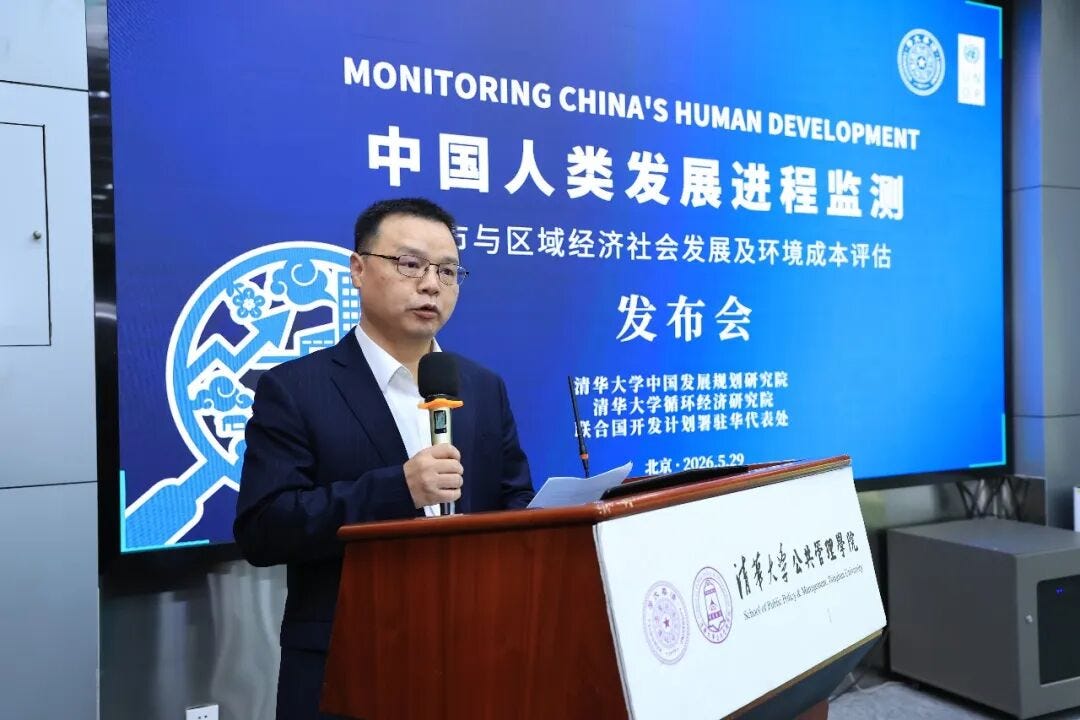
and Bing Zhu, Director of the Institute for Circular Economy at Tsinghua University. Primary authors from the group include Pu Gong, Meng Jiang, and Siyao Zhu. The UNDP team includes Rong Shi, and Xinyi Qu, Kailai Zeng, Xiaomeng Kang, Daryl Lahm and Yichao Wen for research support.
The report has also benefitted from the valuable advice and suggestions of many experts and scholars. We would like to thank Yu Dong, Executive Vice Director of China Institute for Development Planning, Tsinghua University, and Professor Wenji Zhou of Renmin University of China, for their guidance on the report drafting. We also express our gratitude to Violante di Canossa (UNDP China), for her review and valuable feedback
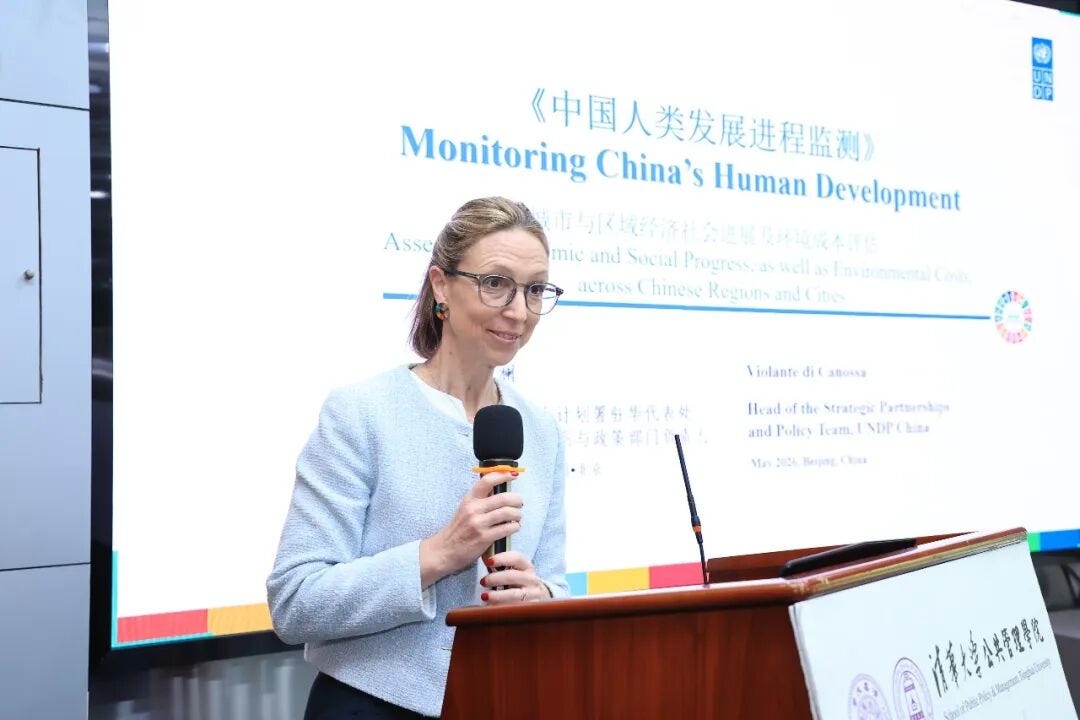
as well as to colleagues in the UNDP Human Development Report Office, Yanchun Zhang and Som Kumar Shrestha and Philip Schellekens (UNDP RBAP). Lastly, we would like to thank Roddy Flagg and Grace Brown for their translation and editing work. This report also received support from the National Social Science Fund of China (23&ZD130, 24VRC043), the joint research project between the National Natural Science Foundation of China (NSFC) and the United Nations Environment Programme (UNEP) (4161101173), and the Tsinghua University Initiative Scientific Research Program (2023THZWYY01).