
One thing I’ve increasingly felt in recent years is that as U.S.–China relations become more securitized and adversarial, both societies are gradually losing the ability — and sometimes even the language — to talk about each other as human beings.
This is partly why I found the following speech unexpectedly moving.
At the 2026 Overseas Young Chinese Forum (OYCF) Annual Meeting, co-hosted by University of California Irvine’s Long U.S.–China Institute in Southern California on May 23, 2026, Susan Mai Easterbrook Cole — the great-granddaughter of General Joseph Stilwell — delivered remarks reflecting on her family’s multi-generational relationship with China and on the wartime legacy of the China-Burma-India Theater.
To Chinese readers, Stilwell is hardly an obscure historical figure. For many generations in China, especially those who grew up before the reform era fully transformed public historical memory, Stilwell/“史迪威” represented a particular image of America: direct, principled, personally connected to China, and respectful toward ordinary Chinese people during one of the country’s most difficult historical moments.
Of course, historians can debate Stilwell’s politics, military strategy, or complicated relationship with Chiang Kai-shek. But what struck me reading this speech was something less geopolitical and more human: the persistence of historical memory at the family level across nearly a century.
Today, when discussions about China and the United States are increasingly dominated by tariffs, semiconductors, export controls, military signaling, and ideological rivalry, there are fewer and fewer spaces for narratives centered on mutual respect, lived experience, and people-to-people ties. Yet those dimensions of the relationship have not disappeared completely. Sometimes they survive quietly — in family stories, educational exchanges, archival projects, museum collaborations, and conversations like this one.
Cole’s remarks are not important because they offer some naïve optimism about bilateral relations. They are important because they remind us that even during periods of profound strategic distrust, historical memory and human relationships continue to exist beneath the level of statecraft.
That, in itself, may be worth preserving.
Below is the speech delivered at the 2026 OYCF Annual Meeting, as provided by UC Irvine’s Long U.S.–China Institute.
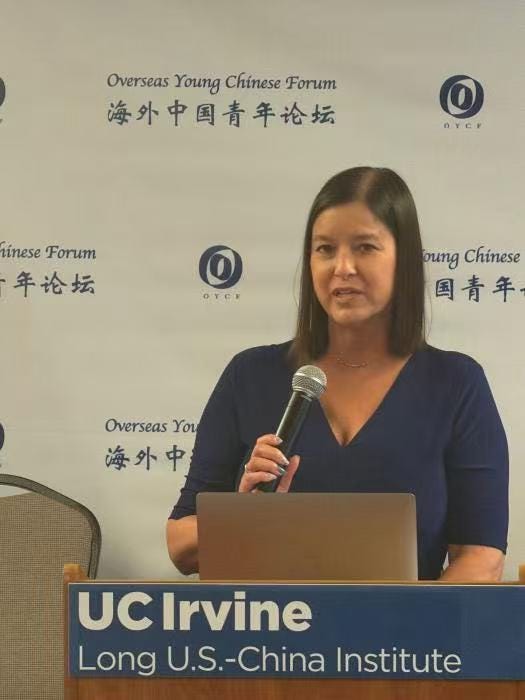
Susan Cole: “The Stilwell Legacy: Friendship, Respect, and the Enduring Power of Exchange”
Good afternoon distinguished leaders, scholars, students, and friends.
It is my honor to stand before you today at this annual meeting of the Overseas Young Chinese Forum. OYCF’s mission, to provide a platform for overseas Chinese scholars, professionals, and those interested in China’s development to exchange ideas and cultivate aspirations, is one that deeply resonates with both my family’s history and my own personal beliefs.
I am especially honored to be here not only as an individual, but as a representative of my family, and as the great granddaughter of General Joseph Warren Stilwell – a man whose life became permanently intertwined with China, its people, its history, and its future.
General Stilwell was an American military officer, but to describe him only in that way would miss what defined him most. He served during World War II as Chief of Staff to Generalissimo Chiang Kai shek and as Commander of U.S. Forces in the China Burma India Theater. His responsibilities were immense – militarily, diplomatically, and personally.
Yet what distinguished him was not rank or authority, but character.
He believed deeply in honor, integrity, humility, and service. He studied China long before the war, becoming fluent in Mandarin, lived in Chinese communities, and formed friendships that shaped his worldview. China was not, to him, an abstract ally. It was a place of people he respected, trusted, and believed in.Throughout his diaries, letters, and speeches, one theme appears again and again: his profound respect and admiration for the Chinese people.
He once wrote:
“I have faith in Chinese soldiers and Chinese people: fundamentally great… honest, frugal, industrious, cheerful, independent, tolerant, friendly, and courteous.”
This was not flattery. It was conviction.
At a time when many underestimated China, General Stilwell did not. He saw strength where others saw hardship. He saw perseverance where others saw limitations. And he believed that with fair treatment and good equipment, training, and leadership, Chinese soldiers could be second to none.
During some of the darkest moments of the war, after the loss of Burma in 1942 and amid constant shortages, his faith in the Chinese people never wavered. At one point he wrote:
“If I was not convinced that the Chinese people deserved a break, I would have thrown in my hand long ago.”
That sentence alone reveals why he was respected by those who knew him and served with him.
One of the most enduring symbols of this shared struggle is what is often called the Stilwell Road. It was a monumental undertaking built through mountains, jungles, and with extraordinary human effort.
The road was not merely an engineering achievement. It was a testament to cooperation, constructed by Chinese laborers, engineers, and soldiers working alongside Allied forces under unimaginable conditions.
My daughter and I were honored to visit the Stilwell Road last September and it was profound to walk where my great grandfather walked because for our whole family, the road symbolizes something larger:
What becomes possible when trust replaces doubt and when shared purpose overcomes adversity.
Every time we visit China and walk parts of that history – whether in museums, memorials, or conversations with old and new friends – we are reminded that the legacy of the road belongs not to one nation, but to all who labored, suffered, and persevered together.
General Stilwell judged people not by rank, nationality, or background, but by actions and integrity.
He believed leadership was about taking care of people, not commanding from a distance. At Ramgarh in India, he focused not only on training Chinese troops for battle, but also on ensuring they were equipped, fed, paid, and treated with dignity. He later established programs so wounded Chinese soldiers could learn skills for life after the war because he believed deeply in their future beyond conflict.
This was not strategy alone. This was humanity.
My sister, father, aunt, uncle and cousins grew up with stories not of glory, but of principle.
We heard about a man who believed courtesy mattered.
A man who learned languages because he wanted to understand people, not control them.
A man who believed humility was strength, and that service was the highest form of leadership.
Although I never met him, I feel his presence profoundly… through his writings, through the respect shown to him across China, and through the friendships our family has been privileged to build with the Chinese people over generations.
Our family has tried, in small ways, to honor that legacy – through scholarships supporting Chinese students, cultural exchanges, museum partnerships, family trips, and most importantly, people to people relationships that continue across five generations within the Stilwell family.
If my great grandfather were alive today, I believe he would strongly support the work of this forum and would be honored to know his name was associated with the Stilwell Fellowship that OYCF sponsors.
It represents exactly what he believed in: knowledge exchange, mutual understanding, long term thinking, and respect across cultures.
He believed that progress, whether military, social, or economic, comes not from dominance, but from learning, cooperation, and trust.
In the early 1930s, he observed that with the right leadership and opportunity, the Chinese people’s capacity for innovation and industry would be world shaping. History has proven him correct.
For the young scholars and professionals here today, the Stilwell legacy offers lessons that remain deeply relevant: Understand people, don’t see stereotypes; build trust through actions; learn the facts of history without being bound by history; believe in the power of exchange.
The future will be shaped not only by governments, but by individuals… by scholars, innovators, bridge builders, and those willing to engage sincerely across borders.
Each time I return to China, I am struck by two things.
First, the remarkable transformation—cities rising, technology advancing, ideas flourishing.
And second, something unchanged:
The warmth, kindness, and generosity of the Chinese people.
It is easy to see why my great grandfather admired the Chinese people so deeply. His respect was earned, and it has endured. He has left us an important legacy that has been passed down now through five generations.
It is my great honor to represent the Stilwell family here today.
But more than that, it is a responsibility to remember that legacy is not about the past alone. It is about what we choose to carry forward.
General Stilwell believed in dignity, courage, honesty, and friendship.
He believed in the Chinese people.
And he believed that cooperation, especially in the hardest times, was both possible and necessary.
May the work of OYCF continue to cultivate aspiration, wisdom, and understanding. And may the friendships formed here contribute, in lasting ways, to a more peaceful and connected world.
Thank you for allowing me to share this story—and for carrying forward the spirit of exchange that my great grandfather so deeply respected.
Why does substack consistently delete positive comments about China, and the Chinese people? This is not a coincidence, it is a pattern.