

In almost any other industry, capturing the bulk of your customers’ waking hours is the ultimate compliment. In China’s fiercely competitive, hyper-scrutinised tech sector, it sounds more like a threat. When a prominent commentator recently heralded the arrival of “ByteDance Time” on the Chinese internet, the ensuing public squabble revealed exactly why a tech giant might violently reject its own coronation.
The phrase was coined late last month by Qin Shuo 秦朔, a veteran business commentator, in an essay examining Hongguo, ByteDance’s phenomenally successful micro-drama app. Citing a Nomura report based on QuestMobile data, Mr Qin noted that ByteDance apps swallowed 40.9% of the time spent on China’s 50 most-used mobile apps in July, compared to Tencent’s 29.1%. Hongguo alone attracted 168m daily active users—more than China’s four leading traditional streaming apps combined. To Mr Qin, the data posed a provocative question: has the Chinese internet shifted from an era anchored by Tencent’s social networks to one ruled by ByteDance’s algorithmic entertainment?

It is a staggering commercial feat. Few companies have ever translated consumer behaviour into frictionless code so successfully. From Toutiao and Douyin to TikTok and AI assistants, ByteDance’s ascent is a masterclass in engineering and corporate agility. Yet Mr Qin’s awe was laced with dread. He fretted that Hongguo’s cliffhanger-driven dopamine loop would inevitably cannibalise the time people once reserved for reading, reflection, and family life.
ByteDance went on the offensive. Li Liang 李亮, a senior communications executive at the firm, dismissed the “ByteDance Time” label as “complete nonsense.” He argued the Nomura data was narrow and noted that competitive leads are notoriously fragile.
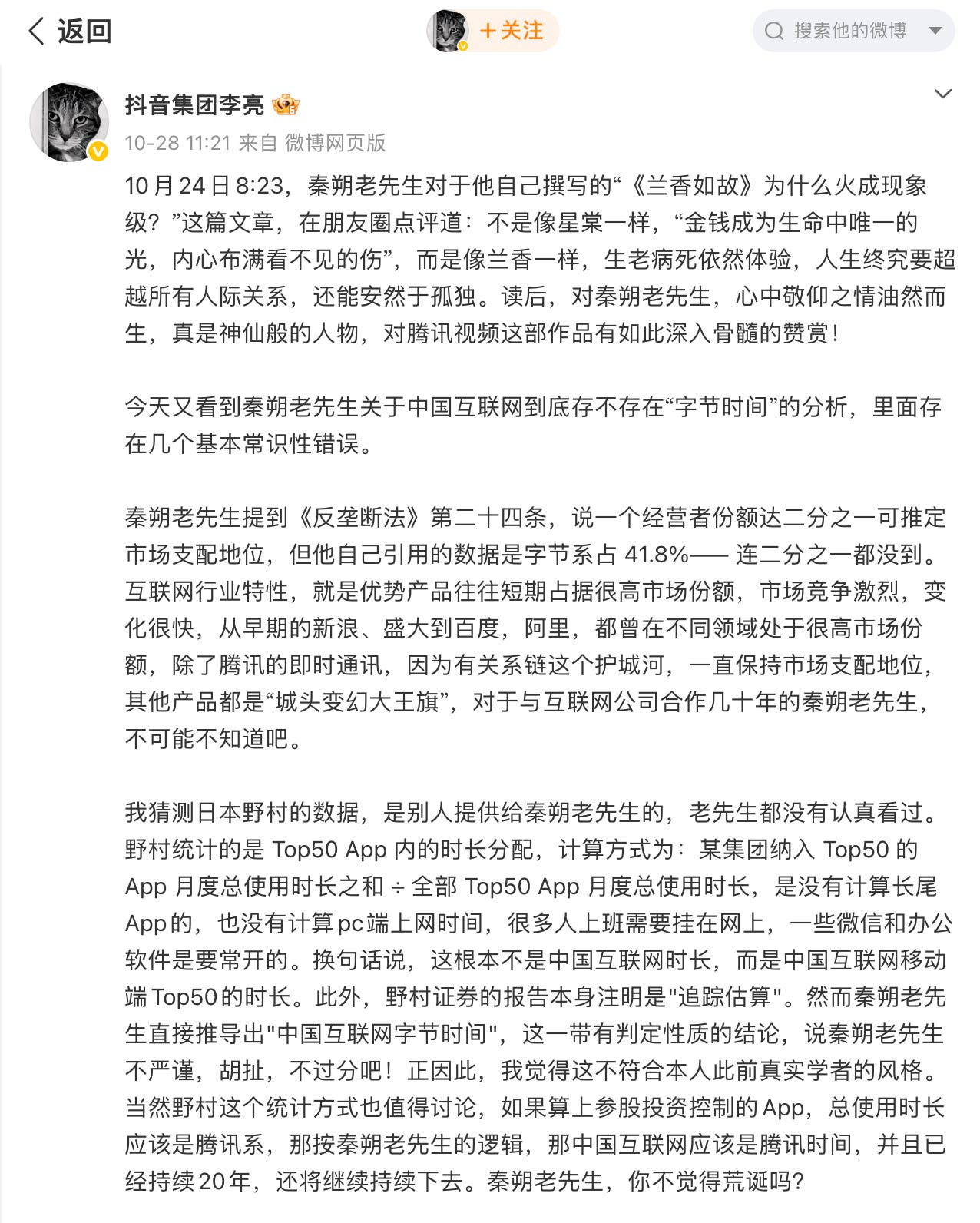
The dispute quickly devolved from methodology to mudslinging. Pointedly noting Mr Qin’s recent appearance at a Tencent creators’ event, and his past work editing books authorised by ByteDance’s arch-rival, Mr Li planted a seed of suspicion regarding the commentator’s allegiances. Mr Qin flatly rejected the insinuations. Yet in the paranoid corridors of Chinese tech, a well-placed insinuation often does the heavy lifting.
The ferocity of the exchange begs a deeper question: why would a company fight so hard to deny its own dominance? The answer lies, at least partly, in the unforgiving nature of Chinese tech regulation. In a jurisdiction where powerful agencies exercise sweeping, often unchallengeable authority over internet platforms, anti-monopoly battles are frequently fought and decided in the court of public opinion long before any official paperwork is filed. For a Chinese tech giant, allowing a narrative of market dominance to take hold can carry significant risks. Once a regulator acts on a widely accepted public narrative, reversing that momentum is nearly impossible. A label like “ByteDance Time” is thus less a badge of honour than a source of unwelcome regulatory attention.
This peril is compounded by China’s expectation for its digital champions to drive industrial upgrading and fundamental scientific breakthroughs, rather than merely perfecting the monetization of leisure. These anxieties recently crystallised when a provocative comparison went viral online recently, claiming that while America directs the bulk of its AI computing power towards coding and enterprise research, China squanders its AI resources on generating cheap revenge-fantasy micro-dramas.
The People’s Daily, the Communist Party of China’s flagship newspaper, rushed to debunk the statistics as flawed and defended the value of entertainment while stressing China’s investments in hard tech. But the lament that “America uses gunpowder to make weapons; China uses it to make fireworks” struck a chord. It exposed a simmering national anxiety: what good is world-class algorithmic prowess if it is solely deployed to build a better entertainment house?
But should a company be penalized simply for being wildly successful at entertaining the masses? Ming Jinwei, a former state-media journalist writing under the influential moniker Mingshu Zatan, leapt to ByteDance’s defence. In an essay titled “There Is Only User Time, Not ByteDance Time,” he argued that in a ruthlessly competitive market, users flock to products because they actually meet their needs.
Cultural preferences, Mr Ming insisted, should not be weaponised into moral hierarchies. Reading a biography of a Song-dynasty poet is not inherently superior to binge-watching a micro-drama or scrolling through short videos. People vote with their thumbs, and their choices reflect genuine value.
It is a robust defence. Yet to wave this away as mere consumer choice ignores the reality of the algorithmic age. A world-class recommendation engine does not merely cater to preexisting desires; by endlessly calibrating what users encounter next, it actively shapes them. It deliberately blurs the line between passively serving an audience and actively inducing its habits.
In China, however, this universal debate over corporate responsibility intersects with a deeply ingrained official, cultural, and intellectual paternalism. There is a long-standing tradition among the country’s elites of delineating what constitutes “edifying” pursuits versus “vulgar” distractions. This top-down moralising begs an uncomfortable question: by what right must every hour of a citizen’s day be productive or edifying? If hundreds of millions of ordinary people, exhausted by the grinding pressures of a hyper-competitive society, actively seek out the empty solace of a three-minute soap opera, why should they be scolded for it? And what makes an opera sung in a foreign language, or some music show put up by instruments that most cannot even name, inherently more worthy than a melodrama on Hongguo? The right to be unproductive—and yes, even the right to consciously choose "vulgarity" and escapism—is a fundamental, if unacknowledged, human comfort.

The phrase "ByteDance Time" is therefore a tribute to a commercial juggernaut masquerading as a regulatory red flag. The company should certainly answer for how its code shapes human habits. But it should not have to bear the burden of intellectually redeeming the masses. As cultural gatekeepers fret over what these hours mean for society, they forget whose time is actually being spent. The clock belongs to the audience. And whether an evening spent on Hongguo is culturally edifying or cheerfully wasted is a verdict that rests with no one else. (Enditem)
