

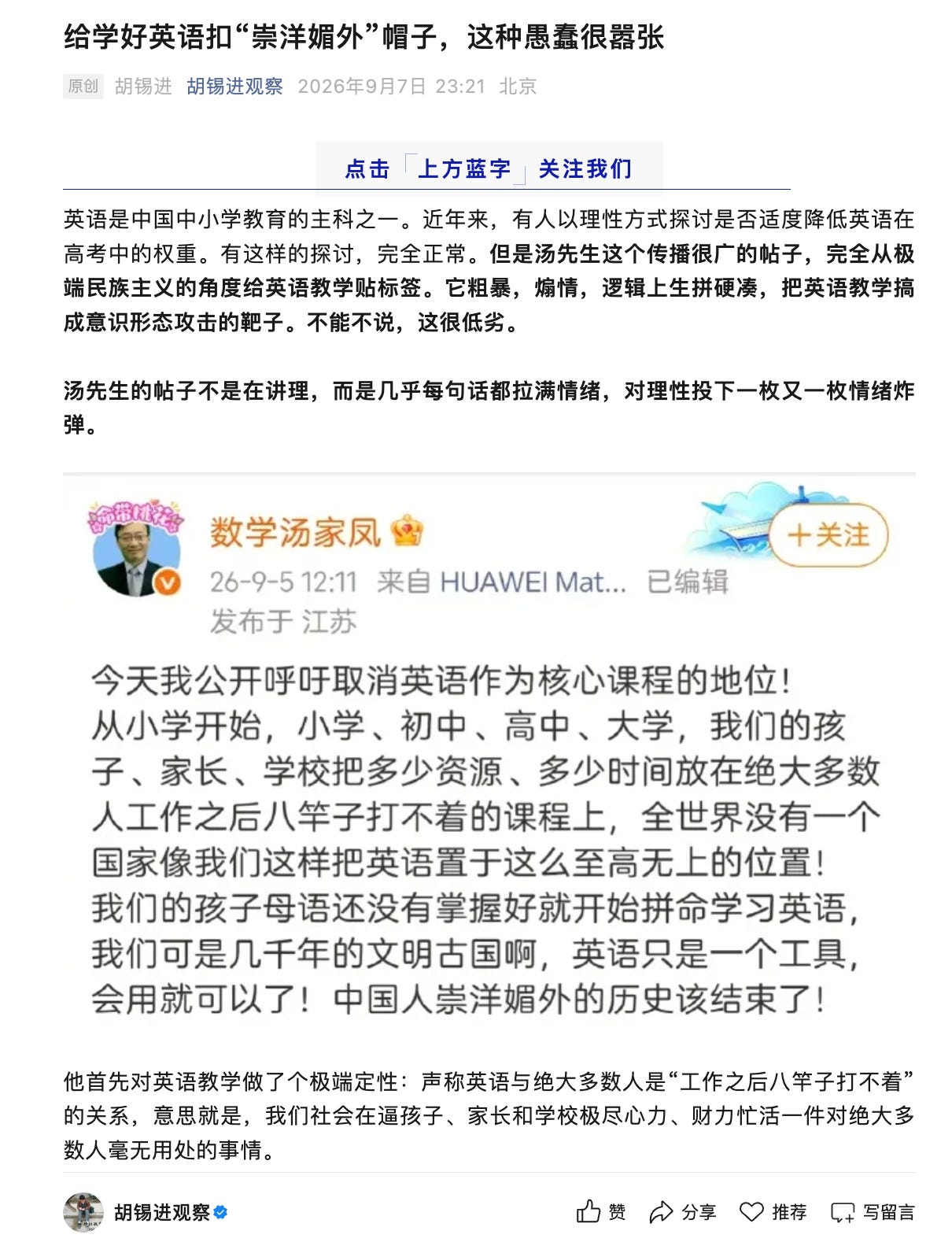
A familiar argument has returned to the Chinese internet. Tang Jiafeng, a popular maths tutor, has called for English to be downgraded in schools, arguing that most Chinese will have little use for it after graduation and that too much time is spent learning it. What made the intervention more combustible was his claim that the era of Chinese people “worshipping foreign things” ought to end. Hu Xijin, the former editor of the Global Times, pushed back.
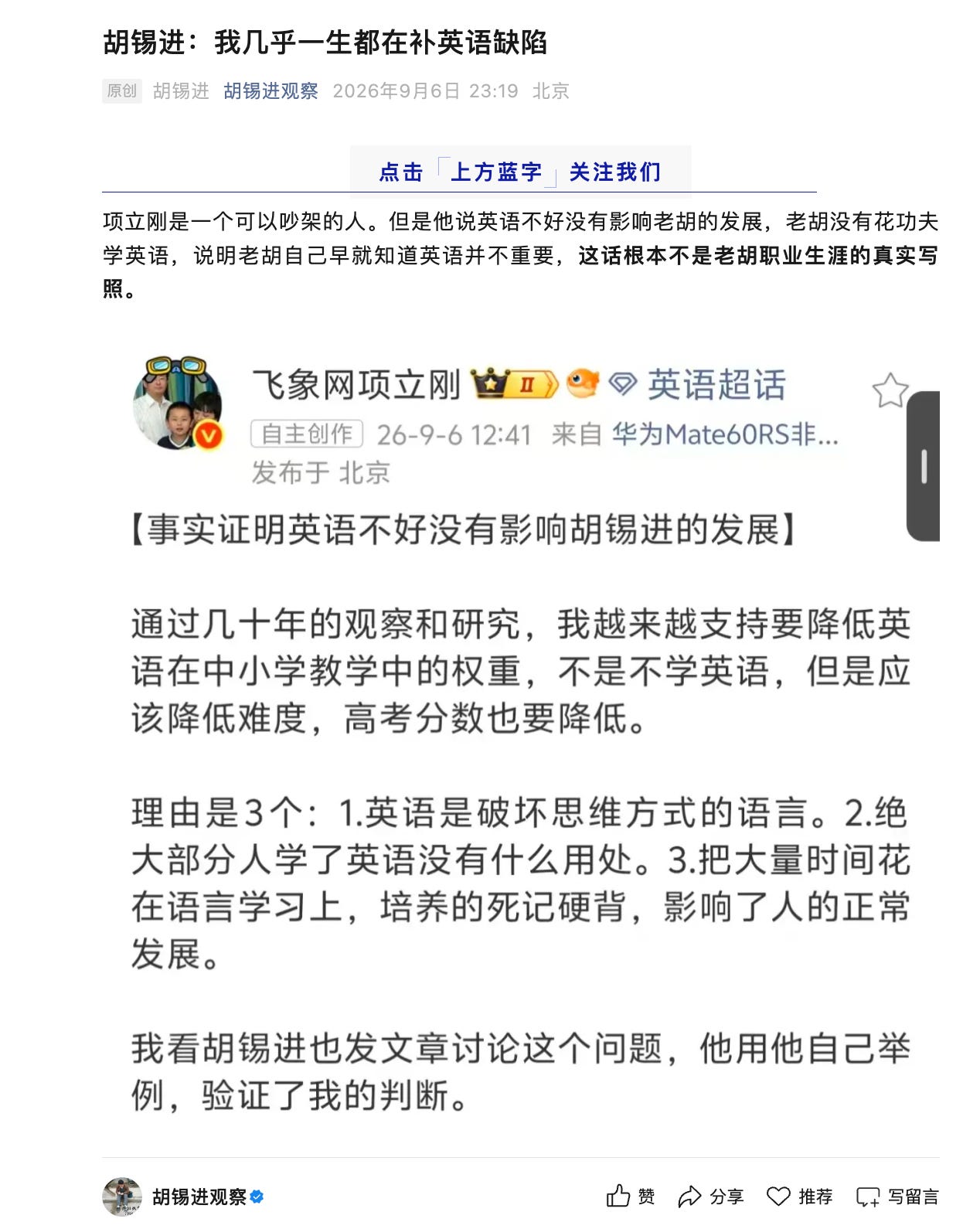
Xiang Ligang, a telecoms commentator with nationalist leanings, challenged Hu in turn, extending the exchange into a three-day series of responses from Hu. There is some irony in seeing Mr Hu, long portrayed abroad as a prominent voice and promoter of Chinese nationalism, now arguing against one of its more inward-looking strains.
The argument is familiar because versions of it surface every few years. Sometimes the complaint is about English’s weight in the gaokao. Sometimes it is about years spent memorising vocabulary that students may never use. Sometimes it becomes a cultural grievance: why should Chinese children work so hard at English when so few Western children learn Chinese? China’s English teaching is often inefficient, and there is nothing unreasonable about debating how much time schools should devote to it. But the regularity with which the argument returns suggests that something else is bothering people.
For much of the reform era, English was part of the price of admission to a world from which China wanted knowledge, technology, investment and opportunity. Scientists needed it to read and publish internationally; officials and scholars used it to deal with foreign counterparts; companies needed it as they moved abroad. Millions of Chinese students spent years learning a language that Americans and Britons acquired without effort. That asymmetry was real, and easier to accept when China was plainly poorer and trying to catch up.
It feels different when the country doing the learning is the world’s second-largest economy, dominates large parts of global manufacturing and increasingly speaks of civilisational confidence. The old arrangement can begin to look less like practicality and more like hierarchy. Why, some Chinese ask, should their children still spend so much effort mastering the language of countries China has already surpassed in some fields?
That is where a sensible argument about education can turn into one about national dignity. Complaining that English is badly taught is not the same as believing it should matter less. Nor is criticising exam-heavy instruction the same as treating the language itself as a residue of cultural submission. The phrase “worshipping foreign things” matters because it shifts the question from usefulness to loyalty.
Yet irritation with a linguistic hierarchy does not make it disappear. English remains useful because too much of the world already operates through it. Its position was built on Anglo-American power, but it now rests just as much on accumulated habit, institutions and network effects. China may reasonably expect its own rise to make Chinese more valuable internationally. But that process will depend on foreigners having stronger reasons to learn Chinese, not on Chinese people deciding in advance that English ought to matter less.
The domestic consequences are also more complicated than critics often admit. Reducing English in public schools would not persuade affluent families to abandon it. They would buy tutoring, international schooling, overseas programmes or better digital instruction. The children most likely to lose access would be those who depend on ordinary schools to provide it. What looks like relief from an unnecessary burden could end up turning a widely available skill into a more exclusive one.
This is one of the strongest parts of Hu’s argument. Most Chinese adults will never need much English, but that is a rather narrow test of what belongs in basic education. A country of China’s size and ambitions needs a broad base of people able to look beyond the Chinese-language world—to encounter ideas at their source, follow debates taking place elsewhere and take part in the exchange of knowledge across borders. Keeping that possibility open is not only an investment in individual opportunity. It is one way of ensuring that a society does not gradually become captive to knowledge, arguments and assumptions circulating only within its own language.
The timing of the latest quarrel is striking for another reason. China has just marked the centenary of Jiang Zemin’s birth, reviving memories of the former top leader’s enthusiasm for foreign languages. Jiang studied and used several of them and repeatedly encouraged Chinese students and officials to do the same, famously reciting the Gettysburg Address to Mike Wallace on 60 Minutes in 2000. His generation associated foreign languages with opening up, catching up and becoming more capable. Learning from abroad did not seem to require any apology for being Chinese.
That contrast says something about how national confidence can evolve. One response to greater power is to conclude that China no longer needs to look outward quite so much. Another is to become less anxious about looking outward at all. The latter is surely the more useful confidence for a country that wants not to retreat from the international system but to exert more influence within it.
English may eventually lose some of its importance. Artificial intelligence will make translation easier, and China’s own weight may steadily increase the value of Chinese abroad. If the returns to learning English fall, schools and families will adjust. But there is a difference between a language becoming less useful and wishing it were less useful because the hierarchy around it has become irritating. Confusing the two would not make the world less Anglophone. It would simply leave some Chinese less able to move through it.
The use of language isn’t just about gaining economically, it’s somewhat too shallow to only look though such a lens While China also has been arguably the biggest beneficiary of the global trades since it joined the WTO.
Language is also the window to a culture, to understanding your life better, to have a different perspective. It’s really hard to explain to anyone what 缘分or幸福 means in English.
Languages serve as the gateway that can benefit in less visible but have profound long term impact
I wholeheartedly agree (also with Thomas Dai); Chinese students should certainly learn English and other foreign languages by all means. But at the same time far more Westerners should study Chinese! There is a need for better mutual understanding.