


The following interview was published in the second issue of 2026 of 世界知识 World Affairs, released on January 16, 2026. It became available on World Affairs’ official WeChat blog on January 15, 2026. World Affairs is published by World Affairs Press under China’s Ministry of Foreign Affairs.
Worth mentioning that Wu Xinbo, the interviewed expert below, published the eye-catching The Case for a Grand Bargain Between America and China: How Trump and Xi Can Reset Relations in Foreign Affairs on the last day of 2025.
Wu authorized the following translation and publication, but didn’t review it before publication.
专访吴心伯:我们正在见证中美关系的又一次转折
Interview with Wu Xinbo: We Are Witnessing Yet Another Turning Point in China–U.S. Relations
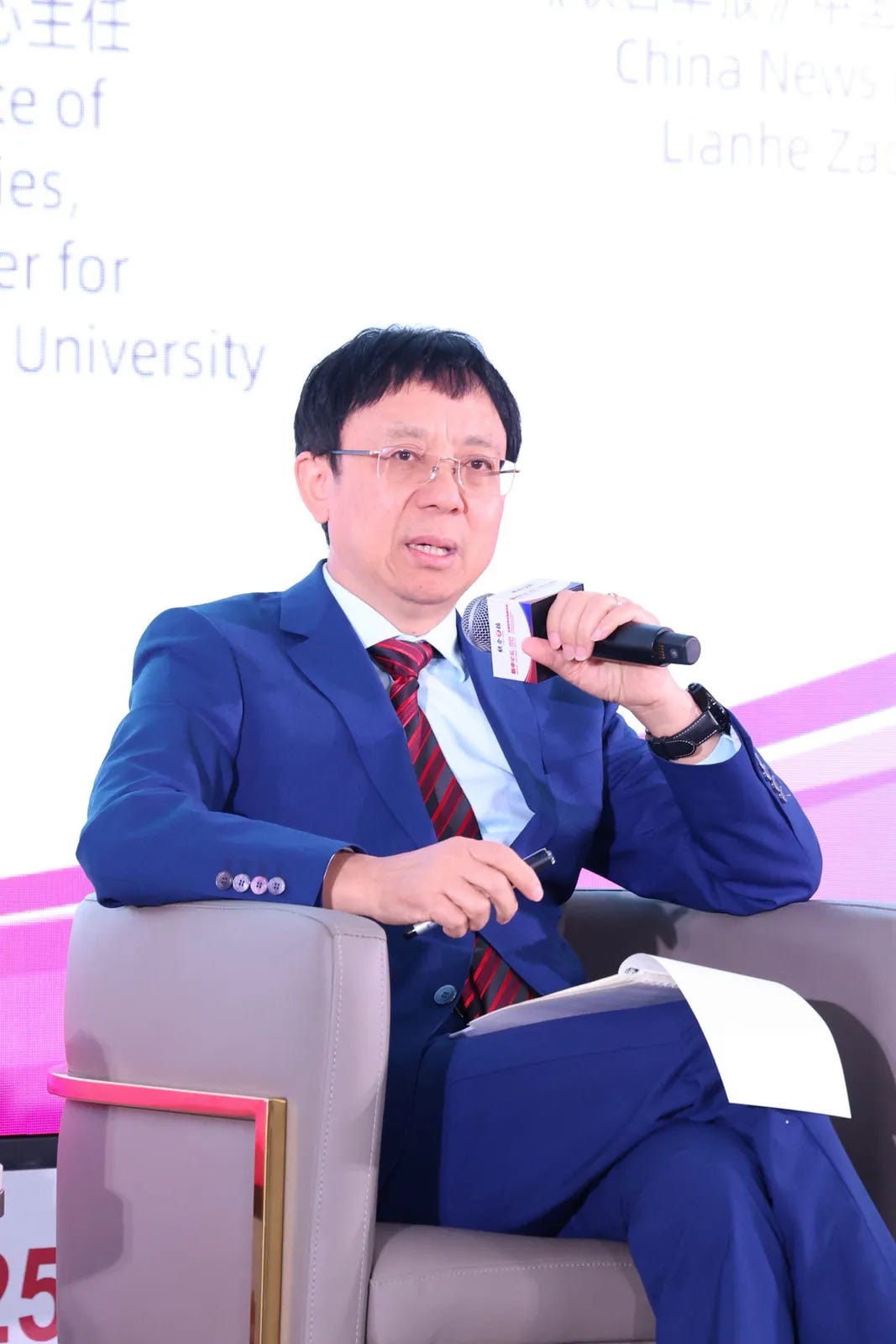
Among Chinese scholars specialising in U.S. studies and China–U.S. people-to-people exchanges, Professor Wu Xinbo is widely regarded as a leading figure. He serves as Dean of the Institute of International Studies and Director of the Centre for American Studies at Fudan University.
In Issue No. 14 (2015), World Affairs published an interview with Professor Wu titled “A Progressive’s Views on China–U.S. Relations,” where he noted that debates within the United States were already gathering pace over the long-standing engagement-based approach to China. He argued that the bilateral relationship was on the cusp of a new environment and a new “normal”, and that strategic and tactical competition between the two countries would intensify.
In the blink of an eye, ten years have passed. During this period, the United States gradually moved away from the constructive language of engagement and placed its China policy on a track of strategic competition. China–U.S. relations, in turn, entered a spiral downturn. The two sides have been drawn into recurring clashes over trade and economic issues, semiconductors, Taiwan, and more. In multilateral settings, the relationship has at times edged towards near-total confrontation.
The “strategic competition” unilaterally launched by the United States, coupled with its protectionist turn, not only failed to slow China’s development and rise; it instead pushed China to step up efforts in indigenous innovation and autonomous opening up. It has also accelerated adjustments in the global economic system and cross-border flows.
After Trump returned to office, he moved quickly to roll out a worldwide “reciprocal tariffs” policy and, in particular towards China, intensified economic pressure and technological restrictions. This time, China responded with firm, reciprocal measures, which soon brought the Trump administration to the negotiating table and produced tangible outcomes. In the China–U.S. strategic contest, this suggests the offence–defence balance is beginning to shift, to a certain extent.
Precisely because he sensed that China–U.S. relations may already be approaching a new historical threshold, on December 20, 2025, reporter An Gang conducted another interview with Professor Wu in Beijing, ten years after the previous one. Professor Wu set out four main views.
First, on the Trump administration’s ongoing adjustments to its external strategy, he described a pattern of “retreat as well as advance”: an overall tendency towards retrenchment, while consolidating influence in the Western Hemisphere to free up major strategic resources for Asia in the future.
Second, on adjustments to U.S. China policy, he argued that strategic competition remains the basic reality, but that U.S. goals and instruments are “becoming more pragmatic”. This is bringing Washington closer to principles long advocated by China, including avoiding conflict and pursuing appropriate cooperation, and China had won this shift through struggle.
Third, on the new turning point in the bilateral relationship, Wu pointed to both a shift in the active–passive balance between the two sides and a stronger effort to keep the intensity of the contest under control. These trends indicate that long-term peaceful coexistence, grounded in mutual respect and equality, is becoming a realistic possibility.
Fourth, on Taiwan, he said he hopes the United States will adapt to the historical trajectory of cross-strait reunification and give serious thought to how its Taiwan policy should be adjusted.
World Affairs: How do you assess the changes in the United States’ global strategy over the past decade? Is this a phased adjustment, or a deeper, structural shift?
Wu Xinbo: Viewed within a longer historical context, my judgment is that this is a fundamental adjustment in America’s global strategy since the end of World War II. This adjustment was not concentrated within the term of any single administration; rather, it has been a cross-administration, cross-party process that has gradually emerged and been advanced over time. Many people are inclined to pin changes in U.S. policy on a particular president, Donald Trump most notably, but that explanation is incomplete. Trump certainly acted as a powerful catalyst, but he is not the root cause. The deeper drivers lie in both domestic and international pressures facing the United States.
Domestically, America’s long-standing social consensus is fraying. During the Cold War and after it ended, U.S. political elites largely accepted the idea that the United States should lead globally, and that even if leadership came at a high price, it was worth paying. For a long time, that consensus underwrote an expansive grand strategy, including a global military presence and political intervention. Today, however, agreement at home over America’s international role and responsibilities has clearly weakened. More and more people are asking: Why pay such high costs for problems so far away? Why must the United States serve indefinitely as the “world’s policeman”? These doubts are no longer confined to ordinary voters; they are increasingly reflected in the prevailing mood among political elites as well.
Internationally, America’s understanding of its own positioning is also changing. After World War II, the United States consistently positioned itself as a typical “internationalist country”—that is, by assuming international obligations, protecting allies, and constructing and maintaining a U.S.-led international order, it would realise its own interests. That self-conception began to loosen during Trump’s first term. It was not meaningfully reversed afterwards and has been further reinforced. This change cannot be simply attributed to Trump personally; he has more so expressed, in a more direct and cruder way, anxieties and dissatisfaction that already existed within American society.
At a more fundamental level, the United States is under structural pressure. At home, resource misallocation is worsening, and social polarisation is deepening. Abroad, the international power balance is more diffuse and diverse—namely, the multipolar trend that Washington has framed as a direct challenge to U.S. primacy. During the Cold War, the United States faced only one opponent, the Soviet Union; now it faces direct “competition” and “challenge” from China and Russia simultaneously, as well as various non-traditional and transnational security threats. With pressure accumulating on multiple fronts, it is becoming harder for the United States to sustain the high-intensity, across-the-board global investment it once maintained. It has no choice but to adjust priorities and refocus.
If the post-Cold War United States once tried to build a unipolar world, it now looks more as if it is moving towards a strategy of “focused offence”. Since Trump’s first term, Washington has explicitly designated China its “primary strategic competitor”, seeking to push Russia into a secondary position, only for the Ukraine crisis to erupt later and pull its attention back.
In Trump’s second term, the U.S. has entered a state of “swinging between triumphalism and decline anxiety”. Its strategic centre of gravity has visibly shifted back towards the Western Hemisphere. At the same time, it increasingly treats drugs, irregular migration, “woke culture”, and other issues as direct threats to America’s social order and the dominant position of white people, prioritising them even above responding to “challenges” from China and Russia. In the Trump administration’s view, these are America’s “real enemies”; if they are not dealt with, the country will “cease to be a country”. These priorities are directly reflected in the latest version of the U.S. National Security Strategy, a shift that is “once in a century”.
World Affairs: Recently, many views have suggested that this report reflects Trump’s push for a “global strategic retrenchment” by the United States. Do you agree with that assessment?
Wu Xinbo: Not entirely. A more accurate description would be “overall retrenchment, selective expansion”, with the ultimate goal being to rebuild external leverage.
The clearest direction of retrenchment is Europe. By seeking to end the Russia–Ukraine war and encouraging the “Europeanisation” of NATO, the United States is trying to reduce the long-term burden it has carried for Europe’s security. This means that the post-Second World War global strategy, long centred on Europe, is being recalibrated.
At the same time, the United States has not clearly pulled back elsewhere. On the contrary, it intends to step up investment in the Western Hemisphere and the Indo-Pacific. In the Trump 2.0 version of the National Security Strategy, the Indo-Pacific is listed after the Western Hemisphere, but it remains one of Washington’s top priority regions.
The Biden administration’s Indo-Pacific concept is centred on geopolitics. But in Trump’s view, the Indo-Pacific is, above all, a theatre where economic gains can be extracted. As a result, the core objective of his second-term Indo-Pacific policy is not ideological positioning or regional order-building, but securing economic returns.
In 2025, during Trump’s two trips to Asia, he pushed “tariff relief in exchange for payments” and announced inward investment commitments of $600 billion, $70 billion, $550 billion, and $350 billion from Saudi Arabia, Malaysia, Japan, and South Korea, respectively. When Crown Prince Mohammed bin Salman visited the United States in November, the headline figure was raised to $1 trillion. Of course, such pledges are unlikely to be fully realised, but they can generate tangible political dividends for Trump.
Of course, Trump’s emphasis on economics in the Indo-Pacific absolutely does not mean he will ignore security. The new National Security Strategy report shows that the basic logic of the United States in handling Indo-Pacific security affairs is to push allies and partners to the front, with the United States providing an umbrella of protection—but charging more for it. Japan’s fiscal budget has already raised defence spending as a share of GDP to 2%.
Since Trump’s first term, the U.S. Indo-Pacific policy has targeted China. Although the new National Security Strategy report avoids again labelling China as the “primary strategic competitor,” and its edge is somewhat restrained, this does not mean the United States has abandoned strategic competition with China. Instead, it highlights key points more sharply and focuses more on economic and technological competition, as well as preparations for military conflict. In America’s view, the essence of post–Cold War international relations is the contest of comprehensive national power; looking around today’s world, the only country that can truly match the United States in this regard is China. Therefore, the competitive tone of America’s China strategy is long-term.

World Affairs: For China–U.S. relations in 2025, the “tariff war” was a particularly major event. Many American scholars and people in the business community have sighed that “China won, the U.S. lost.” How do you assess the special significance of this struggle?
Wu Xinbo: I see 2025 as a turning point in the long-running strategic contest between China and the United States, with the tariff war as its most visible external manifestation. That “turning point” is reflected mainly in two respects.
First, the United States has begun to recognise the limits of its China “toolbox”. Trump initially had great confidence in tariffs, believing they alone would be enough to force China to back down. But the results fell well short of expectations. The tariff escalation in April lasted less than two weeks before the U.S. side could no longer absorb the pressure and moved proactively to de-escalate. On June 5, 2025, I attended the second meeting of the China–U.S. high-level Track II dialogue in Beijing. The U.S. participants opened by saying they were “deeply impressed” by China’s performance in that round of the tariff war. Afterwards, some U.S. think tanks also publicly acknowledged that China showed relatively strong economic resilience in this contest.
Second, China’s leverage over key resources changed the dynamics of the contest. Its rare earth export controls had the effect of a single, decisive move. As far as I understand, the Trump administration was not unaware that China held this card; rather, it assumed Beijing would not strike so hard.
For a long time, a basic U.S. logic on trade was simple: China exports more to the United States than the United States exports to China, so China depends more on the U.S. market and is therefore more exposed in a tariff fight. This episode pushed Washington to recognise that vulnerability cannot be measured by trade volumes alone, but hinges more on “irreplaceability”. Once the United States is choked off at critical systems and supply chains, many key production lines could grind to a halt. The question then is no longer “will growth slow?”, but “will the system seize up?”
If the lens is widened, and the changing dynamics of China–U.S. gamesmanship are understood through two tracks, “talking” and “fighting”, then another historic turning point in the relationship may be coming into view.
China is willing to talk, but only based on equality, respect, and reciprocity, and the U.S. side ultimately accepted that framing. China is also prepared to fight, and it inflicted real costs on the United States. And in America’s strategic culture, actions are judged by results.
Some Americans once told me that the only country that can make the United States think twice before acting is Russia. Going forward, Washington may also have to weigh the consequences more carefully before taking adverse steps against China.
Changes in this year have, in fact, also pushed the U.S. side internally to reevaluate its strategic objectives toward China. Since Trump’s first term, Washington gradually formed a mainstream judgment that the United States could slow China’s development through competition and containment. Extreme hawks even believed it might be possible to push China onto the Soviet Union’s old path. But after several years, more and more people inside the United States have realised that China is difficult to “hold down,” and even more impossible to crush. Other than long-term peaceful coexistence with China, the United States has no alternative.
If this judgment gradually becomes a consensus within the United States, its significance will be enormous. First, the United States needs to accept the reality that China will continue to develop and may surpass the United States in certain fields. Second, the United States will place avoiding conflict with China—especially military conflict—in a more prominent position in its China policy. Third, within a framework of long-term peaceful coexistence, China and the United States will carry out pragmatic cooperation based on exchanges of real interests. Of course, compared with the better periods of China–U.S. relations, the “cooperation list” in the future will certainly be much shorter, but it will by no means be empty.
After the China–U.S. leaders’ meeting in Busan, I asked American scholars in a dialogue with a U.S. think tank, “What did Trump learn from this meeting?” They replied that it strengthened his confidence in working with President Xi Jinping on managing the relationship, and that he came away believing that, on major issues, outcomes acceptable to both sides can be achieved through dialogue and negotiation.
On November 2, 2025, Trump said in a CBS television interview that “I think we can be bigger, better, and stronger by working with them as opposed to just knocking them out.” He also said that China and the U.S. could work together to solve all of the problems of the world. In my view, this is not merely diplomatic rhetoric; to some extent, it reflects genuine intent.
The shift in U.S. perceptions towards China now underway also lends support to the three principles for China–U.S. relations in the new era, as advocated by President Xi Jinping: mutual respect, peaceful coexistence, and win-win cooperation. In 2026, there will be multiple opportunities for the leaders of China and the United States to meet. Hopefully, both sides will move in the same direction and push the relationship towards greater stability and improvement.
World Affairs: On the eve of the Busan meeting, Trump used the term “G2” when talking about his expectations. How should this apparent “return” of the G2 framing be understood?
Wu Xinbo: Around 2008, some people in the U.S. strategic community floated the idea of a “G2”. What they were promoting was a “Group of Two”, implying a form of China–U.S. co-governance. In practice, however, the expectation was that China would help the United States deal with the fallout from the global financial crisis, and Beijing responded coolly.
This time, some American scholars told me that Trump’s “G2” was largely media language designed to grab attention, meaning “Great Two” rather than a concept with clear policy implications, and that it should not be over-interpreted.
Still, in global affairs, the bigger a country is, the heavier the responsibilities it carries. That is an objective reality. As the world’s two largest economies, if China and the United States do not cooperate, many global problems will have no solution, or at least will be far harder to manage.
In this new era, adjustments in China–U.S. relations should avoid falling into a narrative of “redistributing world power”. At the same time, neither side can evade the responsibilities that come with being major powers, including sustaining coordinated cooperation in pursuit of the global common interest.
World Affairs: During President Bill Clinton’s visit to China in June 1998, a discussion forum was held at the Shanghai Library. At the time, as a young scholar from Fudan University, you asked him a question about the Taiwan issue. In responding, Clinton for the first time spelt out the U.S. government’s “Three No’s” policy: not supporting Taiwan independence; not supporting “one China, one Taiwan” or “two Chinas”; and not supporting Taiwan’s entry into any organisation for which statehood is a requirement. Twenty-seven years later, if you had the chance to ask a U.S. president a question face-to-face again, what question would you ask?
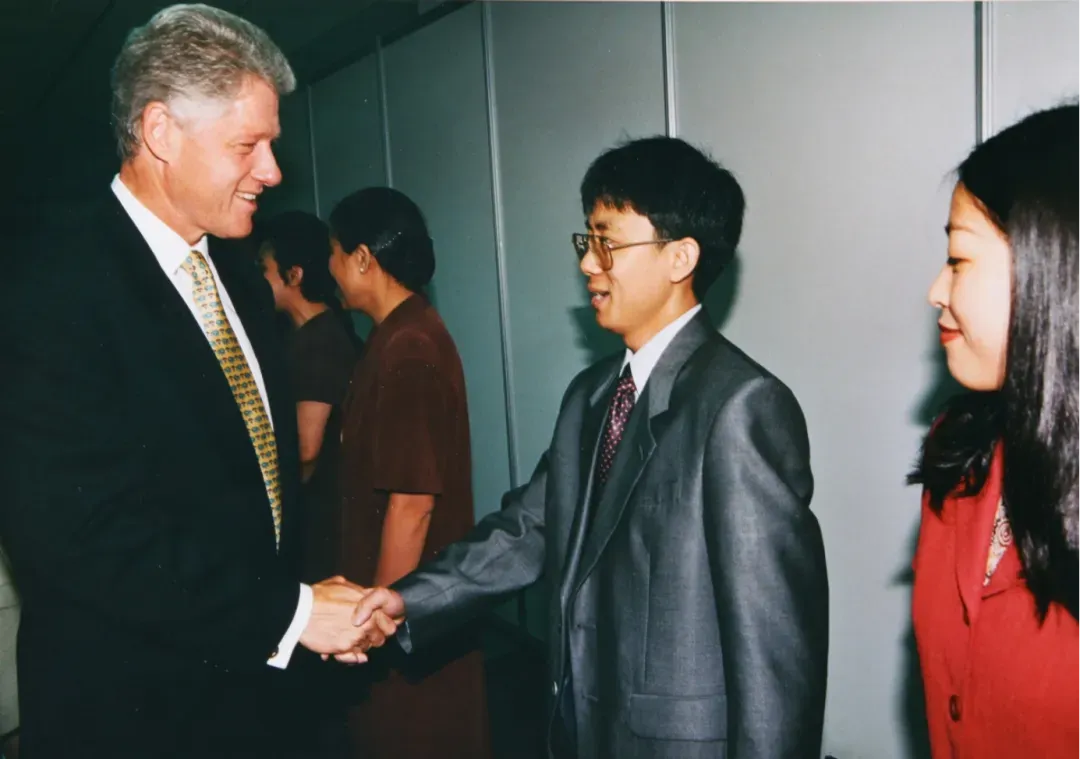
Wu Xinbo: The Taiwan issue is an obstacle that China–U.S. relations can never simply bypass. Back then, I raised it with an American leader because “Taiwan independence” activities were extremely active at the time, and China was under severe pressure.
Today, the situation has changed in important ways. The historical momentum towards reunification across the Taiwan Strait is something no person and no force can stop. The United States, therefore, has to confront a reality: the “ideal status quo” it has long assumed, no reunification and no “independence”, is becoming harder and harder to sustain.
From some recent U.S. statements and research reports, it is clear that this is already being recognised within the United States, and some think tanks have begun seriously examining whether Washington in fact has the capacity to prevent China’s reunification. Trump himself said in an interview that Taiwan is very close to the Chinese mainland, but very far from the U.S. The core message of that remark is plain: for the United States to go to war with China over Taiwan is neither realistic nor cost-effective.
In that sense, what the United States truly needs to think about is not how to block China from achieving reunification, but how to ensure that its legitimate interests and concerns are taken into account in the course of that process.
In terms of policy practice, Trump’s approach to deterrence on the Taiwan issue differs markedly from the Biden administration’s. The Biden administration pursued “active deterrence”: it increased the U.S. military presence in the region, rallied allies, helped Taiwan strengthen its military capabilities, publicly stated that the United States would “defend Taiwan”, and kept up sustained pressure on China, creating a more forward-leaning posture.
Trump’s approach looks closer to “passive deterrence”: maintaining a basic deterrent posture towards China, but placing greater emphasis on risk avoidance and showing little appetite for taking on clear, deliverable military obligations to Taiwan. In this context, the practical significance of the report to the 20th National Congress of the Communist Party of China (CPC) emphasising that “We have thus maintained the initiative and the ability to steer in cross-Strait relations” has become even clearer.
So if I had the chance to ask the U.S. president a question face-to-face again, I would still raise the Taiwan issue, and I would put it this way: “Given the reality that China’s reunification process is already underway, how should the United States adjust its Taiwan policy?” This is not an emotional question. It is a strategic question the U.S. side has to confront, because the Taiwan policy framework from which the United States has long benefited is losing its grounding in reality.
World Affairs: 2025 marks the 40th anniversary of the establishment of Fudan University’s Center for American Studies. The centre invited many senior figures and peers to write commemorative essays, and one striking feature of the collection is the repeated, forceful emphasis on “original aspiration” (初心 chuxin). May I ask: what was your original aspiration in devoting yourself to U.S. studies? In an era when the United States, China, and the world are all changing rapidly, can that original aspiration be sustained? And, through the platform of World Affairs, could you offer a message to the younger generation engaged in U.S. studies?
Wu Xinbo: Those essays have already been compiled and published as a volume titled Four Decades of Splendour, Our Original Aspiration Firm as Rock (四秩风华 初心如磐). For my generation, the original aspiration behind U.S. studies was straightforward: first, to learn from the American experience; second, to serve China–U.S. relations. In April 1984, President Ronald Reagan visited Fudan University and delivered a speech. After the reception work was completed, a consensus emerged within the university: China’s younger generation lacked understanding of the United States, and it was necessary to cultivate, in a systematic way, scholars who study America. That was the original purpose behind establishing Fudan’s Center for American Studies.
I joined the centre in 1992. At the time, China–U.S. relations were turbulent and repeatedly disrupted, so our focus was more on how to rebuild mutual trust and restore cooperation. Later, as U.S. China policy increasingly emphasised competition and the bilateral relationship continued to deteriorate, our research emphasis also shifted, towards how to respond to containment and pressure from the United States and how to safeguard China’s national interests effectively. But regardless of how the focus has shifted, the original aspiration has not: studying the United States and China–U.S. relations has always been in service of China’s development and progress. Even amid intensified strategic competition, the United States remains a subject worthy of sustained, in-depth study. It is necessary not only to examine what strengths it still possesses, but also to reflect on the mistakes and problems that China should treat as lessons.
If I were to say a few words to young people working in U.S. studies, there are at least two points. First, study real problems and produce research that matters. U.S. studies straddle academic and applied research; it cannot be detached from the real policy environment. Second, cultivate a spirit of endurance. Information is far easier to access today than it was in the past, but it cannot replace fieldwork. In the 1990s, when I visited the United States as a visiting scholar, I often paid out of pocket to take long-distance buses and trains between cities, and to speak with people from all walks of life. It was hard, but I gained something every time.
No matter how tense China–U.S. relations become, people-to-people exchanges cannot be cut off. If the older generation’s connections gradually fade, and new ties cannot be built, the elasticity of China–U.S. relations will decline markedly. That is something I worry about.

Simple, imho: China should concentrate on itself (including Taiwan) and Global South countries strong mutual development and forget about the United States.
Perhaps help create a New United Nations without Israel and the US where the Rule of Laws imposed by its Security Council (No Vetoes) is such that any nation not accepting its Resolutions would mean automatic expulsion.
A Coalition of the Willing to Abide by International Law Forever.
I find it hard to believe any scholarly observation of the U.S. would conclude Trump's policy toward China aligns with ones of previous administrations or represents any cohesive, strategic approach by the current administration. Trump's interests extend to flattery and making money. That's it. His advisers are white nationalist who simultaneously want to isolate the U.S. and spread white supremacy globally. Further, Trump only knows zero sum. He never wants to share -- anything, and definitely not global power. Mr. Wu is right about nearly everything with China-U.S. relations, at least, in what's best for both countries and the world. But while previous U.S. administrations may have held faulty policies on China, the Trump administration has NO policy on China. That's worth keeping in mind. Trump will threaten China or play nice or use "the threat of China" as a tool against others (Greenland) to get resources he wants from where ever he wants. That's not a policy. That's just greed. And just to be clear, the Trump administration's approach to China does not reflect the will of a majority of the U.S. population.